bolsonaro

Bolsonaro placed under temporary house arrest after hospital discharge

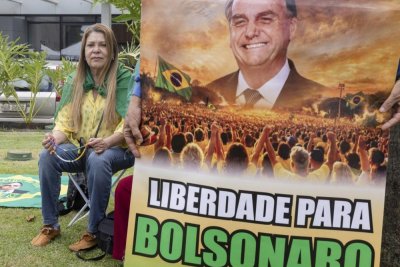
A supporter of former Brazilian President Jair Bolsonaro poses during a vigil outside DF Star Hospital in Brasilia, Brazil, on Friday. Bolsonaro was discharged after two weeks in the hospital with acute pneumonia and returned home under house arrest, as ordered by the Supreme Court. Photo by Andre Borges/EPA

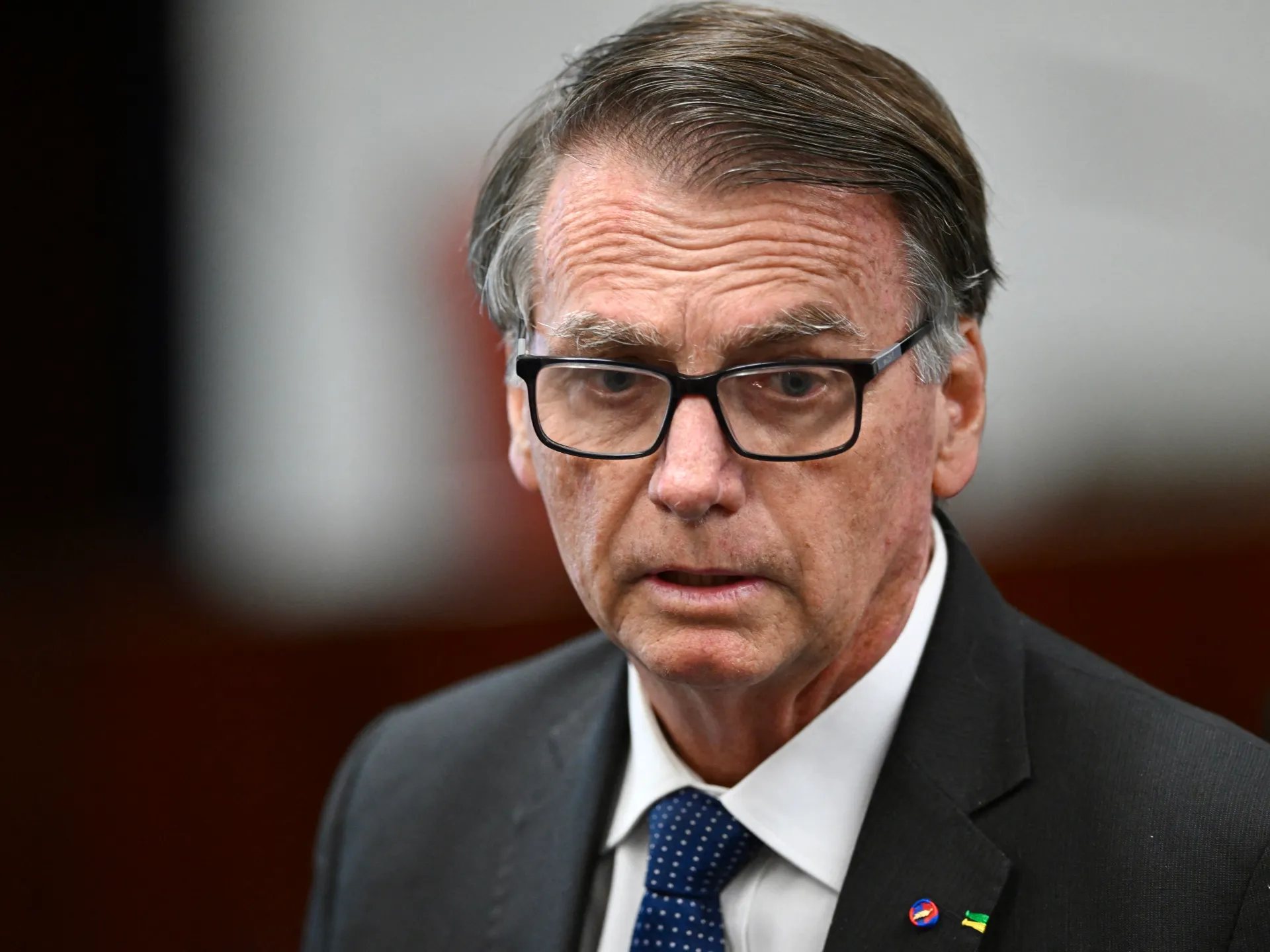
March 27 (UPI) — Former Brazilian President Jair Bolsonaro was discharged from the hospital Friday and transferred to his residence in Brasilia, where he will serve a 90-day period of house arrest.

The house arrest follows a decision by the Supreme Federal Court that considered his health condition, his personal physician told local media.

Bolsonaro, 71, had been hospitalized March 13 with bronchopneumonia after presenting high fever, low oxygen saturation and chills while in prison.

His doctor, Brasil Caiado, confirmed that the former president “has just been discharged” and will continue his recovery at home under a “disciplined” treatment.

The ruling came from Justice Alexandre de Moraes, who authorized the former leader to temporarily serve his sentence under house arrest for an initial period of 90 days, starting from his discharge from the hospital, according to reports by Infobae. The provision may be extended and will be reassessed at the end of that period.

According to the medical team, the former president’s right lung “is normal,” while the left still shows some alterations that will be treated with physiotherapy.

Bolsonaro is serving a 27-year prison sentence for his involvement in an attempted coup after losing the 2022 election to current President Luiz Inácio Lula da Silva.

Bolsonaro had previously been serving his sentence under house arrest. However, the court ordered his imprisonment in November at the Federal Police Headquarters in Brasilia due to flight risk after he damaged his electronic ankle monitor with a welding tool.

Caiado said full recovery from severe bilateral pneumonia can take between six weeks and six months, and did not rule out possible complications such as pulmonary fibrosis.

Bolsonaro’s family made adjustments to his home to facilitate his recovery, including installing a special bed to treat reflux issues and episodes of hiccups.

The doctor described the judicial decision as a “sensible decision” and said the home environment offers better conditions to prevent relapses than a prison facility.

The Supreme Court had previously rejected similar requests from the defense, but in this case determined that the former president’s health condition “requires constant and careful attention,” in line with the recommendation of prosecutors.

House arrest imposes a series of restrictions on Bolsonaro, according to the digital outlet G1. The former president must wear an electronic ankle monitor at all times. He is prohibited from using smartphones, computers or any other means of communication, including through third parties.

He is also fully barred from publishing or recording videos or audio. This is particularly relevant, as polls show a technical tie in a potential runoff between his son Flavio Bolsonaro and President Luiz Inacio Lula da Silva in the October elections.

Source link

Brazil’s Bolsonaro hospitalized with bacterial pneumonia

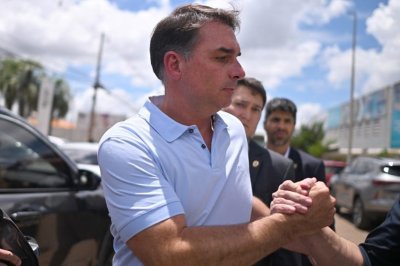
The son of former Brazilian President Jair Bolsonaro, Sen. Flavio Bolsonaro, reacts outside the hospital where his father was taken in Brasilia, Brazil, on Friday. Jair Bolsonaro, has been imprisoned in a Brasilia penitentiary after being sentenced to 27 years in prison for his role in a coup attempt. Photo by Andre Borges/EPA

March 13 (UPI) — Former Brazilian President Jair Bolsonaro was hospitalized Friday in Brasilia after doctors diagnosed a bacterial lung infection, authorities said, marking the latest health episode for the 70-year-old who is currently serving a prison sentence.

Bolsonaro was admitted to the DF Star hospital with fever, vomiting and low oxygen levels. Doctors later confirmed a case of bacterial pneumonia and began treatment with intravenous antibiotics while keeping him under medical observation.

The former president was transferred to the hospital from detention. Since January, he has been held in the officers’ wing of the 19th Military Police Battalion, known as “Papudinha,” in Brasilia, where he is serving a sentence of 27 years, three months in prison for an attempted coup.

Health issues have been a recurring concern for Bolsonaro since a 2018 assassination attempt during a campaign rally in the southeastern city of Juiz de Fora, where he was stabbed in the abdomen.

The attack caused severe internal injuries and required emergency surgery, forcing him to spend weeks recovering in hospital while continuing his presidential campaign.

Since then, Bolsonaro has undergone several abdominal procedures and has been hospitalized numerous times for intestinal obstructions, infections, hernia repairs and other chronic health problems. Doctors said Friday his condition is stable and that doctors continue to monitor the infection.

Source link

Brazil pulls visa of Trump adviser who asked to visit Bolsonaro in prison | Politics News

Brazilian President Luiz Inacio Lula da Silva says Darren Beattie was ‘prohibited from visiting’ Bolsonaro in prison.

The government of Brazil has revoked the visa of Darren Beattie, a far-right adviser to United States President Donald Trump who had planned to visit ex-President Jair Bolsonaro in his prison cell in Brasilia.

Brazilian President Luiz Inacio Lula da Silva confirmed on Friday that Beattie’s visa has been pulled. He equated it to the US pulling visas from Brazilian officials in Washington, DC.

Recommended Stories

list of 3 itemsend of list

Among them was Brazilian Health Minister Alexandre Padilha, whose US visa was revoked last year.

“That American guy who said he was coming here to visit Jair Bolsonaro was prohibited from visiting, and I forbade him from coming to Brazil until they release the visa for my health minister,” Lula said during an event in Rio de Janeiro.

Separately, Brazilian officials told news services, including the AFP, that Beattie had lied about the purpose of the visit on his visa request.

Bolsonaro is a far-right ally of President Trump, and he is currently serving a 27-year sentence for his role in a coup plot after Brazil’s 2022 election.

Friday’s decision shows the continued tension between the Brazilian and US governments, even as Trump and Lula have enjoyed warming relations.

Last August, Trump placed Brazil under heavy tariffs — some of the highest in the world — in protest against Bolsonaro’s prosecution. He demanded that the country’s legal system drop the case against Bolsonaro and accused Brazil of persecuting right-wing voices.

After Trump met Lula at the United Nations General Assembly in September and again at a summit for the Association of Southeast Asian Nations (ASEAN) in October, relations between the two leaders improved.

Lula also reached out by telephone in October in a bid to ease the cumulative 50-percent tariffs on certain Brazilian products. On November 20, Trump responded by issuing an executive order “modifying the scope of tariffs” on Brazilian exports like beef and coffee.

But speculation has remained high that Trump could again intervene in the country’s domestic politics to boost the prospects of the Brazilian right.

Brazil is set to hold a new presidential election in October, where Lula is facing off against Bolsonaro’s eldest son, Flavio.

Lawyers for the imprisoned Bolsonaro had asked the Brazilian Supreme Court to approve a visitation request from Beattie this week, but the court rejected that request on Thursday.

Beattie, a strong critic of Lula’s government, was fired during Trump’s first term in office following reports that he had attended a white nationalist conference.

Bolsonaro, meanwhile, was placed in intensive care on Friday, with hospital officials saying the 70-year-old had a “high fever, a drop in oxygen saturation, sweating and chills” linked to pneumonia.

Source link

Lula, Flávio Bolsonaro tied in Brazil presidential runoff poll

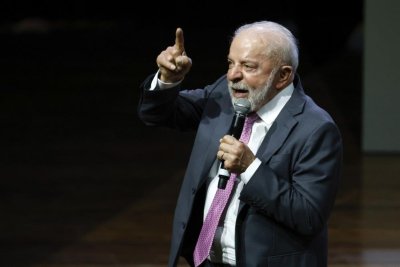
Brazilian President Luiz Inácio Lula da Silva (pictured) and right-wing Sen. Flávio Bolsonaro are each polling 41% in a potential runoff election. Photo by Sebastiao Moreira/EPA

March 12 (UPI) — Brazilian President Luiz Inácio Lula da Silva and right-wing Sen. Flávio Bolsonaro are tied for the first time for a potential runoff after the Oct. 4 presidential election, according to a poll released Wednesday. A runoff would be Oct. 25.

The survey found each candidate with 41% support in a hypothetical second round.

Bolsonaro, a member of the Liberal Party and son of former President Jair Bolsonaro, leads among voters who identify as independent, a shift that could give him an edge.

Among independents, Bolsonaro gained 6 percentage points and would lead Lula 32% to 27% in a runoff scenario. Another 36% said they would not vote and 5% were undecided.

The gap between the two candidates has narrowed steadily, from 10 points in December to seven in January, five in February and zero in March, according to the survey conducted by polling firm Quaest and commissioned by Genial Investimentos.

Similar trends have appeared in other recent polls. A Datafolha survey published Saturday showed Lula with 46% support compared with 43% for Bolsonaro.

Quaest tested first- and second-round scenarios with eight potential candidates. In first-round simulations, Lula leads in two scenarios and is statistically tied with Bolsonaro in five others. Lula’s support ranges between 36% and 39%, while Bolsonaro’s support ranges between 30% and 35%.

Felipe Nunes, Quaest’s director, said Bolsonaro’s gradual rise began after his father publicly named him as a potential candidate in December.

“Flávio has managed to consolidate Bolsonaro’s electorate. He has grown among right-wing voters and improved his performance among independent voters,” Nunes said, according to news website O Globo.

The poll also showed worsening public assessments of the government and the economy.

Both Lula and Bolsonaro face high rejection rates, with 56% of respondents saying they would not vote for Lula and 55% saying the same about Bolsonaro.

“The shift over time is striking. In December, Lula had much greater potential and lower rejection. Now, both have similar levels,” Nunes said.

The survey found 48% of Brazilians believe the economy has worsened over the past 12 months, while 24% say it has improved. In February, negative perceptions stood at 43%.

Source link

As U.S. democracy is in peril, these Brazilian films offer perspective

When Brazilian journalist Tatiana Merlino watched “The Secret Agent” — one of this year’s Oscar nominees for best picture — it felt like seeing scattered scenes from her own life.

As the movie follows Marcelo (played by Wagner Moura) — a professor fleeing from a vindictive businessman during Brazil’s military dictatorship (1964-1985), the story skims through old audio tapes and newspapers, reviewed by a researcher looking into how he died. Like her, Merlino also dug into the past to piece together how her uncle, Luiz Eduardo Merlino, a communist activist, was killed by the right-wing regime in 1971. Though it was initially reported as a suicide, the family soon found his corpse with torture marks in a morgue.

“It became necessary to fight for memory, truth, and justice, because these crimes committed by dictatorship agents weren’t punished at that time, and have not been to this day,” says the 49-year-old journalist, who first saw “The Secret Agent” in São Paulo, and made a career from investigating human rights abuses.

“When a country does not come to terms with its past,” she adds, “its ghosts resurface.”

Recent dictatorship-themed movies like “The Secret Agent” and “I’m Still Here,” which won the Oscar for best international film in 2025, were instant blockbusters back home in Brazil. While both films honor those who, like Merlino, still seek justice for the regime victims, their popularity also got boosted by the country’s zeitgeist.

To many Brazilians, these movies served as reminders of what could have been had former far-right President Jair Bolsonaro, himself a retired Army captain and a dictatorship nostalgic, succeeded in his 2022 attempt at a coup d’etat.

On Jan. 8, 2023, encouraged by Bolsonaro, hundreds of vandals stormed into the Three Powers Plaza, a square in the country’s capital, Brasília, that gathers the congress, the supreme court and the presidential palace. Neither he nor the vandals accepted the 2022 election — won by the veteran leftist Luiz Inácio Lula da Silva, better known as “Lula.”

The uprising followed the same blueprint as the pro-Trump rioters behind the Jan. 6 insurrection in the United States. Although President Trump himself was federally prosecuted for election obstruction, the case was dismissed after his reelection in 2024.

Unlike the U.S., however, Brazil has charged, judged and arrested the conspirators — including Bolsonaro and members of his staff who participated in the coup plot.

“Bolsonaro doesn’t come from Mars,” said “The Secret Agent” star Wagner Moura to the L.A. Times in February. “He’s deeply grounded in the history of the country.”

In 1964, a U.S.-backed coup enacted a violent, 21-year autocracy run by the military, whose effects still resonate today, says Alessandra Gasparotto, a professor at the Federal University of Pelotas (UFPEL).

“It was a dictatorship that worked from a perspective of building certain legitimacy, keeping the congress functioning, but of course, after purging dissent,” explains the Brazilian historian.

“I’m Still Here,” for example, dramatizes the real-life quest of Eunice Paiva, a housewife whose husband Rubens Paiva, a former leftist congressman who had his tenure revoked after the coup, then disappeared in the hands of the military in 1971. To this day, his body still hasn’t been recovered.

In 2014, Bolsonaro, then just a congressman, spit on a bust of Paiva erected to honor his memory during the coup’s 50th anniversary in Congress.

“The cinema of all countries has the role of preserving memory, so if you take a look at the Holocaust, the American Civil War, or World War II movies, it has this role of almost an ally of history,” says writer Marcelo Rubens Paiva, son of Rubens Paiva and author of the book from which “I’m Still Here” is based. “There’s an old saying: History is the narrative of winners, while art is of the defeated.”

In the case of Brazil, the militaries who led the repressive apparatus of the dictatorship got away with torture and murder through a 1979 amnesty law. It was initially enacted to pardon alleged “political crimes” committed by the regime opposition and allow a transition to democracy — but it was also used to pardon the dictatorship’s human rights violations. Then, in the late 1980s, the military oversaw a slow, gradual shift to democracy, stepping down from power only in 1985.

“This new republic had more continuity than novelty, since many politicians who were central to the dictatorship moved to central roles in the democratic government,” explains Gasparotto. “That’s why they built this pact [to forgive the regime’s crimes].”

For that reason, these movies still feel contemporary. “The Secret Agent,” for example, blends past and future through the records analyzed by a researcher, while “I’m Still Here” highlights Eunice Paiva’s post-regime fight for the recognition of Rubens Paiva’s death; without any corpse to officialize his death, he was just deemed disappeared.

When Merlino watched the movie, for example, Eunice reminded her of her grandmother, Iracema Merlino.

“I’m the third generation of my family fighting for memory, truth and justice,” says Merlino. “It started with my grandmother, who passed away, then it was handed to my mother, who’s now very ill, then to me.”

Nowadays, she awaits trial for the third lawsuit attempt of the family to hold her uncle’s torturer, Col. Carlos Alberto Brilhante Ustra, accountable — the two other cases against the accused were dismissed over the years.

Since Ustra’s death in 2015, the Merlino family is now suing his estate for reparations. Yet he still remains a hero to some; in 2016, while Bolsonaro was still a congressman, he shouted a dedication to the memory of the torturer during the voting of the impeachment of Brazil’s former President Dilma Rousseff — herself one of the victims of Ustra in the 1970s, but among the few who survived.

“These films make connections with the present because understanding the past is important for understanding today’s contradictions,” says Marcelo Rubens Paiva. “What happened before interferes in the conflicts a country lives in today.”

So if authoritarians like Bolsonaro don’t come out of the blue, the same goes for other autocratic leaders, like President Trump.

Although founded on democratic principles, the U.S. itself has a long, muddled history with the concept. The authoritarian turn the country is reckoning with is part of a long legacy of inequality that stemmed from the 246-year institution of slavery. Following its abolishment in 1865 came a near-centurylong period of tension marked by racial segregation that we now refer to as “Jim Crow.”

“With some exceptions, the South was governed by a then-segregationist Democrat party — with [rampant] electoral fraud, authoritarianism, use of local police for political repression, and no chance for opposition, even [by] moderates,” says Arthur Avila, a history professor at the Federal University of Rio Grande do Sul (UFRGS) in Brazil.

Although the Civil Rights Act of 1964 and the Voting Rights Act of 1965 ended segregation and granted voting rights to people of all races — signed by then-President Lyndon B. Johnson, a Southern Democrat who broke away from the party’s history to spearhead progressive domestic policy — the decades that followed were ridden with manipulations of the electoral system. For example gerrymandering, or the practice of manipulating electoral district boundaries to favor one political party, is an ongoing, albeit controversial tactic among both Democrats and Republicans.

President Trump himself was federally prosecuted for election obstruction. The indictment alleged that, upon losing the 2020 election, Trump conspired to overturn the results and manipulate the public by spreading false claims of election fraud on social media. It argued that this, in turn, stoked a mob of his supporters into leading the deadly Jan. 6 attacks on the Capitol; but the case was dismissed upon his reelection in 2024.

In the lead-up to the midterm elections in November, Trump has pushed for federal control over elections, restrictions on mail-in voting and the addition of citizenship documents to vote, despite an existing federal law that already prohibits noncitizens from voting in U.S. elections. (He tried implementing the latter through an executive order in 2025, but it was permanently blocked by a federal court; a voter ID bill called the “SAVE America Act” is currently stalling in the Senate.)

“There’s a strong local authoritarian tradition in the U.S. that Trump himself feeds from,” says Avila.

Besides that, according to Avila, the country faces a growing “de-democratization” process from within. This shows in the rising control and dismantling of institutions by reactionary sectors — including efforts to block professional, educational and athletic programs promoting DEI, or diversity, equity and inclusion — from what many critics and scholars have cited as lingering resentment from desegregation, he says.

“We may see it as a slow authoritarian turn in North American politics that didn’t overturn the democratic regime yet,” Arthur considers. “But if this process goes on, and that’s a conjecture, in the next decade the U.S. may become a state of exception that keeps democratic appearances but has been stripped of any democracy’s substance whatsoever.”

As movies such as “The Secret Agent and “I’m Still Here” remind us, a great deal of maintaining a democracy has to do with keeping a good memory.
Source link