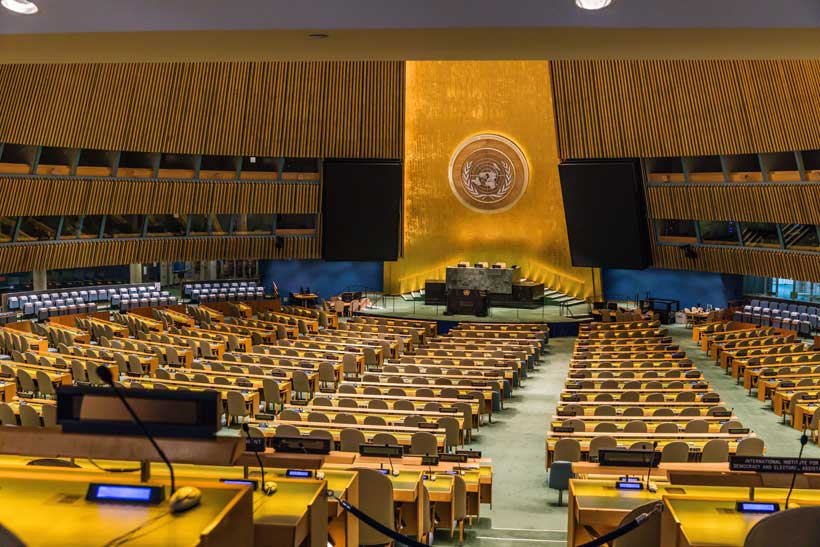
Is the world seeking peace outside the UN? Explore the Peace Council Initiative
US President Trump’s announcement of the creation of the so-called “Peace Council,” involving several countries, including Morocco, sparks a deep debate that goes beyond the diplomatic event itself. It addresses the core of the international order established after World War II. The issue isn’t only about establishing a new international body but also raises an implicit question: Is the United Nations still capable of managing global peace and security, or are we entering a phase in which alternatives are being sought?
From this perspective, the Peace Council becomes a political project par excellence, reflecting shifts in the American vision of the role of international institutions and revealing a structural crisis within the United Nations system.
First: The Peace Council… Read for the idea, not the structure.
Internationally and institutionally, the Peace Council cannot be considered a direct alternative to the United Nations. The latter is grounded in an international charter, legal legitimacy, and semi-inclusive membership, whereas the Peace Council remains a selective framework, initially limited in membership, and its legitimacy is based, in particular, on the political will of the countries involved, foremost among them the United States. However, attention to this formal aspect may overlook the substance of the matter. The true value of the Peace Council lies not in its organizational and administrative structure, but in the political message it carries: explicitly questioning the United Nations’ ability to perform its historical function, offering an alternative grounded in effectiveness rather than consensus, and prioritizing alliance over inclusiveness. In other words, we are facing a shift in how international peace is managed, not just a new institutional addition.
Second: Why does the US administration believe that the United Nations has failed? Washington’s view is rooted in the strong belief that the United Nations has faced significant challenges: it has become hostage to the veto powers within the Security Council; it struggles to enforce its strategic decisions in major international conflicts; and it has shifted from being a mechanism for resolution to more of a platform for political battles. This perspective is not merely popular opinion; it is shared by many international relations scholars, who argue that the UN has not evolved sufficiently to address emerging global and regional issues, including unconventional conflicts, the rise of non-state actors, shifting global power dynamics, and a waning collective commitment to international law. In this context, the Peace Council is regarded by the United States as a tool to address what it perceives as a long-standing institutional paralysis.
Third: The Peace Council… Is it truly an alternative or just a parallel path?
When we look at international relations realistically, we usually consider three levels: 1. Legal level: The Peace Council can’t replace the United Nations when it comes to legitimacy grounded in international law. 2. Practical level: The Council aims to fill a real gap in conflict management, especially in cases where the United Nations has struggled to resolve or contain issues. 3. Symbolic and expressive level: This is where the concern grows, as the Council challenges the UN’s exclusive claim to legitimacy in the “peace industry.” In the end, it’s not just about being an alternative or a supporting body. It’s more like a parallel system that could, over time, become a real competitor if it gains more influence and members.
Fourth: The American Dimension… Redefining International Leadership.
The creation of the Peace Council aligns with Trump’s broader perspective on international relations, emphasizing three key points: reducing dependence on multilateral organizations, strengthening alliances, and shifting decision-making authority to major global powers. From this standpoint, the Council is less about promoting peace and more about reshaping America’s influence and alliances, especially in a world where Washington is reluctant to bear the costs of a global order it cannot fully control. This reflects a shift away from seeking international legitimacy toward a focus on “realistic legitimacy,” in which institutions are judged more by their results than by strict adherence to rules.
Fifth: Morocco and the Peace Council… a strategically chosen location
The Kingdom of Morocco’s decision to join the Peace Council should not be seen as a departure from the United Nations, but rather as a strategic move in its diplomatic efforts to diversify its international partnerships. Morocco maintains strong institutional ties with the UN, actively participates in peacekeeping missions, and is also eager to expand its presence in new global initiatives. By joining the Peace Council, Morocco positions itself favorably in discussions on security and stability, gaining an influential role in shaping international approaches to conflict management. This move also helps to reinforce Morocco’s image as a responsible actor that avoids relying solely on a single framework for its diplomatic and security strategies.
Sixth: Is the time of the United Nations over?
The prediction that the United Nations mission is coming to an end may be premature, but it still carries weight. The key point is that the UN is facing a crisis of legitimacy and effectiveness, not one of existence. It continues to exist, but it can no longer handle alone a world marked by multiple power centers, rising complex conflicts, and waning trust in collective action. So, the Peace Council isn’t signaling its demise but rather highlighting the deepening challenges facing the traditional international system.
In the end, the Peace Council put together by the Trump administration isn’t officially replacing the United Nations yet, but it definitely marks a shift—signaling that we’re moving from one phase to another. We’re entering a time when peace and security are handled through selective alliances and initiatives driven by major powers, rather than through large umbrella organizations. The big question is, will this new approach bring about more effective peace, or will it make the world less legitimate and more fragile? The answer won’t be found just in the data but in how this new model actually plays out on the ground.