Why Chris Hansen hasn’t seen the new film about ‘To Catch a Predator’
Chris Hansen has not seen “Primetime,” the A24 film in which Robert Pattinson plays him, and he probably won’t anytime soon. He walked out of an Aug. 20 screening arranged for him at the studio’s Manhattan offices after refusing to sign a nondisclosure agreement, which he believed would prevent him from raising any legal objection to the way he is portrayed.
But Hansen’s company has purchased preshow advertising in theaters showing “Primetime,” which opens Sept. 25. The spots promote TruBlu, the subscription streaming platform where the former “Dateline NBC” correspondent presents his current sting operations under the title “Takedown.”
“It’s a movie that uses my name, image and likeness,” Hansen told The Times in a recent interview. “Why not direct people to what the real Chris Hansen is doing? Here’s where you can see it.”
Moviegoers, in other words, will be asked to have a seat twice.
The film revisits one of the most provocative and scrutinized franchises in the history of TV news. “To Catch a Predator,” which ran as a periodic “Dateline” investigation from 2004 to 2007, exposed men who used online chat rooms to solicit sex with minors. It accelerated the popularity of the true crime genre while raising lasting questions over journalistic ethics.
Directed by Lance Oppenheim in his narrative feature debut, “Primetime” is based on Luke Dittrich’s 2007 Esquire article “Tonight on Dateline, This Man Will Die,” about the suicide of a Texas prosecutor targeted by one of the stings. It premieres Sept. 5 at the Venice Film Festival.
Hansen, 66, is ready to ride the wave of notoriety the film is bound to generate. He is still pursuing online predators and a new generation of fans have found him on TruBlu, his YouTube page and on social media. “I’ve got to be the only 66-year-old man in America with 1.1 million TikTok followers,” he said.
Hansen first heard from A24 regarding “Primetime” when an executive reached out to him in late May to ask whether he would participate in promoting the film, according to emails obtained by The Times. Over the two months that followed, the journalist and his business partners repeatedly asked to see the film or a script before making any commitment. They also raised the possibility of compensation or a production credit, although Hansen said no formal request was made.
Hansen and his partners repeatedly raised concerns that he had never been contacted about the use of his name and likeness, even as a courtesy, before production was completed. The studio said it wasn’t necessary.
“Chris’s work was an important inspiration for ‘Primetime,’ which is a dramatized film inspired by true events,” according to an Aug. 8 email from A24. “While the film didn’t require individual consultation or permission during production, we’d love to have Chris’s support of the film to the extent he feels comfortable. If not, we certainly understand.”
An A24 representative declined to comment for this story. A person involved with the film who was not authorized to discuss the matter publicly said the nondisclosure agreement Hansen was asked to sign is standard for a movie screened ahead of release, so that viewers do not reveal plotlines or spoilers.
The trailer, released earlier in August, has generated buzz in media business circles for the appearance of Jeff Zucker, former NBCUniversal chief executive, who appears as himself in a small role as a ratings-hungry network executive. Pattinson’s Hansen is later seen in the trailer screaming, “I’ll be bigger than ‘Lost’!” in reference to the ABC hit.

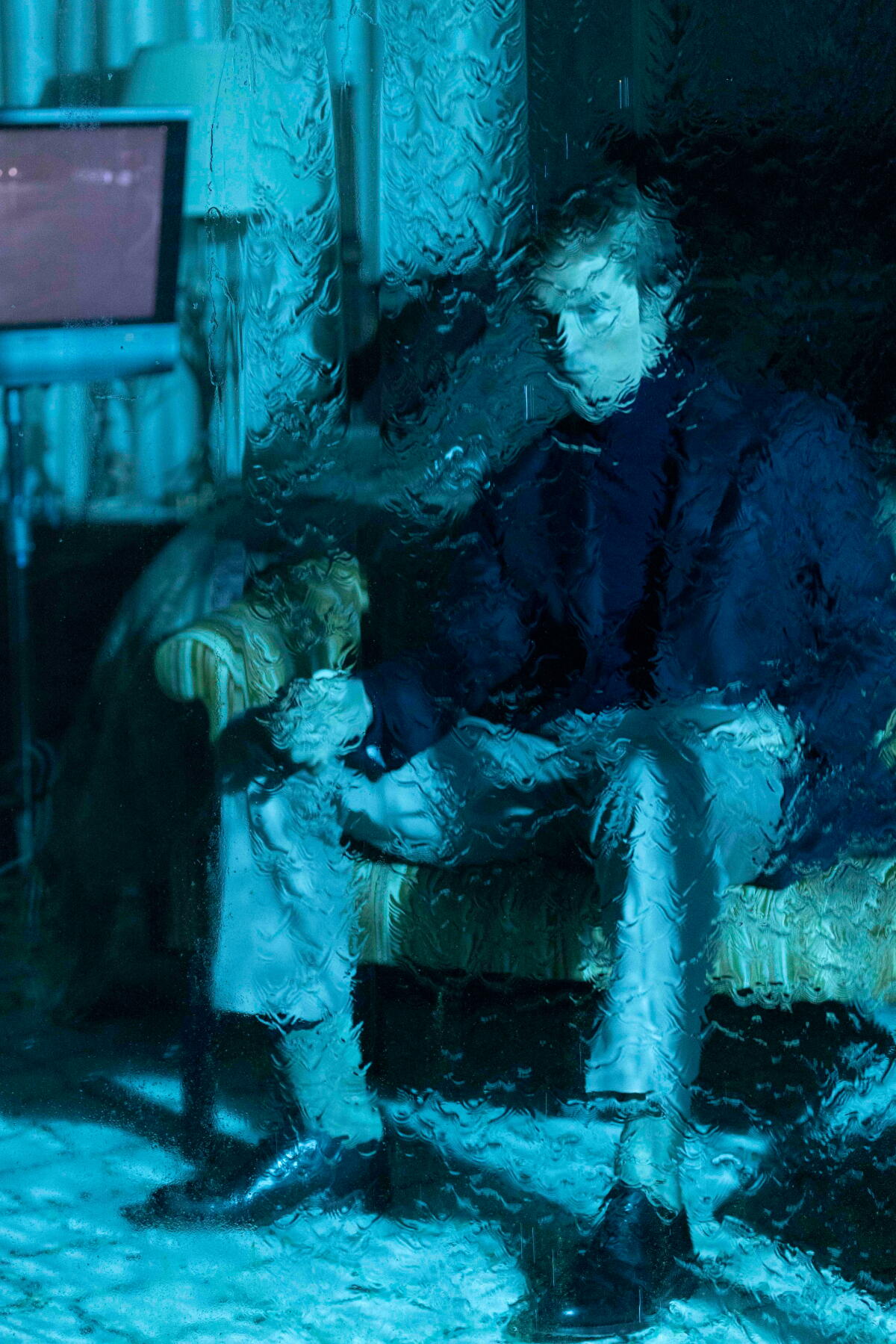
Robert Pattinson in a scene from A24’s “Primetime.”
(Sinna Nasseri / A24)
Hansen said he is not looking for a payout from the filmmakers. But he would like a clearer statement that the film is fiction rather than “inspired by true events,” as it says in the trailer, and perhaps a financial contribution to organizations for victims of child predators.
“I want some recognition that they used my name, image, and likeness in a largely fictional story,” he said. “They used my name, my colleagues’ names and some family members. Based upon what I know about this, it’s an insult to the thousands of people who work diligently, often at great risk, every day to protect children from predators.”
The conflict is hardly the first involving a living celebrity objecting to a fictional depiction. But legal challenges are often futile.
“You don’t own your life story,” said Domenic Romano, managing partner at Romano Law. “If you’re a celebrity, the filmmaker doesn’t need your permission to dramatize it. Even if you’re alive and you don’t like how you’re being portrayed, the 1st Amendment gives broad protection.”
Actor Olivia de Havilland went to court in 2017 over the FX series “Feud: Bette & Joan,” claiming the portrayal of her as a vicious gossip damaged her reputation. The court ultimately ruled in FX’s favor.
Actor Daryl Hannah took a different route, publishing an opinion piece in the New York Times in March objecting to her depiction in FX’s “Love Story: John F. Kennedy Jr. & Carolyn Bessette.” Hannah, who dated Kennedy before he married Bessette, wrote: “In the weeks since the series aired, I have received many hostile and even threatening messages from viewers who seem to believe the portrayal is factual.”
“When entertainment borrows a real person’s name, it can permanently impact her reputation,” Hannah wrote.
The rise and fall of “To Catch a Predator” provides enough drama for a big-screen treatment.
During his run at NBC News, Hansen was an Emmy Award-winning correspondent delivering hidden-camera investigative stories on such topics as identity theft and sex trafficking. But his “Predator” franchise, which used online decoys in chat rooms to draw men seeking sex with minors into police stings turned him into a global sensation, albeit a polarizing one.
NBC News conducted the investigations with the help of a civilian watchdog group called Perverted-Justice and local police in the towns and cities where the stings were set up. The suspects arrested and convicted included a rabbi, a teacher and a doctor.
Decoys posing as young teens lured the men to sting locations, mostly set up at private homes in quiet communities. Hansen would then enter and confront the men with his signature line: “Have a seat.” After a chat with the correspondent (“You see how this looks, right?”), the men were arrested by local police, while a camera crew captured it all.
The tableau of Hansen going face-to-face with suspects seated in suburban kitchens became so familiar it was spoofed in a comedy sketch that opened the 2006 Emmy Awards.
“Predator” remained a giant hit until a November 2006 sting in Murphy, Texas, went awry. Bill Conradt, a Rockwell County assistant district attorney, had been exchanging online messages and photos with a decoy posing as a 13-year-old boy. Unlike other targets, he never came to the sting house. Police obtained warrants and a SWAT team came to his home with a “Dateline” crew in tow. He shot himself to death after law enforcement entered.
Conradt’s family sued NBC, which settled out of court. The incident sharpened the debate over Hansen’s tactics, and as the “Predator” franchise became more popular, he was criticized in journalism circles for collaborating with police and an outside group of private citizens in his investigative work.
There have been many accolades as well. Law enforcement organizations credited the program for shedding light on a new form of criminal activity in the then-emerging internet age. Over the years, Hansen has helped promote advocacy groups and legislation protecting the rights of sexual abuse victims.
“Dateline” continued producing “Predator” investigations for another year after Conradt‘s death, airing its final installment in December 2007 before NBC retired the franchise in early 2008. Hansen has long maintained that the show simply ran its course. The library of his episodes continued to air on cable news channel MSNBC, now called MS NOW.
Hansen left NBC News in 2013 after the network declined to renew his contract. He continued to orchestrate the sting operations on a short-lived syndicated series, “Crime Watch Daily.” He also became one of the first well-known TV journalists to use a Kickstarter campaign to raise money to produce his own work to present on web platforms, which eventually led to the TruBlu site he has now. He also has a podcast series distributed by Red Seat Ventures called “Have a Seat,” a true crime podcast where he interviews figures in law enforcement.