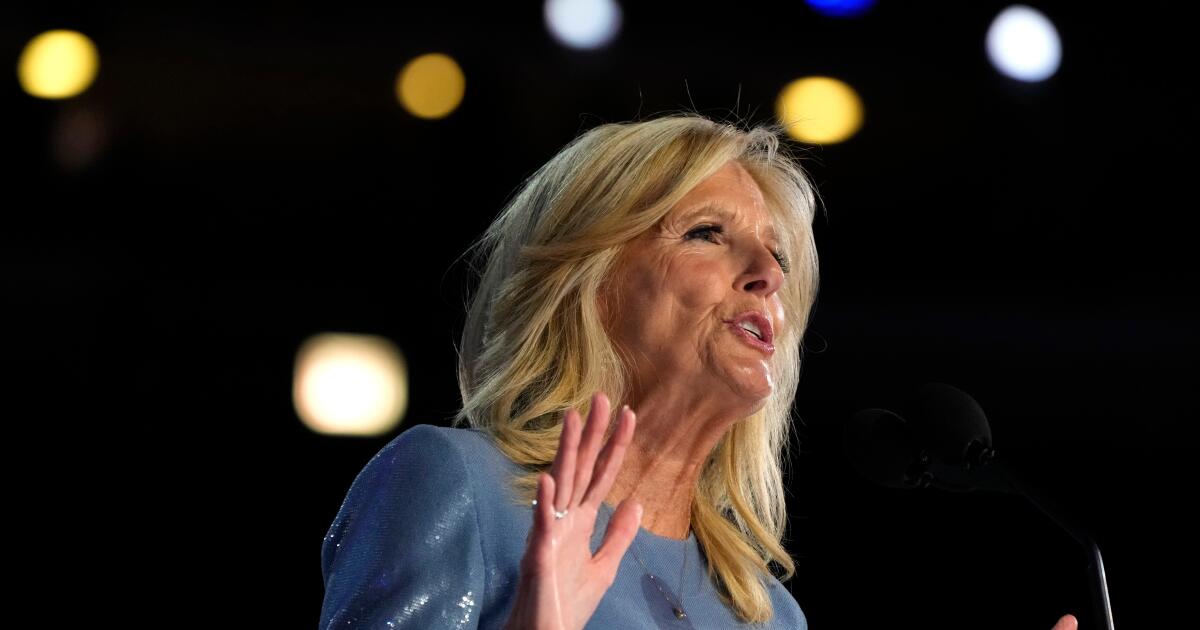
Former first lady Jill Biden delivers remarks in the East Room of the White House in Washington, D.C., on December 2, 2024. A Secret Service agent on her detail mistakenly shot himself in the leg at an airport Friday. File Photo by Annabelle Gordon/UPI.. | License Photo
March 27 (UPI) — A U.S. Secret Service agent on former first lady Jill Biden‘s detail shot himself in the leg by mistake Friday in Philadelphia, the agency announced.
Around 8:30 a.m., the agent sustained “a non-life-threatening injury following a negligent discharge while handling a service weapon at the Philadelphia International Airport during a protective assignment,” a Secret Service statement issued to ABC News said.
“There were no reported injuries to any other individuals and the special agent is being evaluated at an area hospital in stable condition.”
Doctors at Penn Presbyterian Medical Center were evaluating the agent, who was listed in stable condition.
The Secret Service’s Office of Professional Responsibility expects to investigate the incident, CNN reported.
Secret Service spokesman Anthony Guglielmi said Biden was at the airport when the shooting happened, but wasn’t in the agent’s presence.
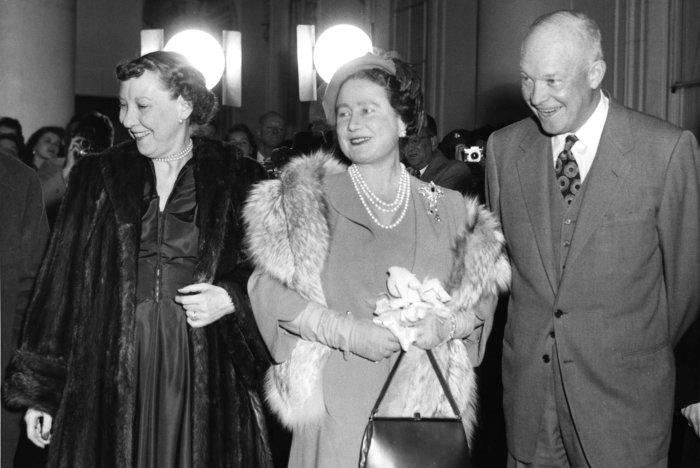
President Dwight D. Eisenhower and first lady Mamie Eisenhower (R) pose for photographers with Queen Elizabeth (C) after welcoming her to the White House on November 4, 1954. She was first lady from 1953 to 1961 and focused on supporting military families, veterans and women’s volunteer efforts. UPI File Photo | License Photo
This is the April 21, 2021, edition of the Essential Politics newsletter. Like what you’re reading? Sign up to get it in your inbox three times a week.
Outgoing presidents often leave decisions for their successors to take on.
Over the last two decades, and four presidents, how to end America’s longest war — in Afghanistan — has been among the largest open questions. President Biden inherited it from President Trump, who inherited it from President Obama, who took it from President George W. Bush. Unpopular, seemingly unending and unwinnable, the war is a case study in how the choices of one administration echo into the next.
Last week, Biden formally announced a deadline of Sept. 11 — the 20th anniversary of the terrorist attacks that provoked the U.S. invasion of Afghanistan — to end military involvement in the country.
“War in Afghanistan was never meant to be a multigenerational undertaking,” he said.
The prospective exit also has been years in the works. Obama promised to scale back U.S. involvement, but first he sent a surge of troops. Trump vowed several times to withdraw all troops, making chaotic progress that stopped short of a full exit. Biden is now the third president to make a similar commitment.
Whether he will follow through remains to be seen. My colleagues David S. Cloud and Tracy Wilkinson have extensively covered the American involvement in Afghanistan, from Trump’s growing tensions with the Pentagon over withdrawal to the lives of Afghanistan’s youngest generation, which was born into U.S. occupation.
Taken together, their work over the last few years reveals the deep roots of Biden’s promise, and the complicated history that will color his path forward.
Get our L.A. Times Politics newsletter
The latest news, analysis and insights from our politics team.
By continuing, you agree to our Terms of Service, which include arbitration and a class action waiver. You agree that we and our third-party vendors may collect and use your information, including through cookies, pixels and similar technologies, for the purposes set forth in our Privacy Policy such as personalizing your experience and ads.
The long path to leaving
January 2017: A president who promised peace leaves office after eight years of war
During his first presidential campaign, Obama pledged to end the war in Afghanistan, as well as in Iraq. He ended his presidency as the first two-term president to see U.S. forces at war for all eight years.
Experts saw his legacy as mixed. He did reduce the number of troops in Afghanistan, cutting their ranks to 8,400, and his administration reduced American deaths — if not Afghanis’ — by relying on diplomacy and on drones to launch airstrikes. Yet intelligence officials said the U.S. faced more threats in more places than the country had seen since the Cold War. “We’re now wrapped up in all these different conflicts, at a low level and with no end in sight,” one expert told The Times.
August 2017:Trump presides over a stalemate and negotiated settlement
Trump the candidate ran as a tough-on-the-Taliban leader, promising a hard-fought and fast victory to end U.S. engagement. But Trump the president softened when it came time to reveal formal plans, Cloud and Wilkinson wrote with former Times reporter W.J. Hennigan. Fighting continued — to show U.S. forces could not be pushed out — while Trump promised that the 16-year war might end “some day” in a negotiated settlement. It was an acknowledgment that victory would elude a president who loved to win and refused to concede defeat.
“This entire effort is intended to put pressure on the Taliban, to have the Taliban understand you will not win a battlefield victory,” then-Secretary of State Rex Tillerson said. “We may not win one, but neither will you. So at some point, we have to come to the negotiating table and find a way to bring this to an end.”
By February 2018, the Trump administration proposed a defense budget that increased spending in Afghanistan by almost $2 billion, for a total of $48.9 billion in the next fiscal year.
December 2018:Trump presses for peace talks and announces a withdrawal of half of troops
That month, a series of announcements signaled Trump’s growing dissatisfaction with involvement in Afghanistan. Increased Taliban attacks had caused hundreds of Afghan civilian and military casualties a month, prompting Trump administration officials to press for a cease-fire agreement, but with dim prospects, Cloud wrote.
Less than two weeks later, administration officials announced a drastic plan: withdraw up to half of the 14,000 American troops serving in Afghanistan, potentially by summer. The backlash was swift from U.S. lawmakers, allies and even the Pentagon. Defense Secretary James N. Mattis was so furious that Trump would abandon allies in Syria and Afghanistan that he resigned in protest, as Cloud reported.
February-May 2020: A truce and a landmark agreement to withdraw
With 12,000 troops still in Afghanistan, the Trump administration brokered a temporary deal with the Taliban to reduce violence for a week in February, Wilkinson reported. The test was a success, and on Feb. 29, U.S. and Taliban officials signed an accord to end the war. The Taliban would prevent Al Qaeda and other terrorist groups from using Afghan territory to threaten the U.S., without renouncing its terrorist ties. In return, the U.S. would withdraw its troops within 14 months, setting a deadline of May 1, 2021.
The plan again drew backlash, from former Trump and Obama administration officials, who warned a complete withdrawal could backfire, Cloud, Wilkinson and Stefanie Glinksi reported. Even as conflict continued between the Taliban and the Afghan government into May, the Trump administration remained committed to removing troops.
November 2020: Hopes of exiting before the election dashed
Trump, hoping that a full exit in 2020 would boost his reelection prospects, made clear to advisors that he cared little about conditions in Afghanistan, Cloud and Wilkinson reported. He wanted out, period. By July, the number of troops on the ground had shrunk to 8,600.
But as the peace talks the U.S. hoped to broker struggled to get off the ground, administration officials said about 4,000 troops would have to remain into November. The Pentagon said too rapid a withdrawal would doom the talks, invite violence and cause American forces to have to abandon valuable equipment. Trump said he wanted a withdrawal by the end of his term in January, and in November — as he refused to concede his loss to Biden — he ordered troop levels reduced in Iraq and Afghanistan, to 2,500 in each country.
Trump’s relationship with Congress further deteriorated in December, in part over the bipartisan pushback to his withdrawal plans. It was among the reasons he cited in vetoing the annual National Defense Authorization Act, Cloud and Jennifer Haberkorn wrote.
April 2021: Biden says it’s “time to end the forever war.”
When Biden took the oath of office on Jan. 20, 2,500 troops remained in Afghanistan. But the new president faced the decision of whether to honor Trump’s May 1 deadline for withdrawing them — the final exit from the war, Cloud wrote. Once again, Defense Department officials pressured the president to delay a full withdrawal as the deadline the Trump administration negotiated with the Taliban approached.
On April 14, Biden made his decision public: The drawdown would proceed, but not so quickly. The U.S. would fully exit by Sept. 11, Cloud and David Lauter wrote.
“I am now the fourth United States president to preside over an American troop presence in Afghanistan. Two Republicans. Two Democrats,” Biden said. “I will not pass this responsibility onto a fifth.”
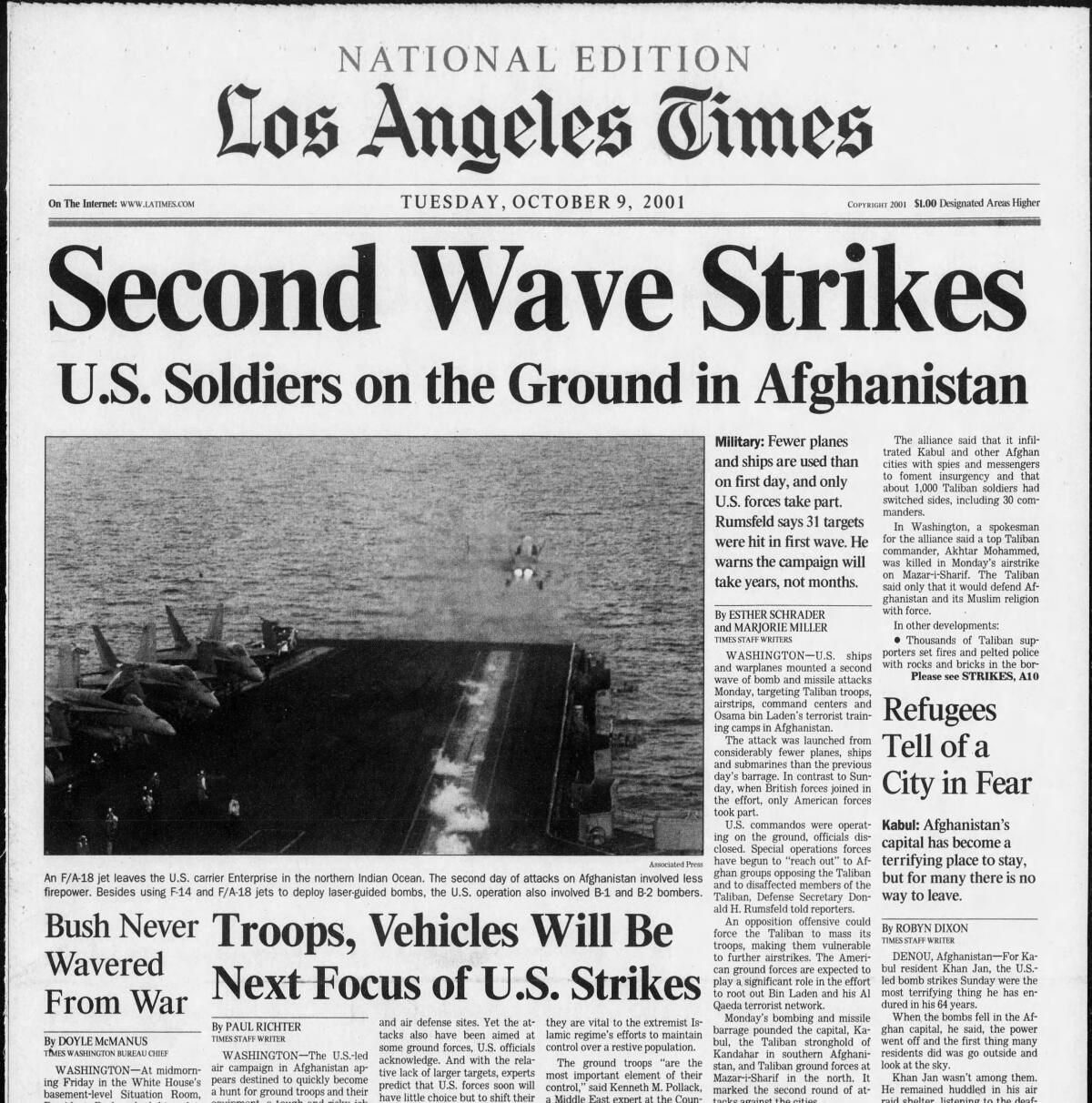
The top half of the front page of the Los Angeles Times on Oct. 9, 2001.
(Los Angeles Times)
Enjoying this newsletter? Consider subscribing to the Los Angeles Times
— The conviction of former Police Officer Derek Chauvin for the murder of George Floyd reenergized a push for sweeping criminal justice reform by President Biden and leading Democrats, who said Tuesday’s verdict was just the first step on the path to national healing, report Evan Halper, Eli Stokols and Sarah D. Wire.
— Anticipating an uproar, Facebook said it would crack down on violent content, hate speech and harassment ahead of the Chauvin verdict. But as Brian Contreras reports, critics are wondering why the platform doesn’t take those precautions all the time.
The latest on the environment
— China, Japan and South Korea are the world’s biggest funders of coal-fired power plants around the globe — and the Biden administration is looking to win their agreement to deep cuts in their greenhouse gas emissions by the end of the decade, write Anna M. Phillips and Wilkinson.
— Biden will convene leaders from around the world on Thursday and Friday as he marks the United States’ return to the global fight against climate change, Chris Megerian writes. Three people with knowledge of the White House plans say Biden will pledge to cut U.S. greenhouse gas emissions at least in half by 2030.
— Solar panels, wind turbines and electric cars will go far in helping California and the Biden administration meet their aggressive climate goals — but not far enough. As time runs short, scientists and government officials say the moment to break out the giant vacuums has arrived, Halper writes.
More from Washington
— Vice President Kamala Harris traveled to North Carolina on Monday to talk about economic opportunities and electric school buses as part of the Biden administration’s efforts to promote its roughly $2-trillion infrastructure, clean energy and jobs plan, Noah Bierman writes.
— The Supreme Court is weighing whether immigrants granted temporary protected status can get green cards — and if the Biden administration will make that decision, David G. Savage reports.
— The Justice Department has brought charges against hundreds of people who stormed the Capitol during the Jan. 6 riot, but one of its most pivotal potential cases involves a man who never set foot inside the building, writes Del Quentin Wilber.
— After Jan. 6, many of the nation’s largest corporations pledged that they would suspend donations to elected officials who opposed the certification of Joe Biden’s victory, hindered the peaceful transfer of power or incited violence. The vast majority kept their word, report Seema Mehta, Maloy Moore and Matt Stiles.
— What is there left to say about House Speaker Nancy Pelosi? Plenty, it turns out. In a new biography, Pelosi dishes on chiding Rep. Alexandria Ocasio-Cortez and using the nickname “Moscow Mitch,” writes Wire.
WASHINGTON — Jill Biden is breaking her silence about Joe Biden’s decision to abruptly end his 2024 presidential reelection bid under pressure from Democrats concerned about his age, health and viability against Republican Donald Trump in a rematch of their 2020 campaign.
A political spouse for nearly 50 years, Jill Biden said she has never publicly discussed her feelings about the three-week stretch when her husband ended his political career, instead saving her thoughts for the pages of her soon-to-be-released memoir.
Gallery Books, an imprint of Simon & Schuster, on Wednesday announced that her book, “View from the East Wing: A Memoir,” is scheduled to be published June 2.
Jill Biden told the Associated Press in a brief telephone interview that the book is a “reflection of my four years as first lady” and that writing it was somewhat healing.
“It was kind of cathartic for me to write it, and I wrote about all the, you know, sometimes painful — but other times, most of it really beautiful moments that Joe and I shared during his presidency,” she said.
Jill Biden declined on Tuesday to discuss any of those moments, good or bad — including watching her husband work his way to the decision to end his five-decade-long political career by dropping out of the 2024 presidential race.
In an announcement video shared on Instagram, she said she wants to “set the record straight.”
The last chapter of her husband’s political career
In April 2023, then-President Joe Biden was 80 and the oldest president in U.S. history when he announced he was running for a second term. His age and fitness to serve another four years — which would take him to age 86 — became a source of concern for the public. Some fellow Democrats began to pressure him to step aside after he turned in a disastrous debate performance against Trump in June 2024 in which he struggled, in a raspy voice, to land his debating points and often appeared to lose his train of thought. Aides blamed the poor performance on a cold.
Joe Biden at first insisted that he would stay in the race, but after a few weeks he withdrew from the campaign and endorsed Democrat Kamala Harris, his vice president. Harris became the party’s presidential nominee but lost to Trump in the November 2024 election.
Jill Biden said that, with the book, “I have put things in perspective,” presenting what she describes as a “more balanced view” of her husband’s time as president.
The memoir is also a tribute of the sorts to women who, like herself, juggle multiple roles.
“It’s also a story about my being able to balance life, you know, as a working woman and as a mother, a grandmother, a first lady,” she said.
During her four years in the role, Jill Biden, 74, made history as the first first lady to continue the career she had before entering the White House. She had taught English and writing for decades at the community college level, and she continued teaching twice a week at a Northern Virginia school while serving as first lady.
Joe Biden ‘doing well’ after his cancer diagnosis
The former president’s office announced in May 2025 that he was diagnosed with an aggressive form of prostate cancer and that it had spread to his bones. He’s receiving treatment.
Jill Biden said it was “quite a shock getting the diagnosis” for her husband, who’s now 83.
“The fact that it is in his bones means that he will have cancer, you know, all his lifetime,” Jill Biden said. She said the doctors say he will “live out his natural life.”
“Like most retired couples, he’ll probably drive me crazy till the end of it,” she joked.
She said he visits Washington at least once a week for meetings or to give speeches.
A unique period in American history
The former first lady also writes in the book about serving during a unique period in U.S. history, including the COVID-19 pandemic and the aftermath of the insurrection at the Capitol on Jan. 6, 2021, according to the publisher.
Her husband was sworn into office on the steps of the Capitol on Jan. 20, 2021, just two weeks after a mob of Trump supporters, spurred by his false claims that the Republican lost because of election fraud, stormed the building in a violent attempt to keep lawmakers from certifying Joe Biden’s victory.
Joe Biden’s first year in office was dominated by the federal response to the pandemic and, while he mostly stayed at the White House, Jill Biden wore face mask and traveled around the country to encourage people to get their vaccinations. She also continued her advocacy on behalf of military families, education and community colleges, cancer prevention and women’s health initiatives.
Before she became first lady, Jill Biden was second lady of the United States from 2009 to 2017, when her husband was Barack Obama’s vice president. She currently chairs the Milken Institute’s Women’s Health Network.
Jill Biden is also the author of “Where the Light Enters,” published in 2019, in which she writes about meeting Joe Biden, then a U.S. senator from Delaware, and marrying and building a life with him. She also has written three children’s books.