

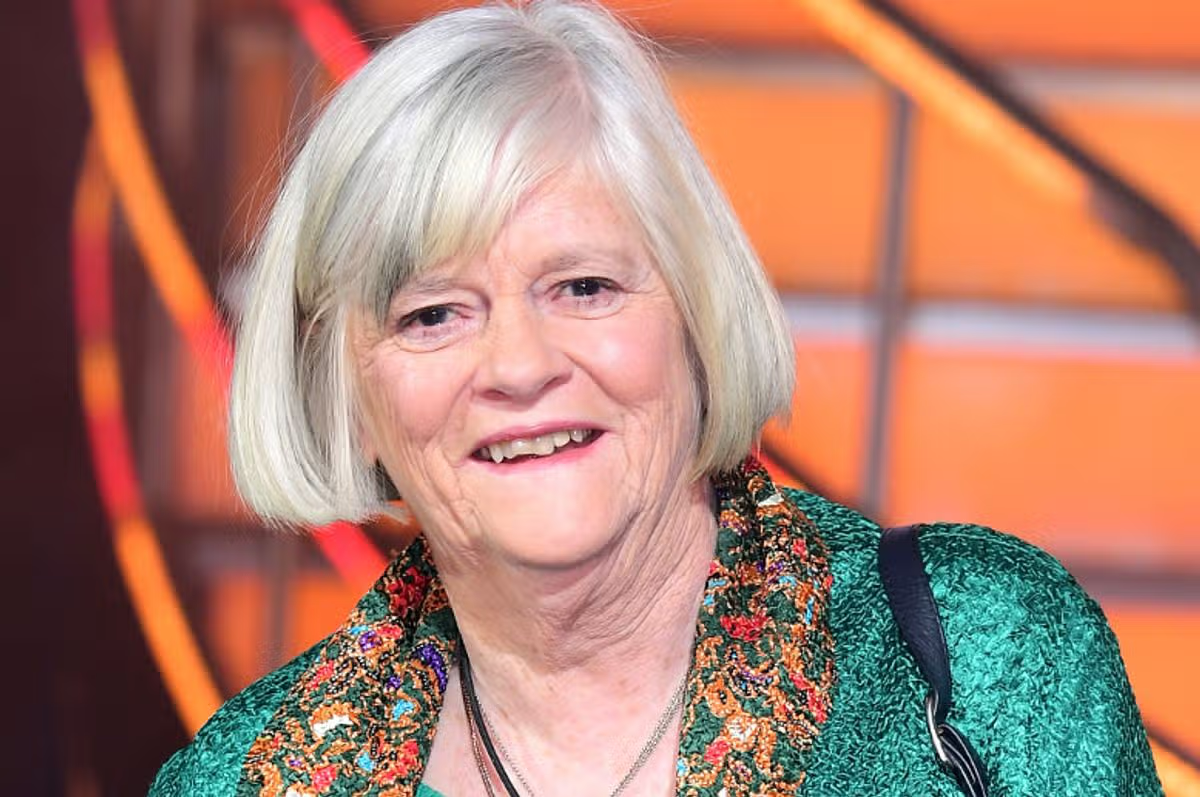
Since the Strictly Come Dancing launched on the BBC in 2004 a host of famous faces have tried on a pair of dancing shoes and kept viewers entertained for weeks, but the show has not been without its fair share of tragedy

Ann died in July this year(Image: PA)
Strictly Come Dancing has graced our screens for over 20 years now – and sadly, we’ve bid farewell to some of its stars along the way.
The dancing is, undoubtedly, a crucial part of the show, but the charm of the BBC programme also lies in delving into the personal lives and relationships of those participating.
Each week, fans gain an insight into their daily routines and the show casts a new light on both well-known and lesser-known celebrities. Heartbreakingly, over the two decades the programme has been on air, some of its celebrity competitors, staff and even presenters are no longer with us.
Ann Widdecombe
Former Tory MP Ann Widdecombe was found dead at her home in Haytor, Devon, in July. More than 100 friends, family and colleagues attended her funeral the following month.
After making a name for herself in the world of politics, Ann had been a surprise entry to the BBC’s Strictly Come Dancing in 2010 where she was partnered with Anton Du Beke. Despite their low scores, the duo became fan favourites making it all the way to quarter-finals.
Speaking to the Mirror ahead of the Strictly launch this weekend, her old sparring partner Craig Revel Horwood praised her courage.
“She was an amazing human being, and she was brave; brave enough to come on Strictly and give me what for.
“And then we ended up working together really closely for three years after and became good friends, and we’re still in contact, to this day. Well, we were in contact to this very day. It’s such a terrible thing that happened.”
Len Goodman
Just as much a legend as Sir Bruce Forsyth, Len Goodman was a cherished member of the BBC show and head judge from the show’s start until 2016. Len left fans heartbroken after stepping down from the show after 12 years, stating at the time that he didn’t want people to tire of him.
“In 2004, I was asked to take part in a brand new BBC Saturday night show and who would have thought me, old Len Goodman, would still be part of this amazing series more than 10 years on, he said at the time, ” he said at the time, “This adventure began when I was 60 and now that I’ve reached my 70s, I’ve decided after this year it’s time to hand the role of Head Judge to someone else.
“It is an honour being part of the wonderful Strictly Come Dancing family and I’m looking forward to my last series very much and to whatever comes next.”
In April 2023, his family confirmed that he had died following a bone cancer diagnosis. He had been living in a hospice in Tunbridge Wells in Kent prior to his death. Tributes flooded in for Len, with his Strictly colleagues sharing their love of his brilliant humour and kindness. Claudia Winkleman tweeted: “I’m so sad about Len. He was one of a kind, a brilliant and kind man. Full of twinkle, warmth and wit. Sending all love to his family and friends.”
Meanwhile, Craig Revel Horwood wrote: “I’ve just woken up to the sad news that my gorgeous colleague and dear friend Len Goodman has passed away. My heart and love go out to his lovely Sue and family. Len Goody Goodman is what I always called him and “It’s a ten from Len & seveeeeern”will live with me forever. RIP Len.”
Robin Windsor
Professional dancer Robin Windsor’s death in February 2024 left the dancing world devastated and in mourning, with his former co-stars and celebrity partners “broken”.
The performer featured on the programme from 2010 until 2013, but was compelled to withdraw from the show due to a back injury and was replaced by Trent Whiddon. He later revealed he had “no choice” in the matter.
After speaking openly about his battles with mental health and finances, he established his own company offering corporate motivational speaking services and corporate team building.
Robin reflected back in 2022: “Leaving Strictly wasn’t my choice. I had a horrible back operation and they decided that they didn’t want to ask me back the next year. It was probably for health and safety reasons, in case something happened, but I was physically fit.”
Sadly, two years later in 2024, Robin’s death was announced. When the news of his passing first broke, details such as the date or the cause of his death were not known. However, it has since been reported that the popular star was found dead inside a London hotel, after previously confiding in a friend about a “troubling incident” that took place over New Year.
Vincent Simone, who had known Robin since he was 17, revealed that a close friend of the dancer started frantically calling his mates when he went missing. But tragically, they were too late, and Robin, 44, was found dead in a London hotel room.
Vincent, who had plans to collaborate with Robin, shared how his friend’s loss has left him devastated. He told The Mirror: “The first thing I thought of when I opened my eyes this morning was Robin. He was the best man I ever met.
“Robin has had these moments in the past – it was an ongoing problem. He would detach himself from people for two or three days. Then he would come back to the world, to reality. But this time, he didn’t come back.”
Caroline Flack
As soon as Love Island host Caroline Flack stepped onto the dance floor, she dazzled everyone. Paired with professional dancer Pasha Kovalev, she triumphed in 2014 by impressing viewers with a series of stunning performances.
But it’s her beautiful Rhumba-inspired showdance to Robbie Williams’ Angels that is forever etched into fans’ memories. Caroline, attached to flowing pieces of fabric, performed a balletic routine with Pasha Kovalev that led them to victory on the show.
Tragically, Caroline took her own life at the age of 40 in 2020.
Lynda Bellingham
Initially known for her comforting ‘Oxo mum’ voice, Lynda became a household name after starring in All Creatures Great and Small, Doctor Who and Second Thoughts, among others.
In 2007, she joined the Loose Women panel and in 2009, she participated in Strictly with Darren Bennett. The duo were eliminated in week four after their Foxtrot to Calendar Girl failed to impress.
Sadly, Lynda was diagnosed with cancer in 2013 and passed away just over a year later at the age of 66.
Paul Daniels
Paul, the late husband of Debbie McGee, competed in Strictly seven years before her, in 2010. The magician was partnered with Ola Jordan, but they were unfortunately the second couple to be eliminated from the competition.
He passed away in 2016 at the age of 77. Debbie, who appeared on Strictly a year later, revealed to Hello magazine that performing on the show helped her rebuild her life after the loss of Paul.
“I had the best partner in Giovanni, and I was back in show business again,” she said, “People knew who I was before, but I was still the magician’s assistant. Since Strictly I’ve been Debbie McGee in my own right.
Neale Pirie
The Strictly family was left heartbroken in 2015 following the sudden death of hair stylist Neale Pirie. Neale, 42, had contacted a family member about chest pains, but medics who raced to his Leicester residence were unable to save him
Strictly’s head makeup artist Lisa Armstrong tweeted at the time: “Utterly devastated and heartbroken over the loss of my sidekick and dear friend.” Meanwhile, Karen Hauer, whose hair Neale had styled for her wedding to Kevin Clifton, posted: “Absolutely heartbroken at the loss of our beautiful friend @Nealepirie. I can’t believe your gone. RIP.
Gary Rhodes
TV chef Gary Rhodes left his kitchen behind to take on the ballroom back in 2008, where he was paired with professional dancer Karen Hardy. The duo became the third couple to leave the competition, following Phil Daniels and Gillian Taylforth
.Gary, who received an OBE in 2006, was a renowned restaurateur who had featured on numerous television programmes including MasterChef and Hell’s Kitchen. His passing at 59 sent shockwaves through the culinary community in November 2019.
The chef had fallen ill suddenly at his Dubai residence during downtime whilst recording a new television programme. His family later revealed that his death resulted from a fatal brain haemorrhage after he collapsed.
Gary’s wife of three decades, Jennie Rhodes, was by his side in his final moments as he succumbed to a subdural haematoma following his emergency hospital admission.
Dave Myers
Dave Myers was a fan favourite on Strictly during his time on the show in 2013. The Hairy Bikers star was partnered with Karen Hauer on the show and they made it all the way to week seven.
Sadly, Dave died in February 2024 after a battle with cancer. In a heartbreaking tribute, his co-star Si King wrote: “I’m afraid I bear some sad news. Most of you will know Dave has been fighting cancer for the past couple of years.
“All who knew Dave are devastated at his passing. His beloved wife brought him such happiness as did her children, Iza and Sergiu who Dave loved like his own. Personally, I am not sure I can put into words on how I feel at the moment.
“My best friend is on a journey that for now, I can’t follow. I will miss him every day and the bond and friendship we shared over half a lifetime. I wish you God’s speed brother; you are and will remain a beacon in this world. See you on the other side. Love ya.”
Jason Wood
Comedian Jason Wood holds the dubious honour of being the first contestant to be eliminated from Strictly Come Dancing back in 2004. The funnyman was partnered with professional dancer Kylie Jones, but their performances failed to win over the judges and they were sent packing in the first week.
The inaugural series had nearly half the number of celebrities compared to the current format, with the show running for a mere seven weeks from May to July. Following its massive popularity among viewers, the show returned for a second series just three months later.
Sadly, Jason passed away in his sleep six years after his Strictly stint, at the tender age of 38.
Willie Thorne
Snooker ace Willie Thorne discovered that dancing wasn’t as natural to him as his beloved sport when he took part in the 2007 series alongside Erin Boag. The duo were the third couple to be eliminated, following Brian Capron and Stephanie Beacham, after their Tango to Lisandro Adrover’s Obertura.
Willie was diagnosed with prostate cancer in June 2015 following routine blood tests ordered by a psychiatrist and underwent treatment. In March 2020, he announced that he had been diagnosed with leukaemia and in June 2020, he was placed in an induced coma after suffering respiratory failure in a Spanish hospital.
A day later, his carer confirmed that he had gone into septic shock and was not responding to treatment. He passed away aged 66 after his life support was withdrawn.
Bill Turnbull
After becoming part of the BBC Breakfast team in 2001 alongside Sian Williams, Sarah Montague, Mishal Husain and Susanna Reid, he stunned viewers by entering the third series of Strictly in 2005.
Teamed up with professional dancer Karen Hardy, the duo became the seventh couple to be eliminated despite impressing both judges and the public. After the programme, Bill went on to enjoy a thriving television career.
But in March 2018, he disclosed that he had been diagnosed with prostate cancer the year before.He passed away at his Suffolk home on August 31 2022, at just 66 years old. Bill’s devastated wife Sarah, known as Sesi, had issued a statement that was read aloud on BBC Breakfast.
Sir Bruce Forsyth
Recognised as Mr Strictly himself, Sir Bruce Forsyth served as the soul of the BBC dance competition, with much of its initial triumph credited to his role as an extraordinary, affectionate presenter.
The cherished British entertainer enjoyed an enormous career stretching over more than 70 years, during which he fronted numerous game shows including The Generation Game, The Price Is Right and Play Your Cards Right. Guinness World Records also acknowledged him in 2012 as holding the longest television career for a male entertainer.
Co-hosting Strictly alongside Tess Daly from 2004 to 2012, he became famous for his exceptional improvisation skills and informing some of the competition’s weaker dancers that they were his “favourite”.
Following his departure from the programme, he remained at home with spouse Wilnelia Merced, who looked after him whilst he battled poor health during his final years.
His final television appearance came in 2015 on Strictly Children in Need Special, and he subsequently had an operation for his abdominal aortic aneurysm, forcing him to withdraw from presenting the Christmas special. He was hospitalised several more occasions throughout the years with chest infections and passed away from bronchial pneumonia at his Wentworth Estate residence on August 18 2017.
Like this story? For more of the latest showbiz news and gossip, follow Mirror Celebs on TikTok, Snapchat, Instagram, Twitter, Facebook, YouTube and Threads.