Walt Disney Co. installed Josh D’Amaro as chief executive Wednesday, beginning a new chapter for the storied Burbank entertainment giant.
Bob Iger passed the reins during Disney’s virtual annual meeting of shareholders, completing the company’s high-stakes and tightly choreographed changing of the guard. After spending two decades molding Disney into a media colossus, Iger segued into a senior advisory role, which will run through December when he officially retires.
The leadership shift comes amid an upheaval in Hollywood as traditional companies wage a desperate battle for survival.
D’Amaro, in his first address to shareholders, pointed to Disney’s signature storytelling as its competitive edge.
“While others in our industry are consolidating just to compete, or struggling to be relevant in a fragmented and disrupted world, Disney is in a category of one,” D’Amaro said during a video segment at the meeting. “This next chapter will be driven by staying focused on world-class creativity, enhanced by technology, bringing unforgettable stories to audiences wherever they are.”
D’Amaro, 55, becomes the ninth leader in Disney’s 102-year history. He was selected last month by Disney board members after a two-year internal bake-off among high-ranking division leaders. Board members were impressed with his business acumen, charisma and his deep love for Disney and its fabled history.
D’Amaro inherits a company that is beloved by millions. It generates $94 billion a year in revenue and employs 230,000 people.
He faces enormous challenges as he steers the ship through a turbulent media environment and tense geopolitics. The war in Iran prompted a sharp increase in fuel costs, which could become a drag on Disney’s critically important tourism business. Executives already have signaled “headwinds” in international visitation at its U.S. theme parks this year.
Lingering Middle East tensions also could weigh on Disney’s plans for a new Persian Gulf waterfront theme park and resort near Abu Dhabi.
D’Amaro, who served as parks and experiences chief until Wednesday, got his corporate start at Disneyland 28 years ago.
“Like so many of you, my connection to Disney goes back to my childhood, long before I began my career here,” D’Amaro told shareholders. “I grew up in a Disney family. We watched ‘The Wonderful World of Disney’ on Sunday nights. I was 10 years old when my family visited Disneyland for the first time. … Disney has always been a place of imagination, innovation and infinite potential.”
Disney previously announced a $60-billion, 10-year expansion program, which D’Amaro has led. But executives must strike a balance by keeping attractions true to their nostalgic core. In Anaheim, the expansion could result in at least $1.9 billion of development.
Disney also must continue to grow its animation business and manage revenue declines from its traditional linear television channels, including ESPN and ABC. It needs to turbocharge its streaming services with compelling movies and TV shows to remain competitive with Netflix and other leaders in the field.
Disney teased upcoming fan favorites, including the May release of Lucasfilm’s “Star Wars: The Mandalorian & Grogu,” a “Bluey” feature film (the kids show featuring an animated puppy, a blue heeler) and a sequel to a “Lilo & Stitch” film for 2028.
Streaming is key to Disney’s future, D’Amaro said.
“Disney+ will continue to evolve beyond a traditional streaming service to become the digital centerpiece of our company,” D’Amaro said, calling the service “a portal that connects our stories, experiences, games, films, and more in entirely new ways.”
The company plans to unify Disney+ and Hulu later this year.
Disney also must continue to incorporate technology while safeguarding its characters and franchises.
“We will continue to develop and embrace new technologies to empower our storytellers — but never at the expense of our characters and worlds, our creative partners, or the trust people place in us,” D’Amaro said. “Because Disney at its core is a company that celebrates human creativity.”
Wednesday also marked a reorganization of the company, configured by Iger, D’Amaro and Disney’s board.
Board members recognized that D’Amaro, who has spent most of his career in the parks division, lacks deep connections among Hollywood’s writers and producers. They elevated longtime television executive Dana Walden, who had been vying for the top job, to the newly formed role of chief creative officer and the company’s first woman president.
ESPN will continue to be managed by Jimmy Pitaro and Disney Entertainment, Studios chairman Alan Bergman will remain in his influential role overseeing film studios including production, marketing and distribution, and sharing oversight for streaming programming with Walden.
D’Amaro’s total compensation package is valued at about $40 million a year, including a $2-million annual base salary, $26.2 million in annual long-term stock incentives, a cash bonus and a one-time promotion award of $9.7 million.
“Josh is a wonderful choice to lead the Walt Disney Co.,” Iger said in a pre-recorded video. “He has passion for our businesses and brands, respect for our people, and he appreciates what makes this company so unique.”
Iger is wrapping up an unprecedented 52-year career at ABC and Disney.
He first stepped into the CEO role in 2005; his first 15 years were almost magical.
Iger led acquisitions of Pixar Animation, Marvel Entertainment and Lucasfilm, the studio behind “Star Wars,” that turned Disney into a blockbuster machine. Sports king ESPN spawned staggering profits, and Disney’s theme parks set industry standards.
Disney’s former Chief Executive Bob Iger will stay on through the end of the year as a senior advisor.
(Jay L. Clendenin / Los Angeles Times)
His decision to buy much of Rupert Murdoch’s 21st Century Fox, a $71-billion deal that closed in 2019, boosted Disney’s television production, refreshed its TV executive bench, and provided a controlling stake in general entertainment streaming service Hulu. The acquisition also gave Disney access to fan-favorite franchises, including “Deadpool,” “The Simpsons,” and James Cameron’s “Avatar.”
But the purchase left Disney saddled with debt just as the COVID-19 pandemic prompted production shutdowns and closures at theme parks and sports venues. It would take several years for Disney to recover.
Iger initially passed the CEO baton to Bob Chapek in February 2020. Iger, then chairman, retired the following year but came back in November 2022 to a mess. At the time, the company was losing billions of dollars on its shift to streaming but that unit is now profitable.
Iger spent the next three years focusing on four business pillars, including improving the quality and profitability of its film studios.
During the last two years, Disney has produced five franchise films that racked up more than $1 billion in worldwide ticket sales, including “Inside Out 2,” “Zootopia 2,” and “Avatar: Fire and Ash.”
The company is banking this year on several other films with blockbuster potential, including Disney and Pixar’s “Toy Story 5,” “Star Wars: The Mandalorian & Grogu” and Marvel Studios’ “Avengers: Doomsday.”
“I would want to be known as someone who was given the keys to this kingdom and brought it to a place that even Walt would be proud of — more storytelling, more innovation, more risk‑taking, and more creation of happiness,” Iger said during a “The Rest is History” podcast last year.
During the meeting, Iger appeared in a prerecorded video that celebrated his numerous career highlights. Shown were clips from his cub years when Iger was a newscaster with bushy black hair. His journey was depicted, including his orchestration of multi-billion-dollar acquisitions that strengthened Disney with more characters and franchises.
Iger, 75 and now gray, ended by thanking shareholders “for the trust you placed in me, for the memories we created together, and for allowing me the honor of serving,” he said. “It has meant more to me than I can say.”
Animated pixie dust twinkled on the screen, courtesy of the fairy, Tinker Bell.
“Bob, on behalf of our employees, cast members, shareholders, and fans around the world, thank you so much for your tremendous leadership, your steadfast support, and your countless contributions to The Walt Disney Co.,” D’Amaro said, as the hand-off was complete.
“You’ve set an incredible example for all of us. … You will be missed,” D’Amaro said.
There was little fanfare during the business portion of the investor meeting.
The company’s slate of board directors were elected with 93% of the vote. Shareholders also approved executive compensation packages with about 85% of votes.
Shareholder-led proposals to compel reports on charities eligible for Disney’s gift-matching program, a review of the company’s accessibility practices in its theme parks for disabled guests, and a push for cumulative voting at future meetings all failed to muster support.
Disney shares closed at $99.41, down roughly 1% on the day.
Russell’s pole position – 0.8 seconds clear of the fastest non-Mercedes car – had sent shockwaves through the paddock on Saturday but the race was initially much closer than qualifying.
Both Ferrari drivers made their expected electric starts, and Leclerc vaulted from fourth on the grid to take the lead at the first corner.
Russell powered past the Ferrari on lap two between Turns 10 and 11 by using extra electrical energy.
But Leclerc was not to go down without a fight and drove past the Mercedes in a similar fashion on the run to Turn Nine on lap three.
Russell tracked Leclerc closely. He challenged for the lead into Turn One on lap nine only for the Ferrari driver to fend him off and leave Russell to fight to retain his position from Hamilton, who by now had joined the leading train of cars.
Antonelli, who had dropped to seventh at the start before fighting back past Norris, Lindblad and Isack Hadjar’s Red Bull, then joined them to make it four cars in the leading group after 10 laps, and they circulated together until Hadjar retired on lap 12.
The Frenchman, who had been running fifth, pulled off on the back straight, bringing out the virtual safety car, usually the trigger for teams to pit and benefit from the reduced time loss compared with pitting under racing conditions.
But while Russell and Antonelli pitted, Leclerc and Hamilton did not. Hamilton immediately questioned the call, saying over the radio: “At least one of us should have pitted.”
Instead, they ran long, sticking to their pre-race plan of a one-stop strategy.
By the time Leclerc pitted on lap 25, Russell was only five seconds behind him, and the Ferrari emerged 14 seconds adrift of the lead.
On fresher tyres, Leclerc might have been expected to narrow the gap to Russell, but he did not, and the fight at the front was over.
Pall bearers carry the casket containing the body of the Rev. Jesse Jackson as it arrives for the public service at the House of Hope church in Chicago on Friday. The public service is for people to pay respects and honor Jackson. Jackson, a well known advocate for civil rights and for the poor, and two time presidential candidate, died Feb. 17 after suffering from progressive supranuclear palsy. Photo by Tannen Maury/UPI | License Photo
March 6 (UPI) — The public funeral for the Rev. Jesse Jackson began Friday morning, with state, religious and local dignitaries attending.
Musical guests scheduled are pop singer and actor Jennifer Hudson, and gospel singers Bebe Winans and Pastor Marvin Winans.
The event, called “The People’s Celebration,” is at House of Hope, a south side venue that can hold 10,000 people.
By 8 a.m. CT Friday, thousands were waiting outside the House of Hope to pay respects to Jackson, USA Today reported.
“This is an occasion for all of us – not only the African American community, but the rest of the world, to celebrate the accomplishments of a great man,” Eric Williams, a Chicago resident and member of the House of Hope church, told USA Today. “He will be greatly missed.”
Jackson died Feb. 16 at 84 of complications from progressive supranuclear palsy.
The civil rights activist lay in state in the Capitol Rotunda in Columbia, S.C., the state where he was born, and there were public and private services held in his honor there.
A service planned for Washington, D.C., has been postponed.
“The Jackson Family looks forward to honoring Rev. Jackson’s work and life in Washington, a city that held rich friendships and deep meaning for the Reverend,” Jackson’s family said in a press release.
Neil Sedaka
American singer/pianist Neil Sedaka performs at the “BBC Proms In The Park” in Hyde Park in London on September 11, 2010. Photo by Rune Hellestad/UPI | License Photo
Science and ICT Minister Bae Kyung-hoon, who doubles as deputy prime minister for science affairs, speaks during a meeting of science and technology-related ministers at the government complex in Seoul, South Korea, 28 January 2026. File. Photo by YONHAP / EPA
March 3 (Asia Today) — South Korea’s Ministry of Science and ICT said Tuesday it has begun distributing graphics processing units to industry, academia and research institutions as part of a government push to expand domestic artificial intelligence capacity.
The ministry said it will supply about 4,000 GPUs starting this month from a pool of 10,000 units secured through last year’s supplementary budget. It selected recipients for the first batch and said the GPUs will be used to support 159 projects.
Under the initial allocation, 2,624 GPUs will go to universities and other academic institutions, 1,288 to industry and 312 to research institutes, the ministry said.
A previous call for proposals drew 514 applications. The ministry said the selected projects will be deployed immediately for AI research and development, including services and model development, based on expert evaluations of factors such as expected technological impact, societal impact and contribution to the domestic AI ecosystem.
The ministry said it will conduct periodic monitoring after allocation. If improper use is found, it said the GPUs could be reclaimed and reassigned to other users.
The ministry also said it plans an additional call for proposals later this month, including 4,000 GPUs for industry users such as small and midsize companies and startups and about 1,000 more for academia and research institutions.
In future rounds, the ministry said it will give greater consideration to applicants based outside the capital area and seek to prevent allocations from concentrating on specific companies or institutions.
Choi Dong-won, the ministry’s director general for AI infrastructure policy, said the GPU program is intended to serve as a catalyst for strengthening AI capabilities and expanding AI services, creating additional demand for infrastructure in a self-reinforcing cycle.
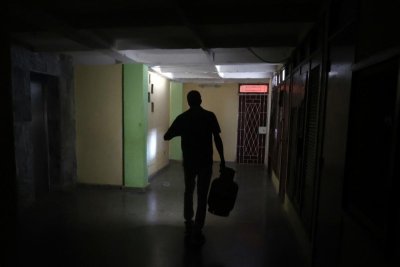
A man walks inside a building during a power outage in Havana in February. Photo by Ernesto Mastrascusa/EPA
March 3 (UPI) — Cuba began March facing a historic energy crisis, with an electricity deficit left 64% of the island in the dark due to fuel shortages and technical failures at its thermoelectric plants.
An electricity deficit is the condition in which demand exceeds the amount of electricity available to supply it. The grid simply doesn’t have enough generation at that moment to meet what homes, businesses and infrastructure are trying to draw.
Cuba’s National Electric System reported a deficit exceeding 2,000 megawatts, resulting in rolling outages lasting up to 20 hours a day, according to figures published on X by the state-run Electric Union, known by its Spanish acronym UNE.
For Tuesday’s peak demand period, UNE forecast maximum consumption of 3,150 megawatts, while available generation capacity was expected to reach only about 1,890 megawatts. The resulting shortfall has forced authorities to disconnect circuits across the country to prevent a total and uncontrolled collapse of the grid.
Eight of Cuba’s 16 thermoelectric plants are offline due to breakdowns and fuel shortages, according to reports. The plants, which process domestically produced and imported crude oil, operate within a system widely considered obsolete and underfunded.
Cuban authorities have blamed U.S. sanctions for worsening the crisis. Government officials have denounced what they call an “energy asphyxiation” by Washington, accusing the United States of restricting oil shipments and limiting access to fuel supplies from abroad.
“The electrical system begins 2026 in worse conditions than it had at the same date in 2025. Thermal plants enter and leave service, oil is scarce and going forward there will barely be diesel and fuel oil for distributed generation,” José Luis Reyes, an analyst specializing in Cuba’s power system, told Diario de Cuba.
“The fragile web of energy production and distribution depends on all kinds of unpredictable factors. Blackouts are guaranteed,” he said.
Independent experts estimate that restoring and modernizing Cuba’s electrical grid would require between $8 billion and $10 billion — a figure seen as out of reach for an economy that has contracted by more than 15% since 2020.
Amid the worsening shortages, Cuban President Miguel Díaz-Canel on Tuesday called for “urgent transformations” to the island’s economic and social model.
During a meeting of the Council of Ministers, Díaz-Canel said the proposed changes include expanding autonomy for state enterprises and municipalities, resizing the state apparatus and boosting domestic food production.
He also urged progress in shifting the country’s energy matrix, promoting exports, easing rules for foreign direct investment and encouraging partnerships between the state and private sectors, including ventures with Cubans living abroad, according to state media outlet Tribuna de La Habana.
The president said the measures must contribute to “macroeconomic stabilization,” increase hard currency revenues and strengthen domestic production, particularly food.
The call for reforms comes amid prolonged economic contraction, high inflation and deteriorating public services, as well as continued political pressure from President Donald Trump, who has advocated for political change on the island.
Trump on Friday raised the possibility of a “friendly takeover” of Cuba, saying the island’s government has been in talks with his administration about the country’s future.
“They are going through major problems and we could very well do something good, I think, something very positive for the people who were forced out, or worse, from Cuba and who live here,” he told reporters at the White House, though he did not specify any potential action against the country.
A highly anticipated new Western drama in the hit Yellowstone franchise is about to start on Paramount+
‘Action-packed’ Western drama has ‘everything you could ask for’(Image: PARAMOUNT PLUS)
Yellowstone’s new spin-off that puts Kayce Dutton (played by Luke Grimes) at the forefront is finally here, and it’s a must-watch for fans of the gripping Western drama.
Airing today (Sunday, 1st March) on CBS in the US and later available on Paramount+, Marshals: A Yellowstone Story follows the rancher and former Navy SEAL as he enlists with an elite squad of US Marshals to deliver justice across Montana.
As he wages war against violence and learns to adapt to working with a team, he must also strive to become the best father possible to his teenage son, Tate (Brecken Merrill).
The latest of several spin-offs from the popular neo-Western saga created by Taylor Sheridan, Marshals promises action-packed cases and gripping drama each week that is sure to keep viewers satisfied.
Although reviews have been mixed so far, garnering a 50 percent score on Rotten Tomatoes, critics agree the show has huge potential and is bound to keep die-hard fans enthralled.
Collider has praised Grimes’ central performance as Kayce, writing that he comes into his own as the Yellowstone franchise’s newest lead.
“Grimes carries the series with ease,” they went on, “graduating from being a supporting cast member roaming alongside Kevin Costner’s shadow to the leading man of his own cowboy-flavoured crime drama.”
Their review also assured fans that the shift to CBS hasn’t sanitised the gritty Yellowstone brand too much, adding: “Marshals is a neo-Western that is chock-full of potential.
“It’s action-packed, thrilling, and full of everything you could ask for in a Kayce Dutton-led series that fights hard to divorce itself from the “Y” that still lingers in the background. It’s not perfect, nor does it claim to be, but once it gets through the initial growing pains, it will be able to stand firmly on its own.”
Men’s Journal described the series as “kick-a**”, promising it still has the “Yellowstone magic”.
The review went on: “Marshals may not be as twisty or unpredictable as 1923 or the recent season of Landman, but it has that same sparkle and magic of the other Sheridan westerns.
“It’s the sort of show that doesn’t ask much to get invested, and rewards you with the simple pleasure of feeling good after you’ve watched an episode. In a world of morally grey anti-heroes, Kayce Dutton is here to be the perennial good guy on horseback. And frankly, it’s good to have him back.”
TVLine was also impressed with the Yellowstone universe’s latest offering, urging potential viewers not to be put off by Marshals’ broadcast on CBS, home to crime procedurals such as NCIS and FBI.
Paramount+ half price sale
This article contains affiliate links, we will receive a commission on any sales we generate from it. Learn more
Paramount+ is offering 50% off its Standard and Premium subscriptions until July 10.
“Marshals actually manages to serve both of its masters quite well,” they wrote.
“With its swelling score, sweeping cinematography, and gorgeous opening credits sequence (a dying art!), you’ll often find yourself wondering, ‘Wait, am I really watching a network procedural right now?’
“Marshals fires on all cylinders, sending the team on explosive missions that guarantee your Sunday nights will end with a bang.”
They concluded: “A visual treat with genuine heart, Marshals is enough of a crime procedural to appeal to viewers who enjoy a complete story told in 60 minutes, while also remaining prestigious enough to satisfy Yellowstone fans who might not typically watch a show like, say, S.W.A.T. or NCIS.”
Marshals: A Yellowstone Story premieres Sunday, 1st March on CBS and the following Monday on Paramount+.
For the latest showbiz, TV, movie and streaming news, go to the new **Everything Gossip** website.
Ensure our latest headlines always appear at the top of your Google Search by making us a Preferred Source.** Click here to activate**** or add us as your Preferred Source in your Google search settings.**
With control of the House — and Trump’s virtually unchecked authority — dangling by a gossamer thread, he reckoned correctly that Republicans were all but certain to lose power this fall unless something unusual happened.
So he effectively broke the rules.
Normally, the redrawing of the country’s congressional districts takes place once every 10 years, following the census and accounting for population changes over the previous decade. Instead, Trump prevailed upon the Republican governor of Texas, Greg Abbott, to throw out the state’s political map and refashion congressional lines to wipe out Democrats and boost GOP chances of winning as many as five additional House seats.
The intention was to create a bit of breathing room, as Democrats need a gain of just three seats to seize control of the House.
In relatively short order, California’s Democratic governor, Gavin Newsom, responded with his own partisan gerrymander. He rallied voters to pass a tit-for-tat ballot measure, Proposition 50, which revised the state’s political map to wipe out Republicans and boost Democratic prospects of winning as many as five additional seats.
Some of those efforts continue, including in Virginia where, as in California, voters are being asked to amend the state Constitution to let majority Democrats redraw political lines ahead of the midterm. A special election is set for April 21.
But as the first ballots of 2026 are cast on Tuesday — in Arkansas, North Carolina and Texas — the broad contours of the House map have become clearer, along with the result of all those partisan machinations. The likely upshot is a nationwide partisan shift of fewer than a handful of seats.
The independent, nonpartisan Cook Political Report, which has a sterling decades-long record of election forecasting, said the most probable outcome is a wash. “At the end of the day,” said Erin Covey, who analyzes House races for the Cook Report, “this doesn’t really benefit either party in a real way.”
Well.
That was a lot of wasted time and energy.
Let’s take a quick spin through the map and the math, knowing that, of course, there are no election guarantees.
But suppose Texas Republicans gain five seats as hoped for and California Democrats pick up the five seats they’ve hand-crafted. The result would be no net change.
Elsewhere, under the best case for each party, a gain of four Democratic House seats in Virginia would be offset by a gain of four Republican House seats in Florida.
That leaves a smattering of partisan gains here and there. A combined pickup of four or so Republican seats in Ohio, North Carolina and Missouri could be mostly offset by Democratic gains of a seat apiece in New York, Maryland and Utah.
(The latter is not a result of legislative high jinks, but rather a judge throwing out the gerrymandered map passed by Utah Republicans, who ignored a voter-approved ballot measure intended to prevent such heavy-handed partisanship. A newly created district, contained entirely within Democratic-leaning Salt Lake County, seems certain to go Democrats’ way in November.)
In short, it’s easy to characterize the political exertions of Trump, Abbott, Newsom and others as so much sound and fury producing, at bottom, little to nothing.
But that’s not necessarily so.
The campaign surrounding Proposition 50 delivered a huge political boost to Newsom, shoring up his standing with Democrats, significantly raising his profile across the country and, not least for his 2028 presidential hopes, helping the governor build a significant nationwide fundraising base.
In crimson-colored Indiana, Republicans refused to buckle under tremendous pressure from Trump, Vice President JD Vance and other party leaders, rejecting an effort to redraw the state’s congressional map and give the GOP a hold on all nine House seats. That showed even Trump’s Svengali-like hold on his party has its limits.
But the biggest impact is also the most corrosive.
By redrawing political lines to predetermine the outcome of House races, politicians rendered many of their voters irrelevant and obsolete. Millions of Democrats in Texas, Republicans in California and partisans in other states have been effectively disenfranchised, their voices rendered mute. Their ballots spindled and nullified.
Iran has begun 40 days of mourning after Supreme Leader Ayatollah Ali Khamenei was killed in ongoing attacks by the United States and Israel, according to Iranian state media.
Top security officials were also killed in Saturday’s strikes, along with Khamenei’s daughter, son-in-law and grandson. The killings mark one of the most significant blows to Iran’s leadership since the 1979 Islamic revolution.
Recommended Stories
list of 4 itemsend of list
President Masoud Pezeshkian condemned the killing as “a great crime”, according to a statement from his office. He also declared seven days of public holidays in addition to the 40-day mourning period.
Reporting from Tehran, Al Jazeera’s Tohid Asadi said people were pouring into the streets of the capital following the news of Khamenei’s killing.
“There will be expected ceremonies,” he said, noting they would likely take place amid continuing bombardment across the country.
People mourn at the Enghelab Square in Tehran [Majid Asgaripour/West Asia News Agency via Reuters]
Protests denouncing Khamenei’s killing were also reported elsewhere, including Shiraz, Yasuj and Lorestan.
“There will be expected ceremonies,” he said, noting they would likely take place amid continuing bombardment across the country.
Footage aired by Iranian state media showed supporters mourning at the shrine of Imam Reza in Mashhad, with several people seen crying and collapsing in grief.
The killing also led to protests in neighbouring Iraq, which declared three days of public mourning. In Baghdad, protesters confronted security forces in the heavily fortified Green Zone, which houses Iraqi government buildings and foreign embassies.
Videos verified by Al Jazeera showed demonstrators waving flags and shouting slogans, with witnesses saying some were attempting to mobilise towards the US Embassy. Footage also showed protesters blocking vehicles at a roundabout near one of the entrances to the area.
Protesters demonstrate near the entrance of the Green Zone after the killing of Iran’s Supreme Leader Ayatollah Ali Khamenei, in Baghdad, Iraq, March 1, 2026 [Thaier Al-Sudani/Reuters]
There was also a protest in the Pakistani city of Karachi, where footage, verified by Al Jazeera, showed people setting fire to and smashing the windows of the US consulate.
However, there have also been reports of celebrations in Iran, with the Reuters news agency quoting witnesses as saying some people had taken to the streets in Tehran, the nearby city of Karaj and the central city of Isfahan.
Meanwhile, the official IRNA news agency reported that a three-person council, consisting of the country’s president, the chief of the judiciary, and one of the jurists of the Guardian Council, will temporarily assume all leadership duties in the country. The body will temporarily oversee the country until a new supreme leader is elected.
Khamenei assumed leadership of Iran in 1989 following the death of Ayatollah Ruhollah Khomeini, who had led the Islamic revolution a decade earlier.
While Khomeini was regarded as the ideological force behind the revolution that ended the Pahlavi monarchy, Khamenei went on to shape Iran’s military and paramilitary apparatus, strengthening both its domestic control and its regional influence.
Attacks across the region
Meanwhile, the Islamic Revolutionary Guard Corps (IRGC) pledged revenge and said it had launched strikes on 27 bases hosting US troops in the region, as well as Israeli military facilities in Tel Aviv.
Explosions have continued to be reported in Qatar and the United Arab Emirates, while security alerts are in place in several countries across the region.
US President Donald Trump, in a social media post on Sunday, warned Iran that it would be hit “with a force that has never been seen before” if it retaliated.
Iran’s retaliatory attacks since Saturday have targeted Israel and US assets across multiple Middle East countries, including Qatar, the UAE, Kuwait, Bahrain, Jordan, Saudi Arabia and Iraq.
Harlan Ullman, chairman of the strategic advisory firm Killowen Group and an adviser to the Atlantic Council in Washington, DC, said the US may have made a “big mistake” by killing Khamenei.
“Decapitation only works when you get all the leaders, and I don’t think that we got all the leaders,” Ullman said, adding that the US should not expect Iran’s leadership to enter negotiations in the immediate aftermath.
Iranian state media reported on Saturday at least 201 people have been killed in the joint US-Israeli attacks across 24 provinces, citing the Red Crescent. In southern Iran, at least 148 people were killed and 95 wounded in a strike on an elementary girls’ school in Minab on Saturday, with the toll continuing to rise, according to state media.
Defending Southern Section Division 1 champion St. John Bosco, the top team in The Times’ high school baseball rankings, began its season Friday with an 8-0 win over La Serna.
Julian Garcia, who missed last season while recovering from an arm injury, was impressive in his debut. He struck out five with no walks and no hits in four innings. Closer Jack Champlin continued to blank the Lancers, getting the final two outs, one on a strikeout.
Noah Everly had three hits and James Clark added two hits and two RBIs.
Orange Lutheran 10, Crespi 0: Gary Morse struck out eight in five innings and Brady Murrietta had two hits and two RBIs for the Lancers.
Gahr 1, El Dorado 0: A ninth-inning run ended the pitching duel. Jake Ourique gave up one hit in six innings for Gahr.
Harvard-Westlake 3, Cypress 0: Evan Alexander, Jake Chung and Nate Blum combined for the shutout. Jake Kim had two RBIs.
JSerra 17, Prosper (Texas) 9: Brise Boop had a home run, a double and four RBIs, and Blake Bowen homered and finished with thee hits for JSerra in Texas.
Sherman Oaks Notre Dame 2, Servite 0: Beckett Berg gave up three hits in six innings. Jacob Madrid and Malakye Matsumoto each had two hits for 4-0 Notre Dame.
Granada Hills 6, Sylmar 1: Max Szczech had a home run, double and single for the Highlanders.
Moorpark 7, Rio Mesa 3: Carson Cerny had a home run, a triple and five RBIs for Moorpark. He also struck out three in three innings. Cody Brossard threw four shutout innings of relief.
Hart 4, Bishop Alemany 2: Hayden Rhodes and Jaiden Chan had RBI hits for Hart, which received six shutout innings from pitcher Cayden Kollasch.
Birmingham 4, San Marcos 2: A two-run fifth lifted the Patriots. Aidan Martinez got his second save.
South Hills 4, Bonita 0: Carson Baker threw a four-hitter with five strikeouts for South Hills. Richie Soto hit a home run.
Los Alamitos 8, Yucaipa 1: Cruz D’Errico had a two-run double and Will McCullough had two hits and two RBIs for Los Alamitos.
El Camino Real 8, Sun Valley Poly 5: An eight-run third inning propelled the Royals. Hudson December gave up no runs in five innings for El Camino Real. RJ De La Rosa had two hits and two RBIs. Blake Dubin had a double, a single and three RBIs.
Sierra Canyon 3, West Ranch 1: Kingston Monette and Mac Kennedy combined on a five-hitter for Sierra Canyon.
Bell 10, South El Monte 1: Adolfo Esquivel finished with two hits and two RBIs and also threw four hitless innings.
La Cañada 9, Arcadia 2: Will Park and Joe Bell each had two hits and two RBIs for La Cañada. Scott Burns struck out seven.
Santa Margarita 4, Loyola 3: The Eagles picked up a run in the top of the seventh to beat their second Mission League team this week. Warren Gravely IV contributed two doubles.
Westlake 6, Highland 1: Blake Miller and Dylan Lee had two hits each for Westlake.
Fountain Valley 4, Tesoro 1: Josh Grack had three hits, including a home run, to lead Fountain Valley. He also threw two scoreless innings with three strikeouts.
Carson 5, West Torrance 0: Skylar Vinson threw five scoreless innings and also had two hits for the Colts.
Newport Harbor 6, Foothill 1: Gavin Guy struck out seven and had two hits for 5-0 Newport Harbor. Henry Mann went three for three.
Boys’ basketball
Gardena Serra 57, Pilibos 51: Chinemerem Anyikwa scored 25 points to help Serra win the Southern Section Division 5 championship at Azusa Pacific. Demetri Galadjyan scored 23 points for Pilibos.
Girls’ basketball
St. Margaret’s 57, Murrieta Valley 41: Jayden Witten had 19 points, one of four players in double figures, to help St. Margaret’s win the Division 3 championship.
Savanna 46, Warren 25: Jazara Madrid led Savanna to the Division 6 title with 16 points.
Crescenta Valley 51, Saugus 43: Kelin Shajanian scored 14 points and Anik Nortikyan contributed 11 rebounds to lead the Falcons to the Southern Section Division 2 championship.