Iranians rally in biggest show of defiance against US since war began | US-Israel war on Iran News
Hundreds of thousands of Iranians have marched in a government-organised show of defiance in Tehran, pledging their readiness to take up arms.
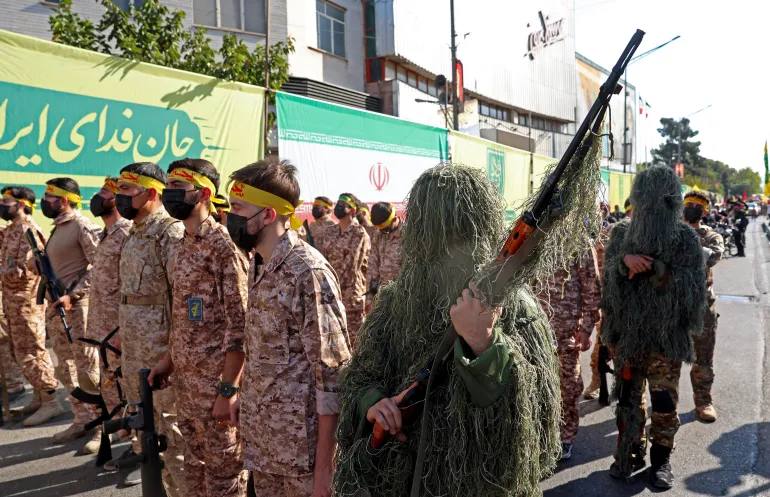
The Iranian government showcased a newly formed volunteer force at the rally on Friday. It will receive limited military and emergency response training to serve as an additional layer of security for Iran’s Islamic Revolutionary Guard Corps (IRGC) and the Basij militia.
Recommended Stories
list of 3 itemsend of list
Volunteers rallied through downtown Tehran in combat uniforms, some carrying flags and weapons, while the government displayed drones, anti-aircraft batteries and other weaponry.
Iranian authorities said 313,000 people joined the event in the capital. Attendance figures could not be independently verified.
Tehran’s IRGC chief, Hassan Hassanzadeh, told the state broadcaster IRIB that over 600,000 people had registered to participate in the voluntary Janfada-ye-Iran campaign. That roughly translates to “Those who sacrifice their lives for Iran”, with over one million expected to take part in the training.
Senior Iranian leaders at the rally included President Masoud Pezeshkian and Basij head, Hossein Taeb.
Taeb told participants that the volunteers would be ready for “full-fledged defence” and would be a “nightmare” for Iran’s enemies.

A broader strategy
Iranian authorities say mobilising the new volunteer force is part of a broader defence strategy.
“The Islamic Republic has mobilised these people to show that they are united, that they have solidarity and that their people are ready to give anything for the country,” said Al Jazeera’s Sinem Koseoglu, reporting from the rally.
Women and teenagers have also registered with the volunteer units, she added.
“I want to show the world that Iran is strong and united. We don’t want war, but we’re ready to defend our country to the very end,” one of the volunteers, Bahera, told our reporter.
Another volunteer, wearing a combat uniform and carrying a rifle, said: “This is our homeland and we won’t let others decide its future”.
President Pezeshkian said in a speech that the rally was a show of solidarity, Koseoglu noted.
“This is not only a message to countries like the US and Israel, which are attacking Iran, but also to the Islamic Republic that we are ready for any crisis.”

Economy and mobilisation
Friday’s rally happened as the Iranian economy struggles under the US naval blockade of Iranian ports and new US sanctions.
Esmaeil Baghaei, Iran’s Foreign Ministry spokesman, condemned the “brutal economic war, deliberately designed to inflict maximum pain and suffering on every Iranian citizen”.
As the latest addition to its economic pressure campaign, the US administration on Thursday went after digital currency networks that it says are illegally providing sanctioned Iranian entities with access to the international financial system.
The struggling economy was a key driver for protests last December that quickly turned into a challenge to the political system in place since the Islamic Revolution in 1979. Iran said about 3,000 people were killed in the protests, but activists say the state crackdown killed over 7,000.
However, the war launched in late February by US-Israeli strikes has since allowed the authorities to regain the initiative by presenting themselves as a bulwark against the country’s enemies.
The volunteer mobilisation campaign started in early April, at the height of US-Israeli attacks.
According to the authorities, more than 30 million people registered for a potential call-up, about a third of the population of 86 million.