beatles

Inside story of Paul McCartney’s new album as UK’s greatest living songwriter, 83, reflects on life BEFORE The Beatles

GO to Dungeon Lane today and it’s strange to think it occupies a special place in Paul McCartney’s heart.

Yet it will go down in pop history alongside other street names associated with him, joining Penny Lane and Abbey Road.

Paul McCartney today in a picture taken by his daughterCredit: Mary McCartney
Paul, left, makes his debut public performance, aged 15, with The Quarrymen, led by John Lennon, right, in 1957Credit: PA:Press Association
Paul in his early years, aged 8Credit: Alamy

Situated in the Speke neighbourhood of Liverpool, the L24 postal district, a faded road sign sets the tone for its desolate air.

It is bordered on one side by a solar farm business and, on the other, by a fenced-off area of scrubland which separates it from the city’s John Lennon Airport.

Before you get very far, a bright yellow “emergency access gate” bars further exploration.

But, as a child, Dungeon Lane was McCartney’s gateway to a stunning rural idyll where he could escape the hustle and bustle of urban life.

Read more on Paul McCartney

RETURN OF THE MACCA

Sir Paul McCartney opens up about childhood on emotional new album


MAN ON THE RUN

Inside new doc revealing how Paul McCartney escaped after The Beatles split

In the Fifties, the lane took him past a daffodil farm to the Oglet Shore on the widest stretch of the River Mersey.

I wonder if young Paul, a keen birdwatcher, ventured into this wilderness clutching his trusty The Observer’s Book Of Birds.

There, he may have spotted any number of waders — curlew, snipe, dunlin, black-tailed godwits.

What we do know is that his lifelong love of our feathered friends began in those days.

This helps explain the compositions dotted through his career such as Blackbird with The Beatles, Single Pigeon with Wings, Two Magpies with The Fireman and solo efforts Jenny Wren and Long Tailed Winter Bird.

To McCartney, his early rambles into the countryside represent humbler, simpler times before The Fab Four exploded on to the scene, before his storied life in the dazzling glare of publicity.

Paul with his dad Jim and brother MikeCredit: Getty
Paul’s childhood home at 20 Forthlin RoadCredit: Getty Images
Paul with mum Mary and younger brother Mike

Sir Paul, 83, has called his 19th solo album The Boys Of Dungeon Lane . . . which is, as he suggests, a trip down memory lane.

He got the title from the lyrics of its first single, Days We Left Behind, released yesterday, a nostalgia-filled acceptance that he has a far longer past than future.

Intimate, beautifully sung with Macca playing acoustic guitar, bass, piano and harmonium himself (how does he do that!?), it is the first taste of a project that has been five years in the making.

“This is very much a memory song for me,” he says. “I was thinking about just that . . . the days I left behind.

“And I do often wonder if I’m just writing about the past — but then I think, how can you write about anything else?”

For McCartney, the song conjures up “a lot of memories of Liverpool. It involves a bit in the middle about John [Lennon] and Forthlin Road which is the street I used to live in. Dungeon Lane is near there.”

Paul was born on June 18, 1942, to his midwife mother Mary and salesman father Jim, and they moved with younger brother Mike to 20, Forthlin Road, Allerton, in the mid-Fifties from Speke, where they had lived since 1947.

We also know that Paul first bumped into John on July 6, 1957, at roughly 4pm, at a garden fete behind St Peter’s Church, Woolton.

In Days We Left Behind, he sings of the bond he formed with the lanky lad 20 months older than him: “We met at Forthlin Road/And wrote a secret code/To never be spoken.”

Continuing his reflection on the song, he says: “I used to live in a place called Speke which is quite working class.

“We didn’t have much at all but it didn’t matter because all the people were great and you didn’t notice you didn’t have much.”

As already mentioned, birdwatching was a hobby, one that required little cash and gave him a lot of pleasure “in the nearby woods and fields”.

Sir Paul with his wife NancyCredit: PA:Press Association
Paul, a keen birdwatcher, owned The Observer’s Book Of BirdsCredit: Alamy

A recent entry in Macca’s Spotify playlists, under the banner Sticking Out Of My Back Pocket, came accompanied by these musings . . .

“My mum had the midwife’s house on the edge of Liverpool, where we lived,” he says.

“It was where Liverpool just stopped and became deep countryside, so that was when I had the opportunity to do quite a bit of birdwatching.”

He particularly cherishes the moment he saw a “skylark rising into the sky, singing its sweet song”.

That unforgettable sight has found its way into Days We Left Behind, with its lines, “In the skies the skylarks rise/Above the sounds of war/Since that day I knew they’d stay/With me for evermore.”

All these decades later, he reflects: “And now because I live part-time on a farm [in Sussex], I’m able to see a lot of birds and I don’t need The Observer’s Book Of Birds quite so much as I did back then.”

McCartney’s new album promises to be one of the most personal, most autobiographical song cycles he’s ever recorded, while also finding room for up-to-date love songs dedicated to third wife Nancy.

Yesterday’s announcement states that it finds him in a “candid, vulnerable and deeply reflective mood, writing with rare openness about his childhood in post-war Liverpool, the resilience of his parents, and early adventures shared with George Harrison and John Lennon”.

I’m guessing here but songs yet to be heard, Momma Gets By and Salesman Saint, appear to be affectionate remembrances of mum Mary, who died when Paul was just 14, and dad Jim.

Sir Paul has called his 19th solo album The Boys Of Dungeon LaneCredit: Supplied
Dungeon Lane, now fenced off on both sidesCredit: supplied

This is not the first time Macca has delved into his early years for songwriting inspiration.

I talked to him about the playful On My Way To Work, which appeared on his 2013 album, New.

He called it a “collection of memories all morphed together”, providing a fascinating glimpse into his life before Beatlemania.

“It’s about me going to my first job, before The Beatles took off, which was working on a lorry for a delivery company called Speedy Prompt Deliveries — SPD.”

McCartney described going to work on the council-run green and cream buses which led to him looking at risqué magazines like Parade.

“I’d go on the bus at some unearthly hour of the morning,” he said. “I might buy a magazine and look at the nudies. I was too young to be interested in the news!”

He remembered how hard-up kids like him ripped the fronts off cigarette packets and traded duplicates with their mates, instead of collecting “football cards or, like in America, baseball cards”.

“It was like, ‘I’ll swap you two Craven A for a Woodbine’. Then there were the posh brands because this bus route went from the centre of Liverpool to the outskirts.

“Posh people would be smoking Passing Clouds or Sobranies and packets of those were very prized.”

Another song, Queenie Eye, referenced a childhood street game from “1940s Britain”.

“It’s what we used to get up to before video games and that whole home entertainment thing,” he said.

“Someone would be elected to be ‘the one’ or the ‘queenie eye’. We’d all stand behind that person and he would throw a ball over his head and one of us would catch it and hide.

“Then we would all chant, ‘Queenie eye, queenie eye, who’s got the ball? I haven’t got it. It isn’t in my pocket!’ It was simple entertainment for simple minds but great fun.”

Now it is time to return to the 2020s and the creation of The Boys Of Dungeon Lane, the follow-up to his captivating lockdown album, McCartney III.

This time, we’re told we can expect “Wings-style rock, Beatles- style harmonies and McCartney-style grooves”.

TRACK LIST

  • As You Lie There
  • Lost Horizon
  • Days We Left Behind
  • Ripples in a Pond
  • Mountain Top
  • Down South
  • We Two
  • Come Inside
  • Never Know
  • Home to Us
  • Life Can Be Hard
  • First Star of the Night
  • Salesman Saint
  • Momma Gets By

The process began around five years ago when Macca met American live-wire producer Andrew Watt, known for his work with Ozzy Osbourne, Lady Gaga, Post Malone and The Beatles’ greatest Sixties chart rivals, the Rolling Stones.

Watt, I gather, “pulled a guitar” on his latest rock icon, who instantly happened upon a chord he didn’t recognise.

As the story goes, the ever- experimental McCartney changed one note, then another, until he had a three-chord sequence.

That led to his new record’s opening track, As You Lie There, which in turn set the ball rolling for the other 13 songs.

It’s remarkable that, as with McCartney III, he is credited with playing all the instruments himself across the whole thing.

It brings to mind how at ease this enduring music obsessive seemed as he suggested specific drum beats and fills to Ringo Starr in The Beatles’ Get Back documentary.

With Macca still touring and playing momentous shows like his 2022 Glastonbury epic, Days We Left Behind has been honed over half a decade when time permitted.

During that period, he even managed to introduce the Stones to producer Watt, who helmed their 2023 comeback album, Hackney Diamonds.

When McCartney was in Los Angeles working with Watt, he was brought in to play bass on Mick Jagger and Co’s punk blast, Bite My Head Off.

Upon its release, I spoke to Keith Richards who was made up over their special guest.

“Yeah, Macca just strolled in with his bass,” the guitar legend drawled. “I think the song reminded him of those times [in the Sixties]. Beatlemania was equally as bizarre as Stones mania.”

There’s a moment towards the end of Bite My Head Off where you can hear someone saying, “Come on Paul, play something”.

“That might have been me,” smiled Richards.

But this is all about Britain’s greatest living songwriter, Paul McCartney, and his new album The Boys Of Dungeon Lane.

Time is precious but when it comes to music and life, he’s still facing forward at 83 — even if he’s remembering a youth long ago when “in the skies, the skylarks rise”.

Source link

Paramount may have landed Warner Bros., now comes the baggage

It took months of effort, lobbying and mounds of cash for Paramount Skydance to finally clinch its prize of Warner Bros. Discovery.

Now, however, the David Ellison-led company faces a long and challenging road to merge these two media giants and set it up for a successful future.

Key to that will be striking a delicate balancing act between investment and paying down its debt load of $79 billion, which is massive even by Hollywood standards.

Notably, the figure is even greater than Warner’s nearly $55 billion of debt post-merger with Discovery, a burden that hamstrung the company for years and led to successive rounds of layoffs and relentless cost cutting.

Last week, my colleague Meg James wrote about the concerns Fitch Ratings and S&P Global Ratings have about Paramount’s credit, given the mountain of debt the company will now carry. Fitch downgraded its credit to BB+ — “junk” territory — from BBB-, and S&P Global Ratings placed the company’s ratings on “negative watch.”

Carrying that amount of debt comes with significant risks.

You’re reading the Wide Shot

Samantha Masunaga delivers the latest news, analysis and insights on everything from streaming wars to production — and what it all means for the future.

By continuing, you agree to our Terms of Service and our Privacy Policy.

For one, a company with a lot of debt that is “junk”-rated is going to be under pressure to cut costs. “Junk status” means a company’s debt is rated below the level that credit agencies consider investment grade. Such a rating means it can be more expensive to refinance or take out new loans, raising the cost of capital.

Paramount executives have already said they plan to find $6 billion in “synergies” within three years, though they’ve emphasized that the majority of their cost cutting will come from “non-labor sources,” including consolidating their streaming technology and cloud providers, combining IT systems across the company and “optimizing the combined real estate footprint and the broader corporate overhead,” among other ideas.

And as I wrote last week, most Hollywood observers and those familiar with Ellison’s plans predict that Paramount will be forced make steep layoffs to offset the cost of the deal and eliminate overlapping roles and functions between the two historic studios.

At the same time, in order to compete with well-funded rivals, Paramount-Warner Bros. will also need to invest in new programming — something that can be difficult for a heavily leveraged business .

Paramount executives have said their cost-cutting efforts won’t include a reduction in production capacity, and Ellison has reiterated that there will be continued spending on programming. Beyond content, he’ll also likely need to invest in improving the technology along with the look and feel of the streaming platforms.

“Whether or not they have the capital to do all of that and to try to get their leverage down is something I’m curious to hear about,” said Naveen Sarma of S&P Global Ratings.

It’s possible that Paramount may not be able to pursue a good opportunity in the future because it has used up all its debt capacity and can’t raise additional financing, said Kelly Shue, a professor of finance at Yale School of Management.

“It might cause them to underinvest in good projects in the future,” she said.

And the company needs to spend on good projects.

The economics of this deal hinge on the combined heft of Paramount and Warner’s two libraries and valuable intellectual property, which will unite Harry Potter, DC Studios, SpongeBob SquarePants and “Mission Impossible” all under one roof.

Building up its streaming platform, which will combine Paramount+ with HBO Max, is important for competing with the behemoth Netflix, which bowed out of the Warner Bros. auction.

And on the theatrical side, Ellison has said the combined company will release 30 films a year — 15 from each studio. That would be a substantial increase from 2025, when the two companies released 18 films — eight at Paramount and 10 from Warner Bros.

“While studios content budgets might not come under immediate focus for cost cutting, we have a hard time seeing no content costs savings considering opportunities to reallocate or pull back from at least the linear networks,” MoffettNathanson’s Robert Fishman wrote in a note to clients last week.

Of course, all of this would come only after the deal’s completion. On the immediate horizon, Paramount needs to secure international regulatory approval as well as at home. Although state attorneys general including Rob Bonta of California have said this is not a “done deal,” most analysts expect that any opposition there is only likely to slow — not stop — the transaction.

A very masculine year in film

A recent study from San Diego State University put a number on something we all suspected: The percentage of female protagonists in the top 100 films last year dropped. A lot.

Female protagonists made up just 29% of the top-grossing films in 2025, down from 42% in 2024, according to the university’s annual study of women’s representation in top films. A selection of film titles from the last year says it all: “The Running Man,” “A Working Man,” “Superman.”

That 29% figure has, unfortunately, been very consistent over the years — it was the same in 2016 and has largely hovered in the range of high 20s to low 30s for the last decade, with a few exceptions (40% in 2019 and 42% in 2024).

Focusing on just the protagonists in the top 100 films means that small fluctuations can change that percentage greatly.

But when the study looked at a broader sample size of the more than 1,900 characters in those films, the results weren’t much better.

The percentage of women in speaking roles was 38%, up just 1% from 2024. And the percentage of major female characters declined to 36% in 2025 from 39% the year before.

The fact that these figures have not moved much, in spite of the countless panels and think pieces about the issue, suggests there isn’t much will in Hollywood to change, said Martha Lauzen, author of the study and founder and executive director of San Diego State’s Center for the Study of Women in Television and Film.

“Representation is social relevancy and social capital,” she told me. “So when you see fewer women than men, that’s a message.”

Stuff We Wrote

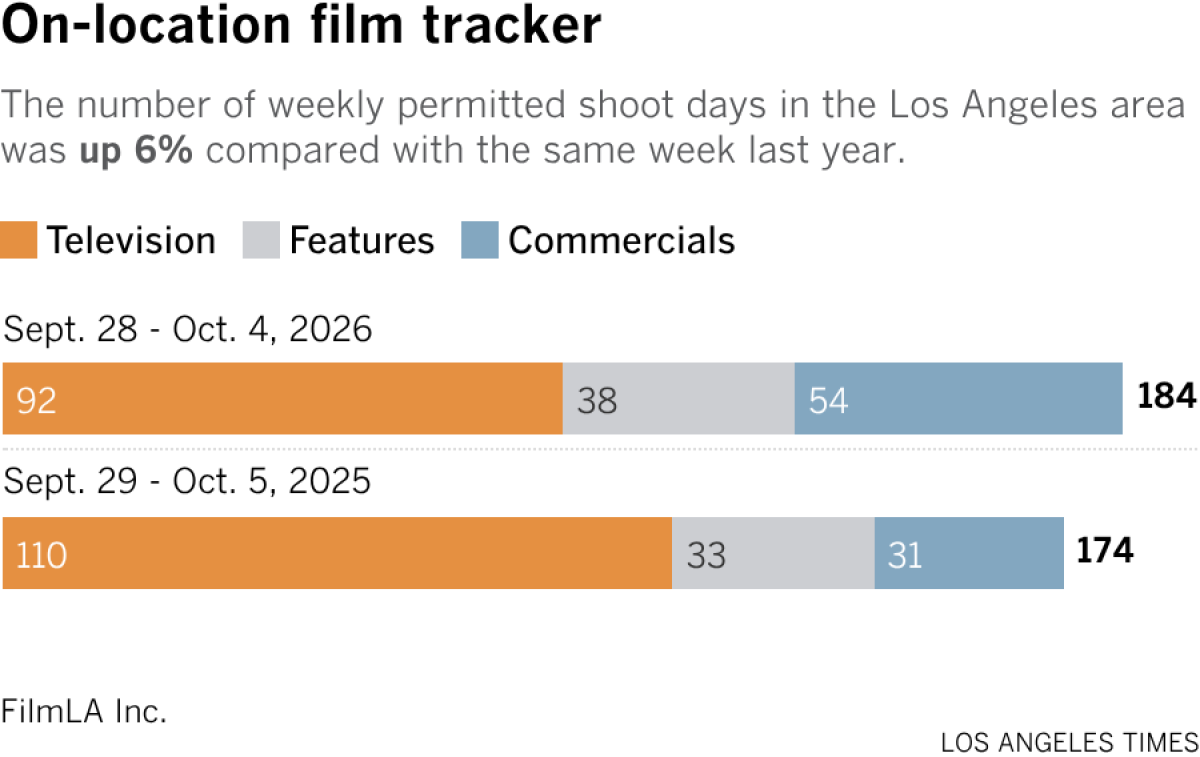
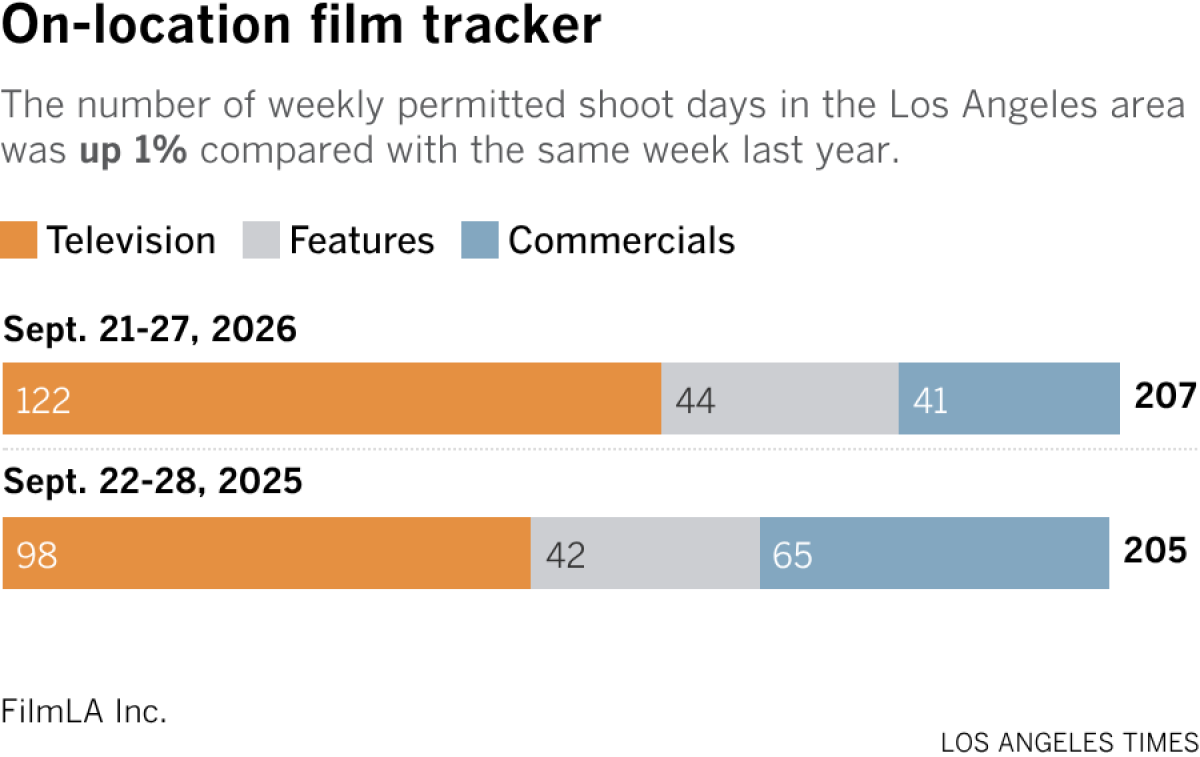
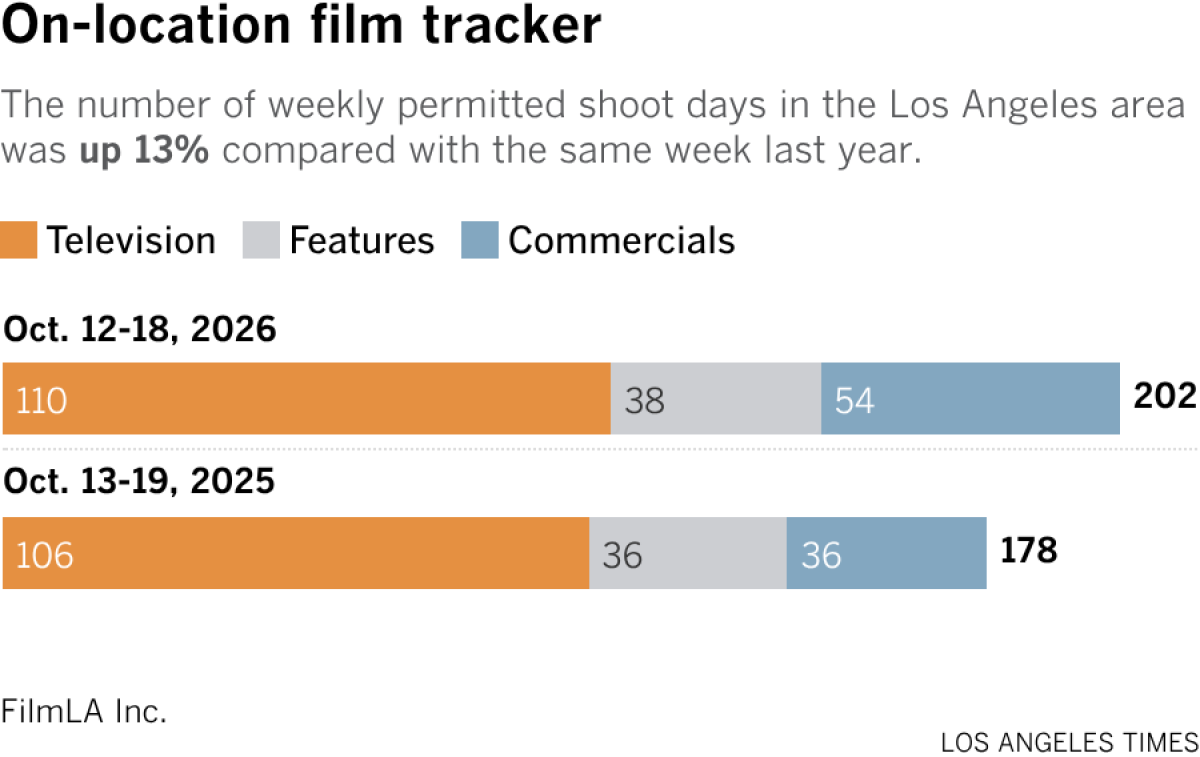
Film shoots

Number of the week

forty-six million dollars

Walt Disney Co. and Pixar’s “Hoppers” came in big at the box office this weekend with a $46-million opening in the U.S. and Canada — the strongest domestic debut for an original animated movie since “Coco” in 2017. Globally, the film made $88 million.

The reception is an encouraging sign for original animated movies, which have largely struggled at the box office since the COVID-19 pandemic while their sequel counterparts have shined.

What I’m watching

Several months ago, some friends and I started a movie club, where we each nominate a film we want to watch and we rotate who gets to make the final selection. Last week, we watched the 1996 comedy “First Wives Club,” which I had never seen but loved for its goofy antics, unexpected song-and-dance number and the focus on the enduring power of female friendships.

Source link