Battleships

Nuclear-Powered Trump Class Battleships Will Reverse One Of The Navy’s “Largest Mistakes”: Navy Boss

The U.S. Navy’s near-total abandonment of surface combatants with nuclear propulsion after the end of the Cold War is “one of the largest mistakes” it’s ever made, according to the service’s top officer. Chief of Naval Operations Adm. Daryl Caudle made this remark today while voicing support for the recently announced decision that the future Trump class battleships will be nuclear-powered. He also explicitly highlighted challenges the Navy has faced when it comes to fueling conventionally-powered ships taking part in operations against Iran, something TWZ recently reported on in detail.

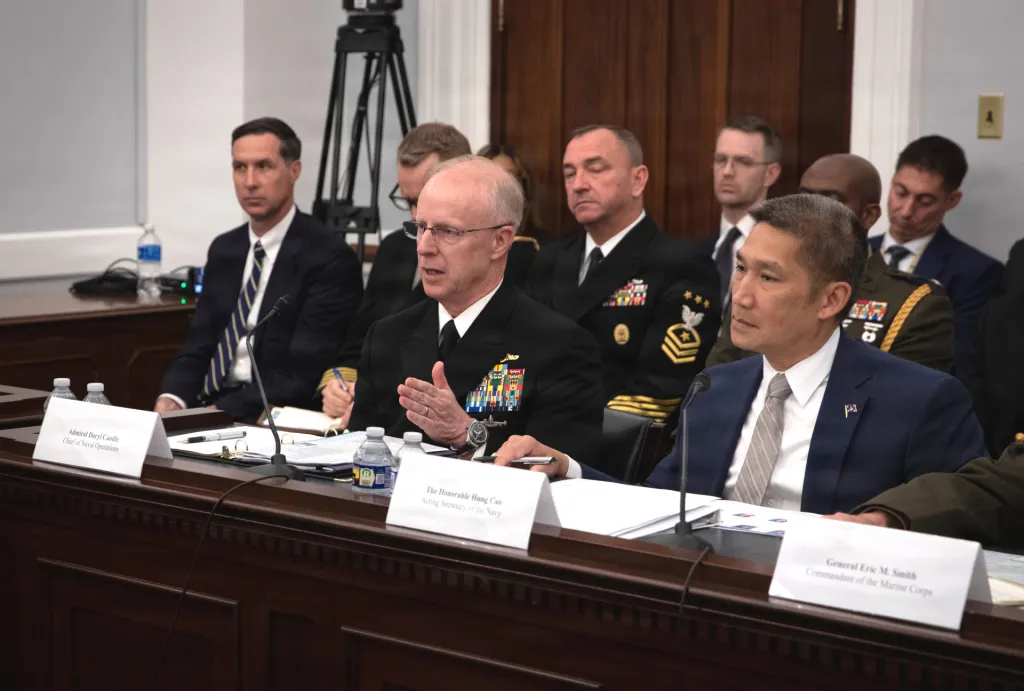
Adm. Caudle, as well as Acting Secretary of the Navy Hung Cao and Commandant of the Marine Corps Gen. Eric Smith, testified before members of the House Armed Services Committee today. The focus of the hearing was on the Department of the Navy’s 2027 Fiscal Year budget request. The Navy disclosed that it had decided the Trump class warships will feature nuclear propulsion in its latest long-term shipbuilding plan, which was released on Monday.

Chief of Naval Operations Adm. Daryl Caudle, left, speaks at a separate budget-related hearing before members of the House Appropriations Committee on May 12, 2026. USN

“I know there have been many conversations and questions over the past few days regarding the news that the Trump class battleship will be nuclear powered. And, as you know, Virginia has a long history of nuclear shipbuilding. What specific design plans can you share at this point and can [you] speak to how nuclear power would enable this system to be successful?” Rep. John McGuire, a Virginia Republican and former U.S. Navy SEAL, asked Adm. Caudle directly.

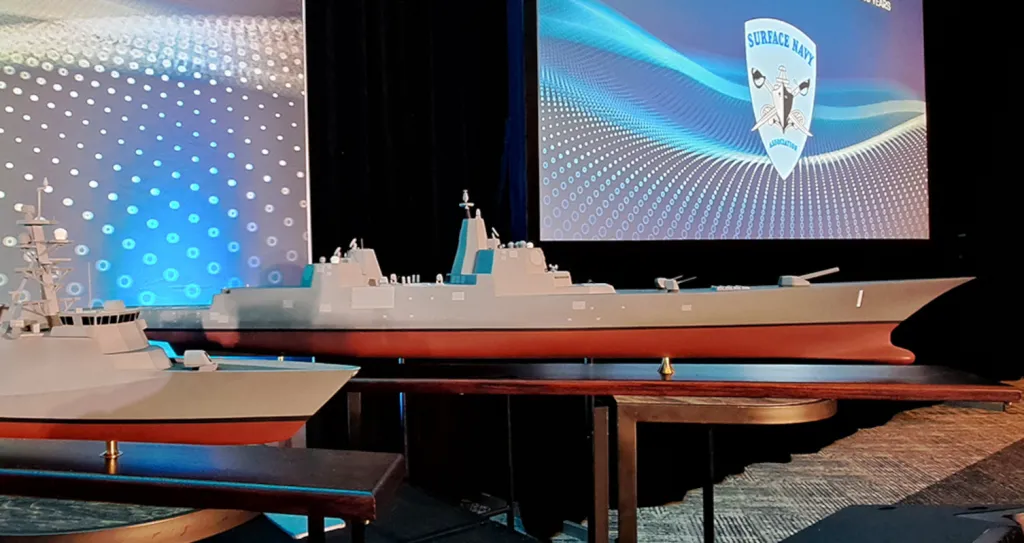
A model of a Trump class battleship. Eric Tegler

“Sir, we walked away from surface nuclear power decades ago, and that was one of the largest mistakes the Navy ever did, and we’re bringing it back,” the Chief of Naval Operations said in response. “We need nuclear-powered surface ships to sustain combat operations with our nuclear-powered aircraft carriers.”

Though a major operator of nuclear-powered submarines, the Navy’s aircraft carriers are currently its only nuclear-powered surface ships. The service previously had a mixture of nuclear-powered surface combatants. This included three one-of-a-kind ships, the cruiser USS Long Beach, the destroyer USS Truxtun (later recategorized as a cruiser), and the frigate USS Bainbridge. There were also two California class and four Virginia class cruisers, the latter not to be confused with the subsequent Virginia class of attack submarines. All of these ships entered service in the 1960s and 1970s. Expensive and complex to operate compared to similar conventionally-powered ships, they were all retired in the 1990s as part of post-Cold War drawdowns across the U.S. military.

A trio of nuclear-powered Navy surface warships sail together in 1964. From left to right, the aircraft carrier USS Enterprise, the cruiser USS Long Beach, and the frigate USS Bainbridge. USN

As Caudle highlighted, the central benefit of nuclear propulsion is functionally unlimited range since naval reactors can operate for decades without needing to be refueled. In the context of modern ships packed with ever-more advanced weapons and other systems, it can also offer an important boost in onboard power generation. As noted, this does come at a cost. Today, Russia is the only country anywhere in the world with a nuclear-powered surface combatant, the Kirov class battlecruiser Admiral Nakhimov. In terms of nuclear-powered surface naval ships of any kind, the French aircraft carrier Charles de Gaulle is the only other example. Russia also has several nuclear-powered icebreakers, but these are operated by the state-run nuclear company Rosatom.

“Imagine what that would have looked like in the Arabian Gulf if I’d had a nuclear-powered battleship there to give the air and defense and fires [sic] power that it could sustain – rotate ships that roll, that need gasoline around it,” Caudle continued today in his response to Rep. McGuire’s question. “So the imperative for this is crucial to develop that level of payload capacity.”

Navy officials have already acknowledged that Iranian attacks on friendly countries in the Middle East in the course of recent operations significantly disrupted established logistics chains. In particular, this impacted how the service delivered fuel to conventionally-powered warships in the region, as you can read more about here.

Threats to fuel supplies would be something the Navy would have to take into account in any future conflict, especially a high-end fight against China across the broad expanses of the Pacific. There are other logistics requirements that nuclear ships do still have in common with their conventionally-powered counterparts, as well, such as food for the crew and fuel for any embarked aircraft. Even with nuclear propulsion, maintenance and other requirements mean that ships cannot stay at sea indefinitely.

One of the US Navy’s conventionally-powered Arleigh Burke class destroyers receives fuel during a replenishment-at-sea operation. USN

“We intend to, with all we can do, use pull-through technologies, [including] things from that we’ve worked on with DDG(X),” the Navy’s top officer added, speaking about the plans for the Trump class specifically. “It will have the SPY-6 radar. It will have the Baseline 10 Aegis combat system. It will pull through, of course, the A1B Ford class reactor plant and all the design that goes with that. The only thing inherently new to it will be the actual hull itself, and so most of the fixtures in it. And I would say the directed energy [weapons] and up gunning, that will also be new.”

Caudle had first shared the A1B reactor detail at another budget-related hearing earlier this week. It was previously known that the Trump class battleship program would leverage prior work done in relation to the now-defunct DDG(X) next-generation destroyer.

Multiple types of laser-directed energy weapons, as well as an electromagnetic railgun, are core elements of the planned armament package on the future Trump class warships. They are also set to be loaded with a mix of nuclear and conventional missiles, including hypersonic types, in several large vertical launch system (VLS) arrays, and have a pair of traditional 5-inch naval guns.

An annotated graphic highlighting various capabilities set to be found on the Trump class design. Note that the mention here of “28 Mk 41 VLS” cells appears to be a typo, as other official information from the US Navy says the ships will have 128 such cells. USN via USNI News

The Navy has previously stated that the battleships, now also referred to as BBGNs, will displace approximately 35,000 tons. This is very roughly three times that of the newest Flight III subvariant of the Arleigh Burke class destroyer. The Trump class vessels are expected to be between 840 and 880 feet long, have a beam (the widest point in the hull) between 105 and 115 feet, and be able to reach a top speed greater than 30 knots, as well.

It is worth noting here that Caudle’s comments today represent a huge change in tone from how he had previously talked about the prospect of nuclear propulsion for the Trump class. Speaking to the press at the Surface Navy Association’s (SNA) main annual symposium back in January, he had notably appeared to downplay the possibility.

“I think it’s a logical question to think, hey, here’s a big capital ship. It’s going to be carrying a lot of load, you know, in places that we don’t necessarily need a strike enforcement air wing as a large ship there that’s in command of a flotilla,” he said at that time. “Wouldn’t it be logical to be nuclear powered? And that brings a tail to the construction of that that [sic] just really fell outside the scope of what we want to do on the speed to get this thing in the water. And so what you trade off with, with persistency that only nuclear power can do, is you end up having, you know, the ability to go produce that — it pushes the battleship into a timeframe that just didn’t meet the operational need of the ship.”

A rendering of a future Trump class battleship. White House/USN

Just last month, former Secretary of the Navy John Phelan had also said making the Trump class ships nuclear-powered was unlikely, citing the need to balance cost and complexity against aggressive schedule demands. Phelan was fired unexpectedly just two days after making those comments. There have been reports that disagreements over plans for the battleships, specifically, as well as other friction within the Trump administration, factored into his dismissal.

“He’s a very good man. I really liked him, but he had some conflict with, not necessarily with [Secretary] Pete [Hegseth], but with some other[s],” President Trump said about Phelan while speaking to the press on April 23. “He’s a hard charger, and he had some conflicts with some other people, mostly as to building and buying new ships. I’m very aggressive in the new shipbuilding.”

BREAKING: President Trump speaks about the firing of Navy Secretary John Phelan:

“He’s a very good man. I really liked him, but he had some conflict, not necessarily with Pete. He’s a hard charger, and he had some conflicts with some other people, mostly as to building and… pic.twitter.com/xJOhYygka4

— Fox News (@FoxNews) April 23, 2026

As it stands now, the Navy still does not expect to order the first Trump class battleship until Fiscal Year 2028 and or see that ship enter service before Fiscal Year 2036. The first example, at least, currently has an estimated unit cost of around $17 billion, which is considerably more than the projected price tag of any of the next four Ford class aircraft carriers.

Even before the nuclear propulsion decision was announced, TWZ had raised numerous questions about the plans for these warships, including their exact operational utility, as well as the costs and risks involved. Caudle’s comments today about leveraging pull-through notwithstanding, nuclear-powered ships are inherently complex and expensive, which are the tradeoffs for the aforementioned boost in capability. A specialized workforce and supply chains are required to build such vessels. Newport News Shipbuilding in Virginia, a division of Huntington Ingalls Industries, is the only yard in the United States currently building surface ships with nuclear propulsion, in the form of new Ford class carriers, all of which have suffered delays.

Enterprise (CVN 80) Construction Update thumbnail

Enterprise (CVN 80) Construction Update


There are two more yards in the country that make nuclear-powered submarines, both of which are already under strain to meet Navy demands. There is a particular need to keep on schedule with the new Columbia class nuclear-powered ballistic missile submarines to avoid any gap in capacity when it comes to the sea leg of America’s nuclear deterrent triad. Additional plans now to supply Virginia class submarines to the Royal Australian Navy, which Adm. Caudle said today he vehemently supports, can only further add to that workload.

The U.S. naval shipbuilding industry, collectively, has other demands to keep churning out conventionally-powered warships like Arleigh Burke class destroyers, as well. This is an industry that has contracted to a worrisome degree, overall, since the end of the Cold War, especially when compared to the completely opposite trend that has been observed in China. Efforts to reinvigorate America’s shipyards, and the continued challenges the Navy is facing in doing so, were key points of discussion at today’s House Armed Services Committee hearing.

Adm. Caudle’s broad statement of support today for a nuclear-powered surface Navy raises the additional question now of whether the service might be interested in expanding this capability beyond the Trump class. Some of the Navy’s prior nuclear-powered surface combatants were derived from conventionally-powered designs. At the same time, any such decision would run up against the same shipbuilding capacity and other questions facing the new battleships.

Just when it comes to the Trump class, the plans for the ships could easily still evolve further, or even come to an end entirely. The timeline laid out now has the battleship program continuing well into the next presidential administration, where the fortunes of a new nuclear-powered surface navy could change dramatically.

Contact the author: joe@twz.com
Joseph has been a member of The War Zone team since early 2017. Prior to that, he was an Associate Editor at War Is Boring, and his byline has appeared in other publications, including Small Arms Review, Small Arms Defense Journal, Reuters, We Are the Mighty, and Task & Purpose.


Source link

Trump Class Battleships Will Be Nuclear Powered (Updated)

The U.S. Navy says its future Trump class battleships are now set to be nuclear-powered. This is a huge development that will impact the cost and complexity of the design. With those issues in mind, now-former Secretary of the Navy John Phelan had said this was “unlikely” to happen just four weeks ago.

The Navy announced its intention to fit a nuclear propulsion system to the Trump class warships in its latest annual shipbuilding plan, which was released earlier today. The document also refers to these future large surface combatants as BBGNs, or nuclear-powered (N) guided-missile (G) battleships (BB). USNI News was first to report on this development.

A model of the Trump class design on display at the Surface Navy Association’s (SNA) annual symposium in January 2026. Eric Tegler

The only nuclear-powered surface vessels in the Navy’s fleet today are its Nimitz and Ford class aircraft carriers. The service has not had a nuclear-powered surface combatant since the 1990s, when the one-of-a-kind cruiser USS Long Beach and frigate USS Bainbridge, as well as four Virginia class cruisers (not to be confused with the subsequent Virginia class of attack submarines) left active duty. Nuclear propulsion offers functionally unlimited range, as well as a major boost in onboard power generation. It also comes with cost and complexity, in terms of a ship’s core design, and what it takes to operate and maintain it. We will come back to those issues later on.

The Navy has now outlined plans to acquire 15 Trump class BBGNs, one virtually every other year, between Fiscal Year 2028 and 2055. Two are also set to be ordered back-to-back in Fiscal Years 2030 and 2031. An initial official estimate has put the price tag of each of these ships at $17 billion. This is more than what the service expects to spend on each of the next three Ford class aircraft carriers, the projected unit costs of which range from roughly $13 to $15 billion.

A chart from the Navy’s latest annual shipbuilding plan laying out the planned schedule for ordering new Trump class battleships, referred to here as BBG(X)s, as well as other vessels. USN

“Our Fleet deserves and our national security requires the most comprehensive capability a surface combatant can provide, not just what we can make do with tradeoffs. The nuclear-powered Battleship is designed to provide the Fleet with a significant increase in combat power by longer endurance, higher speed, and accommodating advanced weapon systems required for modern warfare,” the Navy’s new shipbuilding plan declares. “Adding capability at the highest end of the high- low mix, the Battleship’s primary role is to deliver high-volume, long-range offensive fires and serve as a robust, survivable forward command and control platform, it is not a destroyer replacement.”

The shipbuilding plan highlights various aspects of the planned arsenal on each of the Trump class warships, including its ability to launch a mix of nuclear and conventional missiles, including hypersonic types, loaded into large vertical launch system (VLS) arrays. Each one of the vessels will also have an electromagnetic railgun, a pair of traditional 5-inch naval guns, laser directed energy weapons, and various additional weapons for close-in defense.

An annotated graphic highlighting various capabilities set to be found on the Trump class design. Note that the mention here of “28 Mk 41 VLS” cells appears to be a typo, as other official information from the US Navy says the ships will have 128 such cells. USN via USNI News

“Vastly increased power generation capacity provides warfighting capability across the entire electromagnetic spectrum, including through electronic warfare tools and high-output lasers that allow us to reduce reliance on high-cost single-use munitions for both attack and defense,” the shipbuilding plan also notes. “The internal volume and capability to embark a fleet command staff allows us to take the Maritime Operations Center concept to sea. As a tactical command-and-control platform, the Battleship can lead a Surface Action Group (SAG), integrate its systems with a Carrier Strike Group (CSG) for layered defense, or operate autonomously, possessing the organic capability to defeat advanced threats and distributing our force capability.”

The Navy has said in the past that each of the Trump class warships will displace approximately 35,000 tons, very roughly three times that of the newest Flight III subvariant of the Arleigh Burke class destroyer. They are also expected to be between 840 and 880 feet long, have a beam (the widest point in the hull) between 105 and 115 feet, and be able to reach a top speed greater than 30 knots.

A graphic the Navy previously released detailing the expected specifications of the Trump class design. USN via USNI News

As noted, as recently as four weeks ago, the Navy was pushing back on the idea, at least publicly, that the Trump class warships could be nuclear-powered. The service’s proposed budget for the 2027 Fiscal Year, which was rolled out last month, describes the vessels as non-nuclear BBGs that will feature “diesel generators, gas turbines, [and] propulsion motors.”

“That [the $17 billion estimated unit cost of a Trump class warship] is the early initial estimate. We’ll see where we really settle down as we get through that and start to rationalize some of the costs. So let’s see where we land on that first ship, and then what the economies of scale get us to as we move through it,” former Secretary of the Navy John Phelan had also told reporters at a roundtable on the sidelines of the Navy League’s Sea Air Space 2026 exposition on April 21. “I think a little bit with those numbers, they’re still moving around, because this question is it nuclear-powered, is it not nuclear-powered?”

“It could be [nuclear powered], but it’s unlikely, but it could be,” Phelan said at that time. “I think we’re trying to understand all the proper trade-offs.”

Phelan was fired unexpectedly and with little explanation the following day, with veteran Navy officer Hung Cao taking over as Acting Secretary. On April 23, The New York Times, published a report, citing anonymous sources, saying former Navy Secretary’s sudden exit was tied to disagreements with President Donald Trump over plans for the Trump class battleships, including efforts to accelerate their production and entry into service. There have been reports pointing to other factors in Phelan’s dismissal, including friction with Secretary of War Pete Hegseth, as well.

“He’s a very good man. I really liked him, but he had some conflict with, not necessarily with [Secretary] Pete [Hegseth], but with some other[s],” President Trump himself told members of the press on April 23. “He’s a hard charger, and he had some conflicts with some other people, mostly as to building and buying new ships. I’m very aggressive in the new shipbuilding.”

BREAKING: President Trump speaks about the firing of Navy Secretary John Phelan:

“He’s a very good man. I really liked him, but he had some conflict, not necessarily with Pete. He’s a hard charger, and he had some conflicts with some other people, mostly as to building and… pic.twitter.com/xJOhYygka4

— Fox News (@FoxNews) April 23, 2026

“I think it’s a logical question to think, hey, here’s a big capital ship. It’s going to be carrying a lot of load, you know, in places that we don’t necessarily need a strike enforcement air wing as a large ship there that’s in command of a flotilla,” Chief of Naval Operations Adm. Daryl Caudle also said at a roundtable around the Surface Navy Association’s (SNA) main annual symposium back in January. “Wouldn’t it be logical to be nuclear powered? And that brings a tail to the construction of that that [sic] just really fell outside the scope of what we want to do on the speed to get this thing in the water. And so what you trade off with, with persistency that only nuclear power can do, is you end up having, you know, the ability to go produce that — it pushes the battleship into a timeframe that just didn’t meet the operational need of the ship.”

TWZ has reached out to the Navy for any more information it can offer about when and why the decision was made regarding nuclear propulsion for the Trump class. We have already raised numerous questions about the plans for these warships in the past, including their exact operational utility, as well as the costs and risks involved. As Phelan and Caudle previously indicated, nuclear power can only add to the design’s complexity and up-front price tag, as well as what it will take to operate and maintain the ships once they enter service. These were factors in the Navy’s past decision to move away from nuclear propulsion on surface warships. Russia’s Kirov class battlecruiser Admiral Nakhimov is the only nuclear-powered surface combatant in service anywhere in the world today. Nuclear-powered surface ships of any kind remain a relative rarity globally, as well, even among nuclear powers.

A trio of nuclear-powered Navy surface warships sail together in 1964. From left to right, the aircraft carrier USS Enterprise, the cruiser USS Long Beach, and the frigate USS Bainbridge. USN

The choice now to use nuclear reactors to power the Trump class comes at a time when naval shipbuilders in the United States are already under heavy strain, and have been struggling in many cases to stay on budget and schedule. Newport News Shipbuilding, a division of Huntington Ingalls Industries, is the only yard in the country currently building nuclear-powered surface vessels of any kind, which are the Ford class aircraft carriers. While the USS Gerald R. Ford is in service now, work on subsequent ships in the class continues to be beset by delays and cost growth.

There is also immense pressure on U.S. shipyards that built nuclear-powered submarines. This has been magnified by plans to provide Virginia class boats to the Royal Australian Navy as part of the trilateral Australia-United Kingdom-United States (AUKUS) defense cooperation agreement. The same yards are also responsible for producing the new Columbia class nuclear ballistic missile submarines. Those boats have to be delivered on a tight schedule to ensure there is no gap in the ability of the leg of America’s nuclear triad to meet operational requirements, and there is little, if any, margin left.

The Navy has other shipbuilding plans, as well. Naval shipyard capacity in the United States, or the lack thereof, has been an increasingly worrisome issue for years now, and remains concerning despite U.S. government efforts to reverse the trend in recent years. The Navy’s new shipbuilding plan does underscore the service’s determination to avoid past shipbuilding pitfalls with the new battleships.

“Learning from the lessons of prior shipbuilding programs, the Battleship acquisition plan is a prime example of how we are changing the way the Navy does business. This will be the first clean-sheet surface combatant designed in more than 30 years, and we are deliberately incorporating modern digital engineering, advanced production practices, and AI [artificial intelligence] enabled design tools to reduce cost and schedule risk from the outset,” the shipbuilding plan states. “To strengthen this approach, we are adopting proven best practices from foreign partners with advanced shipbuilding techniques. This includes front loading production engineering to ensure high design maturity before construction begins, using precision modular construction methods, and tightly integrating design, planning, and production teams to minimize rework and accelerate throughput.

Another rendering of the future Trump class battleship design. USN

“We are also applying long term production planning, rigorous process control disciplines, and deeper supplier integration to stabilize the industrial base and improve quality across distributed construction sites. Modeled on commercial shipbuilding, this digital-first approach will accelerate design, reduce manual rework, and create a direct link between design and production,” it continued. “The Battleship will employ a highly modular architecture that enables distributed construction across the industrial base while allowing U.S. shipyards to focus on final assembly, integration, and testing. This strategy strengthens workforce stability, increases industrial base resilience, and delivers a more predictable, affordable path to fielding the capability.”

As it stands now, the Navy is still planning to order the first Trump class warship, set to be named USS Defiant, in Fiscal Year 2028. The current expectation is that it will not enter service until Fiscal Year 2036. This underscores an additional point that the program will carry over into the next presidential administration (and potentially beyond). Further major changes could well be made to its scale and scope, or it could be outright cancelled, in that timeframe.

For now, at least, the Navy has settled on its future Trump class battleships being powered by nuclear reactors.

Update: 5/12/2026 –

A U.S. Navy official has now provided the following statement in response to TWZ‘s queries for more information about the decision to use nuclear propulsion on the Trump class battleships:

The Battleship requirements entail the appropriate balance of survivability, lethality, affordability, endurance, operational flexibility, and industrial feasibility. The FY27 Navy Shipbuilding Plan’s inclusion of a nuclear-powered Battleship will provide the Fleet with a significant increase in combat power by longer endurance, higher speed, and accommodation of advanced weapons systems required for modern warfare.

Contact the author: joe@twz.com

Joseph has been a member of The War Zone team since early 2017. Prior to that, he was an Associate Editor at War Is Boring, and his byline has appeared in other publications, including Small Arms Review, Small Arms Defense Journal, Reuters, We Are the Mighty, and Task & Purpose.


Source link