base

US and UK pulling some personnel from Qatar military base

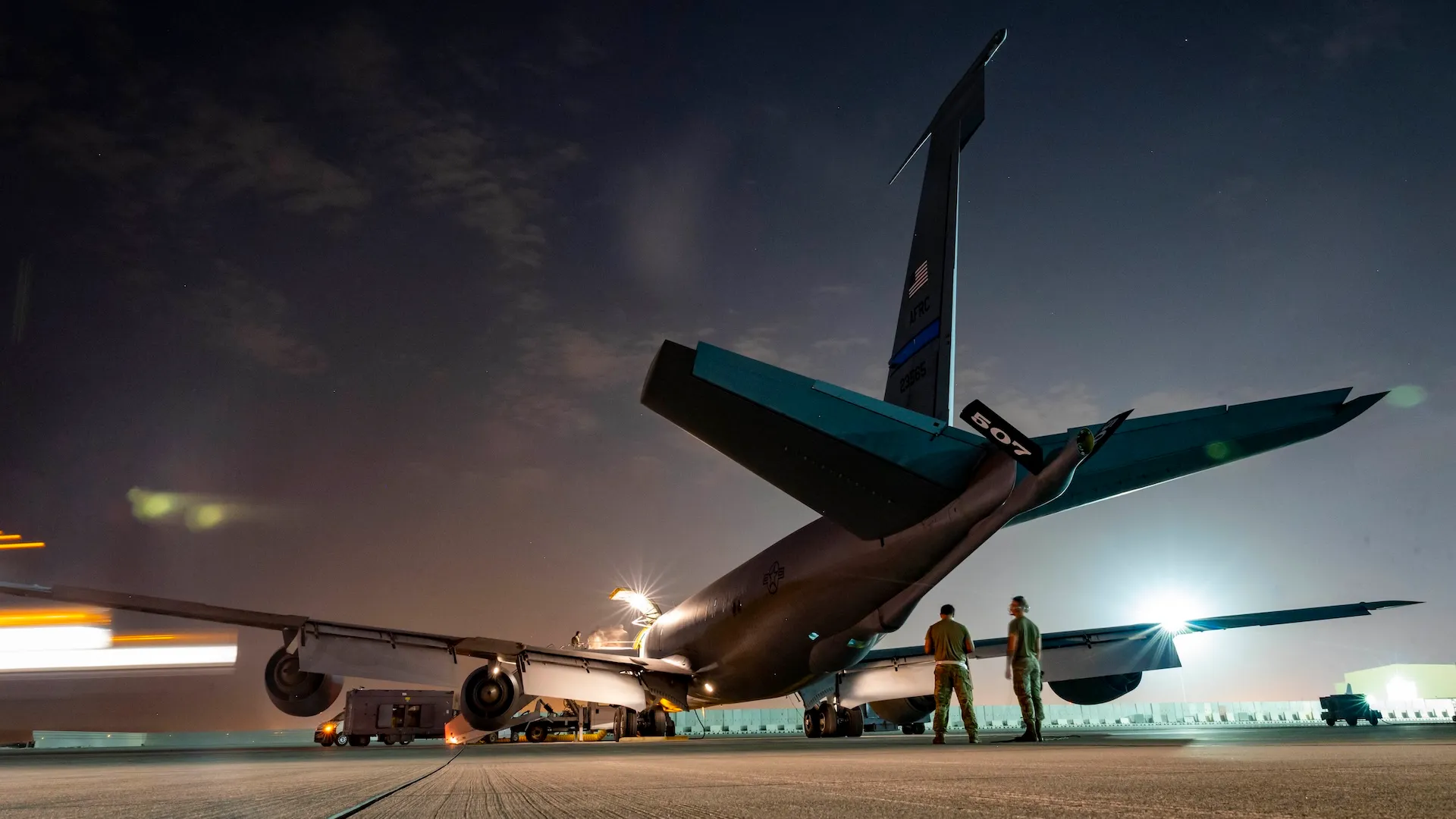
TSGT Scott Reed, USAF Aerial view of the Tanker Ramp at Al Udeid Air BasevTSGT Scott Reed, USAF

Al-Udeid is the largest US military base in the Middle East

The US and UK are reducing the number of personnel at the Al-Udeid air base in Qatar, as US President Donald Trump considers whether to take action against Iran over its crackdown on anti-government protests.

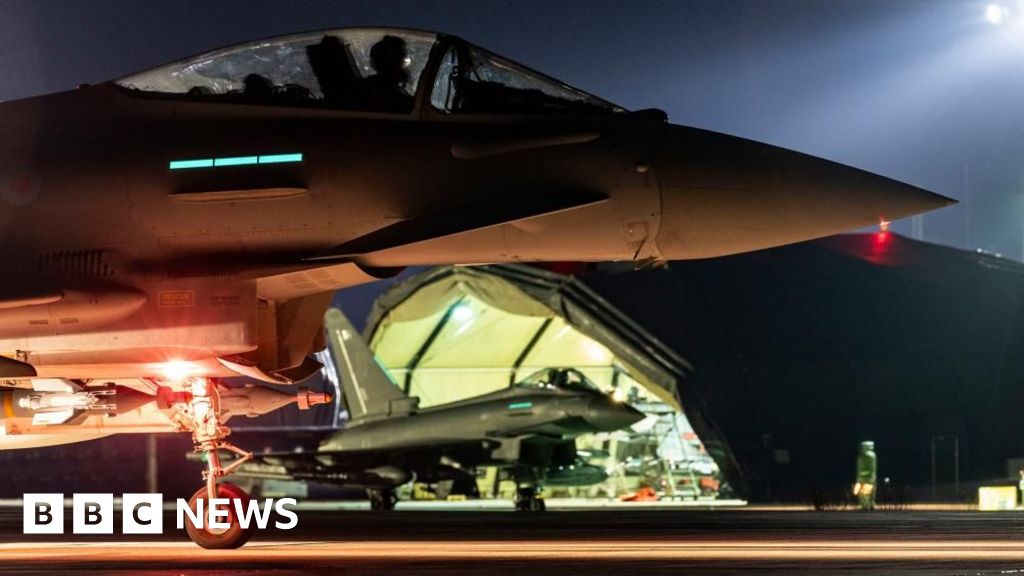
Officials have told CBS, the BBC’s US partner, that the partial American withdrawal was a “precautionary measure”. The BBC understands some UK military personnel are also being removed.

A Qatari government statement said the measures reportedly being taken by the US were “in response to the current regional tensions”.

The Foreign Office has also temporarily closed the British embassy in Tehran, which will now operate remotely, a government spokesperson said.

The US embassy in Doha has advised its personnel to exercise increased caution and limit non-essential travel to the Al-Udeid air base.

Iran closed its airspace from 02:45 local time (22:15 GMT) on Thursday, according to the US Federal Aviation Administration’s website.

The closure was initially due to last two hours, but was later extended to 08:00 local time (03:30 GMT), according to the Reuters news agency.

Several airlines have announced they will reroute flights around Iran in response, including Air India and Germany’s Lufthansa.

Air India warned that passengers could experience delays or cancellations as flights through the region were rerouted. Lufthansa issued a statement confirming its flights would avoid Iranian and Iraqi airspace “until further notice”.

According to rights groups, more than 2,400 anti-government demonstrators have been killed in the recent violent crackdown by the Iranian authorities.

Regarding the removal of military personnel, the Qatari government said it would continue to “implement all necessary measures to safeguard the security and safety of its citizens and residents as a top priority, including actions related to the protection of critical infrastructure and military facilities”.

A UK Ministry of Defence spokesperson declined to comment on reports that UK personnel were being withdrawn “due to operational security”.

Al-Udeid is the largest US military base in the Middle East and about 10,000 personnel are based there, as well as about 100 UK staff. It is not clear how many will be leaving.

Earlier this week, Trump warned the US would take “very strong action” against Iran if the authorities execute protesters. Iran has said it will retaliate if attacked by the US.

On Wednesday, he said his administration had been told “on good authority” that “the killing in Iran is stopping, and there’s no plan for executions”.

When questioned by a reporter, Trump said that these were “very important sources on the other side” and that he hoped the reports were true.

The US president was also asked whether military action was now off the table, to which he replied: “We’re going to watch and see what the process is.”

Al-Udeid Air Base in Qatar

The Reuters news agency, citing diplomats, reported that while some personnel had been told to leave the Al-Udeid air base, there was no immediate sign of large numbers of troops being bussed out like in the hours before an Iranian strike last year.

Speaking to Fox News on Wednesday, Iran’s Foreign Minister Abbas Araghchi warned Donald Trump to “not repeat the same mistake that you did in June,” adding: “You know, if you try a failed experience, you will get the same result.”

The minister also spoke to the reports of a 26-year-old man who had been sentenced to death in Iran, telling the media outlet that “hanging is out of the question” and there would be “no hanging today or tomorrow”.

As well as the temporary closure of the British embassy in Tehran, the US Mission to Saudi Arabia has advised its personnel and citizens to “exercise increased caution and limit non-essential travel to any military installations in the region”.

Italy and Poland have published statements urging their citizens to leave Iran, while Germany has issued a notice to air operators recommending that flights do not enter Tehran, citing potential risk from “escalating conflict and anti-aviation weaponry”.

Iran’s government has accused the US of seeking to “manufacture a pretext for military intervention”, with the parliament speaker warning that if the US attacked, both Israeli and US military and shipping centres in the region would become legitimate targets.

The latest protests in Iran began at the end of December following the collapse of the currency and as the country deals with soaring living costs.

They quickly widened into demands for political change and became one of the most serious challenges to the clerical establishment since the 1979 Islamic revolution.

The US-based Human Rights Activists News Agency (HRANA) said it had so far confirmed the killing of 2,403 protesters, as well as 12 children, despite an internet blackout. More than 18,434 protesters have been arrested during the unrest, the group also reported.

Amnesty International said there were “mass unlawful killings committed on an unprecedented scale”, citing “verified videos and credible information from eyewitnesses in Iran”.

The organisation urged UN member states to recognise the “crimes committed by security forces” in the protests.

Source link

Destruction Seen At Caracas Base That Was A Focus Of The U.S. Military Operation

Details are still emerging about the U.S. operation to capture Venezuelan dictator Nicolas Maduro, an effort known as Absolute Resolve. We now have access to satellite imagery that provides an intriguing look at some of the key targets that were struck by the U.S. military during the operation, which are also indicative of the precision of the weapons employed.

You can catch up with our previous rolling coverage of the operation here.

At this point, we do not know for sure where Maduro and his wife were taken from. One very strong possibility is the major military complex at Fuerte Tiuna, in the Venezuelan capital, Caracas. This is widely reported to accommodate a Maduro compound, and Venezuelan ruling party leader Nahum Fernández told The Associated Press that Maduro and his wife were there when they were captured. U.S. President Trump said the couple was in “a house that was more like a fortress,” which would also fit the description. Certainly, there were U.S. airstrikes concentrated at Fuerte Tiuna, as seen in the satellite imagery that follows in this article.

In terms of the platforms that carried out airstrikes, the Pentagon has confirmed that assets involved included F-22s, F-35s, F/A-18s, EA-18s, and B-1 bombers, as well as numerous drones, any of which could have been delivering munitions. Meanwhile, helicopters of the U.S. Army’s 160th Special Operations Aviation Regiment spearheaded the operation to capture Maduro. It appears that a Night Stalker MH-60 and possibly more rotorcraft may have touched down at or near Fuerte Tiuna.

In our early reporting, we looked at just some of the peculiar fortified locations on the base grounds at Fuerte Tiuna.

Man… there is some very ‘interesting’ features at this base pertaining to what is built into the hillside.

— Tyler Rogoway (@Aviation_Intel) January 3, 2026

This military installation is a known center of gravity for the Venezuelan military, and it has some unique features, including bunkers/tunnels built into the side of the mountain it butts up against. Three examples of the unusual constructions at Fuerte Tiuna are seen in the images immediately below that were taken over the years, long before the operation:

Google Earth
Google Earth
Google Earth

The view of Fuerte Tiuna dated December 22, seen below, shows the site as it looked before the raid:

Satellite image ©2026 Vantor

In the satellite image below, dated January 3, we see the aftermath of the U.S. operation at Fuerte Tiuna, in particular, toward the top of the picture, where U.S. strikes clearly destroyed three long buildings that were part of an original group of six. We can also see significant destruction at an adjacent site, to the left, which is partially surrounded by forest, and is claimed by some unverified sources to have been close to the partly concealed entrance to the Maduro compound.

Satellite image ©2026 Vantor

Reportedly, these U.S.-made Dragoon 300 armored fighting vehicles (essentially a scaled-up version of the V-150 Commando) were among those damaged at Fuerte Tiuna.

Damaged Venezuelan Dragoon 300 APC at Fort Tiuna following US airstrikes, January 3, 2026.

Note that the vehicle has been modified into similar configuration to Cadillac Gage V-100 Commandos.

2026 United States strikes in Venezuela pic.twitter.com/ThfPnqdC5m

— Buschlaid (@BuschModelar) January 3, 2026

The 312th “Ayala” Armored Cavalry Battalion of the Venezuelan Army appears to have had all of its equipment and most of its armored vehicles entirely destroyed in last night’s strike operation by the United States, which heavily targeting the Fuerte Tiuna Military Complex in the… pic.twitter.com/VXmVHRK4ha

— OSINTdefender (@sentdefender) January 3, 2026

This next image, also from December 22, provides an even closer pre-strike view of the same area:

Satellite image ©2026 Vantor

Next, we can see another close-up view, this time from after the raid, with the three long buildings clearly knocked out. The scale of the damage means that we cannot immediately identify what kind of equipment the buildings contained, although at least some military vehicles can be seen destroyed.

Satellite image ©2026 Vantor

The same area is seen below in even greater detail, in an image dated December 22. At least six green-painted military trucks can be made out, as well as a handful of apparently civilian-looking semi-trailers, and around a dozen apparent cargo containers.

Satellite image ©2026 Vantor

The next image provides a post-strike view of the same area, providing a better idea of the scale of destruction, consistent with an airstrike, presumably involving some kind of submunitions, since no obvious large craters are visible.

Satellite image ©2026 Vantor

Now we move to another part of Fuerte Tiuna, namely the area that is partly surrounded by forest. The area is seen here as it appeared on December 22. The primary targets in this particular location are revealed as the two red-roofed storage buildings, one somewhat longer than the other. The shortened building reveals the presence of what look like relatively long trucks or possibly semi-trailers. These may well be associated with air defense systems, which we know were among the main targets of the U.S. airstrikes.

Satellite image ©2026 Vantor

For comparison, this is the same partly wooded area as it appeared today, with extensive destruction evident. The two red buildings and their contents are entirely destroyed.

Satellite image ©2026 Vantor

U.S. forces also targeted what are understood to be gate security buildings at the complex, which can be seen below in another image dated December 22. These buildings were located on a bend in the road, in a wooded area. They may also be another entrance into an underground area.

Satellite image ©2026 Vantor

As of January 3, those same gate security buildings are entirely obliterated:

Satellite image ©2026 Vantor

The final image we have received shows Palacio Miraflores, also in Caracas, as it appeared on January 1. This is the head office of the President of Venezuela. It is located on Urdaneta Avenue, in the Libertador Bolivarian Municipality, and is another, less likely option as to where the Venezuelan leader was seized.

The building was among the targets struck by U.S. forces, in line with early reporting of the operation. Soon after it had begun, videos emerged showing armored vehicles in position, protecting nearby roads. In the event, Maduro may well not have been home, but instead located in the presumed safer location at Fuerte Tiuna.

Satellite image ©2026 Vantor

A V-150 “Commando” Armored Wheeled-Gun with the Venezuelan Army spotted near Miraflores Presidential Palace in the capital of Caracas. pic.twitter.com/ToYWjTRlMn

— OSINTdefender (@sentdefender) January 3, 2026

For now, we still await much more information to provide a better understanding of how Maduro was captured, and from where, exactly.

What is already clear is that this was a meticulously planned and extremely complicated operation involving multiple assets and agencies, fought across various domains, with many more facets of it still to be revealed.

Contact the author: thomas@thewarzone.com

Thomas is a defense writer and editor with over 20 years of experience covering military aerospace topics and conflicts. He’s written a number of books, edited many more, and has contributed to many of the world’s leading aviation publications. Before joining The War Zone in 2020, he was the editor of AirForces Monthly.


Source link

A Filipino tribe fights to stay as a ‘Smart City’ rises on a former US base | Indigenous Rights News

Sapang Kawayan, Philippines – Two hours north of the capital, Manila, on the vast grounds of a former United States military base, the Philippine government is pushing ahead with plans for a multibillion-dollar “smart city” that President Ferdinand Marcos Jr hopes to turn into a future “mecca for tourists” and a “magnet for investors”.

The New Clark City, which is being built on the former Clark Air Base, is central to the government’s effort to attract foreign investment and ease congestion in Manila, where nearly 15 million people live.

Recommended Stories

list of 4 itemsend of list

To accompany the city’s development, the government has also laid out an ambitious slate of projects at a nearby airport complex — new train lines, expanded airport runways, and a $515m stadium that officials hope will be enticing enough to draw the global pop singer Taylor Swift.

Caught between the rising new city and the site of the proposed stadium lies the Indigenous Aeta village of Sapang Kawayan. For the roughly 500 families who live there, in houses of nipa grass and rattan, the developments spell disaster.

“We were here before the Americans, even before the Spanish,” said Petronila Capiz, 60, the chieftain of the Aeta Hungey tribe in Sapang Kawayan. “And the land continues to be taken from us.”

Historians say American colonisers, who seized the Philippines from Spain in 1898, took over the 32,000-hectare (80,000-acre) tract that became Clark Air Base in the 1920s, dispossessing the Aetas, a seminomadic and dark-skinned people thought to be among the archipelago’s earliest inhabitants.

Many were displaced, though some moved deeper into the jungle inside the base and were employed as labourers.

The US turned over the base to the Philippine government in 1991, some four decades after granting the country independence. Since then, the Bases Conversion and Development Authority, or BCDA, has managed the complex. Some 20,000 Aetas are thought to remain in the Clark area today, spread across 32 villages.

But most of their claims to the land are not recognised.

In Sapang Kawayan, residents fear the government’s development boom means they could be pushed out long before they can establish such claims. The community – along with other Aeta villages in Clark – is working with researchers from the University of the Philippines to expedite a long-pending application for a Certificate of Ancestral Domain Title, or CADT — the only legal mechanism that would allow them to assert rights to their territory and its resources.

In January, July and September, Aetas young and old gathered under makeshift wooden shelters in Sapang Kawayan, assembling family trees and sharing stories and photographs. Volunteers documented each detail in hopes of demonstrating that the community there predates colonial rule.

Their 17,000-hectare claim overlaps with nearly all of the 9,450 hectares designated for New Clark City, while 14 kilometres to the south is the airport complex where the new railway line, runway and stadium are slated to rise.

Together, the new city and airport complex “will eat up the fields where we farm, the rivers where we fish and the mountains where we get our herbs”, Capiz said.

As part of a requirement to claim their ancestral lands, the Aeta Hungey gather in the village of Sapang Kawayan to trace their genealogy back hundreds of years ago.
Aetas work with researchers at the University of the Philippines to expedite their application for an ancestral land title [Michael Beltran/Al Jazeera]

‘Taylor Swift-ready’

The Philippine government first announced plans for New Clark City under then-President Rodrigo Duterte, promoting it as a solution to the crippling congestion in Metro Manila. The BCDA describes the development as a “green, smart and disaster-resilient metropolis”.

Construction began in 2018 with major roads and a sports complex that hosted the Southeast Asian Games in 2019.

Designed to accommodate 1.2 million people, the city is expected to take at least 30 years to complete.

The BCDA is now building three highways linking New Clark City to the airport complex, where the “Taylor Swift–ready” stadium is planned. Officials have hyped that the stadium, to be built by 2028, will lure Swift after she skipped the Philippines during the South Asian leg of her Eras tour last year.

“One of the main elements that make Clark so attractive to investors is its unmatched connectivity,” the BCDA’s president, Joshua Bingcang, said this year, citing the airport, a nearby seaport and major expressways. “But we need to further build on this connectivity and invest more in infrastructure.”

That expansion has come at a cost for Aeta communities.

Counter-Mapping PH, a research organisation, and campaigners estimate that hundreds of Aeta families have been displaced since construction of the city began, including dozens of families who were given just a week in 2019 to “voluntarily” vacate ahead of the Southeast Asian Games.

They warn that thousands more could be uprooted as development continues.

The BCDA has offered financial compensation of $0.51 per square metre as well as resettlement for affected families. In July, it broke ground on 840 housing units, though it is unclear whether they are intended for displaced Aetas.

The agency maintains that no displacement has occurred because Aetas have no proven legal claim to the area. In a statement to Al Jazeera, the BCDA said it “upholds the welfare and rights of Indigenous peoples” and acknowledges their “long historical presence” in central Luzon, where Clark is located. However, it noted that Clark’s boundaries follow “long-established government ownership” dating to the US military base, and that the New Clark City does not encroach on any recognised ancestral domains.

The BCDA also contended that it is the National Commission on Indigenous Peoples (NCIP) that deals with the applications for a Certificate of Ancestral Domain Title, and stressed that it respected “lands awarded to Indigenous peoples”.

The Clark International Airport Corporation, which oversees the airport complex, offered similar assurances, stating that “there are no households or communities existing in the said location”. The group added that while the extended Clark area has Aeta communities, none exist within the airport complex itself.

Labourers work on buildings in the games village for this year's Southeast Asian Games (SEA Games) in New Clark City in Capas town.
Labourers work on buildings in the games village for the Southeast Asian Games (SEA Games) in New Clark City in Capas town, Tarlac province, north of Manila, on July 19, 2019 [Ted Jibe/AFP]

‘Since time immemorial’

Only a handful of Aeta tribes have been awarded CADTs.

Two certificates have been granted on the outskirts of Clark, while the application filed by Sapang Kawayan and other villages inside the base have languished since 1986.

Marcial Lengao, head of NCIP’s Tarlac office, told Al Jazeera that to grant Aetas in Clark a CADT they must “prove that they have been there since time immemorial”, meaning, during or before the arrival of the Spanish colonisers to the archipelago 400 years ago.

The commission, he said, specifies minimum requirements for a CADT: a genealogy of at least five clans dating back at least three generations or to the precolonial period, testimonies from elders, a map of the domain and a census of the current population.

Lengao said Sapang Kawayan’s application has yet to complete these.

But even if the application is granted, the village faces another unique hurdle. Because the BCDA owns land rights to Clark, any CADT approved by the commission in the area must then be deliberated by the executive branch or the president’s office.

“They will be responsible for finding a win-win solution,” Lengao said.

Activists, however, denounced the NCIP’s requirements as onerous and warned that the longer Aetas remain without a CADT, the more vulnerable they are to losing their lands.

“Without a CADT and without genuine recognition from the government, the Aetas will continue to be treated like squatters on their own land,” said Pia Montalban of Karapatan-Central Luzon, a local rights group.

‘Among the most abused Indigenous Filipinos’

The Aetas, who rely on small-scale subsistence farming, are among the most historically disenfranchised Indigenous peoples in the Philippines. No official data exists on the Aeta population, but the government believes them to be a small subset of the Philippines’s Indigenous peoples, numbering in the tens of thousands nationwide.

The Aeta Tribe Foundation describes them as among the “poorest and least educated” groups in the nation.

“They are among the most abused Indigenous Filipinos,” said Jeremiah Silvestre, an Indigenous psychology expert who worked closely with Aeta communities until 2022 while teaching at the Tarlac State University. “Partly because of their good-natured culture, many have taken advantage of Aetas. Worse, they live off a land that is continuously taken from them.”

Silvestre, too, described the CADT process as “unnecessarily academic”, saying it required Indigenous elders to present complete genealogies and detailed maps to government officials in what he likened to “defending your dissertation”.

Changes in government personnel can restart the entire process, he noted.

A World Bank report last year found that Indigenous peoples in the Philippines “often face insurmountable bureaucratic hurdles in their efforts to process CADTs”. The report called recognising and protecting Indigenous land rights a “crucial step in addressing poverty and conflict”.

For the families of Sapang Kawayan, experts fear the lack of formal recognition could lead to displacement and homelessness.

“There’s no safety net,” Silvestre said. “We may see more Aetas begging on the street if this continues. Systemic poverty will also mean the loss of an Indigenous culture.”

Victor Valantin, an Indigenous Peoples Mandatory Representative for Tarlac Province, which includes parts of Clark, fears that the territory for the Aetas in the former base is shrinking as the new projects accelerate.

“We’ll have to move and move,” he said. “Shopping centres won’t move for us.”

Valantin went on to lament what he sees as a familiar imbalance.

“BCDA projects happen so fast,” he said. “But anything for us will be awfully slow.”

Source link