Bandar Abbas

U.S., Iran trade attacks; Trump says Iran to pay for ship damage

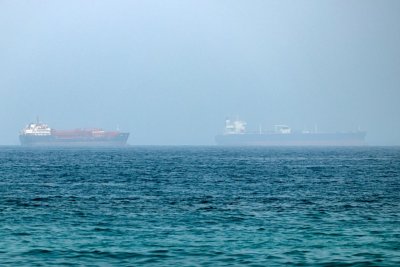
Cargo vessels are seen at one end of the Strait of Hormuz near the coast of Dibba Al Fujairah, United Arab Emirates, on Tuesday. President Donald Trump said Thursday that vessels damaged transiting the strait would be paid from frozen Iranian assets. Photo by EPA

July 24 (UPI) — The United States and Iran traded attacks Thursday night and Friday morning, as President Donald Trump announced that damage inflicted by Iran on ships transiting the Strait of Hormuz would be paid with U.S.-held Iranian assets.

U.S. Central Command said its latest wave of attacks, which were completed at 9 p.m. EDT Thursday, lasted for about two hours, 15 minutes, during which its forces hit Iranian military command centers, drone storage facilities, communications networks, coastal surveillance sites and maritime capabilities.

State-run Islamic Republic of Iran Broadcasting reported explosions early Friday local time across the country, with strikes in Ahvaz, Bandar Abbas, Omidiyeh, Qeshm and Andimeshk. Officials in Bandar Abbas reported that two people were injured.

Explosions were also reported by the IRIB in southern Khorramabad.

The Iranian Army announced retaliatory drone strikes on U.S. bases in Jordan and Bahrain.

Bahrain’s Ministry of Interior said sirens were sounding. It urged residents to remain calm and seek shelter.

The United States has been hitting Iran for nearly a fortnight as it seeks to regain freedom of navigation of the Strait of Hormuz, a vital energy route that Iranian forces have tried to seize amid the war by attacking commercial tankers that try to transit it.

Maritime traffic freely flowed through the Hormuz until the United States and Israel attacked Iran in late February. Iran responded with its maritime blockade of the chokepoint, causing gas prices to spike and threatening nations with an energy crisis.

Mid-June, the United States and Iran signed a memorandum of understanding to lay foundations to end the war, but fighting resumed earlier this month over a dispute over what the agreement meant for control of the strait. Iran says the agreement recognizes its authority over Hormuz transit. Washington says Tehran committed to freedom of navigation.

CENTCOM said Thursday, as it has after the completion of each new wave of attacks, that it was seeking to further degrade Iran’s ability to attack vessels transiting the Hormuz.

“The international waterway remains open for transit despite recent attacks from Iran’s Islamic Revolutionary Guard Corps,” the statement said.

“Commercial vessels continue to free navigate the strait with U.S. military support.”

Late Thursday, President Donald Trump announced online that damage ships incur while traveling the Strait of Hormuz would be paid by for with the hundreds of millions of dollars in Iranian assets that the United States has frozen via sanctions.

“These damages may be very substantial but, nevertheless, this is the fair and equitable thing to do,” he said in a statement.

Iranian Foreign Minister Seyed Abbas Araghchi lashed out in response online, warning the international community that “Seizing another nation’s assets to pay for unrelated future claims is an incendiary precedent.”

“Those who celebrate or profit from such funds should remember: once governments normalize confiscation, no one’s assets are safe,” he said in a statement.

“Ensuing chaos will not be pretty or peaceful.”

Source link

United States strikes Iran for 10th night in a row

Traders work Monday on the floor of the New York Stock Exchange on Wall Street in New York City. Oil prices fluctuated in response to the latest bout of military exchanges between the U.S. and Iran. Later Monday, the United States attacked Iranian sites for the 10th day in a row. Photo by John Angelillo/UPI | License Photo

July 20 (UPI) — The United States launched strikes on Iran for the 10th night in a row Monday as U.S. President Donald Trump said Iran would pay for the deaths of three U.S. service members.

U.S. Central Command posted on social media that a new round of strikes had started, while Iranian media reported explosions heard in several locations, including port areas of Chabahar and Konorak on the southeast coast, Bandar Abbas and Qeshm.

Iranian media also reported possible U.S. attacks on Shiraz, an inland city in the southern part of Iran.

Trump said in a social media post earlier Monday that Iran would pay “many times over” for the deaths of U.S. service members and that he’s passed that directive to Secretary of Defense Pete Hegseth.

Earlier in the day, the Department of Defense identified two U.S. soldiers who were killed Friday by an Iranian strike in Jordan. Another soldier was killed Saturday in Iraq but has not yet been identified, and another is missing.

The Pentagon said Monday that nearly 100 U.S. service members have been injured over the last two weeks. Spokesman Sean Parnell said in a social media post that 96% have returned to duty.

“They are determined to get back in the fight,” Parnell wrote. “The vast majority of injuries experienced were minor concussions.”

Parnell’s statement occurred after reports from both the New York Times and CNN about how the Pentagon has reported injuries to U.S. troops in the Iran war. The Times reported that the Defense Department withheld reports on dozens of injuries to troops. CNN said the U.S. military has been slow to report on injuries, partly due to a military website with a delay in updates.

Iran continued to target countries that host U.S. military bases. The Kuwait military said it was intercepting “hostile” missiles and drones Monday afternoon, part of three rounds of Iranian attacks that day.

“The General Staff of the Kuwaiti Armed Forces confirms that any explosions that may be heard are the result of air defense systems intercepting hostile targets,” the military said in a statement.

Jordan said that it intercepted incoming missiles from Iran on Monday as well. The armed forces said the missiles caused no casualties or damage.

Also Monday, the UK Maritime Trade Operations center, which monitors shipping in the Persian Gulf, northern Indian Ocean and Red Sea, reported that a tanker was struck by a projectile in the Strait of Hormuz.

Source link

Iran says it hit U.S. command center in Syria as Hormuz fight escalates

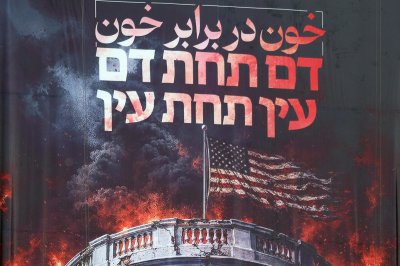
An anti-U.S. billboard that hangs at Palestine Square in Tehran, Iran, features a sentence in Persian that reads “Blood for Blood,” on Thursday. Photo by Abedin Taherkenareh/EPA

July 17 (UPI) — Iran early Friday said it struck a U.S. special operations command center in southeastern Syria, escalating the war over the Strait of Hormuz, as the United States attacked bridges and other urban infrastructure in Iran.

The Islamic Revolutionary Guard Corps described the strike in a statement as a “surprise attack” conducted in retaliation for the seven soldiers killed early Wednesday in a U.S. attack on Bampur, near Iranshahr in southeastern Iran.

The elite military unit claimed to have destroyed a U.S. radar system and several special-operations helicopters. It claimed to have killed “a large number” of Americans.

State-run media reported Iran also attacked U.S. bases and assets in Kuwait and Bahrain in retaliation for the U.S. attacks hours earlier. Islamic Republic of Iran Broadcasting claimed the United States destroyed five bridges around Bandar Abbas near the Strait of Hormuz.

U.S. Central Command said it had completed a “major wave” of attacks on Iran at 9:40 p.m. EDT Thursday. It said it hit dozens of Iranian military targets, including coastal surveillance and air defense sites, military logistics infrastructure and maritime capabilities.

Though CENTCOM made no mention of civilian infrastructure, President Donald Trump on Tuesday warned that the U.S. military would be ramping up its attacks through the week and would include civilian targets, but explicitly stating, “Next week comes the bridges.”

While the war began in late February, with the Trump administration seeking to dismantle Iran’s nuclear weapons program and encourage regime change, this latest chapter is centered on the vital shipping lane of the Strait of Hormuz.

The Trump administration is seeking to restore freedom of navigation through the chokepoint, while Iran is fighting to maintain the leverage afforded by its ability to restrict passage.

Early Friday, the United Kingdom Maritime Trade Operations center said a tanker had been struck by an unknown projectile, causing minor damage to its port side.

“All crew are safe and accounted for,” it said.

The strike is at least the eighth attack on a commercial ship to attack in the Strait of Hormuz in a little over a week.

Source link

U.S., Iran trade attacks for fifth straight day in fight for Hormuz

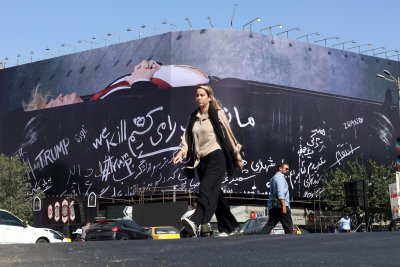
1 of 2 | An Iranian woman on Wednesday walks next to a huge anti-U.S. billboard featuring U.S. President Donald Trump in a coffin, accompanied by a sentence in Persian that reads, “We kill Trump.” It is displayed at the Enghelab Square in Tehran, Iran. Photo by Abedin Taherkennareh/EPA

July 15 (UPI) — The United States attacked Iran on Wednesday, and Iran struck U.S. assets across the region into Thursday morning, marking the fifth straight day of strikes between the two nations as they fight over the Strait of Hormuz.

U.S. Central Command launched two waves of attacks seeking to degrade Iran’s ability to threaten vessels transiting the vital chokepoint between Iran and Oman.

Iran’s Islamic Revolutionary Guard Corps said early Thursday that it was conducting missile and drone strikes targeting U.S. assets at Ali Al Salem Air Base in Kuwait.

“Once again, we remind the honorable people of Kuwait that the United States is committing these crimes against Muslim Iran from your soil,” the elite military unit responsible for protecting Iran’s Islamic regime said in a statement.

The IRGC-aligned Fars News Agency reported early Thursday that U.S. bases and facilities in Bahrain, as well as in Kuwait, were being struck. It separately said it was attacking U.S. assets at the Al-Azraq Base in Jordan.

The extent of potential damage could not be independently verified. However, the Kuwait Army said its air defenses were confronting drone attacks, and the Jordanian Armed Forces said they downed eight Iranian missiles early Thursday. Bahrain’s Ministry of Interior urged residents to find shelter as sirens blared, suggesting an incoming attack.

CENTCOM said in a statement that its second wave ended at 9 p.m. EDT, hitting command centers, air defense sites, coastal surveillance facilities and missile ad drone capabilities.

In announcing the strikes hours earlier, CENTCOM had said they were “targeting Iranian military capabilities used to threaten vessels freely transiting through the Strait of Hormuz.”

“The U.S. military is holding Iran accountable at the commander in chief’s direction,” the post said.

The U.S. attacks followed earlier strikes on Greater Tunb Island in the Strait of Hormuz, a key site for Iran’s coastal defenses and missile storage, during a 90-minute wave. The U.S. military also said it fired on the Curacao-flagged Belma vessel transiting international waters toward Iran.

CENTCOM accused it of violating a military blockade of Iran’s coast that Trump reimposed Tuesday afternoon to deny Iran maritime trade.

The IRGC said Ahvaz, a southwestern Iranian city, had come under U.S. attack, with missiles reportedly hitting near Baghaei Hospital, which treats children with cancer, requiring all but the most ill patients to be transferred to another medical facility.

Iran’s Parliament Speaker Bagher Ghalibaf told state media that Iran had “no reason” to abide by any deal with the United States if it did not benefit from it, but he left the door open for possible diplomacy, stating: “We must utilize diplomacy and negotiation to achieve and stabilize our national interests.”

While the war began in late February with President Donald Trump seeking to dismantle Iran’s nuclear and conventional weapons programs while encouraging regime change, the current chapter of the war is over the Strait of Hormuz. U.S. President Donald Trump is fighting to restore freedom of navigation through the waterway, down which about one-fifth of global energy supplies flow. Tehran is fighting to preserve its ability to restrict passage through the chokepoint as leverage and has previously suggested it could charge vessels that transit it.

The U.S. attacks came as Trump told reporters that Iran’s leaders “better behave” on Wednesday, one day after he threatened that the United States would strike bridges and power plants if Iran did not return to the negotiating table.

“They want to settle so badly,” Trump said later Wednesday at a defense summit in Pennsylvania. “They don’t like what we’re doing, and they do want to settle. We’ll find out whether or not we settle with them or we just finish it off.”

Source link

United States launches fifth straight day of Iran strikes

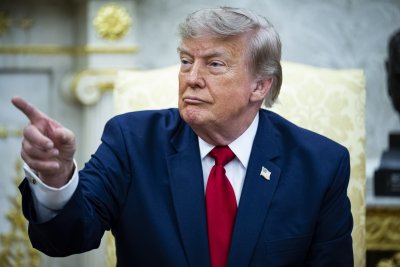
US President Donald Trump is shown Tuesday in the Oval Office of the White House in Washington, D.C. The United States military struck Iran for the fifth straight day Wednesday, with Trump saying Iran’s leaders “better behave.” Photo by Graeme Sloan/UPI | License Photo

July 15 (UPI) — The United States struck Iranian targets again Wednesday evening, marking the fifth straight day of strikes and the second wave that day, as President Donald Trump said Iran’s leaders “better behave.”

U.S. Central Command said in a social media post that the later strikes “are targeting Iranian military capabilities used to threaten vessels freely transiting through the Strait of Hormuz.”

“The U.S. military is holding Iran accountable at the Commander in Chief’s direction,” the post said.

The U.S. attacks followed early strikes on Greater Tunb Island in the Strait of Hormuz, a key site for Iran’s coastal defenses and missile storage, CNN reported. The United States military also said it fired on a ship that tried to violate its blockade of Iran’s ports and “redirected” two other commercial vessels.

Iranian media reported explosions in several areas, including Bandar Abbas and the city of Ahvaz. The state-run Islamic Republic of Iran Broadcasting said Shahid Baghaei Hospital, which is in Ahvaz and treats children with cancer, evacuated families after a U.S. projectile landed nearby, CNN reported.

Meanwhile, Iran said it struck U.S. military targets in Kuwait, Jordan and Bahrain. Iranian negotiator Bagher Ghalibaf told state media that Iran’s leaders had “no reason” to abide by any deal with the United States if the country did not benefit from it, but he left the door open for possible diplomacy. An Iranian Foreign Ministry spokesperson, however, said Iran has no plans for negotiations.

Trump said Wednesday that Iran’s leaders “better behave” as he spoke with reporters, one day after he threatened that the United States would strike bridges and power plants if Iran would not negotiate again.

“They want to settle so badly,” Trump said later Wednesday at a defense summit. “They don’t like what we’re doing. We’ll find out whether we want to settle with them or if we just finish it off.”

Source link

U.S. hits Iranian targets for 2nd night as fears of escalation widen

The United States on Sunday carried out a second night of airstrikes against Iranian targets as their dispute over transit rights in the Strait of Hormuz threatened to escalate beyond the region. U.S. Navy file photo by Mass Communication Specialist Seaman Zoe Simpson

July 12 (UPI) — The U.S. military said late Sunday ithad completed a new wave of attacks against Iran, as world leaders raised fears that a fragile cease-fire would collapse and the conflict could widen beyond the region.

The Sunday attack was the second consecutive night that the United States had attacked Iran and was the fourth round in a week, prompting retaliatory strikes from Tehran against regional U.S. military assets following each operation, as the two sides battle over the vital Strait of Hormuz shipping route.

U.S. Central Command said its forces had completed the wave of strikes, claiming to have hit dozens of targets with precision munitions with the intent to “degrade Iran’s ability to continue attacking international shipping flowing through the Strait of Hormuz.”

Iranian air-defense systems, coastal radar sites, missile and drone capabilities and small boats were among the targets attacked by U.S. fighter jets, naval assets and aerial and sea drones on Sunday, CENTCOM said.

“The Strait of Hormuz is a vital maritime corridor for global trade,” CENTCOM said in a statement.

“Iran does not control it.”

The announcement of the operation’s conclusion came hours after CENTCOM said it had begun and after the U.S. military refuted Iran’s claims that it had closed the vital waterway in response to what it characterized as violations of the 25-day-old U.S.-Iran memorandum of understanding that established the shaky cease-fire.

“The Strait of Hormuz is open to all vessels seeking to lawfully transit the international waterway,” CENTCOM declared. “U.S. forces are positioned and prepared to ensure that freedom of navigation remains available despite unwarranted Iranian aggression, harassment, threats, and arbitrary declarations. Iran does not control the strait.

“Traffic is flowing.”

Late Sunday, Iranian media reported explosions near Sirik and west of Bandar Abbas in the country’s south during the second night of U.S. strikes, which came shortly after Iran’s Islamic Revolutionary Guard Corps targeted what it called American military assets in Qatar, Oman, Bahrain, Kuwait, Jordan and the United Arab Emirates.

As CENTCOM announced the completion of its strikes, state-run Islamic Republic of Iran Broadcasting reported that Iran’s Islamic Revolutionary Guard Corps was targeting U.S. bases in Jordan.

Those attacks drew condemnation from the Gulf states and warnings from world leaders that events were spiraling quickly.

Pakistan’s foreign ministry said it is “following with deep concern the recent incidents that are further escalating the regional tensions.”

Islamabad, which mediated the memorandum of understanding, “reiterates its strong support for the sovereignty and territorial integrity of all brotherly countries in the region, and urges all sides to exercise restraint, take immediate steps towards de-escalation, and uphold respective commitments under the [MOU].”

U.N. Secretary-General António Guterres on Sunday similarly expressed “deep concerns” over what he called a “serious escalation & renewed military confrontations in the Gulf, including the Iranian attacks on ships in the Strait of Hormuz, the attacks by the U.S. on Iran, and the attacks by Iran on targets in the neighboring countries.

“These attacks must all stop,” he said, warning that “a return to full-scale hostilities would have catastrophic consequences — for the peoples of the region, for international peace & security & for the global economy.

“I urge Iran & the U.S. to urgently resume negotiations & to address outstanding issues through diplomacy,” Guterres said.

The fighting comes as the two sides were negotiating the implementation of the MOU, with the Strait of Hormuz appearing to be a sticking point.

The United States resumed striking Iran on Wednesday after Iran attacked three commercial ships in the vital chokepoint. The Trump administration is seeking to regain freedom of navigation through the strait, while Iran seeks to maintain control over ships transiting it.

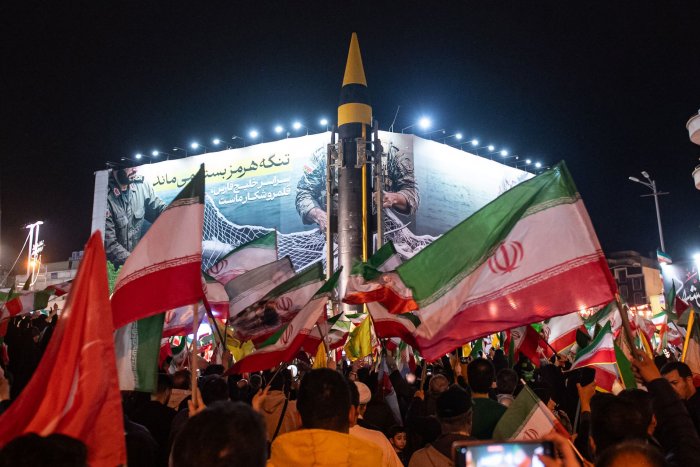
A missile identified as “Khorramshahr-4” was on display during a public rally in Tehran’s Enghelab Square on April 21, 2026. Photo by Behnam Tofighi/UPI | License Photo

Source link

United States strikes Iran again as Trump issues new threats

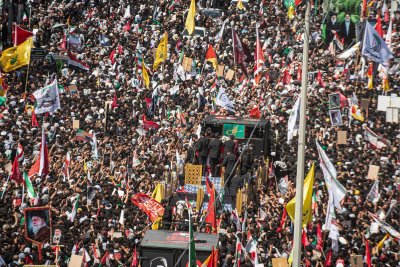
A crowd of mourners gathered around an vehicle carrying the coffin of Iran’s late Supreme Leader Ali Khamenei during the funeral procession Wednesday from Iran to Najaf, Iraq. The funeral convoys bearing Khamenei’s coffin will pass through the holy Iraqi cities of Najaf and Karbala amid renewed U.S. military strikes on Iran. Photo by Behnam Tofighi/UPI | License Photo

July 8 (UPI) — The U.S. military resumed attacks against Iran on Wednesday afternoon “to further degrade their ability to threaten freedom of navigation in the Strait of Hormuz,” U.S. Central Command said.

“The United States is holding Iran accountable for recent unjustified aggression against commercial shipping and civilian crews freely navigating a vital international waterway,” the statement continued.

U.S. President Donald Trump, speaking at a news conference at the end of the NATO summit in Ankara, Turkey, said the United States would resume its naval blockade of Iran. He said further negotiations were “a waste of time” and added “Let’s just finish the job.”

Trump had earlier characterized the resumed strikes as “a little warning,” and said, “We’re going to hit them hard tonight, but we’ll see how it all works out.”

Iranian media reported explosions in the cities of Bandar Abbas and Sirik, which the United States also struck Tuesday, and in the cities of Chabahar and Konarak on Iran’s southern coast. Sources said Iran’s Bushehr nuclear power plant did not sustain any damage.

U.S. Defense Secretary Pete Hegseth said Wednesday that the Pentagon would strike Iran “even more and even deeper” if Trump said the word.

Earlier Wednesday, Trump called Iran’s leaders “scum” and “vicious, violent people.”

Iranian Foreign Minister Abbas Araghchi said that addressing Iran with “derogatory language” does not diminish it.

“Iranians are known for their civility, culture and strong moral values,” he said in a social media post. “We do not answer vulgarity with vulgarity, but with action: fearlessly and with great valor.”

Tuesday’s attacks lasted about four hours and struck more than 80 targets, U.S. Central Command said. The attacks came after Iran attacked three commercial ships in the Strait of Hormuz.

The United States also reimposed sanctions on Iranian oil sales in retaliation for the attacks. Iran said the sanctions were “in clear violation” of the memorandum of understanding to end the conflict between Iran and the United States that was signed in June.

Source link

United States launches new strikes against Iran, reimposes sanctions

July 7 (UPI) — The U.S. military said late Tuesday that it struck dozens of targets in Iran in response to Iran attacking three ships in the Strait of Hormuz.

The attacks were “to impose heavy costs for targeting and attacking commercial shipping crewed by innocent civilians in an international waterway,” U.S. Central Command said in a social media post. “Iran’s demonstrated aggression was unwarranted, dangerous and a clear violation of the cease-fire.”

It announced the end of the offensive hours later, saying more than 80 targets were hit with precision munitions, including air defense systems, command-and-control networks, coastal radar sites and more than 60 small boats of the Islamic Revolutionary Guard Corps used to attack commercial vessels transiting the strait.

“The unwarranted aggression by Iranian forces is a clear and dangerous violation of the cease-fire and undermines freedom of navigation,” CENTCOM said in a statement.

“CENTCOM forces remain postured and prepared to hold Iran accountable when the agreement is not adhered to or obeyed by.”

The attack comes amid seemingly stalled negotiations between Iran and the United States on implementing a previously agreed to memorandum of understanding that could pave the way to ending the war.

The Strait of Hormuz, however, has been a sticking point. Washington is seeking freedom of navigation, while Iran is attempting to hold onto control of the important energy shipping route that it seized in late February with a military blockade in response to the U.S.-Israel attack that started the war.

After the three commercial vessels were struck in the Strait of Hormuz, the United States also reimposed sanctions on Iranian oil sales in retaliation for the attacks. The Treasury Department revoked waivers allowing Iran to sell oil and petrochemicals, CBS News reported.

Iran said the sanctions were “in clear violation” of the memorandum of understanding to end the conflict between Iran and the United States that was signed in June. Iran’s Foreign Ministry said it “holds the U.S. government responsible for this breach of commitment,” CNN reported.

The ministry said the United States “has repeatedly committed both minor and major violations of various provisions of the” agreement over the past 20 days.

Following the completion of the U.S. strikes, Iranian Parliament Speaker Mohammad Bagher Ghalibaf accused the Trump administration of committing “major MOU violations,” including its adjustments in the strait, making threats, reinstating sanctions and attacking Iran.

“The era of bullying and extortion is over,” he said in an online statement.

“It leads nowhere. We don’t fold.”

Iranian state media earlier reported explosions in Bandar Abbas and Sirik. Iran had previously warned the United States and Israel not to launch any strikes during the funeral for Ayatollah Ali Khamenei, who was killed by U.S. attacks in February. The funeral is expected to last throughout this week.

The earlier strikes by Iran were on tankers that were allegedly trying to travel the strait by a route Iran has warned against, CBS News reported. While Iran did not claim the attacks, state media said at least one ship ignored warnings.

U.S. President Donald Trump is in Ankara, Turkey, for a NATO summit, during which attendees were expected to discuss the Strait of Hormuz.

Source link

U.S., Iran trade attacks amid cease-fire, Hormuz tensions

May 28 (UPI) — The U.S. military attacked Iran, Tehran confirmed early Thursday, as Iran announced retaliatory strikes of its own.

Iran targeted a U.S. air base at about 4:50 a.m. local time in response to the U.S. military striking presumed Iranian military assets near Bandar Abbas Airport in southern Iran.

“This response is a serious warning so that the enemy knows aggression will not go unanswered, and that in the event of a repeat, our response will be more decisive and the responsibility and consequences will lie with the aggressor,” Iran’s Islamic Revolutionary Guard Corps said in a statement carried by Iranian state media.

The air base targeted and whether it sustained damage were not known. The U.S. military has yet to comment.

The announcement came as the Kuwait Army said its air defenses were confronting “hostile missile and drone attacks.” While the United States maintains a significant military presence in Kuwait, it was not immediately clear whether those attacks were related to the U.S.-Iran exchange.

Explosions were heard near Bandar Abbas, Iranian state news agency Tasnim reported earlier Thursday.

Citing an unidentified military source, the news agency said the U.S. attack followed the Iranian Navy firing shots toward a U.S. oil tanker that had turned off its radar system and intended to pass through the Strait of Hormuz.

The oil tanker reportedly ended its attempt to transit the vital energy maritime trade route.

Iran has been enforcing has been restricting access through the Strait of Hormuz since the start of the war, permitting only certain vessels through. The United States responded with a military blockade of Iran’s ports, cutting it off from sea-based trade.

The two sides have been in talks since a fragile cease-fire was agreed to last month, with Thursday’s U.S. strikes on Iran the second time it has attacked the country so far this week.

On Monday, the U.S. military attacked southern Iran, describing the strikes as “self-defensive” in nature.

The Trump administration has repeatedly stated that it intends to secure free navigation of the Strait of Hormuz, one way or another, though it would prefer to do so through diplomacy.

Iran’s control of Hormuz is reportedly one of its conditions in negotiations on ending the war. In response to reports carried by Iranian state media that Iran and Oman, which border either side of the Strait of Hormuz, are in talks over control of the choke point, President Donald Trump said the transit route will be open to all countries and under no government’s control.

“It’s international waters. Nobody’s going to control it. We’re going to watch over it. We’ll watch over it, but nobody’s going to control it. That’s part of the negotiation that we’re having,” he told reporters during a Cabinet meeting on Wednesday.

“And Oman will behave just like everybody else or we’ll have to blow them up. They understand that. They’ll be fine.”

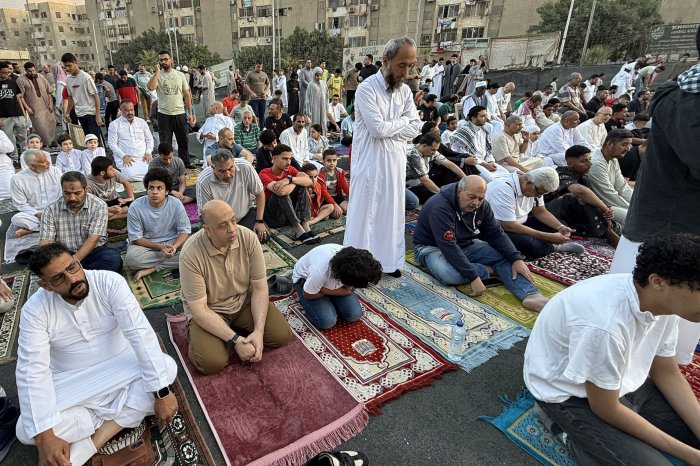
Muslims perform Eid al-Adha prayers at sunrise in Cairo, Egypt, on May 27, 2026. Photo by Ismael Mohamad/UPI | License Photo

Source link

U.S. military says ‘defensive strikes’ carried out in southern Iran

The U.S. Central Command said U.S. forces carried out “defensive strikes” in southern Iran on Monday, targeting missile launch sites and Iranian boats attempting to emplace mines. U.S. Navy photo by Mass Communication Specialist Seaman Zoe Simpson

May 25 (UPI) — The United States launched strikes in southern Iran on Monday even as negotiators for Tehran and Washington were preparing for further talks to end their war, a U.S. military spokesman said.

Capt. Tim Hawkins of the U.S. Central Command said in a statement issued to media outlets that the strikes were “self-defensive” in nature and were carried out “to protect our troops from threats posed by Iranian forces.”

“Targets included missile launch sites and Iranian boats attempting to emplace mines,” Hawkins said. “U.S. Central Command continues to defend our forces while using restraint during the ongoing cease-fire.”

The semi-official Mehr News Agency in Iran reported that “several explosions” were heard in the area of Bandar Abbas along the Strait of Hormuz and that civil defense sirens had been sounding there.

The agency said the situation in the city “is completely under control and there is no reason for any concern for the honorable people of Bandar Abbas.”

The announcement of new strikes came only hours after U.S. President Donald Trump wrote on his Truth Social platform that negotiations with Iran were “proceeding nicely,” but also issued a warning that the war could reignite if an agreement isn’t reached.

Iran, meanwhile, confirmed some progress had been made but cautioned that no agreement was on the verge of being signed.

Tehran’s lead negotiator, Parliament Speaker Mohammad Ghalibaf, and Foreign Minister Seyed Abbas Araghchi arrived in Doha for the talks, the semi-official Fars News Agency reported.

The renewed attacks came on the heels of Secretary of State Marco Rubio signaling to reporters while in India that an agreement appeared on the horizon before walking it back hours later.

Rubio had said that the president may have an update on negotiations but later walked that back, saying the agreement was “still a work in progress.”

The United States is seeking to have Iran reopen the important Strait of Hormuz energy route. After that is achieved, negotiations will entered the next phase focused on ending the war.

Iranians rally after a ceasefire announcement at Enqhelab Square, in Tehran on April 8, 2026. Photo by Behnam Tofighi/UPI | License Photo

Source link

U.S. strikes Iranian military sites after attacks on warships

U.S. Navy Arleigh Burke-class guided-missile destroyer USS Rafael Peralta, left, is one of three warships reported to have been attacked by Iranian missile and drone Strikes on Thursday. File Photo by Mass Communication Specialist 1st Class Ryre Arciaga/U.S. Navy/UPI

May 7 (UPI) — U.S. Central Command said Thursday that American forces struck Iranian military sites responsible for “unprovoked” missile, drone and boat attacks on U.S. warships in the Strait of Hormuz.

“U.S. forces intercepted unprovoked Iranian attacks and responded with self-defense strikes as U.S. Navy guided-missile destroyers transited the Strait of Hormuz to the Gulf of Oman,” CENTCOM said in a statement.

CENTCOM said Iran had targeted the USS Truxtun, the USS Rafael Peralta and the USS Mason.

“No assets were struck,” it said.

The U.S. strikes targeted the Bandar Abbas and Qeshm ports near the strait, CBS News and CNN reported, each citing unnamed U.S. officials.

The attacked Iranian facilities included “missile and drone launch sites; command and control locations; and intelligence, surveillance and reconnaissance nodes,” according to CENTCOM.

After the U.S. vessels had transited the strait, President Donald Trump promptly took to social media to post a warning to Iran.

“Missiles were shot at our Destroyers, and were easily knocked down,” he wrote. “Likewise, drones came, and were incinerated while in the air. They dropped ever so beautifully down to the Ocean, very much like a butterfly dropping to its grave! A normal Country would have allowed these Destroyers to pass, but Iran is not a Normal country. They are led by LUNATICS.”

Iran’s elite Islamic Revolutionary Guard Corps Navy said in a statement carried by Iranian state-owned outlet Press TV that it attacked the U.S. warships in response to an alleged U.S. cease-fire violation as well as a U.S. attack on an Iranian tanker near the Iranian city of Jask.

Iranian forces caused “significant damage” to the U.S. warships, it said.

A spokesperson for the Khatam al-Anbiya Central Headquarters also said the Iranian strikes were in response to the “aggressive, terrorist and outlaw” U.S. military, Press TV reported.

The attacks come after Trump earlier this week called off Project Freedom, a U.S. military operation to escort ships through the Strait of Hormuz, as Washington and Tehran try to reach an agreement to end the war.

Despite the attacks, Trump told reporters that the fragile cease-fire that halted the war that began in late February was still intact.

“They trifled with us today. We blew them away,” Trump told reporters Thursday evening.

“If there’s no cease-fire, you’re not going to have to know. You’re just going to have to look at one big glow coming out of Iran.”

Source link