Forty-nine seconds. That’s all it took for the Seattle Storm’s Flau’jae Johnson to fire off a 27-foot three-point jumper to take the lead. In less than a minute, she sank the Sparks’ hopes of beating one of the worst teams in the WNBA, leaving 39 more minutes for the Sparks to consider just how the team got there.
Johnson, already the main act in Seattle, bolstered her WNBA Rookie of the Year case by scoring 23 points as the Storm defeated the Sparks 82-64 Monday night at Crypto.com Arena.
Each time the Storm drove down the court, there was Johnson, her ponytail fluttering as she skirted around the arc before driving into the paint, nonchalantly tossing up layups as if it was still shootaround. Not even the relentless defense chants summoned from the Sparks’ MCs stopped her.
“I don’t know,” coach Lynne Roberts said after the game. “We just weren’t good offensively.”
And while her teammates supplied Johnson with enough passes to at one point secure a 13-point lead, the Sparks (8-11) lost because the team couldn’t build enough momentum.
In the end, Seattle outmaneuvered and outbodied the Sparks, snatching steals and flipping the ball around the perimeter until the Storm fired off a shot. Even when the ball bounced off the rim or backboard, Johnson or Storm center Dominique Malonga, who had nine rebounds, was there, hoisting the basketball away from the closest white jersey.
When asked how the team could’ve compensated defensively, Dearica Hamby kept it short: “Stop them from scoring.”
In comparison, the Sparks, without an offensive rebound until the end of the third quarter, were forced to make perfect shots, though that was far from the team’s grasp. Hamby, who went six for nine, led the team with 17 points, but even she couldn’t go toe-to-toe with Johnson alone. Worse, the Sparks’ abysmal 17.2 three-point percentage all but abandoned that avenue of attack, leaving the team to face Malonga in the paint.
“I’m not trying to let us off the hook at all, but sometimes you just have nights like that, and we all had them at the same time,” Roberts said. “Shooting 17% from three doesn’t help.”
The Sparks struggled to transition to the basket, giving up 19 turnovers resulting in 25 free baskets.
“I don’t think that there is a strong line of playing in transition,” Nneka Ogwumike said. “Sometimes we attribute taking an early shot to transition when in reality, if you’re taking an early, contested shot in transition, it’s probably not the most ideal shot.”
So as the Sparks fell further behind, the holes left by the injured Cameron Brink and Kelsey Plum widened.
In the Sparks’ previous matchup against the Storm a month ago, the two had totaled 34 points in the nail-biting 88-83 win. But in Monday’s game, the Sparks could only cling to the game with clenched fists as the gap widened.
“Credit them,” Roberts said. “They played hard and made shots. We missed them.”
By the end, the Sparks spent the game playing catch-up, never regaining the lead after surrendering it in the first 49 seconds to Johnson.
As Dodgers third baseman Max Muncy moved fluidly through a chopper at the edge of Camelback Ranch’s infield grass and made a running throw to first, his offseason work started to snap into place.
He wasn’t thinking about the angle he took to the ball, or how to get into the right position to throw — or anything, really. He was just moving instinctively.
“That’s how I like to field it in my work, is not necessarily traditionally,” Muncy told The Times on Thursday. “I like to field it one-handed, sometimes off the wrong foot, sometimes off balance, and that’s what works for me really, really well. I just couldn’t get that into the game. And finally getting those first couple of balls [this spring] to go that way just made everything click in my head and gave me the freedom to know that I can do it when it matters.”
Muncy has put together an impressive all-around first half. His .871 OPS through Thursday leads NL third basemen. He’s on pace for his highest slugging percentage (.513) in five years. But he’s most proud of the work he’s put in on the defensive side.
“I felt like I would show flashes of this, but never the consistency,” Muncy said. “And so to be able to just do it on the consistent daily basis that I’ve been doing this year, that’s easily what I’m most proud of.”
Now, with that well-rounded body of work, he’s in position to claim the third All-Star selection of his career and first since 2021.
Muncy entered Stage 2 of All-Star fan voting this week as the favorite to claim the starting nod at third base, up against fellow finalist Alec Bohm. But voting totals reset, adding some unpredictability to the process. The All-Star starters are set to be revealed Saturday at 4:30 p.m. on Fox.
“In total, the player, the defense, the hitting, the slugging, I think this is the best version of Max,” manager Dave Roberts said. “I’m so happy that he’s leading the All-Star voting.”
Not only is this shaping up to be Muncy’s best offensive season since 2021, it’s the best defensive season of his career, regardless of position.
Entering this weekend’s series against the Padres, he had a fielding run value of plus-five runs, tied with the Giants’ Matt Chapman for the highest mark among third basemen, according to Statcast.
“He’s always been a hitter,” first-base/infield coach Chris Woodward told The Times. “And I think he took it upon himself to say, ‘I’m going to prove to everybody that I’m a really good defensive player,’ which he has been in his time here, but he’s just never had the opportunity to play one position.”
Though Muncy is in his 11th major-league season, and has played all around the infield for most of it, 2022 marked his first season making the majority of his appearances at third base. And 2023 was his first season moving there full time.
He was also limited by injuries in that span. For years, he still felt the effects of the elbow injury he suffered toward the end of 2021. And he strained his right oblique in each of the last two seasons.
“Third base was just a new position for me, and it just took time to learn it,” Muncy said. “And so just trying to get my work to translate into the game is a tough thing to do, and that’s kind of the secret to every aspect of baseball.”
Each infield position is unique, with its own quirks in footwork, angles and timing. Each has plays — like a slow-roller up the third baseline that requires a quick throw across the diamond — that no other position will encounter.
“When a righty gets around the ball, it comes off the bat a lot different than when a lefty gets around the ball,” Muncy said. “And it’s weird how that works, and it’s hard to explain, but that’s just the way it is.”
For much of Muncy’s baseball life he played on the right side of the infield, fielding pull-side contact from left-handed hitters and opposite-field contact from right-handed hitters. That was second nature.
“You have to completely flip that,” Muncy said of playing third base, “and understand which way it’s going to bounce, how it’s going to bounce, how it’s going to get to you. It just took years of experience to finally get to that point.”
Dodgers shortstop Mookie Betts, left, and third baseman Max Muncy congratulate each other coming off the field after a defensive play against the Baltimore Orioles on June 19.
(Gina Ferazzi/Los Angeles Times)
Woodward has always been impressed by Muncy’s agility, surprised when the Dodgers first promoted him in 2018 (as he returned to the big-leagues for the first time since being released by the A’s the previous spring) and by how he moved at second base, despite an atypical build for a middle infielder.
Now, after an offseason with a new diet and training program, he may have leveled up that part of his game — even at 35 years old.
“In the past it was a good first step, and he couldn’t sustain his speed,” Woodward said. “And this year I think he can sustain the speed through the ball.”
Said Muncy: “I’m still beating the age curve for now.”
Woodward also noted how good Muncy is at staying on top of the mental side of the game, knowing how specific pitches to different types of hitters should change his positioning. That, along with regular communication, are some of the details that make the Dodgers infield look like it’s moving as a unit — or, as Woodward put it, an “NFL defense” because of the way they swarm to the ball.
The Dodgers’ infield defense as a whole has improved even from last season (No. 6 in fielding run value) to sit in the No. 3 spot in the majors (plus-17 runs) a little past the halfway point of the season.
Muncy unlocking even more potential in the hot corner is a big part of the Dodgers raising their defensive ceiling. That’s helped the Dodgers, who own the best record in the majors, create separation in the standings. But it’ll be even more vital in the postseason, when the margin for error is at its thinnest.
In All-Star voting, defense won’t be the determining factor. Muncy’s increased power at the plate is the far flashier aspect of his case to start the Midsummer Classic. But a well-rounded resume doesn’t hurt.
Muncy can picture it: his three children — Sophie Kate, who turns 5 this month, Wyatt James, 3, and Macie Grace, who was born in January — taking in All-Star weekend in Philadelphia, watching their dad represent the National League.
“Being able to have my kids experience the whole ordeal with me would mean everything to me,” Muncy said. “My oldest is kind of old enough now to remember these types of things, and so I think it’d be really special to just share that moment with them.”
Roki Sasaki’s abysmal appearance faded away in the Dodgers’ 12-7 win over the San Diego Padres after Los Angeles rose from a catatonic first inning. The Dodgers roared back from a 6-0 deficit as Andy Pages skirted a tying double down the left-field line, and Mookie Betts and Max Muncy each drove in runs to give them the lead in a four-run fourth inning. All of which sent the sellout crowd into jubilant celebrations, some jumping, others breaking out World Cup chants.
“I don’t know,” manager Dave Roberts said of the team’s ability to turn the game around. “Thankfully, it played out the way I didn’t expect, or the way it started.”
By the time the game ended, Sasaki’s three-inning start seemed like a murky nightmare the Dodgers awoke from in a sweat. Except the Dodgers weren’t dreaming, and the team hadn’t done much to assuage the concerns with Sasaki.
The problem with Sasaki isn’t his stuff. On his best nights, when the velocity and command combine, Sasaki blows past batters with a triple-digit fastball and cutting off-speed pitches. The problem has been how to tick the radar without making the strike zone look like a Jackson Pollock painting — and recently, it has.
Sasaki’s June swoon, impervious to the calendar change, continued into Thursday’s series opener against the Padres, in which the right-hander gave up three home runs and seven hits before Roberts called it quits going into the fourth inning.
“They were on everything,” Roberts said. “You could see it.”
One possible concern? Tipping pitches. While Roberts and catcher Dalton Rushing said the team would need to do some more research into Sasaki’s start, both left the door open to this answer.
“That would be a big explanation as to how they felt like they were on every pitch,” Rushing said.
As San Diego chugged through its lineup, Sasaki struggled to keep up. With his first pitch, he gave up a double to Fernando Tatis Jr., who scored on Manny Machado’s home run that left center fielder Pages staring at the ball’s path as it plopped down on the other side of the blue outfield fence.
The inning was only a preview of the Padres’ power. Each of the nine San Diego batters got his chance against Sasaki in the second, and the team quickly dug the Dodgers into a six-run hole. He surrendered two home runs in the second inning. First, Jackson Merrill blasted a ball to left-center field, and, two outs later, Jake Cronenworth drove in two runs with a shot to right-center.
Sasaki said through interpreter Kensuke Okubo that he felt like he needed work on his command to improve, but he felt like his fastball was good.
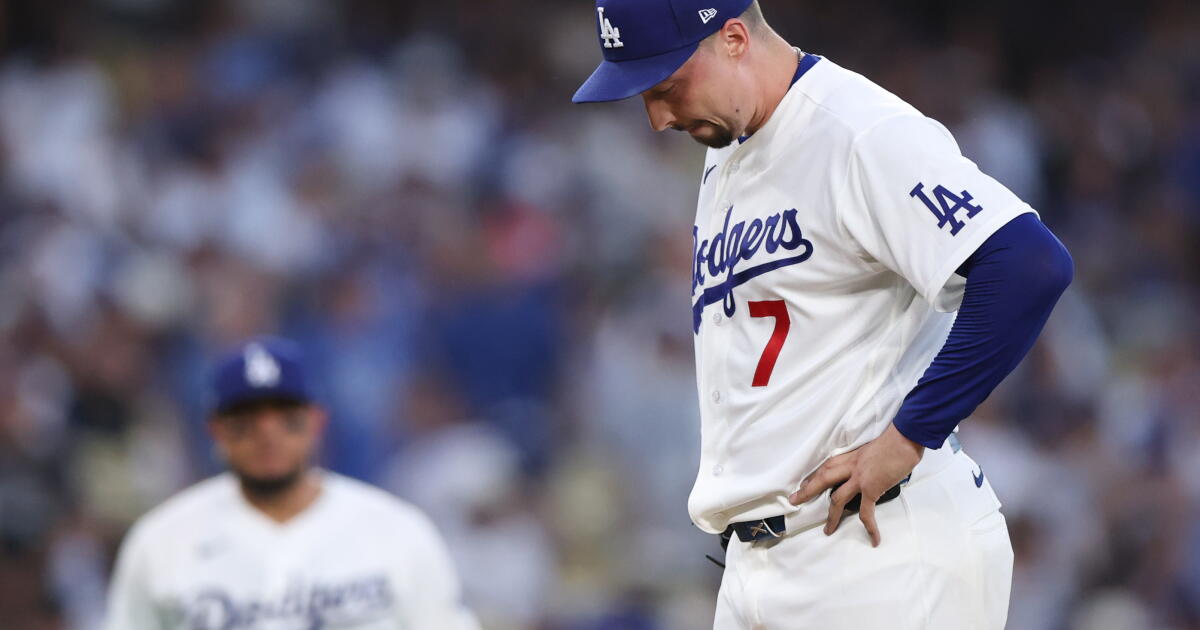
Roki Sasaki has his head down after giving up a solo homer to Jackson Merrill in the second inning.
(Gina Ferazzi / Los Angeles Times)
“I don’t think my stuff was bad today,” Sasaki said. “Overall, it wasn’t great but a lot of things evolved.”
Part of Sasaki’s issue lies with his approach. Roberts said he wants the second-year pitcher to be aggressive, to play the cat-and-mouse game required to beat batters in the box. But when given the opportunity, Sasaki has shrunken in recent outings, struggling with his command and his ability to pitch deep into games.
“We had a great May, so let’s just get back to competing and making pitches,” Roberts said.
When reliever Will Klein walked out to the mound in the fourth to the aggressive, rambunctious clamor of the Dropkick Murphys’ “I’m Shipping Up to Boston” and collected two scoreless, one-hit innings, the relief was immediate: The Dodgers took the lead.
The lineup already was revving, as Dalton Rushing homered in the second inning while Sasaki was still in the game, and both Kyle Tucker and Max Muncy drove in runs in the third, cutting the deficit to two. The Dodgers broke through against the Padres’ bullpen to score six runs in the fourth and fifth innings.
“The bullpen was fantastic tonight, and then the offense came up big,” Roberts said.
A late catch by Pages helped close out the game after he gloved a ball despite ramming into the padding of the center field wall. A combined effort by Paul Gervase and Tanner Scott shut down San Diego’s ninth-inning momentum after it pushed across a run.
“Turned back around, was able to find the ball and make a really good catch right there,” Tucker said. “That was a huge out.”
The Dodgers (57-31) beat their division rivals for the fifth time in seven games to open a 13-game lead over both San Diego and Arizona. The Padres, meanwhile, have given up 65 runs over the last six days, the most in such a span in franchise history.
But San Diego’s flaws don’t negate the Dodgers’ as they burned through six relievers in their win. So, while the Dodgers crawled out of the hole with a season-high 17 hits, the steep cost heightens the pressure on the rest of the rotation the rest of the series.
GUADALAJARA, Mexico — Spain, ranked second in the FIFA rankings and the favorite to win the World Cup, did not play its best game, but did enough late Friday to defeat Uruguay 1-0 and eliminate the South American team in one of the most anticipated matches of the first round.
Spain finished first in Group H, while first-time participant Cape Verde advanced in second place with just three points, the result of three draws. Uruguay was eliminated from the tournament with only two points, following two draws and one loss.
For much of the match on Friday, Spain lacked better offensive coordination ahead of facing more dangerous opponents in the upcoming do-or-die rounds.
Alex Baena scored a goal in the 42nd minute by connecting with the ball after a cross from the right. The ball slipped past goalkeeper Fernando Muslera, who at first seemed to have no trouble blocking the shot, but the ball found the back of the net, making all the difference on Friday night in Guadalajara in front of 45,065 fans — most of whom were rooting for Spain. Muslera did not return for the second half and was replaced by Sergio Rochet.
“We have to celebrate because, honestly, it’s hard to finish first in a group like this,” said Baena, a midfielder for Atlético Madrid.
“It was a physically demanding match — extremely intense — and we rose to the occasion,” said Spain coach Luis de la Fuente, who emphasized that winning the World Cup requires winning tough matches against tough teams like Uruguay.
“I’m proud of this team because they want to keep growing. I have complete faith in this team. We’re where we are, and that’s exactly where we wanted to be,” added De la Fuente, who noted that the team needed to improve its fluidity of play.
Uruguay failed to beat Saudi Arabia or Cape Verde — two teams that, on paper, seemed inferior at the start of the tournament. Coach Marcelo Bielsa’s team couldn’t find its rhythm or play at its best.
“I wasn’t able to bring out the full potential of Uruguay’s players,” Bielsa said, visibly shaken by his failure with the Uruguayan national team. “What I’m leaving behind for Uruguayan soccer is nothing, because any contribution a coach might make to the soccer of a country where he worked for three years never takes root if results aren’t achieved.”
At the end of the match, Uruguay’s Agustín Canobbio was sent off after committing a hard foul on Spanish defender Pau Cubarsí in the 95th minute, prompting several Uruguayan players to protest the decision by U.S. referee Ismail Elfath.
For Bielsa and Uruguay, this marks the end of an era in which many believe the Argentine coach lost control of the locker room and his relationship with the media became strained because of his eccentric and explosive personality, but, above all, a lack of wins.
Cape Verde will face Argentina in the round of 32 on Friday in Miami. Spain will face the second-place finisher in Group J, which will be determined late Saturday by the match between Algeria and Austria. The game will be played at SoFi Stadium.
The match was the fourth and final World Cup game played in Guadalajara. Before the game began, a minute of silence was observed in memory of the victims of the earthquakes in Venezuela. So far, Venezuelan authorities have reported that more than 900 people have died and that thousands are missing.
MINNEAPOLIS — The series finale between the Dodgers and Minnesota Twins featured a marquee pitching matchup between Shohei Ohtani and Joe Ryan. But the Dodgers’ 4-3 win on Wednesday wasn’t quite the pitcher’s duel it was advertised to be, in front of the Twins’ first sellout crowd of the season at Target Field.
The Dodgers offense had eight hits against Ryan, tied for the second-most he’s allowed in a start this season, and four runs in six innings. And Ohtani gave up three runs (two earned) and five hits.
Ryan won the first battle — the one against Ohtani the hitter to lead off the first inning.
Ohtani roped a first-pitch fastball to right field, clocking an exit velocity of 110.7-mph, into the glove of Twins outfielder Kody Clemens. That was part of a three-up, three-down first inning for Ryan. Ohtani countered with a hitless first inning of his own on the mound, but with a walk.
In the top of the second, Mookie Betts’ solo homer gave the Dodgers (52-29) an early lead. The 300th home run of Betts’ career was part of a three-hit day for the shortstop, a triple shy of the cycle.
The Twins’ offense responded.
Their first run was the result of a passed ball. Ohtani gave up singles to three of the first four batters he faced in the second inning, to load the bases. Then, Ohtani threw a first-pitch fastball inside to Ryan Kreidler. It got past catcher Dalton Rushing, who seemed to expect a different pitch, and the ball rolled out of play to tie the score.
Rushing, in his first game back in the lineup after being removed Monday to rule out a concussion, huddled with Ohtani and pitching coach Mark Prior on the mound to debrief.
Ohtani then gave up a two-run single to Kreidler before striking out Trevor Larnach to end the inning.
It was a good thing Ohtani, who went 2-for-5 on Wednesday, had lobbied to hit and pitch. Dodgers No. 9 hitter Alex Freeland led off the third with a double. Then Ohtani sent a ground ball up the middle to give himself some run support.
That started a three-run rally for the Dodgers. Max Muncy later drove in Ohtani, and Alex Call contributed a sacrifice fly to give the Dodgers a lead again.
Twins left-hander Anthony Banda, who received his World Series ring Monday from a gaggle of his former teammates, took over for Ryan in the seventh.
Ohtani was the first hitter he faced. And Banda struck him out on a fastball that barely clipped the outside corner — and was initially called a ball, before a successful ABS challenge by Twins catcher Victor Caratini.
Banda then hit Andy Pages with a pitch and gave up a single to Freeman. But he escaped unscathed, stranding them at the corners.
The Twins threatened in the seventh and eighth, but Dodgers right-hander Kyle Hurt overcame a pair of walks, and left-hander Alex Vesia navigated a pair of singles to hold the score. Closer Tanner Scott secured the save.
An eye-watering, cough-inducing thick stench of burning plastic permeated Dodger Stadium on Sunday morning. The smoke from the Boyle Heights warehouse fire had spread into every crevice and corner of the facility, inescapable despite the masks handed out to staff.
“It’s a little dark out there, little Gotham City when I was driving up,” Dodgers manager Dave Roberts said.
Major League Baseball approved the Father’s Day game to be played, according to Roberts. Still, the ominous atmosphere was hard to miss. When rolling up Vin Scully Avenue, a white smoke hung like a curtain behind the small hills on the other side of outfield walls, obscuring the normally scenic view of the San Gabriel Mountains.
Perhaps that should’ve been the first sign things wouldn’t go as planned for the Dodgers, who lost 12-1 to the Orioles. The loss marked the first time the Dodgers (49-29) have lost consecutive games since May 12.
“It’s everywhere in baseball, to be quite honest, but my concern is our team,” Roberts said of the Dodgers’ recent performances. “I don’t know the answer. It happens sporadically with all teams.”
By the time Emmet Sheehan took the mound, the smell had diluted, and the sunshine broke through the haze. The 26-year-old hasn’t won in more than a month, despite what at the time appeared to be a bounce-back performance against the Chicago White Sox last week. Sheehan lasted 3 1/3 innings against Baltimore, none particularly worse than the first.
Sheehan (3-5) loaded the bases, and Orioles catcher Samuel Basallo put Baltimore (37-42) on the scoreboard with a softly hit ball that split first baseman Freddie Freeman and right fielder Kyle Tucker. A two-out single by Colton Cowser put the Orioles up by two. With the bases loaded, Sheehan worked out of trouble with two strikeouts and a pop out. But the inning cost him four hits and nearly 30 pitches.
“We just got to have a better approach or plan with respect to the game situation,” Roberts said before the game. “Go out there and conduct, good and bad, not always gonna get the results, but I just think that we’re just missing at times the layer of the right approach in that particular situation.”
Sheehan struggled the most with his slider. Normally, the pitch elicits about a 43% chase rate, though against Baltimore it plummeted to 18%. The nose-dive, mainly caused by his inability to throw the slider in the zone, made his other pitches look less competitive, and the Orioles started connecting with his fastball. He gave up two home runs on the pitch to Taylor Ward in the second and Cowser in the third.
Meanwhile, Max Muncy drove in the Dodgers’ only run in the first with a line drive to left field. Shohei Ohtani, who had reached first on a walk and took second on Freddie Freeman’s single, slid home as the throw came in. However, the ball bounced off Basallo’s gear and ricocheted away from the plate.
The Orioles scored runs in four consecutive innings before Edgardo Henriquez threw a 1-2-3 inning in the fifth. The team tacked on four runs in the seventh, when, with a man on, the Dodgers ereliever Jonathan Hernández intentionally walked Gunner Henderson, who had gone two for four. So, He then threw a belt-high sinker down the middle of the plate that Pete Alonso smashed into the right field bleachers for a three-run homer. Hernández could only watch the ball soar, hunched over.
Blaze Alexander hit a two-run homer in the eighth. But position-player pitcher Miguel Rojas dealt a 1-2-3 ninth inning, one of the team’s three innings it held the Orioles scoreless. By then, the skies had cleared enough for the faint outline of the San Gabriel Mountains to appear. The Dodgers, though, finished the game as uncompetitive as it had started.
Injury Updates
Catcher Will Smith will not travel with the team this week as the team takes on the Twins and the Padres, Roberts said before the game. Smith is expected to participate in some baseball activities and will have a better estimate of his return depending on how he feels after.
Teoscar Hernández is slated to play in a rehab assignment Tuesday with the triple-A Oklahoma City Comets before joining the team in its final June series against the Athletics.
Reliever Blake Treinen, on the 15-day injured list with right elbow inflammation, got some good news. The MRI did not show any structural damage, only inflammation that Roberts attributed to the wear and tear of the season. “I don’t think it’ll be a long thing,” Roberts said. “Obviously, he’s on the IL, so it’s going to be two weeks, but hopefully it’s not much more beyond that.”
Iran’s terrible, horrible, no good, very bad World Cup got a lot better Sunday.
By playing Belgium to a scoreless draw before another packed house at SoFi Stadium, Iran is in position to win its group with a victory over Egypt on Friday and advance to the knockout stage for the first time.
That would be a just reward for a team that is unbeaten two games into what has been a trying tournament off the field.
Before it even left Iran, the team was forced to move its training camp from Tucson to Tijuana, and more than a dozen members of its delegation were told they would be barred from entering the U.S. The players had their movements in the U.S. severely limited, heard their national anthem jeered twice and generally have been unwelcome as the first qualifiers to play a World Cup game in a country with which they are at war.
And if all that wasn’t bad enough, on Sunday, Iran had a brilliant first-half goal, one that seemingly had given it its first lead of the tournament, erased on a video replay that confirmed the narrowest of offside violations.
The disallowed goal, one of the best any team has scored in this World Cup, came on a set piece in the 25th minute. Iranian captain Ehsan Hajsafi took the free kick from about 35 yards, but instead of going to the goal, he pushed the ball through the Belgium wall to Mehdi Taremi, who took a clean first touch, then put a left-footed ball between Belgian keeper Thibaut Courtois and the left post.
Iranian soccer fans hold a pre-revolutionary Iranian flag following the team’s scoreless draw with Belgium in the World Cup at SoFi Stadium on Sunday.
(Robert Gauthier / Los Angeles Times)
The play caught Belgium completely by surprise, and for one of the few times in this tournament, Iran had reason to cheer. But the celebration was short-lived when referee Dario Herrera took the goal away after a lengthy video review determined Taremi to be offside.
That was the best thing that went right for Belgium in a first half it dominated, only to come up empty. It had an 11-2 edge in shots, completed six times as many passes and controlled the ball for more than 36 of the first 45 minutes. But it couldn’t get the ball past Iranian keeper Alireza Beiranvand.
If the World Cup has been trying for Iran, it’s been frustrating for Belgium, which needed an own goal from Egypt’s Mohamed Hany to escape with a draw in its opener. And a smothering Iranian defense that frequently packed seven players in the box added to that frustration Sunday.
Belgium forward Romelu Lukaku, left, and Iran defender Shojae Khalilzadeh battle for the ball in the second half of a World Cup match at SoFi Stadium on Sunday.
(Robert Gauthier / Los Angeles Times)
That allowed Iran to get the first dangerous chance of the second half — and it also came off a set piece — with Taremi banging a clean volley on target from the center of the box. But Courtois stood his ground and made the save.
The game took a turn in the 62nd minute when Belgium’s Nathan Ngoy mishit a weak backpass, sending Taremi on a breakaway with only Courtois to beat. When Ngoy reached out and grabbed the Iranian by the shirt, pulling him to the ground, he drew a red card, leaving Belgium to play the final half-hour down a man.
Iran clearly deserved a better fate after absorbing wave after wave of a withering Belgium attack without breaking. It also was quicker and far more creative on offense, though it had nothing to show for that.
For Belgium, still looking for its first goal of the tournament, the result was another strain on an aging golden generation of players. If they don’t beat New Zealand in their final group-stage game Friday, they’ll leave the World Cup after the first round for a second straight time.
PHILADELPHIA — Kyle Schwarber launched two long home runs in Philadelphia’s eight-run third inning and Bryce Harper became the 11th player in franchise history to hit for the cycle, leading the Phillies to a 15-3 victory over the New York Mets on Saturday night.
Schwarber led off the Phillies’ huge inning with a solo homer off Mets starter Freddy Peralta, sending the ball 456 feet into the second deck in right field.
Later in the inning, Schwarber hit a three-run shot off Cionel Perez into nearly the same spot, 457 feet away.
Schwarber is the 67th player in major league history to hit two home runs in an inning and the second this season, joining Houston’s Yordan Alvarez, who accomplished the feat on June 12. He’s the fourth Phillies player to do so, along with Trea Turner (Aug. 19, 2023), Von Hayes (June 11, 1985) and Andy Seminick (June 2, 1949).
Schwarber hit his third homer of the game — giving him a major league-leading 28 — in the seventh, a two-run shot off Tobias Myers. He finished four for five with six RBIs and scored four runs.
Harper completed his first career cycle by the fifth inning. He hit a solo home run in the first, his 16th of the season. He doubled and scored on an error in the third, then singled after Schwarber’s second home run.
In the fifth, Harper lined a ball into the gap in left-center field and motored around to third base for a two-run triple. He’s the first Phillies player to hit for the cycle since Weston Wilson on Aug. 15, 2024. Harper finished four for five with three RBIs and two runs.
Harper is the second player this season — and this week — to hit for the cycle, joining the Chicago Cubs’ Pete Crow-Armstrong, who accomplished the feat Monday night in a 5-4 win over Colorado.
SEATTLE — The World Cup is only a little more than a week old, but it’s already a historic one for the U.S.
With Friday’s 2-0 win over Australia, the U.S. matched its best World Cup performance ever with two victories. Their six goals match the most the U.S. has ever scored in the group stage and its goal differential of plus-five is also its best ever in the tournament. The U.S. also clinched a spot in the round of 32.
Most impressive of all, however, is how the U.S. achieved most of that without their best player, Christian Pulisic, who had an electric first half in the U.S. opener against Paraguay but hasn’t seen the field since. And while Pulisic, who is nursing a calf injury, was missed Friday, he wasn’t needed, with the U.S. outpossessing, outpassing and outshooting Australia by wide margins.
The Americans hardly needed any help, but Australia gifted the U.S. its first goal anyway when defender Cameron Burgess deflected in a cross from Folarin Balogun in the 11th minute. The sequence started with Antonee Robinson pushing the ball forward for Balogun from just inside the halfway line. Balogun ran onto the ball then turned on the jets, making a dash up the left wing before turning toward the penalty area and bending a pass toward Sergiño Dest in the six-yard box.
Australian goalie Patrick Beach, guarding the post, reached out his left hand but missed the ball, allowing it to strike Burgess’ left foot and carom into the roof of the net igniting a red, white and blue-clad crowd of 66,925 inside Seattle Stadium (Lumen Field) and tens of thousands more who gathered outside the stadium and at viewing parties spread throughout the city.
The first U.S. score in its opener with Paraguay came on an almost identical own goal, with Paraguayan midfielder Damián Bobadilla getting his right foot on a pass Weston McKennie had aimed at Balogun.
Australia tried to deal with the Americans’ superior speed and technical abilities by getting physical, rough play that German referee Felix Zwayer largely allowed. But Australia paid dearly for that just before the intermission when Alex Freeman, who was leveled by Australia’s Paul Okon-Engstler moments earlier, climbed off the turf to head in a loose ball to give the U.S. a 2-0 lead at the break.
A look at how the U.S. scored its goals in a 2-0 win over Australia.
That sequence started with a free kick following a foul by Burgess. Robinson left-footed the ball to an unmarked Dest at the top of the box, a shot that was blocked in the wall, then arced toward the goal. Freeman and Balogun raced Beach to the ball, with Freeman getting there just ahead of the Australian goalie to nod it in.
The goal was originally negated by an offside that was quickly overturned by the VAR official.
Australia tried to make a game of it in a second half that turned increasingly chippy, but the U.S. defense held firm.
The U.S. — and Pulisic — have five days to prepare for their group-stage finale with Turkey on Thursday at SoFi Stadium, where the potential for even more history awaits.
U.S. fans react after a 2-0 win over Australia at Seattle Stadium (Lumen Field) on Friday in World Cup Group D play.
Not much good comes to mind when you think about the effects of climate change.
Wildfires, floods, melting ice caps, heat waves, the bleaching of ocean reefs.
But then there’s baseball, and one possible silver lining.
Has global warming turned Dodger Stadium into a home run launching pad?
I was watching Monday night’s ESPN telecast of the L.A. game against Tampa Bay when the play-by-play announcer said that once upon a time, it was an article of faith that fly balls didn’t carry far in the heavy night air of Chavez Ravine.
However, the announcer continued, a Dodger executive had told him that over the last several years, “in general, the marine layer is gone, and the ball has started to carry at night, and you can see it now in the numbers. It is a great home run hitters park.”
This is statistically true. Between 2020 and 2025, Dodger Stadium had more home runs than any other major league park, although this year’s total is lagging behind last year’s pace. In all of Major League Baseball, home run totals have fluctuated but gradually increased over the years, with this year’s pace running slightly ahead of last year’s.
That can’t all be attributed to climate change, as retired Dodger great Steve Garvey is going to explain in a minute. When considered city by city and decade by decade, there are lots of factors in home run totals, from ballpark dimensions to playing strategies to the number of long ball hitters in each lineup.
And now we have to ask ourselves: Is global warming producing more home runs than steroids did?
The warm-up is real, but it isn’t new. In Game 2 of the 2017 World Series, the temperature at Dodger Stadium topped 100 when the first pitch was thrown, and the ballpark was like a popcorn machine. The Dodgers and Astros combined for a record eight home runs, and The Times’ story quoted a NASA climate scientist who noted that the marine layer was a no-show.
While watching Monday night’s game, I emailed Dodger fan Edgar McGregor, the meteorologist who warned neighbors about the catastrophic weather conditions that resulted in the Eaton fire. I asked what he thought about this theory of a link between a diminished marine layer and the number of home runs.
“There is absolute truth to that,” said McGregor, explaining that “when oceanic temperatures are warmer, the marine layer is weaker.”
McGregor broke down the aerodynamics: “Cold air is dense, so a baseball has to push more atoms out of the way as it travels deep. Warm air has lower density, so balls travel farther.”
UC climate scientist Daniel Swain said this pattern will accelerate “for the rest of our lives as air continues to warm and baseballs continue to meet less and less resistance.”
This doesn’t mean that an infield pop-up will become a home run, but Swain said balls travel four inches farther per 1 degree Fahrenheit increase, “meaning that the average hit goes about 1-2 feet further than it would have in the early 20th century.”
That doesn’t sound like a staggering difference, but with thousands of batted balls over the years, that’s a lot of outs turning into doubles, triples and home runs. Swain sent me a 2023 study from the American Meteorological Society journal titled “Global warming, home runs, and the future of America’s pastime.”
Researchers reviewed data between 2010 and 2019, finding that “higher temperatures substantially increase home runs,” with about 50 per year “attributable to historical warming.” That adds up to about 500 more home runs.
The scientists concluded: “Each degree of global warming is associated with an additional 95 home runs per baseball season.”
Home runs bring fans to their feet, as in Monday night’s game, when Kyle Tucker pumped one that made it just over the right field wall and Miguel Rojas popped the game-winner with a shot that barely cleared the left field fence. So I don’t want to sound like a party pooper, but there is no bigger story in the world than the accelerating destruction of the only sandlot we’ve got.
If the right team hits a homer, feel free to go ahead and cheer. But if the wrong team hits one, you can remind friends and loved ones that each homer is like a fossil fuel bugle call signaling the end of the world as we know it.
Thankfully, the marine layer has not yet disappeared entirely. We still got some May gray this year and some June gloom as well. I wondered, though, if there were any retired Dodgers out there who might be thinking they’d have walloped more home runs if they’d had the advantage of warmer air.
“I do remember some balls just not traveling far, especially compared to day games,” said James Loney, who played first base for the Dodgers from 2006 to 2012 and had 106 career homers with three teams.
Today’s Dodgers hit a lot of home runs primarily because the lineup is stacked, Loney said. But he said he recalled players from visiting teams hammering a long ball and passing him at first base, thinking “they had a home run, and then making a right turn back to the dugout.”
Garvey, also a first baseman, slugged 272 home runs in his 18-year career and told me that if he were playing in this era, “I probably would have hit another 40 or 50 home runs.”
But Garvey, who started with the Dodgers in 1969, said weather is just one of many factors that have led to more home runs in today’s game, which has abandoned finesse in favor of brute force.
Garvey said the bats are harder, the balls are livelier, the pitchers throw harder (more velocity means more pop for batters) and launch angles are talked about more in baseball than at Cape Canaveral.
“We never heard the term ‘launch angle,’” said Garvey, who told me he went up to the plate trying to hit a line drive, not a moon shot.
“My goal used to be a .300 average, 200 hits, 100 RBIs and 20-plus home runs,” said Garvey, who hit 20 or more homers six times, with a high of 33 in 1977.
Today’s Dodgers have plenty of swat in their lineup, ranking behind only the Yankees in home runs so far as they chase a third straight World Series ring. They’re in first place even though one of their biggest bombers, Shohei Ohtani, is about a dozen homers shy of last year’s pace.
But Swain has good news for Ohtani, for Dodger fans and for manufacturers of short-sleeved shirts.
“This year, there is going to be exceptionally high humidity for most of baseball season in SoCal due to the developing very strong El Niño event and record warm coastal ocean temperatures,” he said.
“So, it’s indeed plausible,” Swain continued, “that the combination of long-term warming from climate change, plus shorter-term warming and humidity increase from El Niño and near-shore ocean warming, might increase the number of home runs this season.”
One can only hope the home team does the most celebrating.
The 28-year-old quarterback has dedicated much of the offseason to tweaking his footwork — putting his left foot in front of his right from the shotgun, against traditional NFL form — to fit Los Angeles’ new offensive coordinator’s scheme.
McDaniel prioritizes getting the ball to playmakers in space as efficiently as possible, as he did for four seasons as the Miami Dolphins head coach with speedy wideouts Tyreek Hill and Jaylen Waddle, and envisions Herbert’s flip in footing accelerating and syncing the timing of passes with receivers’ route breaks.
“If guys train it so that they don’t have to think about it and they can be comfortable, you can do a couple things that put the defense in a bind with how you do your footwork,” McDaniel said at Chargers minicamp in El Segundo. “I don’t mandate it. With Justin, I really just showed him where I thought it would be advantageous, and he didn’t blink for a second and was excited to attack it.”
“The patternization in Mike McDaniel’s system has required some footwork changes,” added head coach Jim Harbaugh. “[Herbert’s] been working very hard, very hard at those. And as you would expect, Justin has picked it up.”
McDaniel said he got the idea as an up-and-comer on staffs in Houston and Washington alongside current 49ers head coach Kyle Shanahan and pointed to Matt Ryan and Tua Tagovailoa as recent quarterbacks with whom he has implemented the stance change and reaped positive results.
Herbert, who has been one of those traditional right-handed quarterbacks to have their right foot forward from the shotgun, has embraced his new coordinator’s methodology.
“It’s about playing the way that [McDaniel] sees the quarterback position being played,” Herbert said, “and talking about how we can get the ball to the receivers in a position where they can run with it and allow them to do the things that they’re so good at: making plays.”
To accelerate his adaptation, Herbert has thrown less in practice sessions and done plenty of drills without a football — two markers that are simply unlike the seven-season veteran, who is known to sling the rock plenty at practice and in games.
McDaniel and Harbaugh added that, besides helping Herbert adjust his feet, keeping the ball out of their quarterback’s hands during the offseason will help him stay fresh later in the regular season.
Herbert is on board, but made it clear he does not require any maintenance.
“I’ve thrown a lot of footballs, and it’s May and June and I didn’t think it was as necessary to throw as much now,” Herbert said. “And do everything I can to get the footwork ready and get the offense down. The throws, they’ll be there. We’ve got plenty of time in camp and throughout [organized team activities] to get timing. I think it’s been smart by everyone, taking it easy.”
Herbert added that it’s better to focus on where his feet are now rather than in a live, meaningful game. However, Harbaugh and McDaniel said Herbert is ramping up his throwing in practice with training camp looming.
The Chargers expect big things out of McDaniel’s offense after they averaged a subpar 21.6 points per game in 2025.
Harbaugh and McDaniel are hopeful for career years from Quentin Johnston, Ladd McConkey and Tre’ Harris — exactly what the wideouts want to hear.
“As you all know … the timing, that’s a different aspect for us than we’re used to, but I think it’s great,” McConkey said. “It just gets the ball in the playmakers’ hands and lets us go to work.”
Before any dreams of the Chargers winning a Super Bowl on their home SoFi Stadium turf can come true next season, Herbert must simply get his footing, with his feet and new playbook.
“I’m sure you guys are eager to see him execute in a high regard in the stuff that we’re doing,” McDaniel said. “You got to be patient … that’s been part of the very calculated, very deliberate, intentional process that we take into the offseason.”
Miguel Rojas had practiced his dance moves in the Dodgers dugout Monday, long before he hit the go-ahead home run. Before the game, he strutted around, at one point even grabbing Dalton Rushing, decked in full catcher’s gear, to get hyped.
Rojas, who pinch-hit for Alex Freeland in the bottom of the seventh and homered to center, was more measured as he crossed the plate without any antics. His veteran steadiness never indicated that he‘d hit a pinch-hit home run only one other time in his career.
The Dodgers’ 4-3 win over Tampa Bay rid them of their middling road performance. The team split a six-game trip, capped by a Sunday loss to the Chicago White Sox, before returning home.
No one found more immediate success than Kyle Tucker, who temporarily put his .227 batting average on the trip in the rearview mirror. For how long remains a question. Tucker’s season so far has looked more like a teenager testing out their driver’s license: stopping and starting and stopping again. Yet everything seemed to be working when the Dodgers (46-27) beat the Rays (41-28).
Of the five Dodgers who’ve played at least 60 games, Tucker has the lowest batting average (.238). Still, he battled in an eight-pitch duel in the second inning before taking a changeup 384 feet over the wall in right-center. His home run tied the score at three apiece, and Tucker wasn’t finished.
The next inning, the Rays’ Ben Williamson hit a two-out single to Tucker in right field, and Tampa’s Jonathan Aranda darted around third toward home. Tucker lasered a ball to Rushing, who tagged Aranda out on the slide.
Miguel Rojas acknowledges the bullpen after homering in the seventh inning.
(Eric Thayer / Los Angeles Times)
The defensive play helped buoy an otherwise precarious start by pitcher Eric Lauer. The left-hander had been undefeated in three starts with the Dodgers, a large departure from the 1-5 record he had with the Toronto Blue Jays. After starting his year with a 6.69 ERA, Lauer had dropped it to 2.76 with the Dodgers.
But inconsistencies plagued Lauer’s start, ranging from the three earned runs he gave up in the first two innings to a pitch clock violation in the fourth. While Lauer eventually settled, the command of his fastball remained absent. He normally crosses the strike zone with 53.7% accuracy on his fastball, getting batters to chase about 37% of the time. In the series opener, Lauer threw his four-seamer in the zone only 42% of the time, cutting his chase rate to 23%.
In other words, the best pitch in Lauer’s arsenal became one of his worst, and the Rays took advantage. Junior Caminero doubled in the first inning, and Ryan Vilade followed with a home run on a cutter, silencing a sold-out Dodger Stadium before the game could even heat up. The Rays tacked on another run on a safety squeeze, taking the lead until Tucker’s home run. Lauer finished after six innings, giving up the three earned runs on six hits and three walks, striking out four.
Tampa Bay starter Nick Martinez fared about as well. The right-hander lasted 5-1/3 innings of three-run baseball, striking out six and walking one.
While there was movement on the bases for both starters, the game lulled until the seventh. A couple of feet separated Rushing’s foul ball from a home run. Reliever Steven Matz didn’t get so lucky with Rojas, who delivered his first homer since April 20.
The Iranian national team finally got to just play soccer.
Their journey to the World Cup has been uniquely fraught, with a war erupting between the host of their matches and their home country.
They had to relocate their base camp from Arizona to Tijuana, struggled to get all of their traveling party into the United States amid visa scrutiny and absorbed President Trump’s suggestion they may not be safe if they chose to play in the World Cup.
Iran forward Mohammad Mohebi (8) heads the ball for a goal during the second half against New Zealand in group play at the World Cup on Monday.
(Ronaldo Bolanos / Los Angeles Times)
With the focus shifted solely to soccer, Iran’s 2-2 draw with New Zealand in front of an announced crowd of 70,108 Monday night at SoFi Stadium may have felt like a victory because of the sheer fight it took for Team Melli to play in Inglewood.
After Belgium and Egypt tied 1-1 earlier Monday, all the teams in Group G are tied at one point apiece.
The All Whites showed no signs they were rattled by the pro-Iran crowd or their standing 65 slots behind Iran in FIFA world rankings.
Iran fell behind twice, but the team rallied to avoid plummeting to the bottom of its group.
A flurry of chances generated by both teams during stoppage time never translated into a winning goal.
New Zealand struck first.
New Zealand forward Elijah Just, right, celebrates after scoring his second goal against Iran on Monday.
(Robert Gauthier / Los Angeles Times)
Elijah Just rumbled toward the box and seemed to pinball around the Iranian defense. He passed to Sarpreet Singh, who chipped the ball to Chris Wood in the box. Wood then chested the ball back to Just, who took one touch before kicking the ball in for New Zealand’s first goal in the seventh minute.
A small but hearty contingent of New Zealand cheered.
After the hydration break, Iran’s Ramin Rezaeian pushed the ball into the box and tapped it to Saman Ghoddos. Shahriyar Moghanlou’s shot was blocked, but Rezaeian was in position to tap the deflection into the far lower left corner of the net in the 32nd minute.
The stadium roared as Mexico fans joined Iran fans cheering and waving flags.
1
2
3
4
1.Iran goalkeeper Alireza Beiranvand watches the ball go into the net after a goal by New Zealand forward Elijah Just in the first half.(Allen J. Schaben/Los Angeles Times)2.Iran defender Milad Mohammadi leaps over a New Zealand defender during the second half.(Kelvin Kuo / Los Angeles Times)3.New Zealand defender Finn Surman, top, goes after the ball in front of Iran forward Ali Alipour during the second half.(Allen J. Schaben / Los Angeles Times)4.Iranian soccer team fans show their support during the team’s 2-2 draw with New Zealand.(Kelvin Kuo / Los Angeles Times)
Both teams has chances to break the tie late in the first half.
New Zealand earned a free kick in the 45th minute just outside the box. Wood took a direct shot at the goal, but Iran goalkeeper Alireza Beiranvand gathered it with ease.
During first-half stoppage time, Rezaeian’s free kick was headed home by Ali Nemati, but Nemati was clearly offsides and the goal was waived off by the referees.
In the 54th minute, Iran turned the ball over and Just connected with Just for his second goal of the match.
Iran responded in the 64th minute with Rezaeian’s cross headed home by Mohammad Mohebi, tying the game and delighting fans.
Iran forward Mohammad Mohebi reacts after scoring against New Zealand in the second half Monday.
(Kelvin Kuo / Los Angeles Times)
Before the game, protesters outside SoFi Stadium argued Iran’s oppression regime should be sanctioned for human rights violations and banned from competition. Other Iranian Americans countered they gathered at the venue to cheer on players rather than Iran’s totalitarian leaders.
Iran captain and star striker Mehdi Taremi said before the game he hoped the team that has unified in the face of massive distractions could provide solace during a difficult time.
“We, the players of the national team, we play for every Iranian, be it the Iranian diaspora or be it Iranians in the country,” Taremi said through a FIFA interpreter. “Look, in every country, people have different opinions, but we are here as footballers to unite people, and we will try to bring joy to all Iranians, irrespective of where they live.
“Everyone is entitled to their own opinion, and we respect them, but we are here to bring joy to the Iranian people. We do not get involved in politics. We are here to play football.”
CHICAGO — Fans around Rate Field rose to their feet as Yoshinobu Yamamoto embraced his teammates before walking off the mound.
Of course, the Dodgers fans stood. But fans clad in White Sox jerseys joined them, waving White Sox hats in the air, acknowledging the brilliance they’d just witnessed.
In the Dodgers’ 7-1 win against the White Sox on Saturday, Yamamoto carried a perfect game bid into the eighth inning and a no-hit bid into the ninth.
Dating back to Yamamoto’s last start, against the Angels, he retired 45 straight batters, one shy of the major-league record set by Yusmeiro Petit in 2014.
In an eventful game, which included Shohei Ohtani returning to the lineup to homer in his first at-bat, a two-homer performance from Max Muncy, and a team-effort bounce-back after getting blown out the night before, Yamamoto’s performance on the mound stole the show.
Yamamoto, who exited with one out in the ninth inning and a pitch count of 109, was efficient even within each out. A 10-pitch strikeout in the third inning showed how Yamamoto wasn’t going to give in.
The Dodgers right-hander was one pitch away from striking out Jacob Gonzalez for seven straight pitches. But Gonzalez kept fouling off anything close to the strike zone.
For the 10th pitch of the at-bat, Yamamoto challenged Gonzalez with a cutter over the plate. And finally, Gonzalez swung through it.
The next inning, Yamamoto retired the side in eight pitches.
The only thing that slowed his roll was the mound itself. Yamamoto asked for the grounds crew to fix it in the sixth. And then he kept cruising.
Dodgers catcher Dalton Rushing slaps hands with Dodgers pitcher Yoshinobu Yamamoto in the ninth inning Saturday against the White Sox.
(Zoe Davis / Getty Images)
He had help from a steady defense behind him for much of the game.
The sixth inning included two highlight-worthy plays. Tristan Peters hit a sharp ground ball up the first-base line, and first baseman Freddie Freeman made a sliding stop, tossing the ball to Yamamoto at first to complete the play. Then left-fielder Alex Call ran into the retaining wall in foul territory to catch Edgar Quero’s fly ball for the final out of the inning.
For the most part, Yamamoto made it look easy. The hardest contact against Yamamoto came the third time through the lineup. In the seventh, he pumped a heater to the top rail against Miguel Vargas, who stayed on top of the pitch to send a line drive to left field — and right to Call.
In the eighth, he fell behind Colson Montgomery 3-1. But he worked back to a full count. Montgomery then scorched a line drive up the first-base line — into Freeman’s glove.
His perfect game bid ended two batters later, with two outs, on an error.
Yamamoto got Chase Meidroth to chase a slider, hitting a ground ball to shortstop Mookie Betts. But Betts mishandled the hop. The ball shot to his left, where second baseman Santiago Espinal tried to salvage the play but couldn’t pick up the ricochet cleanly.
The no-hit bid was next to fall. Yamamoto piped a fastball down the middle to Peters, who sent it over the wall in right field.
Yamamoto stayed in for one more batter, inducing Quero to fly out, before handing the ball over to manager Dave Roberts. Left-hander Alex Vesia took over for the final two outs.
Ohtani returns, hits home run
Dodgers star Shohei Ohtani runs the bases after hitting a home run against the White Sox on Saturday.
(Matt Marton / Associated Press)
Before Yamamoto took the mound, Ohtani’s return was the big story of the day.
As Ohtani stepped into the batter’s box for the first time, he was greeted by a smattering of boos.
He took his first swing at the second pitch of the game. And he sent it into the right-field stands. A no-doubter, proclaiming that his availability was no longer in doubt.
Ohtani returned to the Dodgers lineup after exiting against the Pirates on Thursday because of inflammation in his left knee.
“I think Shohei drove it,” Roberts said of the decision to play. “Training staff drove it. We took him out of the game the other night just for precautionary reasons. Yesterday, treated it up. Today he feels great. All the confidence that he can go out there and hit, feel good, not regress at all.”
The Dodgers (45-26) will continue to monitor Ohtani’s knee as he prepares to take the mound Wednesday against the Tampa Bay Rays at Dodger Stadium.
“I think we’re full go,” Roberts said before Ohtani threw on flat ground Saturday. “But I do think once he’s out there playing catch and we see how his knee responds to the pressure, the torque will be some good information.”
Even before Ohtani’s knee swelled (it’s still unclear what caused the inflammation) the Dodgers planned to have him pitch the day before their off-day on Thursday.
They switched Ohtani and left-hander Justin Wrobleski in the rotation order, with Wrobleski set to pitch Tuesday on regular rest.
That remains the plan, even after Wrobleski was hit in the leg by a comebacker Thursday. He left the game with a bruised right hamstring.
The Dodgers considered bringing in a spot starter, Roberts said, in order to keep the full rotation on extra rest.
“But considering how Wrobo’s start went short, feels good after it, we feel the four days’ rest will be fine for him,” Roberts said. “And then where Shohei is at, we feel good about just leaving it status quo.”
Ohtani returned without restrictions in his designated-hitter role — except for one request from his manager, after a couple days of parsing whether a steal attempt that was snuffed out by a foul ball had contributed to Ohtani’s injury.
Though they didn’t find a clear inciting incident, Roberts made it clear Saturday: “There will be no base stealing.”
It was a game eight years in the making. The first World Cup match on American soil in more than a generation and the start of a tournament that has the potential to alter the direction of soccer in this country for the next generation.
And the U.S. seized on every bit of that opportunity Friday, with Christian Pulisic setting up two goals and Folarin Balogun scoring twice in his World Cup debut, sparking an impressive 4-1 victory over Paraguay in a game that was far more one-sided than the score indicated.
The U.S., which needed a big effort to start the tournament, was on the front foot from the start, going in front to stay in the seventh minute — although it was Paraguayan midfielder Damián Bobadilla who got credit for the goal after stepping in front of Balogun and deflecting in a cross from Weston McKennie.
Pulisic, the American star who is under intense pressure to perform in this tournament, set up the goal, pushing the ball between a pair of defenders before poking it on for McKennie in the center of the box. Bobadilla then did the rest, inadvertently sticking his right foot in front of the ball and bouncing it by Paraguayan keeper Orlando Gil.
Balogun appeared to double the lead coming out of the hydration break midway through the opening half, but the goal was negated by an offside call. That only delayed the second goal, however, with Balogun making it 2-0 by one-timing in a perfect feed from Pulisic from the penalty spot in the 31st minute.
Balogun added to the U.S. advantage just before the intermission, running on to a perfectly weighted through ball from Malik Tillman, stepping through a challenge from Omar Alderete entering the penalty area and turning around Paraguayan captain Gustavo Gómez before left-footing a shot into the top left corner to complete his first brace for the national team.
Gil was just a spectator on the play, with no chance to best the save. The goal marked the first time Paraguay had given up three scores in a World Cup game — much less one half — since 2002 and it came at the end of what was arguably the best opening 45 minutes a U.S. team has played in the tournament in decades.
Gio Reyna scored the fourth U.S. goal on the final play of the game.
Pulisic left in favor of Sebastian Berhalter to start the second but the U.S. continued to dominate in every way it was possible to dominate, controlling the ball for nearly 60 of the 90 minutes and completing more than twice as many passes. Paraguay’s first shot on goal didn’t come until the 73rd minute when Mauricio, a halftime substitute, took advantage of a slow-reacting U.S. defense to pull a goal back.
U.S. coach Mauricio Pochettino also got a solid game out of center back Chris Richards, playing for the first time since tearing two ligaments in his left ankle a month ago.
The Americans will face Australia in the second of three group-stage games next Friday in Seattle, where a draw will all but guarantee them a spot in the round-of-32, something Pulisic said should be just the first objective for this team.
This World Cup is the largest and most ambitious sporting event in history, with three host countries — Canada and Mexico, in addition to the U.S. — and a record 48 teams playing 104 games in 16 cities spread across four time zones. A long run by the American team, playing on home soil, could excite a nation and give soccer the kind of boost it hasn’t seen since 1994, the last time a World Cup was played here.
It could also change the narrative of a tournament whose run-up was clouded by outrageously high ticket prices, travel bans, the threat of ICE raids at tournament venues and the war in the Middle East, the first to pit a World Cup host against a World Cup qualifier.
And the U.S. portion of that tournament opened with pomp despite those circumstances, with Thai pop star Lisa, Nigerian recording artist Rema and Brazilian singer Anitta headlining a 10-minute mini concert staged before a massive replica of the World Cup trophy set over a blue map of the U.S. Katy Perry mounted a stage of her own an hour later to debut her song “Wonder” as the flags of the 48 participating countries circled around her.
President Trump did not attend the game, just as Mexican president Claudia Sheinbaum skipped her country’s opener Thursday in Mexico City and prime minister Mark Carney missed Canada’s first game Friday in Toronto. Secretary of State Marco Rubio took Trump’s place in the Hollywood-heavy crowd of 70,492 that packed SoFi Stadium, one which included Tom Cruise, David and Victoria Beckham, Halle Berry, Rob Lowe, Becky G, Jaime Foxx, Paris Hilton, Bill Gates, Justin Trudeau and Kareem Abdul-Jabbar.
That crowd was a sea of blue and red — the U.S. and Paraguay share the same colors — but the cheering was primarily for the Americans since Paraguay rarely mounted a threat.
FATBOY Slim has opened up about the ‘awkwardness’ he felt with ex Zoe Ball after their divorce, shortly after they reunited to take some new family snaps.
The couple tied the knot in 1999 but their romance wasn’t all smooth sailing, with Zoe admitting to having an affair with DJ Daniel Peppe.
Sign up for the Showbiz newsletter
Thank you!
Fatboy Slim has admitted that his relationship with ex Zoe Ball was initially ‘awkward’ after their divorceCredit: youtube/@BeginAgainWithDavinaHe spoke about it with Davina McCall on her podcast, Begin AgainCredit: youtube/@BeginAgainWithDavina
After briefly separating the duo got together again three months later up until their divorce in 2016.
Speaking to Davina McCall on her Begin Again podcast about it Fatboy Slim, real name Norman Cook, shared how ‘awkward’ he felt with Zoe initially after the split as they attempted to co-parent their children Woody and Nelly.
Though overall the star praised the dynamic him and Zoe hold today, saying it might even be better now than when they were a couple.
He said: “Our triumph is to remain really good friends and parents, even though we’re not a couple anymore…
The podcast chat comes shortly after Zoe and Norman attended a wedding togetherNorman looked dapper in a grey suitZoe is a TV regular, known for previously hosting Strictly Come DancingCredit: BBCNorman and Zoe went their separate ways in 2016 after tying the knot back in 1999Credit: Shutterstock Editorial
“It was a bit awkward at first, but then we got this rhythm where… we’re probably actually better than we were when we were a couple.
“You sign on to be parents, that’s for life.
“You can sign up for marriage and you can get divorced. But you can never stop being parents.”
Norman also praised Zoe for being really good at keeping him “grounded”, noting: “Going through it together was great because, Zoe is a really good teacher, she was really good, really measured and she’s kept me really grounded to earth…”
The podcast chat comes a week after Norman and Zoe reunited to attend a friends wedding over the weekend.
Their daughter Nelly was a bridesmaid at the stunning event that took place at Parnham Park in Dorset.
Zoe posted a series of sweet clips and snaps from the day to her Instagram account.
She wore a cream dress with a slit covered in ruffles, while Norman opted for a handsome grey suit.
In the post’s caption, Zoe penned: “Congratulations Eva & James & Willow
“We love you so much. The most perfect wedding celebration for our dear magic friends.
“Groomsmen, Bridesmaids & a few close folk to celebrate the Wedding.”
Every morning, Harvard-Westlake tennis player Chase Klugo’s house shakes like it’s in the middle of a small earthquake. His alarm clock, a big and bulky machine that’s Bluetooth-connected to the house’s fire alarm, rattles his room until he finally shuts it off.
Klugo’s moderate-to-severe hearing loss requires hearing aids to navigate life, a daily reminder that he isn’t like his teammates. Instead of forgetting his sneakers or a racket at home, Klugo might mistakenly leave without his hearing aid’s batteries.
In Sacramento, Gov. Gavin Newsom is negotiating with the legislature to pass the 2026-27 budget by a June 15 deadline. Klugo wants to add language to the budget to include hearing aid coverage — an idea that, despite bipartisan support, has stalled on Newsom’s desk multiple times.
“It’s been instilled in me since I was young that it’s important for not only yourself to thrive, but your community to thrive,” Klugo said, sitting in his family’s house in the San Fernando Valley. “I find it insane how someone can be denied one of their five senses, and not only one of their five senses, but one of the most important senses that you could possibly have.”
Off the court, Klugo is quieter, more reserved. His coach at Harvard-Westlake, Robert “Bo” Hardt, described him as a 45-year-old man trapped in a 17-year-old’s body. Hardt reminds Klugo to go to parties and enjoy his high school experience, but it’s the furthest thing from Klugo’s mind.
Instead, he does community outreach for the about 20,000 deaf or hard-of-hearing children in the state whose hearing aids are not covered by their insurance. He works with Michelle Marciniak, the founder of Let California Kids Hear, to share his story.
California’s current $30 million plan, the Hearing Aid Coverage for Children program, had just 314 active participants as of April. The $6,000 out-of-pocket cost every three years of hearing aids can force some parents into debt or to delay or skip treatment, Marciniak said.
An insurance mandate would decrease the taxpayer money spent on the HACCP, reducing the number of children who need the program’s assistance. Instead, more private insurance companies would cover costs associated with hearing aids for children and young adults under 21-years-old, she said.
Harvard-Westlake tennis coach Robert “Bo” Hardt described Chase Klugo as a 45-year-old man trapped in a 17-year-old’s body.
(Courtesy of Harvard-Westlake)
Newsom has cited concerns about the precedent of adding requirements to California’s affordable care act insurance and raising prices for those who don’t need the hearing aid coverage, favoring expanding the state-funded program instead, according to Cal Matters.
Let California Kids Hear and Klugo have been steadfast in their response that insurance costs would be minimal and the state program falls far short of fulfilling needs throughout the state. Thirty-five other states require coverage of children’s hearing aids — through a state mandate for all insurers, their affordable care act insurance or both.
Klugo is persistent for a reason. Those most affected by any legislation can’t knock on state representatives’ doors or write letters to Newsom, he said. Deaf and hard-of-hearing children are more likely to achieve a high quality of life personally and professionally when hearing concerns are identified and intervened with before they’re 6 months old, according to the World Health Organization.
Children who don’t receive treatment for hearing loss are more likely to be at risk for developmental issues in speech perception, language, cognitive and social skills, according to the World Health Organization’s 2021 world report on hearing.
“These babies, they can’t tell their stories about what’s actually happening. I’m sure the parents are obviously furious and they can advocate, but they don’t have that experience of what it’s like to actually firsthand experience it,” Klugo said. “So I think it’s my job to do that.”
Marciniak has worked with hard-of-hearing teenagers like Klugo to spread awareness for nearly a decade.
“It’s a really heavy weight,” Marciniak said. “Every single person, every single year has supported this. It’s not a red, it’s not a blue issue. This is about a child’s ability to hear, and it shouldn’t be dependent on their zip code or their family’s income.”
“It haunts me.”
Tennis has been Klugo’s outlet to release the weight he feels on his shoulders sometimes, he said. An overflowing duffle bag of tennis balls sat by the front door, the only chaos in a tidy house. Klugo’s parents — Karen, a former tennis player in high school, and his father, a Penn State swimmer — each carried the genes that could lead to hearing loss. Neither, though, was affected.
Karen first found out about hearing loss when Klugo’s older sister failed a routine newborn auditory test. Klugo did, too. The family adapted to its new normal, and Klugo and his sister enrolled in athletic programs.
Still, Klugo’s hearing loss couldn’t be brushed away. In fourth grade, he was reading a book and had turned off his hearing aids. He only realized something was wrong when he looked at his teacher, whose face was drained. He looked around. All his classmates had pushed in their chairs, and he was the only one left in the classroom in the middle of a fire drill.
Not every situation is life-threatening, but most that Klugo encountered in school required self-advocacy. Sure, teachers needed to talk louder, especially when they turned around and Klugo couldn’t read their lips. But he also needed his friends to be more patient. Sometimes it took one or two times to understand what they were saying.
When the family moved from Ohio after his freshman year, Klugo’s self-reliance helped elevate the tennis team. In return, Klugo joined a built-in support system.
“He’s intense, but he’s good, and they respect the way he works, and that rubbed off on a lot of the team, too. It’s like a pro in his practice habits and his work,” Hardt said. Take his doubles teammate Aaron Chung, for instance. Chung speaks in a low, hushed tone, but to accommodate Klugo, he becomes a bit louder — though not too loud to give away their attack plans to their opponents.
“I told him that you got to speak up, because I’m not gonna be able to hear if it’s super loud and you’re very quiet,” Klugo said. “He’s typically a pretty quiet person too on the court, which has been cool to see him transform a little bit. He’s been doing a great job helping me out.”
After Chung and Klugo huddle, they line up on the court like two halves of the same body, moving in tandem as the balls ricochet off rackets. It’s a flow of squeaking of tennis shoes and the pitter-patter of the ball hitting the concrete court until either Klugo or Chung scores. The same teenager who drafts op-eds to send to places like the Times plots his next battle attack.
When either of the two scores, Klugo releases a full-chested yell in celebration, and they slapped hands, a rhythm that repeats until the sets are over, until the game is over. From a distance, his mom watches in the shade on the benches. His dad paces in the background.
Every so often, the sun catches on the small, clear wires of Klugo’s hearing aids. Otherwise, they’re shielded from the sun under his white baseball cap and his curly hair.
Klugo’s teammates help out with more than winning sets. Klugo’s Bluetooth alarm clock isn’t portable, and the hotel alarms ring too softly for him to hear. He can’t sleep in his hearing aids. The device will completely block the ear canal and cause a low buzzing noise that makes drifting off hard. So, when Harvard-Westlake travels, one of his teammates wakes him.
Klugo wears his hearing aids while competing, but even then he might miss something. Karen has watched her son accidentally miss his opponents saying something as he turns to get a stray ball.
Nonetheless, Klugo’s leadership as a junior on the team makes him a leading team captain candidate next season, Hardt said.
On the court, the well-spoken, thoughtful Klugo sheds any semblance of the person who takes time to answer questions and lists off numbers about hearing loss.
But, tennis doesn’t change who Klugo is, Karen said. The sport only amplified his personality.
“It’s helped me be a better person off the court,” Klugo said. “On the tennis court, too. It’s a game of who’s going to be better on that day, and I feel like the person who wants the most and is advocating the most for themselves is going to end up winning.”
Fans were left concerned for Stephen Sanchez after his chaotic Summertime Ball performanceCredit: Shutterstock EditorialThe star stepped out on stage and immediately almost fell overCredit: TikTok/ @_floss._
A video of Stephen Sanchez has emerged and shows the star’s chaotic performance at the Summertime Ball.
Taking to the stage the flamboyant star was dressed in a peach suit.
But as The Until I Found You hitmaker started to perform, he was seen slipping and sliding everywhere.
At one point Stephen looked like he was about to fall off the stage, as he tried to regain his balance.
The Angels flipped the script on the Dodgers, preventing a Freeway Series season sweep with a 13-5 win Sunday afternoon at Dodger Stadium.
Emmet Sheehan’s start only lasted 1 ⅓ innings, as he struggled to keep his pitch count low. He threw 35 of his 49 pitches in the second inning alone. Many of those went to Nick Madrigal, who battled Sheehan in a 14-pitch at-bat in which Madrigal won two ABS challenges.
“I thought the stuff was good coming in,” said manager Dave Roberts about Sheehan. “After the first inning, I just didn’t feel comfortable getting him past the 40-pitch mark in one inning. I’m not going to put this guy in harm’s way.”
The Angels third baseman drew a walk, marking the beginning of the end for Sheehan, who already allowed a single. The 26-year-old pitcher loaded the bases with another walk. Angels catcher Sebastián Rivero drove in two runs with a center-field single.
“Frustrating,” Sheehan called his outing. “Couldn’t put guys away, not efficient.”
The game shifted into an unexpected bullpen game, and the Dodgers shuffled through seven pitchers. Edgardo Henriquez retired five consecutive batters. But the Dodgers’ spiral continued. Jo Adell reached first after a ball deflected off the glove of Miguel Rojas. Adell then moved to second on a passed ball by catcher Dalton Rushing. Reliever Blake Treinen then gave up a walk and before Rivero hit another two-run single.
Madrigal beat the Dodgers (42-24) in another double-digit pitch plate appearance in the fifth. Home plate umpire Dan Iassogna called a third strike, but Madrigal argued with the umpire, emphatically slapping his head. After an ABS review, the pitch was determined to be a ball. Rushing, seemingly not pleased with a borderline check-swing call, argued with Iassogna. In the end, a 12-pitch at-bat resulted in another walk.
Coupled with a missed call for a walk on a foul-tip earlier in the game, the check-swing call added to a frustrating afternoon for the Dodgers.
“It should be reviewable,” Roberts said of the foul tip. “That changed the game, and obviously the Madrigal check-swing. I felt that he went. That did impact the game.”
Dodgers manager Dave Roberts walks on the field during the seventh inning Sunday against the Angels.
(Eric Thayer / Los Angeles Times)
Roberts replaced Alex Vesia with Jonathan Hernández, who gave up a two-run single to Jose Siri. Miguel Rojas threw out Madrigal at home on the hit to limit the damage.
In the third inning, Kyle Tucker drove in a run on a groundout that landed a foot away from home plate, but it gave Shohei Ohtani just enough time to sprint home after Rivero threw to first.
Still, the Dodgers, who had outscored the Angels 41-5 in games this season before Sunday, struggled. Twice, Rushing hit singles. Twice, Ryan Ward, the next batter, grounded into a double play, dashing any momentum. Rushing and Ward hit back-to-back home runs to right field in the sixth, but the Dodgers couldn’t capitalize on the momentum.
Rushing received more playing time than predicted this series, but he said he embraced the opportunity. He matched his career-high with four hits on Sunday. His home run was his first since April 20.
“This year, my whole goal was make sure if there’s an opportunity that I can pick a day that Will [Smith] needs rest, make sure that I can provide just as much as he does with the bat as well as behind the plate,” Rushing said Saturday. “He knows I’ll catch every game if he can’t go back there.”
Catcher Will Smith did not play Sunday because of neck stiffness, despite Roberts predicting the catcher would return for the series finale. Imaging on Smith’s neck came back negative, though it’s unclear if he’ll play Tuesday against Pittsburgh.
“It’s not anything serious, but it’s something that is preventing him from playing,” Roberts said. “It’s kind of a day-to-day thing.”
Rushing’s and Ward’s home runs were quickly negated when Adell hit a two-run homer to left-center field. Zach Neto also hammered a seventh-inning, three-run home run. By the time the game concluded, the bottom of the Angels lineup batted 13 for 15, walking four times. The Angels (25-41) could’ve scored more if not for Neto and Mike Trout, who hit a combined one for 12.
“The bottom half of the order, they were fouling off a lot of balls, we couldn’t put those guys out,” Roberts said. “But, yeah, the Madrigal at-bat really was a difference today.”
Glasnow talks about his injury
Dodgers starting pitcher Tyler Glasnow (back spasms), who was put on the 60-day injured list Saturday, attributed his slow recovery to trying to come back too soon. He plans to rest a few days before building back up.
“It’s uncomfortable,” Glasnow said. “When I get into my load, something feels weird. The more I go, the more it starts to aggravate it. Generally, before I start to throw, as long as it’s completely gone, it gets over the hump, it’s gone, and then I can get back to full speed. I just feel like I haven’t gotten there yet.”
The chasm between the Freeway Series rivals was on display in the Dodgers’ 9-2 win against the Angels at Dodger Stadium on Saturday night.
The bottom of the first inning took so long that Dodgers starter Yoshinobu Yamamoto resorted to throwing a ball against the back of the dugout to stay warm.
The one-run lead the Angels (24-41) had jumped out to in the top of the inning — when a leaping center fielder Andy Pages couldn’t quite reel in Oswald Peraza’s deep line drive for an RBI triple — was long forgotten after the Dodgers rallied for nine runs in the first.
Andy Pages celebrates with teammates in the dugout after hitting a two-run home run as part of a nine-run first inning for the Dodgers.
(Ronaldo Bolaños / Los Angeles Times)
It was the most runs the Dodgers scored in a single inning in nearly five years, matching their seventh-inning rally against the Nationals on July 2, 2021.
The Dodgers (42-23) helped themselves with a show of power. Pages drove in the first two runs by crushing a center-cut changeup from Angels starting pitcher Jack Kochanowicz over the left-field wall.
Judging by his stroll out of the batter’s box, Pages seemed to know it was a homer on contact.
The ball had so much loft that reliever Blake Treinen parked under it in the bullpen and caught it with his hat. His fellow relievers mobbed him in an impromptu mosh pit.
Dodgers pitcher Yoshinobu Yamamoto delivers against the Angels in the first inning Saturday at Dodger Stadium.
(Ronaldo Bolaños / Los Angeles Times)
Later in the same inning, after the lineup turned over, Shohei Ohtani also notched a two-run homer, for his second hit. In between, rookie Ryan Ward hit a two-run double off the wall.
The Dodgers brought 12 batters to the plate and recorded six hits in a row — seven total.
The Angels’ shoddy defense exacerbated the scoring spree. They had a chance to get out of it just four runs into the rally.
Kochanowicz had faced eight hitters and only recorded one out when Angels manager Kurt Suzuki turned to his bullpen.
Veteran left-hander Brent Suter jogged in with the bases loaded. Immediately, Suter got Alex Freeland to hit a ground ball to shortstop Zach Neto, for what should have been an inning-ending double play.
Instead, Neto’s throw across his body sailed past second and into foul territory on the other side of the diamond. By the time Angels right fielder Jo Adell collected the ball and threw to the cutoff man, three runs were scored.
Rams defensive end Myles Garrett throws out the ceremonial first pitch Saturday at Dodger Stadium.
(Ronaldo Bolaños / Los Angeles Times)
Ohtani was up next. And in a two-strike count, he stayed inside a sinker to launch his two-run blast to left-center field.
The Angels’ defense didn’t fare much better in the second, although Suter navigated a pair of misplays — Neto muffed a one-hopper up the middle, which was ruled a single, and third baseman Donovan Walton overthrew first on a chopper — to escape without the Dodgers extending their lead.
Yamamoto retired 22 straight en route to eight innings of two-hit ball.
By mid-game, both teams were putting in replacements. The Angels had time to chip away, but they didn’t score again until Neto’s solo homer off Dodgers reliever Jack Dreyer in the ninth inning.
The contrast was glaring.
Smith scratched
Dodgers catcher Will Smith was scratched from the lineup because of a stiff neck, manager Dave Roberts said. The issue “came out of nowhere,” Roberts said, pointing to a “bad night’s sleep or a bad pillow.”
“He was going to play two out of three [against the Angels] regardless,” Roberts said. “So it’s nice that we could kind of tap Dalton [Rushing] on the shoulder and get him in there.”
Roberts said he expects Smith will return to the lineup Sunday.
Injury update
Right-handed reliever Brock Stewart (left foot bone spur) is progressing after a setback a week and a half ago stymied his throwing progression.
The last time Stewart threw live batting practice, he aggravated the injury by running afterward. But throwing to hitters Saturday went better. He’s scheduled to throw one more live BP session before going out on a minor-league rehab assignment, Roberts said.
Roster moves
The Dodgers added right-hander Nick Frasso to the 40-man roster and transferred right-hander Tyler Glasnow (back spasms) to the 60-day injured list.
The team originally expected Glasnow to avoid the IL altogether, but his back issues have persisted. He remains shut down from throwing after a flare-up.
“He wants to get cranking again,” Roberts said, “but the doctors just aren’t allowing it and the body is not allowing for it right now.”
The Dodgers also traded left-hander Antoine Kelly, whom they signed to a minor-league deal in November to the Cubs.
T.J. Rumfield got a gift when his long flyball bounced off Jo Adell’s head for a most unusual home run, and the Colorado Rockies defeated the Angels8-2 on Tuesday night.
Willi Castro hit a three-run homer in the fourth inning and Hunter Goodman had a solo shot in the second. Tomoyuki Sugano (5-4) gave up two runs in five innings for the win.
Castro and Rumfield hit back-to-back homers in the fourth off starter Grayson Rodriguez (2-2), who gave up eight runs, eight hits and three walks in 3 2/3 innings.
With the Rockies holding a 7-0 lead, Rumfield sent a flyball to deep right-center, where the ball grazed the outside of Adell’s glove before hitting his head and bounding over the wall.
There was brief confusion on the field when the ball caromed back into the outfield. Rumfield stopped at second base, initially unsure of the ruling, before proceeding around the bases.
An eerie silence descended upon Dodger Stadium as the swatted ball soared toward the right field corner.
What was this? Who was this?
This wasn’t a crowd-roaring drive by a future Hall of Famer. This wasn’t a Ravine-rattling shot by a perennial All-Star.
This was rare. This was weird. This was a long fly by a long-shot outfielder ending a long minor-league journey with his first appearance at Dodger Stadium.
The ball flew and flew and, suddenly, this was a home run. A home run? Who was that again?
Yeah, the sunny 28-year-old did the Freddie Freeman Hop as he rounded second base in a wonderful show of giddy celebration by a guy who’s earned it.
“Kind of a blackout, if I’m going to be honest with you,” Ward said. “Hit it and kind of just went numb.”
Feel free to go numb with him. With his fourth-inning solo blast in Sunday’s 9-1 victory over the Philadelphia Phillies, this not-exactly-a-kid-anymore was the once-in-a-lifetime story.
After seven minor league seasons, his first major-league home run.
After 156 minor-league homers, his first big-league dinger.
After years of trudging through Great Lakes and Ogden and Tulsa and Oklahoma City, his first big fly at 1000 Vin Scully Ave.
In fact, it was his first game at Dodger Stadium, period, and he soaked in the atmosphere with the same wide-eyed wonder as all those little leaguers who marched around the field before the game.
”When I went out to left field, kind of just looking around, taking it in, just realizing how special it was, just have fun with it, enjoy it all,” he said.
The Dodgers’ series win against a team that will challenge them in October was especially a blast for the “others,” the role players who wind up being so important, with Ward and Alex Freeland homering while Alex Call hit a two-run single.
“Everybody in this locker room is a superstar,” Freeland said. “A lot of us get overlooked just because we have guys like Shohei and Freddie. Everybody in this clubhouse can ball.”
Nobody was as excited to just be in the clubhouse as Ward, who is one of the little-known casualties of the Dodgers’ success, a decent hitter from their farm system who has never gotten a chance because the Dodgers don’t have a need for just-decent hitters.
”When I went out to left field, kind of just looking around, taking it in, just realizing how special it was, just have fun with it, enjoy it all,” Ryan Ward said after hitting a solo home run Sunday.
(Ronaldo Bolaños / Los Angeles Times)
When it comes to position players, with the exception of the former prospect Andy Pages, they buy stars, they trade for stars, they hoard stars, and they rarely give a long look to anybody who isn’t guaranteed to be a star.
It is in this environment that Ward has surely asked himself, what does he have to do?
He was drafted out of Rhode Island’s Bryant University in 2019 and by 2021 he was showing home-run power with 27 jacks at class-A Great Lakes. Every year he climbed the minor league ladder, and every year he grew stronger, with 34 homers and 104 RBIs two years ago, and 36 homers with 122 RBIs last year when he was named Pacific Coast League MVP.
How long has he been in the bush leagues? He is triple-A Oklahoma City’s career leader in home runs.
But he was prone to slumps, and oversized swings, and average defensive skills, and last season at Oklahoma City his strikeouts equaled his RBIs.
So he never got even a major-league sniff, leading him to spend his winters working a snow plow with his father to stay in shape, yet he never complained.
“Even talking to Freeland today on the bench, and he made a note that Ryan was probably the most positive guy down there in triple A, and that speaks to his character,” said manager Dave Roberts. “And if there’s anyone that has the right to be salty and frustrated, it’s him, but he was professional about it, and he was an easy one to recall and get him here.”
This finally happened late last month when Ward was recalled to briefly fill a hole when Freddie Freeman went on paternity leave. He played two games in Colorado, had a couple of hits, and was sent back down.
This weekend, he was recalled again to replace Teoscar Hernández, who was placed on the injured list with a strained left hamstring. Ward was jammed in the lineup Sunday, struck out against Phillies’ rookie Andrew Painter in the second inning, then made contact on a 1-and-0 pitch and sent it whirling into the right-field bullpen.
“Watching it go over the fence was really cool,” he said.
Ryan Ward celebrates as he runs the bases after hitting a home run in the fourth inning against the Phillies.
(Ronaldo Bolaños / Los Angeles Times)
Watching the ball returned to his locker in a glass cube was perhaps just as cool. And then celebrating afterward by getting doused with all sorts of stuff by his thrilled teammates? Off the charts.
“I’m probably gonna smell for a little bit,” he said.
Smell of what?
“You name it.”
Considering Ward hit his homer in the fourth inning, you’re probably wondering how he performed the rest of the game. Well, um, there was no rest of the game. He was almost immediately benched again for Call.
And the struggle continues.
“Keep trying to grind your game as much as you can and just kind of force the door down,” he said.