‘The Testaments” Chase Infiniti on fame, ambition and One Direction
In this week’s episode of The Envelope podcast, Chase Infiniti discusses her meteroic rise, her Emmy nomination for “The Testaments” and nurturing the ambition to become an actor since age 10.
Kelvin Washington: Hello, everyone, and welcome to this week’s episode of The Envelope. You have myself, Kelvin Washington, alongside my usual suspects, Yvonne Villarreal, Mark Olsen as well. It’s been a week, so I’m trusting everybody’s good. Yvonne, we’re coming to you here because you’re going to help us break this down. Don’t bug the eyes. Yes, we’re coming to you. The [TV] Academy, they’re making some changes when it comes to the live broadcast, and it can be a little bit confusing. That’s why we got you here. Tell us more.
Yvonne Villarreal: They announced that they will be moving five categories that are usually handed out during the ceremony, the Primetime [Emmys] ceremony, to a week prior and handing them out during the Creative Arts Emmys’ weekend. They say the decision is sort of to make space to innovate the live show and incorporate new things. You know, viewership is always something that they’re after. But it’s causing a stir in Hollywood because we’re losing some mainstays of the show, and that’s writing for a variety series, but also taking a big hit is the limited series or movie categories. We’re losing supporting actor, supporting actress, but also writing and directing. And people have a lot of thoughts. Mark, I want your thoughts. Kelvin, I want your thoughts.
Mark Olsen: I feel like there’s a disconnect between the people who watch award shows and the people who make and produce award shows, where I feel like those of us who watch them, we just want more sort of genuine moments from the talent, from the nominees. I want more speeches! And so taking away five categories, there’s going to be that much fewer speeches. I just can’t help but think of like Linda Cardellini, who’s one of the people nominated, she was on our roundtable earlier this year and just like a great presence, a stalwart TV actor, and to have to take away that chance for her to potentially get up onstage be really genuine, why would you not want that as part of your show instead having these kind of like canned comedy bits or, you know, hacky reunions plus canned comedy bits that nobody particularly wants.
Villarreal: It’s an awards show.
Washington: True, but maybe I’m Nobody in this case. We were talking about this a little bit earlier, you guys were making fun of the 1990s reunions there. I enjoyed it. I enjoyed seeing, I think it was maybe two years ago, when they had “Martin” up there and they had never been invited; they were kind of joking, “Oh, we never got invited” or “We never won an Emmy.” And so I think it’s been pretty cool. And I will say that this is the challenge for productions, when you’re trying to appease everyone. Is it about the awards? It is about the length of time — just speed this thing up? Is it about having the magical moments? And then you see the Grammys try to get these things right as well. You’re never gonna be able to please everyone. So I think it’s always a difficult balance. So we’ll see how it works out this year. But I’m looking at you, Mark, some people might enjoy those. And you too, those nerdy little reunion shows.
Villarreal: But in a time when it’s already hard to get a show visibility in this marketplace, and so many people don’t know what’s nominated anymore, when you’re taking away an access point for them to discover something or not tell them about a show, it’s a short-sighted change I think.
Washington: The only response I would add to that is that’s kind of where we are. Even if you keep up with television, movies and music, it seems to be a lot more word of mouth than historically where things are plastered everywhere. And even if you didn’t care about the particular thing, you saw it, you heard it. Now it’s like word of a mouth and just watercooler or just the algorithm telling you what to like.
With that being said, somebody who’s having a great run right now, Chase Infiniti. I know you had a chance to speak with her. Of course, “Handmaid’s Tale” did so well. Then there’s the spinoff, “The Testaments.” Tell me a little bit more about your chat with her.
Villarreal: Talk about, like, a breakout nomination this year. Chase has really been a star on the rise. She made her debut in Apple TV’s adaptation of the legal thriller, “Presumed Innocent” playing Jake Gyllenhaal’s daughter. And in recent projects, she’s played this young revolutionary, both in Paul Thomas Anderson’s “One Battle After Another” and now in “The Testaments,” which takes place after the events of “The Handmaid’s Tale.” She’s the daughter of a high-ranking commander, but she’s also the biological daughter of June, who’s Elisabeth Moss’ character. And this show is really about seeing the rebellion of young teenage girls and how they are sort of key to the inside resistance of toppling this regime. And so we talked a little bit about that.
Washington: All right, well, you got me a little nervous. You’re talking about the rebellion of teenage girls. You know, I’ve got a 9, a 7, and a 5-year-old, so that could be my future.
Villarreal: Let’s hope it is. They’re the future.
Washington: You’re right, you’re right. Yvonne and Chase, here they are now.

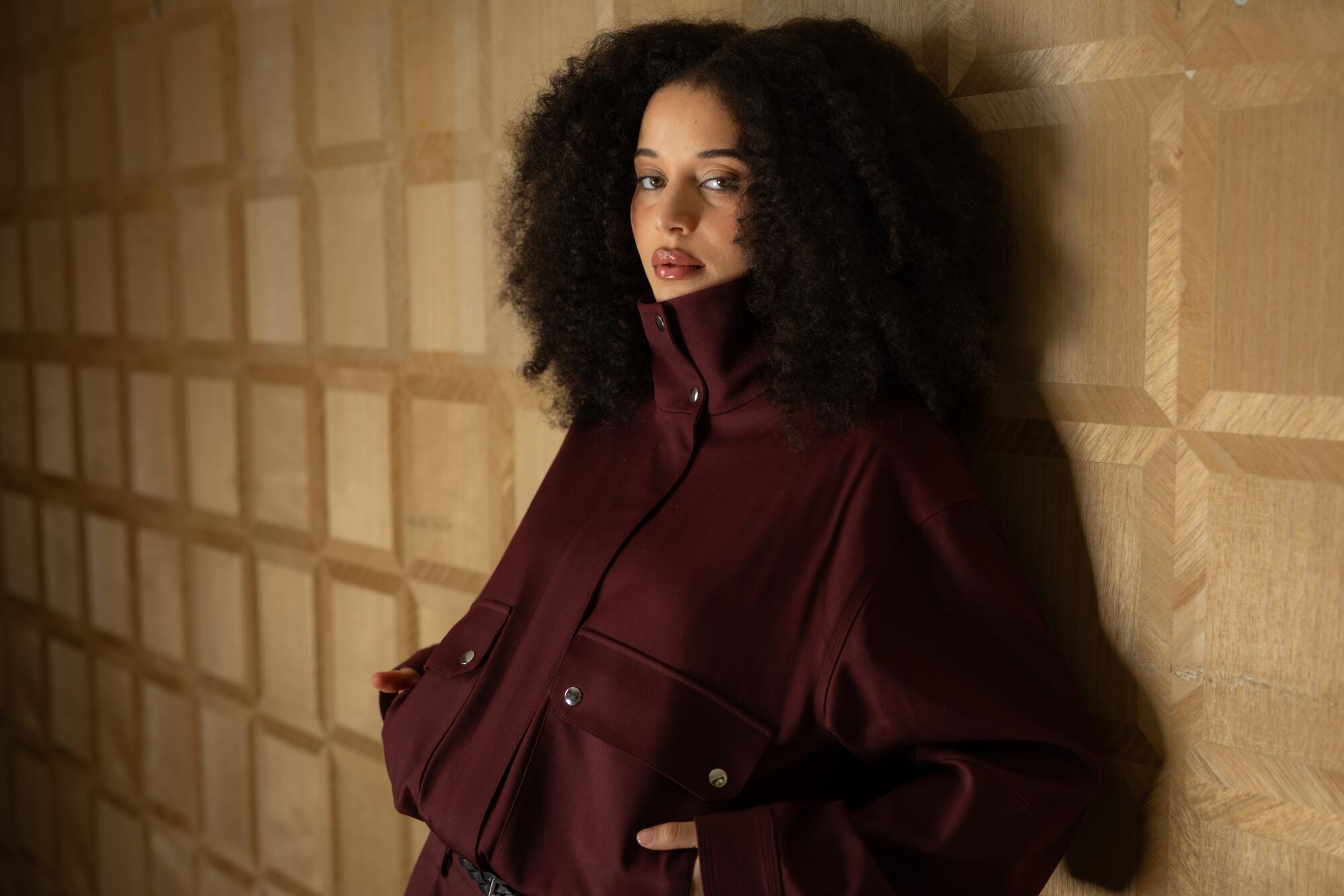
Chase Infiniti, photographed in late March ahead of “The Testaments” premiere.
(Jason Armond / Los Angeles Times)
Yvonne Villarreal: Chase, thanks so much for being here. Congratulations on your Emmy nomination. What do you want to remember about this moment, this feeling?
Chase Infiniti: Oh. I don’t know. I’m trying to take little pictures in my brain of everything and remember all of the influx of emotions that I felt that entire time, but also throughout the whole journey of making Season 1 of “The Testaments.” There’s so many things about it that I’m like — I just never want to lose that feeling. There’s a lot of [memorable] moments I had on set and also during the press tour and then even finding out about the Emmy nomination, which feels very crazy to say. But even finding out about that, there’s so many little things that I’m like, “I never want to lose that feeling. I want to keep it in my brain forever.”
Villarreal: Is it as thrilling as what you remember feeling when you booked that first role in a local production of “Hairspray,” when you were 10?
Infiniti: It definitely does. I also feel very grateful that with my job and with everything I get to do, I really try to keep intact how much I love the work and how much I love creating. That’s what helps it keep that same energy as me finding out I’m playing Crystal in “Hairspray” versus me finding out that I have an Emmy nomination.
Villarreal: Were you on Cloud 9 getting the news of Crystal?
Infiniti: Oh, yeah. I was so happy because I was it was the first time I ever had a name in a musical. And I remember when I was a kid, I watched the movie version of it every night for six months. Not a lie. Me and my sister would turn it on religiously after school and we would start singing “Good Morning, Baltimore.” It got to the point where we knew almost every line in the movie.
Villarreal: I feel old asking which version of “Hairspray”… Zac Efron? What was it about it?
Infiniti: It’s just catchy — everything about it. It just makes me happy, When I hear “Run and Tell That,” I just want to do twirls in my room. I love musicals so much and they make me so happy. If I’m ever down or need a little pick-me-up, I’ll literally just blast that soundtrack. I blast the soundtrack to “Pippin” or … “Shrek: The Musical.” I remember being in the production and it kind of brings me back to those happy memories I had ,or productions that I saw that I was like, “Oh, my gosh, this really makes me want to work towards being in something like that.” I love musicals.
Villarreal: It was just two years ago where the general public was starting to learn your name with your debut in Apple TV’s “Presumed Innocent.” Since then, you’ve navigated the film award season with “One Battle After Another,” and now the TV awards season with “The Testaments.” How do you make sense of what this moment is? Are there still things you’re getting used to? What have you enjoyed about this part of the job?
Infiniti: There’s a lot of things I’m still getting used to. Especially with “One Battle,” I think the biggest adjustment I had was people knowing me before I walked up to them — people that I’m massive fans of. I met Angela Bassett at something, and she came up to me and said my name, and I was like, “You’re Angela Bassett, and you know who I am?” That was like an “Oh, my gosh” [moment]. I’m still really adjusting to that. I feel like there’s a disconnect in my brain between like what I think people know of me versus what reality actually is. And my friends bring it up all the time and they’re like, “Chase, these people know who you are.” But I can’t wrap my head around that. It’s very strange, especially going from like a 0 to 100 situation. That’s something that I’m still trying to find an adjustment on in my brain.
[What have I] enjoyed about it? I’ve gotten to meet all of my superheroes, in a way. All the people that I’ve grown up watching on the screen and on the stage, [I’ve encountered at] all of these different events and in passing, and everyone could not be kinder and just getting to meet them and just pour into them how much they’ve shaped my life and shaped the creative work I want to do. Another adjustment thing is hearing them pour back into me too. That’s something that I’ve been getting used to. But meeting the superheroes of it all in my brain has been something I’ve really loved. Also getting to meet people who’ve watched “The Testaments”; like younger girls who’ve watched it and then really found a connection point with it, and it’s had an impact on them and their friends. That’s something I really cherish about getting to do what I get to do. I had it with “One Battle.” It’s really cool to see it happening again with “The Testaments.” That’s a very wonderful gift.
VIllarreal: Before we delve further into “The Testaments,” I do want point out this moment onstage at the Academy Awards. When “One Battle After Another” won best picture, Paul Thomas Anderson singled you out, calling you “My American girl” and the “heart of this movie.” Place me in that moment as Chase.
Infiniti: Well, I didn’t hear him. I just heard him say my name. I remember he was going down the list and saying names of different people, and I thought that it was something like that. I was touched that he even mentioned me onstage. Obviously, that movie has quite literally changed my life and that entire cast. And I love Paul so much. So I didn’t hear him onstage, and it wasn’t until afterwards that my parents had sent me a screenshot of the [closed] captions from that night. They were like, “This is what Paul said about you.” I just remember feeling so honored that I got to be a part of something that changed my life, but [it was a film that] also really, I think, changed a lot of people’s lives as well; they connected with it. I can distinctively remember every single day on that job. I just remember feeling such a rush of emotions after reading [what he said] because I love that movie and I love Paul so much. I could not be more grateful for that opportunity and for the opportunity to play Willa, let alone get to be a part of the crazy world that is a Paul Thomas Anderson set. But I learned so much. There’s so much I could say about it.
Villarreal: How did playing Willa inform how you thought about Agnes, who’s also this young revolutionary in the making, as you were putting yourself on tape for “The Testaments”?
Infiniti: I signed on to it with one script in mind. Obviously, I had read the book beforehand, so I had an idea of what she was going to go through, but I didn’t necessarily know how it was going pan out onscreen. The biggest help Willa [provided] beforehand going into that is, I feel like I, by nature, have a little bit of a rebellious spirit, but I really had to turn it up with Willa. I think that being able to access that through Willa and then shape it differently for Agnes, given the circumstances of where she is, was the biggest key between the two. They do share the strong sense of rebellion. Granted, Agnes doesn’t know where it comes from. She doesn’t really know how to handle it, necessarily. But I think that that was a nice way into Agnes and creating her world mentally of where she is and also the inner turmoil of, “I know that there’s this thing happening inside me, but I don’t really understand it.” I think [that] was the biggest cheat code from Willa to Agnes.
Villarreal: What was it about “The Testaments” that spoke to you and made you want to tackle the material?
Infiniti: Just from that one script alone that I read before I signed on, it was hidden that it was “The Handmaid’s Tale,” but you can get a sense of what the world is based off of that initial script. I just fell in love with how detailed it was. It didn’t feel like there were any question marks in the world, and I think that diving into something [like] that felt very interesting because it’s not otherworldly but it feels otherworldy in the sense of the way that they speak and the way Gilead itself looks on paper versus on the screen. That was something that I found to be very interesting. But I think with Agnes specifically, I really love the amount of love that she has for her friends, because that’s something that I feel very strongly about. My friends and my family, but especially my friends, are the people I cherish most in my life. My loved ones are near and dear to my heart, and I will do anything for them. That’s something that I really loved about Agnes. That makes me very happy to see, that even in a world that’s so dark and so dim — even if she doesn’t view it as that, it is dark and it is dim for a young girl in Gilead —she still has so much love and so much hope for her friends. And I found that to be very inspiring.
Villarreal: Did you have any hesitation about the heaviness of this fictional world?
Infiniti: I don’t think that that necessarily terrified me, because I think that I have this very privileged ability to step into this world that seems like it’s so far outside of what we are, I guess, used to — but it’s really not. Nothing that Margaret Atwood writes is fiction. It is all based off of history or things that are happening at the time that she’s written it. I knew that it was going to be very relevant. I’m in this very privileged position where this isn’t my reality, but this is the reality of so many women around the world. And I thought when I read this script that this was a way for people to not, I guess, become desensitized to seeing these things, because I think that we’re in a world where it’s so easy to just turn off your phone, scroll past something, and just ignore what’s actually really happening. With “The Testaments” and with the things that these girls go through, I truly feel heartbroken. But if this in any way can wake people up, can help people continue to ask questions and really question their own environments, that was something that I wasn’t scared of. And I really felt empowered to join something that was doing that. And I am also grateful that on that set, it never felt like the material was too heavy for a day because our entire cast and our entire crew kept the energy on set very light. And if there was ever a point where a day was extra heavy, I knew that I could turn to Lucy [Halliday, who plays Daisy] and she would always be there for me. I know that I can turn to one of the directors and they would always be there, or even one of the [production assistants]. Everybody on set was very forthcoming with kindness and always very open. That was something that helped to keep the heaviness of the subject matter [from] going home with us.
Villarreal: Agnes has only known obedience and repression. She’s very controlled with her emotions. As somebody with roots in musical theater, did you have to curtail some of those instincts that you might’ve had to be a little more expressive? How was it settling into Agnes?
Infiniti: It was honestly pretty easy because you get into the space, you get into the world, and you instantly are transported and you get little context clues based off of the things that you see in Agnes’ room versus the things that you’ve seen in the school — or the absence of things. The absence of things really helped to start to put me in a box in a way — not the negative connotation of that — like putting the costume on. It really helped for me to feel the restriction of the world to understand what Agnes’ mind is, and getting to see that from the outside and then getting to step into it. It wasn’t that hard to shut off that part of my musical theater brain, but I think part of that is also I’ve learned how to maneuver through that just based off of “Presumed Innocent” and “One Battle,” because both of those parts are also very, very much so not musical theater-y at all. So I think that was also something that I had the privilege of learning on both of those sets.
Villarreal: Something that stands out with Agnes is we’re witnessing her awakening. Gilead is all she’s ever known. And she’s very dutiful to the practices of that society. But she’s grappling with coming into her identity and feeling this gap of her internal thoughts and feelings and what society tells her to be. What was important to you in having those two realities live side by side?
Inifiniti: The one thing I never wanted her to lose was her sense of love. She is a character who that is at the root of most of her decisions, especially when it comes to the final episodes with Becka [played by Mattea Conforti]. I think the love that Agnes has in this world is something baseline I never want to lose. I really tried to maintain that throughout.
There’s so much that you keep to yourself — your inner thoughts, your inner personality in a way — versus what you outwardly show the world. I just had to turn up the extremes when it came to Agnes, and really make sure to keep those things that she keeps close to her heart guarded. And put on this almost armor in a sense of what she views to be the most perfect version of herself for the outside world. And then watching that kind of crumble, those layers are peeled apart based off of what happens to her and what she sees happen to her friends. But also, there’s a point in everyone’s life where they realize, “Oh, what I had been raised under the belief of is actually not the reality. Whether it be something like that or whether it be an idea or an ideal that you have about the world or about yourself or your morals, just based off of what you’ve been raised with. I think that everybody has a point in their life where they have to face a version of reality that they’ve been told versus what actually is reality. There’s things that I’m still learning, and there’s still things that I’m questioning just based off of what I see in my personal life, and then also with my friends or what my family goes through.
Villarreal: A key character in the show is menarche and the menstrual cycle. We see how it’s weaponized, but we also see how it gives these young girls their power. What was it like to explore that?
Infinti: The thing I honestly really enjoyed about it is the openness of it. Like, you know when you go to the bathroom — and this is perfect podcast talk — and you’re taking your pad or your tampon to go change, but you’re hiding it because you’re like, “I don’t know if I want anybody to see it” [or hear] the crinkling of everything. But I think that the openness of everything in the show — granted, circumstances are completely different — but the openness that they have with it, I found to be very freeing and refreshing in a way. That was something, especially when we started shooting, that we all talked about, because we were like, “We’ve never been in a place where it didn’t feel like there was a stigma against it.” It felt like we were almost encouraged to talk about it. Getting to put this show out into the world and letting girls see that there isn’t something that they should be afraid of, but also letting them see that this is normal. This is not something that we should be scared of, let alone try to hide, because it’s a part of womanhood. It’s also a part of girlhood and a point of connection between younger girls. Getting to see it on the screen and see the way that these girls talk about it, ignoring the society of Gilead and the amount of pressure that the men put on them in this society, that connection that they have with those few things that span across culture, that is something that we were all very happy to kind of have that openness with something that we’ve felt so scared to talk about, especially at like 14 and 15.
Villarreal: Scared to experience too.
Infiniti: I remember when I got my period for the first time I was like, “What is happening? I don’t know what is going on.” The first person that you call, if it’s not your mom or another maternal figure in your life, is your friends. Because they’re normally the person closest to you in proximity if you’re at school or if you were at an after-school activity or something like that. Getting to have that openness felt very refreshing to have on set.
Villarreal: There was so much openness that there was a menarche playlist curated by director Mike Barker. Tell me the backstory on this.
Infiniti: We did. I’m trying to remember how we found out about this playlist. We were doing a camera test for the costumes, and I remember Mike just putting on this playlist and he’s like, “I like putting up these songs for everyone to listen to” because there was no dialogue in this little camera test between me, Mattea, Rowan [Blanchard], Lucy, Brad [Alexander], Amy [Seimetz] and Mabel [Li] — I can’t remember if I might be forgetting somebody else, and I’m so sorry if I am. But it was a bunch of the cast and then there was also some pinks in there just to see how everything looks on camera. And we were hearing all these different songs playing. We’re like, “Wow, this is great. Thanks for putting together a playlist, Mike.” At some point, Lucy went to grab his phone to look at what the song was and his playlist was open, and she’s like, “Why is the playlist called ‘The Menarche Playlist’? And after that, it just became us trying to get him to approve a song that we would suggest.
Villarreal: I remember you telling me Britney Spears’ ”… Baby One More Time” was on it. But I had wondered who else made the cut.
Infinti: “… Baby One More Time” was on it. I think that was the first song on it, but there would be points in lunch — we’d all eat lunch together — and we’d be like “OK, Mike, what about this one for the menarche playlist, or what about about this one?” We would all secretly hope that they would get added to the show.
Villarreal: Did one of your suggestions get added?
Infiniti: There are songs on there that I don’t even remember. So one of them probably did get added. I just don’t remember what it was.
Villarreal: Agnes is somebody that doesn’t really experience culture. We don’t know what kind of music she likes, what kind of TV or film she likes. And you’re someone that’s very much into culture, at least from what I’ve seen. Were you thinking about what she might like? How did you think about her backstory with that kind of absence?
Infiniti: I was really just relying on what you saw of her in “The Handmaid’s Tale,” and that was the extent of what I would let a part of her backstory be because she doesn’t remember much about her childhood. Once she becomes conscious, in a way, in Gilead, all I did was rely on the things that I knew that she liked and really try to remind myself, “She doesn’t know what a movie is. She knows what ‘Jaws’ is, but she doesn’t really have an understanding of what watching a movie is like. She doesn’t know what YouTube is, she doesn’t know what a phone is.” I had to keep reminding myself, especially at the beginning, to not put those things in the forefront of our minds, unless, of course, like you’re a Pearl girl who has prior knowledge of everything. A lot of it was just reminding myself, “You don’t know what this is, she doesn’t know what this is.” If I were to meet Agnes right now, she would probably think I was crazy because she just doesn’t understand a lot the things I’ve seen, and the things that we use in our day-to-day life, and I really tried to make sure to keep that intact, but also relying on the bits of information that I had from “The Handmaid’s Tale” going back to the show. And also, of course, we had Bruce Miller, so I could ask him anything.
Villarreal: What would you, Chase, expose her to? If she were to come to you, what she should be listening to or watching, what’s the guide you’d give her?
Infiniti: The crash course to being 14? I would show her One Direction. I’m sorry. That is something that is so quintessential to being a 14-year-old, especially me being 14. I would be like, “Agnes, I see the things that you love and you’re obsessed with. I’m going to show you the thing that I was in love and obsessed with when I was your age.” I would be very curious to see how she would react to hearing One Direction for the first time; hearing “What Makes You Beautiful,” that would be interesting to see. I would show her something that is representative of me being her age. I still am a fan. I’ve always been a fan my whole life, but especially One Direction, that’s probably something I would show her.
Villarreal: Who was Chase at 14? You talked earlier about having a little bit of that rebellion in you. And after playing these two characters back to back, what have you sort of learned yourself, about your power or finding your voice, especially in an industry like Hollywood?
Infiniti: Something that I realized when I was probably about 13 or 14 is, I used to be very upset when people would underestimate me. I found a way to, I guess, not make it my superpower … but use it as opposed to [letting it be] something that would defeat me. [I would] use it as something to continue to motivate me to work towards the goal that I already had because there’s always gonna be people that underestimate you. There’s always going to be people in the world that want to pour negativity into you when you’re truly just living your life, working towards the things that you want. That was something that I realized pretty young because I knew at 10 that I wanted to be an actor. And so at that point, I kind of made a shift in my mind where I was like, “OK, I need to start working towards the thing that I want to do.” At 13, people were like, “Why are you so motivated to do this? It’s a bit embarrassing that you want to be an actor. What makes you think you can do that?” And I was like, “Because I want to do it.” I never had a doubt in my mind that this would be the thing that I would get to do because that was something that my parents always told me. They were like, “Dream big because the dreams that you’re imagining can be your reality, especially if you work hard enough towards it.” And I feel very lucky that I get to do the thing I’ve always dreamed of doing.
Villarreal: How does that live side by side with also learning how to deal with rejection so young?
Infiniti: It’s a lot of tears, a lot of sad days, sad weeks, conversations with my friends, conversations with parents. But from being underestimated, I remember my dad being like, “You have to get comfortable with ‘no.’ And it’s not going to be fun. It’s not gonna be something that you’re excited to hear, because no one’s excited to hear that they didn’t get something that they really wanted.” Now I’m at a point where I’ve really learned how to process it and not let a no or a rejection affect my view of myself or affect my view of a performance or my abilities to do anything. It took a long time to learn, and I’m still nowhere near perfect, but I’m definitely at a place that’s better than when I was 13 because it is hard for somebody that young to get that amount of rejection. It’s also hard for somebody at my age to handle that level of rejection, especially when you get so close to something. I have to give that credit to processing those things to my parents because that is all them. I had many tear-filled nights when I was a kid because I was so sad that I didn’t get a solo in something, and they’re like, this doesn’t mean that you’re not talented. I’m also somebody who believes the right things will find you. And they’re [my parents] also the people that kind of instilled that in me too.
Villarreal: Does that reframing of no also give you the confidence to approach Leonardo DiCaprio and Benicio del Toro and say, “Will you make a TikTok with me?”
Infiniti: It honestly was like a lot easier than I thought it was going to be. I was very specific. I did lots of research because I also was like, “I want it to be something that they can look at and also laugh at.” They can enjoy it.
Villarreal: Do you think you’ll get there with Ann Dowd? A TikTok?
Infiniti: I would love to. I don’t know what it would be, but I would love to make a TikTok with Ann Dowd one day. If it could be like all the girls on set making a TikTok, I would be very happy. I do have some planned. So, we’ll see.
Villarreal: Margaret Atwood makes a cameo in the finale of Season 1. How do you even talk to Margaret Atwood when you meet her? What was that experience like for you?
Infiniti: The person who was probably the most shocked was Lucy because Lucy Halliday is the biggest Margaret Atwood fan I think I’ve ever met. I had the gift of getting to witness Lucy meeting Margaret for the first time. But meeting her — she’s so kind. [Producer] Warren Littlefield says this all the time where he’s like, “You can’t talk to Margaret Atwood and not learn something with every conversation.” I just remember being very quiet and listening to her talk and listening to her ask questions of me, ask questions of Lucy, but we would just pour into her and be like, “Thank you so much for your work because you truly have touched millions.” She’s also so funny and so witty and very charismatic. I remember being very nervous beforehand, but she made it very easy for our nerves to go away. The highlight was getting to see Lucy meet Margaret.
Villarreal: You’re about to head out to Canada to start production on Season 2. You’ve seen two scripts. What do you hope to see for Agnes in Season 2?
Infiniti: I hope Agnes is happy, and I hope that she can continue to push and find her happiness. I hope that she doesn’t lose her spark, and I hope that’s something that she continues to explore and understand why she is the way that she is. Those are two hopes that I have.