audience member

‘5 Lesbians Eating a Quiche’ becomes an immersive experience in L.A.

Anxieties due to war. A culture inhospitable to LGBTQ+ communities. And an underpinning of loneliness and suppressed yearning.

The play “5 Lesbians Eating a Quiche” is set in 1956, but its themes resonate in 2026. The United States is at war. Attacks on gay marriage and other LGBTQ+ rights remain a cornerstone of today’s conservative movement. A reimagining of the 2011 production, one popular with universities and fringe festivals, seeks to further modernize the show in which a morning gathering quickly turns into a stay in a Cold War-era bomb shelter after near nuclear annihilation.

When I arrived at the back room of a Glendale church, I was given a new name. It was clear that “Todd” was not welcome here. “Joan” turned out to be a suitable replacement, and I was immediately asked how my life had been since my husband had died. For on this night I would no longer be occupying the role of a straight white male. Every audience member is asked to take on the persona of a widow, for losing a husband appeared to be a perquisite to enter this meeting of the Susan B. Anthony Society for the Sisters of Gertude Stein.

How did he die, I was asked. “Ski accident,” I blurted out. “Yours?” A camping travesty that led to a bear mauling, I was told. Ad-libbing, in addition to quiche, was on the menu tonight. Metaphors, absurdities and seriousness intermingle in this production from New Forms LA and directed by Marissa Pattullo.

Pattullo’s vision for “5 Lesbians Eating a Quiche” ramps up the interactivity, seeking to transform a largely traditional proscenium show, albeit one with a few moments of fourth-wall breaking, into one that is centered around audience participation. Staged in a flex space without a tinge of irony at the Glendale Church of the Brethren, “5 Lesbians,” written by Evan Linder and Andrew Hobgood, has been reconstructed as a largely immersive production, that is one that asks audiences to lean in and interact.

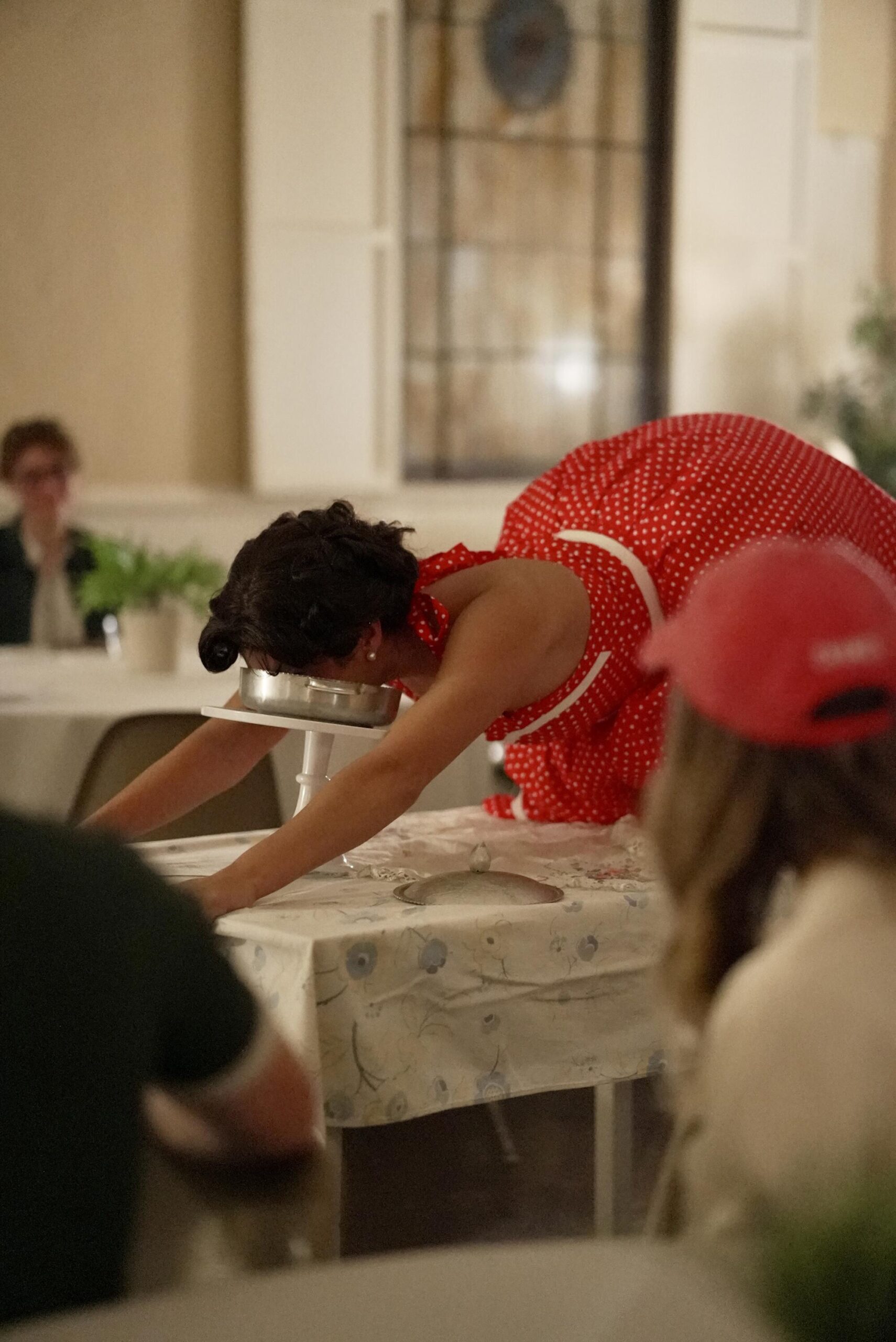
An actor on all fours on a table eating a quiche.

Jessica Damouni’s Ginny Cadbury devouring breakfast in “5 Lesbians Eating a Quiche,” a show that unfolds as a giant metaphor.

(New Forms LA)

While there is a small stage, it is used sparingly. The five-person cast roams the room, sitting at various circular tables to blur the lines between script and improvisation. Typically a svelte 75-minute show, on the night I saw the production it swelled to about two hours, allowing time for drinks, mingling and, of course, the eating of a quiche. Pattullo has added an intermission, with quiches courtesy of Kitchen Mouse and Just What I Kneaded included in the ticket.

For quiche, I was told often, was the primary topic of conversation at the Easter-timed meeting, so much so that it was clear within moments that this was a gathering not of breakfast enthusiasts but of the repressed. The hidden meaning is no secret; it’s in the title of the play.

“It’s a giant metaphor,” Pattullo, 30, says. The show, she adds, “keeps finding ways to make sense with the times, whether it’s Trump being elected, or we’re at war. Or gay marriage. All of those things. A bomb going off and being trapped inside. It speaks to whoever is watching it.”

Pattullo, who splits time building New Forms LA and serving tables at Los Feliz’s Little Dom’s, first discovered the show while in college in the Midwest. It immediately resonated, and Pattullo has been tinkering with ways to perform it live ever since. During the worst of the COVID-19 pandemic, she staged an online version of the show, and debuted it as an immersive production last winter. It’s back for two weekends this month.

“5 Lesbians” makes a relatively smooth transition to the immersive format. Perhaps that’s because the audience, in the script, is cast as attendees of the Susan B. Anthony Society for the Sisters of Gertude Stein’s brunch meeting, whose motto is “no men, no meat, all manners.” For about the first 30 minutes of the show we largely interact with the actors. Dale Prist (Nicole Ohara) has hidden ambitions. Vern Schultz (Chandler Cummings) seems ready for the group to cut its charade. Lulie Stanwyck (Noelle Urbano) is fighting so hard to stay prim and proper that she feels on the verge of bursting.

“I really like to play,” Pattullo says, referencing how “5 Lesbians” lends itself to improvisation. “Some of the girls I think are very ‘stick to the script.’ I’m like, ‘Stray from the script.’ If people come in late, call them out. If people are talking, call them out. You can adjust and improvise in immersive theater. Having a script but being able to break from it, is really fun for me. It tickles me.”

Three actors in 1950s period garb surround a table with breakfast.

Wren Robin (Emily Yetter), Vern Schultz (Chandler Cummings) and Lulie Stanwyck (Noelle Urbano) protect breakfast in “5 Lesbians Eating a Quiche.”

(New Forms LA)

There’s an underlying tension in the show because it walks a line between silliness and graveness. Ultimately, “5 Lesbians” is about finding joy in dark times, and moments inspire uncomfortable laughter, such as jokes about gay marriage being legal in four years’ time (1960) or Ginny Cadbury (Jessica Damouni) devouring a quiche in a way that leaves nothing to the imagination. But it’s also a show about how stressful moments can bring about vulnerability and community, as the whole church practically exhaled when Wren Robbin (Emily Yetter) finally let her hair down and expressed who she truly was.

“5 Lesbians Eating a Quiche”

“Even when we did it back when I was in college, Trump had just won, so it just feels like it’s keeping relevant,” Pattullo says. The timeliness, she says, makes it such an amusing play to perform.

Pattullo will sometimes, depending on cast availability, take on a role in the show. It’s a chance, she says, to amplify the play’s wackiness, which she believes helps puts audiences at ease and makes its difficult subject matter easier to digest. She tries to create the most outlandish tale possible for when relaying to guests one on one how her husband perished.

“My story was a raccoon attack,” she says. “Because my husband thought the raccoon was behaving with foreign intent, like the raccoon was a spy or something. It was just stupid.”

Or it was evidence of how immersive theater can delight when it deviates from the script.
Source link

‘Every Brilliant Thing’ review: The interactive Daniel Radcliffe

What makes life worth living? For hard-core “Harry Potter” fans with money to burn, it might be getting Broadway tickets to interact fleetingly with Daniel Radcliffe in “Every Brilliant Thing,” an ingenious and touching solo performance piece written by Duncan Macmillan with Jonny Donahoe on the subject of suicide — or more precisely, on the ordinary joys that militate against such a drastic step.

Radcliffe was breathlessly scampering up and down the aisles of the Hudson Theatre before the show began, enlisting audience members to be participants in the play. Having seen “Every Brilliant Thing” twice before, once at the Edye (the black box at Santa Monica’s BroadStage) starring Donahoe in 2017 and once at the Geffen Playhouse’s intimate Audrey Skirball Kenis Theater starring Daniel K. Isaac in 2023, I knew exactly what he was up to.

The play revolves around a list that the narrator began at the tender age of 7 after his mother first attempted suicide. While she was still in the hospital, he started compiling, as much for her benefit as for his own, sources of everyday happiness.

Ice cream, water fights, kind people who aren’t weird and don’t smell unusual. These items are given a number, and audience members assigned a particular “brilliant thing” are expected to shout out their entry when their number is called.

The list gradually grows in complexity as the narrator gets older. Miss Piggy, spaghetti bolognese and wearing a cape give way to more sophisticated pleasures, such as the way Ray Charles sings the word “You” in the song “Drown in My Own Tears” or the satisfaction in writing about yourself in the second person.

Music plays a prominent role in “Every Brilliant Thing,” which was adapted from a monologue/short story Macmillan wrote called “Sleeve Notes.” The narrator’s terribly British father takes refuge from the emotional storms of his household by listening to jazz records in his office. John Coltrane, Cab Calloway, Bill Evans, Nina Simone are favorite artists, and the narrator can tell his father’s mood simply by the record he’s decided to play.

The production, directed by Jeremy Herrin and Macmillan, involves every level of the Hudson Theatre. I assumed I would be safe, occupying an aisle seat in the murderously expensive prime orchestra during a press performance attended by critics. But I wasn’t flashing a pad as my colleague across the aisle from me was doing to ward off any intrusions. And just before the show was about to start, Radcliffe was suddenly kneeling beside my seat asking if the person I was sitting with was my partner.

I told him that we weren’t a couple, just friends, and that I would be the worst person he could possibly ask to perform anything. But Radcliffe wasn’t so easily put off. “Let’s just say that you’re an older couple who have been together for some time,” he whispered. “And all you have to do is hand me this box of juice and candy bar when I refer to the older couple.”

OK, what harm could there be? Little did I know that “older couple” was to become “old couple,” a term that seemed to be repeated incessantly, at least to my Gen X ears not yet accustomed to scurrilous millennial attacks! I composed myself by pretending that we were in the world of anti-realism. But in truth, I would like to be the kind of person who would offer an anxious kid in a hospital waiting room a juice box and a candy bar, so maybe the casting wasn’t so far-fetched after all.

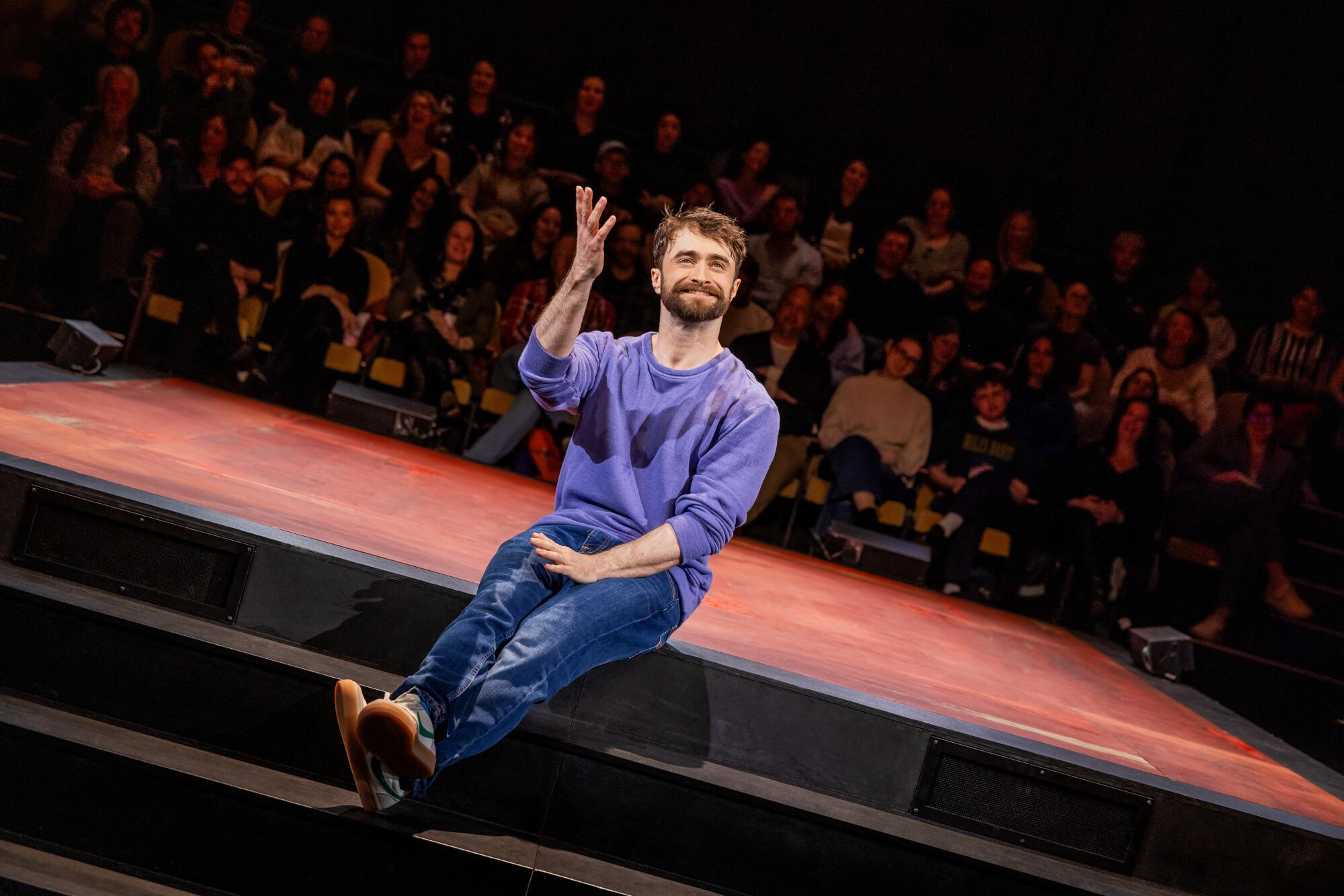
Daniel Radcliffe in the Broadway production of "Every Brilliant Thing."

Daniel Radcliffe in the Broadway production of “Every Brilliant Thing.”

(Matthew Murphy)

A theatergoer was called upon to play the vet who euthanized the narrator’s childhood pet, a dog named Indiana Bones that was symbolized by a coat someone volunteered from the audience. It was the boy’s first experience of death, a difficult concept for a young mind but an important precursor for a boy not given the luxury of existential innocence.

Other audience members, particularly those seated on the stage, played much more elaborate roles. One man, first invited to serve as a stand-in for the narrator’s father, was asked instead to play the boy. He was given one word to say in reply — “Why?” — as his father tries to explain the reason his mother is in the hospital. This same enlisted actor was later called upon to play the dad giving a toast at his son’s wedding, one of the rare occasions when he was able to summon language for the kind of deep feeling he would normally only be able to express through his records.

One kind and patient spectator conscripted to play the school counselor had to remove her shoe to improvise a sock puppet, one of the tools of her empathetic practice. Another audience member sensitively played Sam, the narrator’s love of his life, a relationship that reveals the long-term toll of being raised by a parent suffering from suicidal depression.

Radcliffe’s audience wrangling was as intuitively sharp as his deeply felt performance. He has the comfort of a good retail politician, who’s not afraid of making direct contact with crowds. Two-time Tony winner Donna Murphy, in the house at the reviewed performance, gamely went along when Radcliffe briefly enlisted her luminous services.

Obviously, Radcliffe is the main reason “Every Brilliant Thing” is on Broadway. The show, which began at Britain’s Ludlow Fringe Festival in 2013, is a gossamer piece, a 70-minute curio best experienced in close quarters without the high expectations and ludicrous prices of New York’s turbo-charged commercial theater. The Hudson Theatre lends a mega-church vibe to the proceedings, but the spirits of theatergoers are nonetheless moved.

A scruffy-faced Radcliffe, twinkling accessible geniality in jeans and a sweatshirt, zips up and down the cavernous theater as though waging a one-man campaign against the isolation epidemic. There’s no denying that Harry Potter has matured into an assured stage actor. His Tony-winning performance in “Merrily We Roll Along” should have put to rest any doubts, but the glare of his fame can still obscure his serious chops.

Sincere yet never smarmy, ironic without ever being cynical, well-groomed though far from swank, he’s a more glamorous version of the character than the one originated by Donahoe, the British comedian with an everyman demeanor whose portrayal seemed so genuine at the Edye that I mistakenly thought that the play was his personal story.

Donahoe’s performance was filmed for HBO, but “Every Brilliant Thing” is meant to be experienced in a theater. The whole point of the show is to transform the audience into an impromptu ensemble, a group of strangers emotionally united through the story of one young man’s intimate knowledge of suicide, a subject that Albert Camus called the “one truly serious philosophical problem.”

I’m of two minds about “Every Brilliant Thing.” I was moved once again by the piece, but I’m grateful I didn’t have to wreak havoc on my credit card to pay for my seats. I love the interactive, gentle humanity of the play, but I was also acutely aware of how the work has been commodified. I applaud Radcliffe’s willingness to carve an independent path as an actor, but I might have been more impressed by his adventurousness had he decided to perform in a pocket venue that didn’t have the tiers of pricing I associate with airlines.

Yet launching a conversation around mental health with an audience magnet as powerful as Radcliffe is on balance an excellent thing. And Radcliffe’s compassionate portrayal of a survivor recognizing that he’s not out of the woods just because he made it into adulthood is one of those things that makes a theater lover just a little more appreciative of the humanity at the center of this art form.

Source link