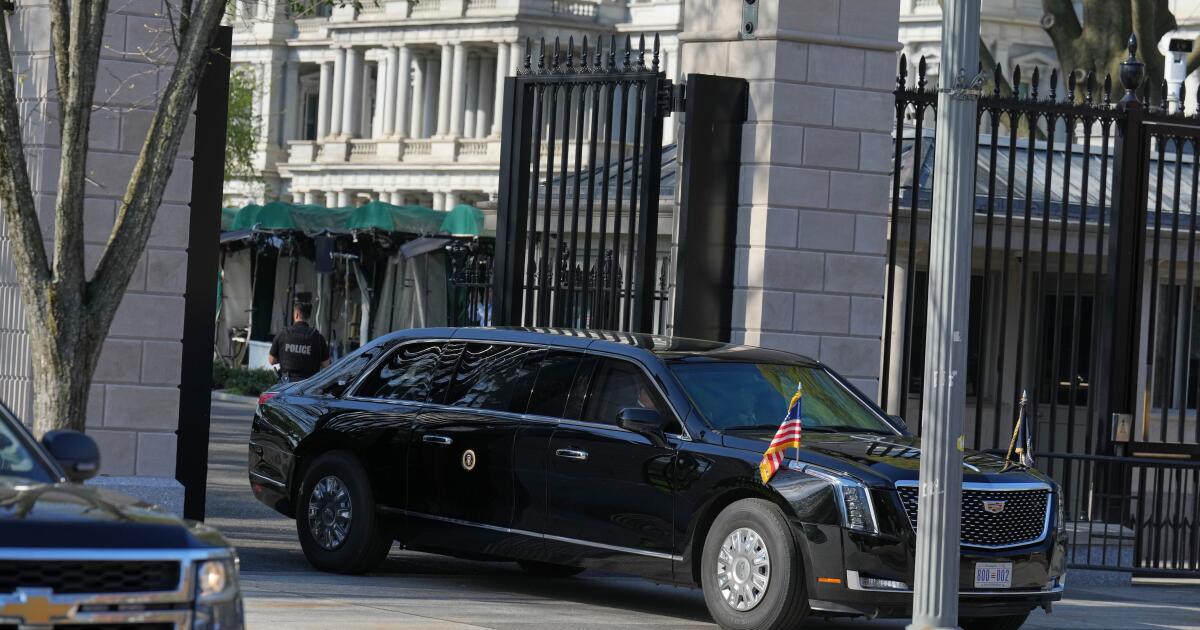

arrives

Guinea-Bissau’s deposed President Embalo arrives in Senegal after coup | Military News

Senegal’s Foreign Ministry says Umaro Sissoco Embalo arrived in the country a day after he was deposed in a military coup.

Guinea-Bissau’s deposed president, Umaro Sissoco Embalo, has arrived in Senegal, the country’s Ministry of Foreign Affairs has confirmed, a day after a group of military officers in Guinea-Bissau seized power in a coup.

Senegal’s Foreign Ministry said in a statement on Thursday night that Embalo had arrived in Senegal after authorities engaged with actors in Guinea-Bissau to try to secure his release.

Recommended Stories

list of 3 itemsend of list

Embalo reached Senegal on board an aircraft chartered by the Senegalese government, it said.

“The government of the Republic of Senegal reaffirms its readiness to work alongside ECOWAS, the African Union and all relevant partners, with a view to supporting dialogue, stability and the rapid restoration of constitutional order and democratic legitimacy in this brotherly nation,” the statement said.

Embalo was deposed on Wednesday after military officers announced they had seized “total control” of Guinea-Bissau ahead of the expected release of presidential election results in the West African nation.

Embalo had been vying for re-election against his main challenger, Fernando Dias. Both had declared victory ahead of the release of the provisional results.

But the main opposition PAIGC party was barred from presenting a presidential candidate, raising criticism from civil society groups, which said the election was illegitimate.

Dubbing themselves the “High Military Command for the Restoration of Order”, the military officers read out a statement on television on Wednesday, declaring that they had ordered the immediate suspension of the electoral process “until further notice”.

They also ordered the closure of Guinea-Bissau’s borders and an overnight curfew.

On Thursday, General Horta Inta-A was sworn in as the country’s transitional president, defending the military takeover by saying that there had been “sufficient [evidence] to justify the operation”.

But the coup – one of several to hit Guinea-Bissau since the country gained independence from Portugal in 1974 – has spurred widespread concern, including from regional bodies.

The chairperson of the African Union Commission condemned the situation earlier on Thursday, calling for the immediate and unconditional release of Embalo and all other detained officials.

Mahmoud Ali Youssouf also urged “all parties to exercise the utmost restraint in order to prevent any further deterioration of the situation”.

Source link

Maduro Literally Rattles His Saber As Hegseth Arrives In Caribbean

As U.S. President Donald Trump continues to mull his options for dealing with Venezuelan dictator Nicolas Maduro, Secretary of War Pete Hegseth arrived in the Caribbean to meet with regional leaders. The visit comes as the U.S. has built up a large military presence in the region and the world awaits what Trump will do next. You can catch up with our most recent coverage of the Caribbean operation in our story here.

“The Secretary will meet with President Luis Abinader, Minister of Defense Lt. Gen. Carlos Antonio Fernández Onofre and Cabinet officials to strengthen defense relationships and reaffirm America’s commitment to defend the homeland, protect our regional partners and ensure stability and security across the Americas,” according to the Pentagon. His visit follows a trip to the region by Air Force Gen. Dan Caine, Chairman of the Joint Chiefs of Staff, who returned to Washington last night.

Though Trump says he is open to discussions with Maduro that could avoid hostilities, the South American leader continues to show outward displays of defiance.

On Tuesday, Trump remained coy about his intentions for what has been dubbed Operation Southern Spear, ostensibly a counter-narcotics effort but one also aimed at pressuring Maduro.

“I might talk to him. We’ll see,” Trump told reporters Tuesday night aboard Air Force One in reference to Maduro. “But we’re discussing that with the different staffs. We might talk.”

Asked why he would want to talk to Maduro after his administration designated the cartel he allegedly leads a foreign terrorist organization (FTO), Trump noted that the Venezuelan leader has two options. As we previously discussed, the FTO designation opens the aperture on the ability for Trump to order kinetic operations against Venezuela.

“If we can save lives, we can do things the easy way, that’s fine,” Trump explained. “And if we have to do it the hard way that’s fine, too… I’m not going to tell you what the goal is. You should probably know what the goal is. But, they’ve caused a lot of problems. And they’ve sent millions of people into our country.”

PRESIDENT TRUMP on potential talks with Venezuelan President Nicolás Maduro: “If we can save lives, if we can do things the easy way, that’s fine. And if we have to do it the hard way, that’s fine too.” pic.twitter.com/g8pxPvcfgv

— Fox News (@FoxNews) November 26, 2025

For his part, Maduro tried to exude an aura of confidence on Tuesday, invoking the memory of national hero Simon Bolivar to rally a nation under the gun. You cannot travel far in Caracas or much of the rest of the country without coming upon a memorial to Bolivar, who liberated the country from Spain 200 years ago and remains highly revered.

Speaking at an event honoring that liberation, Maduro urged Venezuelans to fight “foreign aggressors” just as Bolivar did.

“We have to be capable of defending every inch of this blessed land from any sort of imperialist threat or aggression, wherever it comes from,” Maduro, clad in camouflage from head to toe, exclaimed. “I swear before our Lord Jesus Christ, that I will give my all for the victory of Venezuela.”

“We must be ready to defend every inch of this blessed land from imperialist threat or aggression, no matter where it comes from,” Maduro continued as he brandished a sword believed to have once belonged to Bolivar. “There is no excuse for anyone to fail at this decisive moment, for the existence of the Republic, no excuse.”

CARACAS, VENEZUELA - NOVEMBER 25: President of Venezuela Nicolás Maduro delivers a speech while holding the Venezuelan independence hero Simon Bolivar's 'Sword of Peru' during a military ceremony on November 25, 2025, in Caracas, Venezuela. The United States recently designated the "Cartel De Los Soles" (Cartel of The Suns) as a foreign terrorist organization, a group allegedly led by the president of Venezuela, Nicolas Maduro, and which, it is presumed, includes high-ranking members of the Venezuelan government. (Photo by Jesus Vargas/Getty Images)
President of Venezuela Nicolás Maduro delivers a speech while holding the Venezuelan independence hero Simon Bolivar’s ‘Sword of Peru’ during a military ceremony on November 25, 2025, in Caracas, Venezuela. (Photo by Jesus Vargas/Getty Images) Jesus Vargas

While the Trump administration insists that its efforts are ultimately aimed at stopping the flow of drugs into the United States, the president of Colombia told CNN that there is another motivation for the large military buildup.

Oil “is at the heart of the matter,” Gustavo Petro claimed to CNN in an exclusive interview, noting that Venezuela has what are considered the largest oil reserves in the world.

“So, that’s a negotiation about oil. I believe that is (US President Donald) Trump’s logic. He’s not thinking about the democratization of Venezuela, let alone the narco-trafficking,” he continued, adding that Venezuela is not considered a major drug producer and that only a relatively small portion of the global drugs trade flows through the country.”

Of course, Petro’s point of view has to be seen as coming from a leader who has been at odds with Trump. Since the American president returned to the White House, Petro “has harshly criticized the Trump administration’s immigration policies, its support for Israel and its military activity around Latin America,” the cable network noted. Trump, meanwhile, has sanctioned Petro for a perceived lack of support in drug interdiction efforts.

“Trump is not thinking about the democratization of Venezuela, let alone the narcotrafficking. It’s about oil.”

Colombian President Gustavo Petro speaks exclusively to @IsaCNN about why the US president is targeting Venezuelan President Nicolás Maduro. pic.twitter.com/EtjYsQVIuS

— CNN International PR (@cnnipr) November 25, 2025

Whether Trump is considering offering Maduro an off-ramp before what could be airstrikes on targets in Venezuela or a covert action to depose the South American strongman remains unknown. However, there are indications that Maduro is not interested in a negotiated exit from power.

“The calculation for Maduro is that he will always be safer here than anywhere else,” Phil Gunson, an analyst in Caracas for the International Crisis Group, told The Wall Street Journal.

With a $50 million bounty on his head as the result of being a fugitive from U.S. drug charges, Maduro likely feels unsafe outside his cocoon of protection in Venezuela. 

Beyond that, the list of countries that would take him and provide security is short. Russia or Cuba might, but as the Journal noted, refuge in a European capital or elsewhere would bring limited security from those seeking not just material reward, but also revenge after years of what many consider a despotic rule.

The public statements issued by both Trump and Maduro in recent days contrast with previous sentiments. While Trump has left speaking with Maduro as an option, he reportedly privately turned down de-escalation overtures from the South American leader. Meanwhile, though Maduro is putting on a brave face, it was said that he was open to leaving power in exchange for amnesty for him and his lieutenants, the lifting of the bounty and a comfortable exile, according to claims in a report from The Atlantic.

Meanwhile, there are 15,000 U.S. troops, a dozen ships and an array of aircraft in the Caribbean waiting for orders. To highlight that presence, the military has produced a steady stream of videos pushed out on social media. They show U.S. forces on ships like the aircraft carrier USS Gerald R. Ford, or land-based in Puerto Rico, training and preparing.

An F/A-18E Super Hornet launches from the flight deck of the world’s largest aircraft carrier, Ford-class aircraft carrier USS Gerald R. Ford (CVN 78), in the western Atlantic Ocean.

U.S. military forces are deployed to the Caribbean in support of #OpSouthernSpear.… pic.twitter.com/9mb4sJocJP

— U.S. Southern Command (@Southcom) November 26, 2025

The flight deck never sleeps.

The world’s largest aircraft carrier, Ford-class aircraft carrier USS Gerald R. Ford (CVN 78), conducts night flight operations in the Caribbean Sea. 

U.S. military forces are deployed to the Caribbean in support of the U.S. Southern Command… pic.twitter.com/sZwhTiH5J2

— U.S. Navy (@USNavy) November 25, 2025

These visuals are part of the Trump administration’s increasing pressure campaign on Maduro. On Nov. 24, Air Forces Southern Command publicized another Bomber Attack Demonstration, with B-52H Stratofortresses from Minot Air Force Base conducting the mission in the Caribbean. It was at least the second such demonstration in a week.

As we explained in an earlier story, the B-52s “are capable of unleashing waves of standoff cruise missiles and can carry a host of other conventional munitions that can be employed against targets on land and at sea. Though the Venezuelan armed forces have limited air defense capabilities, they could still pose a threat. Standoff strikes from aircraft like the B-52 and other assets would be a likely component of any future U.S. direct action against targets inside the country to help reduce risks to friendly forces. They could even target air defense systems to help clear the way for follow-on operations.”

.@usairforce B-52H long-range bombers from @TeamMinot conducted a Bomber Attack Demo in the Caribbean Sea in support of Operation Southern Spear, bringing Hemispheric security & stability, Nov 24. During the mission, USAF integrated with fighter jets & trained on rapid mobility. pic.twitter.com/cQAhMJMV5c

— Air Forces Southern (@AFSOUTH) November 26, 2025

All the while, American men and women will spend another holiday away from home, a fact of life in the service. Whether they will be pressed into action against Maduro remains unknown.

Contact the author: [email protected]

Howard is a Senior Staff Writer for The War Zone, and a former Senior Managing Editor for Military Times. Prior to this, he covered military affairs for the Tampa Bay Times as a Senior Writer. Howard’s work has appeared in various publications including Yahoo News, RealClearDefense, and Air Force Times.


Source link

New U.S. ambassador arrives in Chile, sparks controversy with government

U.S. President Donald Trump (L) listens to then National Border Patrol Council President Brandon Judd (C) deliver a statement on border security in the James Brady Press Briefing Room of the White House in Washington in January 2019. Now ambassador to Chile, Judd sparked controversy with his press conference. File Photo by Michael Reynolds/EPA

Nov. 25 (UPI) — A diplomatic controversy with the United States spilled into Chile’s presidential campaign after the new U.S. ambassador, Brandon Judd, used his first public appearance to level sharp criticism at President Gabriel Boric, prompting a formal protest from the government.

During his initial press conference, Judd directly accused the Chilean president of “damaging the bilateral relationship” and undermining investment and strategic cooperation with the United States.

He said he was “disappointed” by Boric’s criticism of President Donald Trump‘s environmental policy and argued that such remarks “harm the Chilean people.”

He also made an explicit reference to the election, saying that “with governments that are ideologically aligned, it will be easier to work,” a comment widely interpreted as support for far-right candidate José Antonio Kast.

The government of Gabriel Boric responded with a formal note of protest.

Foreign Minister Alberto van Klaveren called the ambassador’s remarks “inappropriate and unfortunate” and said his comments on the political process “amount to interference in our country’s internal affairs,” a message delivered to the U.S. Embassy’s chargé d’affaires.

Regarding the issue, left-wing candidate Jeannette Jara said, “Chile doesn’t need any granddaddy looking after it, and that goes for the Americans, as well as any other country,” Emol reported.

She added that her government would maintain good relations with everyone, but expects “Chile’s sovereignty to be respected, as well.”

Right-wing candidate Kast questioned Judd’s intervention, but focused his criticism on the Chilean government.

“Every time our president leaves Chile, he creates a conflict with some foreign country,” he said. He then directed a message at the administration.

“Spend your time solving problems with other governments instead of sending protest notes,” Kast said.

In the hours that followed, the issue moved into Congress.

Opposition lawmakers urged Boric to receive the new ambassador’s credentials before the end of the month, arguing that the ceremony signals seriousness, stability and a normalization of the bilateral relationship to investors and partners.

The president of the Communist Party, Lautaro Carmona, accused the ambassador of interfering in the election by “indicating that one candidate would be better than another for the United States.”

At the center of the dispute are Chile’s regulatory rules.

Judd has argued that Chilean bureaucracy is delaying U.S. projects ready to invest, linking the political climate to the business environment and the need for clear timelines.

That narrative has seeped into the campaign, where credentials, protocol and signals to investors have become points of dispute and tools for political positioning before the electorate.

Chile’s presidential runoff will be held Dec. 14. Polls show Kast with a wide lead.

Source link

Pressure On Maduro Cranked Up As USS Gerald R. Ford Arrives In Caribbean

The world’s largest aircraft carrier and its dozens of fighter aircraft are now in the Caribbean Sea, joining the largest U.S. military buildup in the region since the 1962 Cuban missile crisis. Meanwhile, the State Department announced Sunday that it plans to designate the drug cartel allegedly headed by Venezuelan dictator Nicolas Maduro as a Foreign Terrorist Organization (FTO) on Nov. 24, widening the aperture for potential military actions. These moves are the latest escalation of pressure on the South American leader, as the world awaits U.S. President Donald Trump’s decision on what, if any, further military actions he will take.

Sunday night, Trump appeared to offer a carrot to Maduro, saying he would be willing to open up a dialogue with the embattled Venezuelan leader.

“We may be having some discussions with Maduro,” Trump told reporters before boarding Air Force One in West Palm Beach. “They would like to talk… I talk to everybody.”

President Donald Trump said he is open to speaking to Venezuelan President Nicolas Maduro amid rising tension with the country. This follows another deadly U.S. strike over the weekend. pic.twitter.com/zuvonOHbtJ

— USA TODAY Politics (@usatodayDC) November 17, 2025

Trump did not elaborate; however, in private, he has talked to aides about Venezuela’s huge oil reserves, estimated at 300 billion barrels, the largest in the world, The New York Times claimed in a recent article. Trump has reportedly had an offer from Maduro that would give the U.S. rights to much of that oil in return for forestalling military action. While the American president called off those talks, a senior administration official told the Times that they were not entirely dead. The deployment of the aircraft carrier USS Gerald R. Ford and three of its escort ships, the official added, was a means to gain leverage over Maduro.

The U.S. Navy’s Gerald R. Ford Carrier Strike Group, including the flagship USS Gerald R. Ford (CVN 78), left, USS Winston S. Churchill (DDG 81), front, USS Mahan (DDG 72), back, USS Bainbridge (DDG 96), and embarked Carrier Air Wing Eight F/A-18E/F Super Hornets assigned to Strike Fighter Squadrons 31, 37, 87, and 213, operates as a joint, multi-domain force with a U.S. Air Force B-52 Stratofortress, Nov. 13, 2025. U.S. military forces, like the Gerald R. Ford Carrier Strike Group, are deployed in support of the U.S. Southern Command mission, Department of War-directed operations, and the President’s priorities to disrupt illicit drug trafficking and protect the homeland.
The U.S. Navy’s Gerald R. Ford Carrier Strike Group, including the flagship USS Gerald R. Ford (CVN 78), left, USS Winston S. Churchill (DDG 81), front, USS Mahan (DDG 72), back, USS Bainbridge (DDG 96), is now in the Caribbean, the Navy announced on Sunday. (Petty Officer 3rd Class Tajh Payne) Petty Officer 3rd Class Tajh Payne

Trump on Sunday added that while he will notify Congress about what he will ultimately decide, he doesn’t need their permission to strike Venezuela.

“We’re stopping drugs from coming into our country,” the U.S. president continued. “I told [Secretary of State] Marco [Rubio]  – go to Congress and let them know we’re not letting drugs come through Mexico, we’re not letting them come through Venezuela, and let Congress know about it. We don’t have to get their approval. But I think letting them know is good. The only thing I don’t want them to do is leak information… and they put our military at risk.” 

On Sunday, the administration also announced two major sticks it could use against Maduro.

The Ford and its escorts – the Arleigh Burke class guided-missile destroyers USS Bainbridge, USS Mahan, and USS Winston S. Churchill (DDG 81) – arrived in the Caribbean, according to a Navy release. A U.S. official told The War Zone on Monday that the aircraft carrier was in the vicinity of Puerto Rico, which puts it roughly 700 miles north of the Venezuelan capital of Caracas and the epicenter of the military buildup in the region.

The Ford brings with it a great deal of additional capability to the newly named Joint Task Force Southern Spear, the enhanced counter-narcotics operation for which these forces have ostensibly been gathered. There are four squadrons of F/A-18 Super Hornets, a squadron of E/A-18 Growler electronic warfare jets, a squadron of E-2D Advanced Hawkeye airborne command and control aircraft, MH-60S and MH-60R Seahawk helicopters and a detachment of C-2A Greyhound carrier onboard delivery planes.

From front to back, the world’s largest aircraft carrier, USS Gerald R. Ford (CVN 78), Royal Moroccan Navy FREMM multipurpose frigate Mohammed VI (701), and Military Sealift Command fast combat support ship USNS Supply (T-AOE 6), steam in formation while transiting the Strait of Gibraltar, Oct. 1, 2025. Gerald R. Ford, a first-in-class aircraft carrier and deployed flagship of Carrier Strike Group Twelve, is on a scheduled deployment in the U.S. 6th Fleet area of operations to support the warfighting effectiveness, lethality and readiness of U.S. Naval Forces Europe-Africa, and defend U.S., Allied and partner interests in the region. (U.S. Navy photo by Mass Communication Specialist Seaman Apprentice Alyssa Joy)
The Ford brings with it dozens of tactical aircraft in nine squadrons. (U.S. Navy photo by Mass Communication Specialist Seaman Apprentice Alyssa Joy) Seaman Alyssa Joy

There were already seven Navy surface warships plus support vessels, a special operations mothership and aircraft, including F-35B stealth fighters, MQ-9 Reaper drones, P-8 wartime patrol aircraft, AC-130 Ghostrider gunships and about 15,000 U.S. personnel deployed to the region. Beyond that, there are “site surveys ongoing to see if even more military assets should be sent to the region,” a U.S. official told The War Zone on Nov. 7.

A U.S. Marine with Marine Fighter Attack Squadron 225, U.S. Marine Corps Forces, South, guides a U.S. Marine Corps F-35B Lightning II assigned to VMFA-225 after its landing at Jose Aponte de la Torre Airport, Puerto Rico, Sep. 22, 2025. U.S. military forces are deployed to the Caribbean in support of the U.S. Southern Command mission, Department of War-directed operations, and the president’s priorities. (U.S. Marine Corps photo by Lance Cpl. Michael Gavin)
A U.S. Marine with Marine Fighter Attack Squadron 225, U.S. Marine Corps Forces, South, guides a U.S. Marine Corps F-35B Lightning II assigned to VMFA-225 after its landing at the former Roosevelt Roads Navy base, now Jose Aponte de la Torre Airport, Puerto Rico. (U.S. Marine Corps photo by Lance Cpl. Michael Gavin) Lance Cpl. Michael Gavin

As the Navy highlighted that the Ford had crossed into the Caribbean, Rubio on Sunday announced that he “intends to designate Cartel de los Soles as a Foreign Terrorist Organization (FTO), effective November 24, 2025.”

“Based in Venezuela, the Cartel de los Soles is headed by Nicolás Maduro and other high-ranking individuals of the illegitimate Maduro regime who have corrupted Venezuela’s military, intelligence, legislature, and judiciary,” according to a State Department release. “Neither Maduro nor his cronies represent Venezuela’s legitimate government. Cartel de los Soles by and with other designated FTOs including Tren de Aragua and the Sinaloa Cartel are responsible for terrorist violence throughout our hemisphere as well as for trafficking drugs into the United States and Europe.”

.@StateDept intends to designate Cartel de los Soles as a Foreign Terrorist Organization (FTO). Headed by the illegitimate Nicolás Maduro, the group has corrupted the institutions of government in Venezuela and is responsible for terrorist violence conducted by and with other…

— Secretary Marco Rubio (@SecRubio) November 16, 2025

Venezuelan political circles see the State Department’s move “as an ultimatum: a final window for Maduro to negotiate his exit or face what many see as the most serious U.S. threat to his rule to date,” The Miami Herald reported, “as the U.S. deploys the largest concentration of military assets in the Caribbean in decades.”

Trump on Sunday said designating Cartel de los Soles as a foreign terrorist organization allows the U.S. military authority to target Maduro’s assets and infrastructure inside Venezuela.

“It allows us to do that, but we haven’t said we’re going to do that,” Trump explained. 

ÚLTIMA HORA | Trump dice que designación del Cartel de los Soles “permite” que Washington ataque los activos de Maduro en Venezuela.

“Nos permite hacer eso, pero no hemos dicho que vamos a hacer eso, y podríamos discutir (con Venezuela)”, aseguró. https://t.co/qgzJv2atKC pic.twitter.com/j6zeVpWIDp

— AlbertoRodNews (@AlbertoRodNews) November 17, 2025

U.S. Rep. Carlos A. Gimenez, a Republican from Miami and fierce Maduro critic, lauded the State Department action.

“Remember that by designating the Cartel of the Suns as a foreign terrorist organization, it allows us to attack them militarily within the framework of U.S. law,” he stated on X. “Then they can’t say they weren’t warned. It’s almost over.”

🚨#SOSVenezuela Acuérdense que al designar al Cartel de los Soles como una organización terrorista extranjera, nos permite atacarlos militarmente dentro del marco legal estadounidense.

Luego que no digan que no se les avisó.

Queda poco.

— Rep. Carlos A. Gimenez (@RepCarlos) November 17, 2025

While he said on Friday that he “sorta made up my mind” on what to do about Maduro, Trump appeared noncommittal on Sunday.

So far, U.S. kinetic actions against the cartels have been limited to strikes on alleged drug smuggling boats. On Nov. 15, the U.S. carried out the 22nd known attack, which combined have killed at least 80 people. The majority of those strikes were carried out by the MQ-9s and some by the AC-130 Ghostriders, as we have noted.

These attacks, however, have been criticized for being extrajudicial strikes without Congressional authorization. The administration has justified the strikes by declaring drug cartels to be “unlawful combatants,” and Trump has claimed, without proof, that each sunken boat has saved 25,000 American lives, presumably from overdoses. 

On Nov. 15, at the direction of Secretary of War Pete Hegseth, Joint Task Force Southern Spear conducted a lethal kinetic strike on a vessel operated by a Designated Terrorist Organization. Intelligence confirmed that the vessel was involved in illicit narcotics smuggling,… pic.twitter.com/iM1PhIsroj

— U.S. Southern Command (@Southcom) November 16, 2025

If expanded strikes on land targets occur after the November 24th horizon, they could be limited to strictly cartel and drug production target sets that do not include state facilities. These could include labs, logistical nodes, such as port facilities, and cartel personnel. Striking military installations and other state infrastructure that the U.S. believes actively facilitate the drug trade would be a further escalation. Going directly after the Maduro regime and its military capabilities as a whole would be the farthest rung up the escalation ladder.

For his part, Maduro seems to be wavering between acquiescence and bravado.

On Nov. 15, Maduro sang John Lennon’s iconic peace anthem “Imagine” during a rally with supporters. Maduro urged calm, repeating “Peace, peace, peace” while government officials made peace signs on stage.

However, at the same rally, Maduro showed defiance, essentially telling the Trump administration to mind its own business.

“The U.S. wants to rule the world but ignores its own millions without housing, food, education, or battling addiction,” the Venezuelan strong man proclaimed. “They want to ‘save’ others with weapons. First, save yourselves; we know what to do with Venezuela.”

Venezuelan President Maduro:

The U.S. wants to rule the world but ignores its own millions without housing, food, education, or battling addiction.

They want to “save” others with weapons.

First save yourselves; we know what to do with Venezuela. pic.twitter.com/ml1CoNfCeN

— Open Source Intel (@Osint613) November 16, 2025

What will happen next is anyone’s guess. By law, Congress has seven days to review the State Department’s designation of Cartel de los Soles as an FTO. However, as we noted earlier in this story, Trump has hinted that he doesn’t need Congressional approval to attack Venezuela. In addition, it should be noted that Trump’s reported suggestions that potential adversaries want to talk are not necessarily a sign of impending calm.

On June 15, during the crisis about Iran’s nuclear weapons ambitions, Trump said Iran would “like to make a deal. They’re talking. They continue to talk,” adding that there was “no deadline” on the talks. Just six days later, the U.S. attacked three Iranian nuclear facilities in an operation dubbed Midnight Hammer.

As tensions in the Caribbean continue to simmer, we will provide updates when warranted.

Update 3:46 PM Eastern –

Speaking to reporters at the White House Monday afternoon, Trump was asked if he has ruled out putting U.S. troops in Venezuela.

“No, I don’t rule out that,” he answered. “I don’t rule out anything.”

Contact the author: [email protected]

Howard is a Senior Staff Writer for The War Zone, and a former Senior Managing Editor for Military Times. Prior to this, he covered military affairs for the Tampa Bay Times as a Senior Writer. Howard’s work has appeared in various publications including Yahoo News, RealClearDefense, and Air Force Times.


Source link

USS Ford arrives in Caribbean, Trump hints at action in Venezuela

Nov. 16 (UPI) — The USS Gerald R. Ford Carrier Strike Group entered the Caribbean Sea on Sunday, adding to a military build-up in the region, as President Donald Trump signaled that he may have decided on a possible U.S. show of force in Venezuela.

The Ford, the largest aircraft carrier in the world, leads a strike group assigned to dismantle international narcotics trafficking organizations.

President Donald Trump said on Friday that he is getting closer to deciding on a course of action in Venezuela after a series of high-level meetings with officials amid mounting tensions in the region.

“I sort of have made up my mind – yeah,” Trump told reporters about Air Force One when asked about the meetings and the situation in Venezuela. “I can’t tell you what it would be, but I sort of have.”

Trump was briefed last week on options for military action in Venezuela, one of which could potentially include outing President Nicolas Maduro, several officials told CNN.

The U.S. military has dispatched more than a dozen warships and 15,000 troops in the area, part of what the Pentagon is calling “Operation Southern Spear.”

Last week, Trump was briefed by Defense Secretary Pete Hegseth, Secretary of State Marco Rubio, Joint Chiefs of Staff Gen. Dan Kaine and a larger group of national security officials about U.S. options in Venezuela.

They discussed a wide range of options, including air strikes on military and government facilities, drug-trafficking routes and a potential attempt to remove Maduro directly.

Trump has previously considered targeting cocaine production facilities and trafficking routes inside the country, CNN reported. The president last month authorized the CIA to operate in Venezuela, but administration officials later told lawmakers that there is no justification that would support military action against any land targets in the country. Trump recently said on CBS News’ 60 Minutes that he is not considering that option.

Source link

Most advanced U.S. aircraft carrier arrives in Caribbean in major buildup near Venezuela

The nation’s most advanced aircraft carrier arrived in the Caribbean Sea on Sunday in a display of U.S. military power, raising questions about what the new influx of troops and weaponry could signal for the Trump administration’s drug enforcement campaign in South America.

The arrival of the USS Gerald R. Ford, announced by the U.S. military in a news release, marks a major moment in what the Trump administration says is an antidrug operation but has been seen as an escalating pressure tactic against Venezuelan President Nicolás Maduro. Since early September, U.S. strikes have killed at least 80 people in 20 attacks on small boats accused of transporting drugs in the Caribbean and eastern Pacific Ocean.

The Ford rounds off the largest buildup of U.S. firepower in the region in generations, bringing the total number of troops to around 12,000 on nearly a dozen Navy ships in what Defense Secretary Pete Hegseth has dubbed Operation Southern Spear.

The Ford’s carrier strike group, which includes squadrons of fighter jets and guided-missile destroyers, transited the Anegada Passage near the British Virgin Islands on Sunday morning, the Navy said in a statement.

Rear Adm. Paul Lanzilotta, who commands the Ford’s carrier strike group, said it will bolster an already large force of American warships to “protect our nation’s security and prosperity against narco-terrorism in the Western Hemisphere.”

The administration has maintained that the buildup of warships is focused on stopping the flow of drugs into the U.S., but it has released no evidence to support its assertions that those killed in the boats were “narco-terrorists.” An Associated Press report recently found that those killed included Venezuelan fishermen and other impoverished men earning a few hundred dollars per trip.

President Trump has indicated military action would expand beyond strikes by sea, saying the U.S. would “stop the drugs coming in by land.”

The U.S. has long used aircraft carriers to pressure and deter aggression by other nations because their warplanes can strike targets deep inside another country. Some experts say the Ford is ill-suited to fighting cartels, but it could be an effective instrument of intimidation for Maduro in a push to get him to step down.

Secretary of State Marco Rubio says the United States does not recognize Maduro, who was widely accused of stealing last year’s election, as Venezuela’s legitimate leader. Rubio has called Venezuela’s government a “transshipment organization” that openly cooperates with those trafficking drugs.

Maduro, who faces charges of narco-terrorism in the U.S., has said the government in Washington is “fabricating” a war against him. Venezuela’s government recently touted a “massive” mobilization of troops and civilians to defend against possible U.S. attacks.

Trump has justified the attacks on drug boats by saying the U.S. is in “armed conflict” with drug cartels while claiming the boats are operated by foreign terrorist organizations.

He has faced skepticism and opposition from leaders in the region, the United Nations human rights chief and U.S. lawmakers, including Republicans, who have pressed for more information on who is being targeted and the legal justification for the boat strikes.

Senate Republicans, however, recently voted to reject legislation that would have put a check on Trump’s ability to launch an attack against Venezuela without congressional authorization.

Experts disagree on whether or not American warplanes may be used to strike land targets inside Venezuela. Either way, the 100,000-ton warship is sending a message.

“This is the anchor of what it means to have U.S. military power once again in Latin America,” said Elizabeth Dickinson, the International Crisis Group’s senior analyst for the Andes region. “And it has raised a lot of anxieties in Venezuela but also throughout the region. I think everyone is watching this with sort of bated breath to see just how willing the U.S. is to really use military force.”

Finley writes for the Associated Press.

Source link

Border Patrol arrives in Charlotte, N.C., for immigration enforcement

U.S. Customs and Border Protection began immigration enforcement activities in Charlotte, N.C., on Saturday morning, which prompted several local businesses to close for the day. File Photo by Bonnie Cash/UPI | License Photo

Nov. 15 (UPI) — U.S. Customs and Border Protection agents initiated enforcement of federal immigration laws in Charlotte, N.C., on Saturday.

Many businesses on Central Avenue in the eastern portion of Charlotte closed as federal agents began making arrests and detained people in local neighborhoods, the Charlotte Observer reported.

Local officials expressed their support for migrants in Charlotte and Mecklenburg County.

“We want people in Charlotte and Mecklenburg County to know we stand with all residents who simply want to go about their lives contributing to our larger community,” Charlotte Mayor Vi Lyles and Mecklenburg County Commission Chairman Mark Jerrell and Charlotte-Mecklenburg Board of Education Chairwoman Stephanie Sneed said in a joint statement.

“Our region has thrived and grown because our strength lies in our diversity and our collective commitment to each other and to this community,” they said.

“Let us all — no matter our political allegiance — stand together for all hard-working and law-abiding families.”

The local officials said the arrival of the CBP agents unnecessarily created “fear and uncertainty in our community.”

Federal agents have most recently been deployed to Chicago, where Immigration and Customs Enforcement spent the past month enforcing immigration law amid opposition from protesters and others.

The Charlotte Observer reported a man saying the federal agents smashed a window on his vehicle, and another said agents aimed a rifle and threatened to shoot him after he followed them.

CBP agents also allegedly broke the window of another man’s vehicle and took his keys after stopping him twice in 10 minutes, but the man did not say if he was following the agents as they went about their work.

Local officials earlier said the Charlotte-Mecklenburg Police Department does not participate in immigration enforcement and asked community members to stay peaceful amid the immigration enforcement action, according to NBC News.

North Carolina is not a sanctuary state, and state law prevents local governments from declaring themselves to be sanctuaries for those who have illegally entered or otherwise remained in the United States.

The federal immigration enforcement effort in Charlotte prompted Asheville, N.C., Mayor Esther Manheimer to suggest the city could be next, WLOS reported.

Source link

Syria’s al-Sharaa arrives in US for official visit | News

Visit comes as Syria announces launching a ‘large-scale operation’ targeting ISIL cells across the country.

Syrian President Ahmed al-Sharaa has arrived in the United States for an official visit, according to state media, during which Washington hopes to enlist Damascus in its global coalition against ISIL, or ISIS.

Al-Sharaa’s arrival in the US capital came late on Saturday as Syria’s Ministry of Interior announced launching a “large-scale security operation” across the country, targeting ISIL cells.

Recommended Stories

list of 4 itemsend of list

Al-Sharaa, whose rebel forces ousted longtime ruler Bashar al-Assad late last year, is due to meet US President Donald Trump at the White House on Monday.

It is the first such visit by a Syrian president since the country’s independence in 1946, according to analysts. Al-Sharaa, who had met Trump for the first time in Riyadh in May, was removed from a US “terrorist” sanctions list on Friday.

US envoy to Syria Tom Barrack said earlier this month that al-Sharaa would “hopefully” sign an agreement to join the international US-led alliance against ISIL.

Washington is also preparing to establish a military presence at an airbase in Damascus to help enable a security pact that the US is brokering between Syria and Israel, according to the Reuters and AFP news agencies.

For his part, al-Sharaa is expected to seek funds for Syria, which faces significant challenges in rebuilding after 13 years of brutal civil war. The World Bank has estimated that the cost of reconstruction could take at least $216bn, a figure that it described as a “conservative best estimate”.

Al-Sharaa once led Syria’s offshoot of al-Qaeda, but his anti-Assad group broke away from the network a decade ago and later clashed with ISIL. Al-Sharaa’s group, Hayat Tahrir al-Sham (HTS), was delisted as a terrorist group by Washington in July.

Al-Sharaa’s trip to Washington, DC, comes after his landmark visit to the United Nations in September, his first time on US soil, where he became the first Syrian president in decades to address the UN General Assembly in New York.

On Thursday, the US led a vote by the UN Security Council to remove sanctions against him.

In Damascus on Saturday, state media reported that Syrian security forces had carried out 61 raids across the country targeting ISIL cells.

A spokesperson for the Syrian Interior Ministry said at least 71 people were arrested, while explosives and weapons were seized.

Syria’s SANA news agency, citing the ministry, said the operations were carried out in the Aleppo, Idlib, Hama, Homs and Damascus countrysides, and that the campaign was part of “ongoing nation efforts to combat terrorism and protect public safety”.

Source link