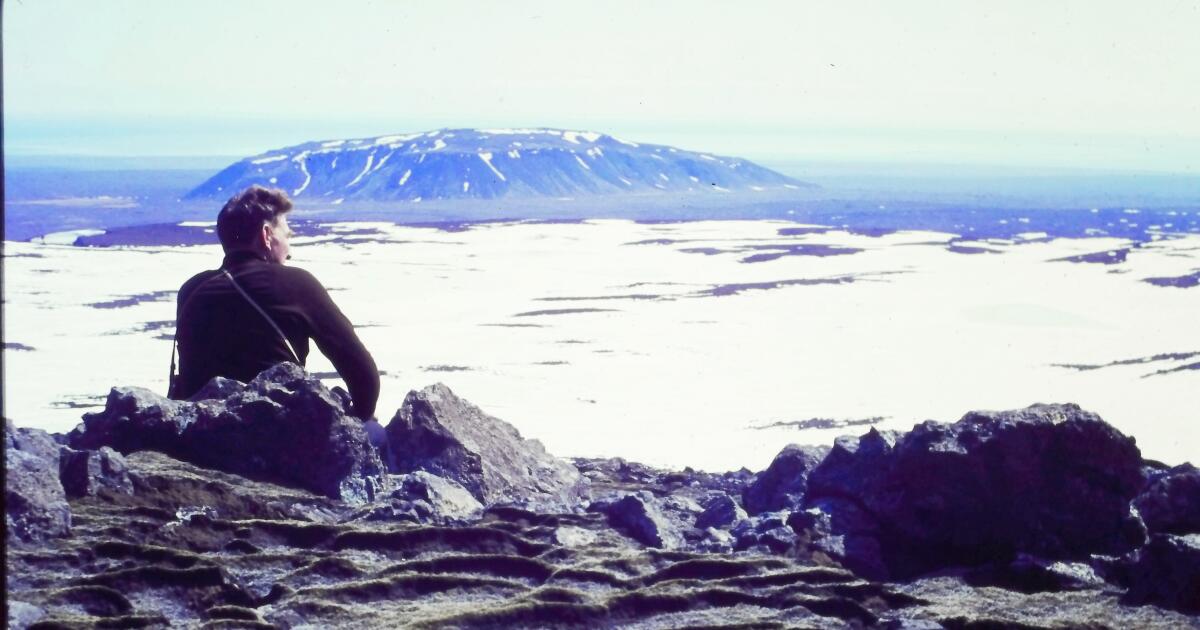
Glaciers aren’t stationary. Immense and imposing, formed through the downward trajectory of water from mountains as it collects and freezes, they have always moved. Now, however, they’re leaving. The demise of glaciers is a fact inherent in all the bad news about the effects of climate change on what once seemed permanent. But for Icelanders, whose connection to glaciers is ancient and mythic, our human epoch has become an extended hospice for the landscape of their lives.
Somehow, though, Sara Dosa’s documentary on this matter, “Time and Water,” avoids playing like a funeral in waiting. Built around Icelandic writer Andri Snær Magnason’s voiced lamentations on a vanishing frozen world, along with archival footage of his family, it’s no simple howl of grief, even when it takes us to a publicly held memorial in 2019 for Iceland’s Ok glacier, the first such “death” diagnosis in the country’s history. Rather, Dosa’s film is a meditation on change — both the kind that we accept with a heavy heart and something more general. “Time and Water” is a curiously vibrant elegy, teeming with appreciation for the intimate majesty that is all life, generational and geologic.
Dosa has finessed this emotional-meets-elemental space before in her Academy Award-nominated 2022 documentary “Fire of Love,” about married volcanologists Katia and Maurice Krafft. That was a wonderfully eccentric romance forged in molten lava. Here, she’s in a collaboration of sorts with her subjects, both human and elemental. Magnason’s opening narration over spectacular footage of glaciers — up close and from far away — gently informs us that we’re watching a time capsule, one where the bonds of family and environment are intertwined.
We learn how Iceland’s glaciers, essentially rivers of varying pace, begat their unique ecosystems, but also how they provided the breathtaking terrain upon which Magnason’s grandparents Hulda and Árni fell in love. (Grandma Hulda was the first woman to fly in Iceland, itself a very cool fact.) The onset of dementia in Árni spurs his grandson to consider what’s lost when the markers of memory depart. “Time and Water” touches on the epic verse called rimurs, passed down via chanted song by Icelandic women, their descriptive, sorrowful tales like dispatches from previous ages.
“Tone poem” is an overused term in cinema, but the humbling “Time and Water,” graced with a playful, atmospheric Dan Deacon score, earns that distinction. Naturally, it helps that you can never tire of all the air-crisped glacier imagery, captured digitally and in 16mm. Folded into the cozy slide-show vibe of Magnason’s home videos and the carefully chosen archival footage, the movie plays like a scrapbook portrait in which home just happens to boast the grandest of backyards.
How much longer will Icelanders enjoy it? The glaciers are predicted to be gone within 200 years. That’s an eternity or a drip, depending on whose survival we’re talking about. Still, “Time and Water” collapses the notion that we are somehow separate from these ancient, essential formations: an encouraging hello to the future from inside a sobering goodbye.
‘Time and Water’
In English and Icelandic, with subtitles
Rated: PG, for some thematic elements, smoking and brief language
Running time: 1 hour, 33 minutes
Playing: Opens Friday, June 5 at Laemmle Royal and Laemmle Glendale
More than 20 years after Michael Jackson was acquitted on charges of child molestation — and two months since the global superstar’s record-breaking biopic skirted any mention of abuse allegations — a new Netflix docuseries brings his trial and the aftermath to the foreground.
“Michael Jackson: The Verdict,” a three-part documentary directed by Nick Green and released Wednesday, chronicles his 2005 trial in Santa Maria that began with a search raid of the pop star’s sprawling Neverland Ranch and ended with a jury finding him not guilty on 10 counts, including four counts of child molestation. At the center of the case was Gavin Arvizo, a then-15-year-old cancer survivor from Los Angeles.
Because recording was not allowed in the courtroom, the documentary relies heavily on archival footage from media surrounding the trial and firsthand accounts of key figures involved, including prosecutor Ron Zonen, Jackson family attorney Brian Oxman, journalist Diane Dimond, two trial jurors, and friends and supporters on both sides of the case.
The episodes also delve into the 2003 documentary “Living With Michael Jackson,” in which the pop star is interviewed by British journalist Martin Bashir, that sparked questions about his behavior, leading to the charges against Jackson. Jackson’s historically questionable relationships with children, the media circus surrounding the trial and the effect it had on fans, the family at its center and Jackson himself are explored, too.
Here are six key takeaways from “The Verdict.”
Jackson allegedly had his personal assistant order child pornography
One of the docuseries’ most revealing interviews came from Vincent Amen, a former Jackson associate who worked at Neverland Ranch from 2002 to 2003. He said he was put in charge of taking care of the Arvizo family during their stay at the property following media backlash from Gavin Arvizo’s appearance in “Living With Michael Jackson.”
At that time, Amen said, he “wholeheartedly” believed in Jackson’s innocence, especially because Jackson’s friend Frank Tyson, also known as Frank Cascio, a member of the family who filed a lawsuit against Jackson’s estate in April detailing alleged sexual abuse, vouched so strongly for him. Cascio, who met Jackson when he was 5 years old and later became his personal assistant, told Amen, “Michael would never do this with a child.”
Amen’s conviction shifted, however, after he discovered a disturbing magazine that apparently belonged to Jackson in Cascio’s possession.
“Frank cleaned out his house of anything that came from the Neverland Ranch. And he hands me a Nike bag,” Amen said in the docuseries. “I took the bag and I’m driving home, and I felt, ‘Something’s a little suspicious.’ And I said, ‘Let me take a look in this bag.’ I start taking videos to document this. I open the bag. I start looking, and I see a magazine.”
The series shows shaky footage of Vincent apparently finding a nudist magazine called “Naturally.” He flips to a video ordering section with titles circled in black marker, including videos called “Nudist Youth Weekend” and “Euro-Nudist Family.”
“I confronted Frank, I said, ‘Frank, what is this magazine? Because, you know, there’s circles around videos with naked children,’” Amen recounted. “He said, ‘That’s just a phase that Michael and I went through. He circled the videos that he wanted, I ordered them, and it was a phase that we went through.’ They watched them together.”
The Arvizo children called Jackson ‘daddy’ and had their own bizarre nicknames
Along with footage of the nudist magazine, Amen held on to other evidence of his time with Jackson and the Arvizo family, including a set of Polaroid pictures featuring Gavin’s mom, Janet, and younger brother, Star.
In one, Star points directly into the lens. It’s captioned, “You my daddy Michael.” Another photo of a smiling Janet and Star includes a handwritten caption from Janet that says, “Dearest loving Michael, we appreciate you being our family. What God brings together, no man can undo. We love you.”
Under a photo of Star with a cross-eyed expression, he wrote, “I love you, my daddy Michael. Your son, Blowhole.”
“These are the nicknames that Michael would give these young boys,” Amen said.
Bashir documentary marked a pivotal shift in the perception of Jackson
Martin Bashir in “Michael Jackson: The Verdict.”
(Netflix)
Though the first allegations of child molestation against Michael Jackson emerged in 1993, it was footage from Bashir’s “Living With Michael Jackson” that ignited public concern about Jackson’s relationship with Gavin.
In a pivotal scene from the 2003 documentary, Jackson brings Gavin in as an example of a child with cancer that he helped. Gavin, 13 at the time, leans his head on Jackson’s shoulder and holds his hand. Jackson tells Bashir that the two often share a bed at the Neverland Ranch, though in another scene he stresses that it’s not sexual.
“I realized that we had something that was hugely significant, but I didn’t realize the extent of the bombshell until the broadcast,” Bashir recalled in “The Verdict.”
“You can see it. You can look at that moment in the Martin Bashir documentary and you can actually pin the end of his life to that very moment,” J. Randy Taraborrelli, Jackson’s childhood friend and biographer, said in the docuseries.
Given Jackson’s stardom, news and tabloid media swarmed the scene of the trial along with droves of dedicated fans (and a much smaller contingent of detractors). And the archival footage from “The Verdict” shows the extent to which fandom and media frenzy influenced the proceedings.
Jackson’s fans stationed themselves throughout the route he’d take to the Santa Maria courthouse with signs showing their support, sometimes standing and shouting and other times driving alongside him and honking. Jackson had his director of security, Kerry Anderson, film these drives while he waved and engaged with supporters.
As many as 1,000 fans showed up on the first day of the trial, and many would line up starting at 5 a.m. for raffle tickets that would allow them to enter the courtroom. One fan interviewed for the docuseries, Sheree Wilkins, said she quit her job as a preschool teacher to move to Santa Maria for the trial. When the “not guilty” verdicts were announced, she fainted and had to receive medical attention.
TV news stations from around the world, including Taiwan, Japan and Mexico, sent crews to cover the trial.
Even inside the courtroom, where cameras were not allowed, enthusiasm for Jackson’s music could not be contained. Attendees recalled everybody, from the jury to the judge and even the prosecution, “swaying in their seats” when songs played as part of an evidence display.
“I remember me moving in time to his music,” prosecutor Ron Zonen said. “At one point Tom [Sneddon, the District Attorney leading the prosecution] jabbed me and said, ‘Would you stop moving your foot?’ ”
Jackson’s mental and physical health deteriorated
Mark Geragos briefly served as Jackson’s defense attorney.
(Netflix)
According to numerous interviews in “The Verdict,” Jackson’s substance use was problematic before and during the trial.
Jackson was not at Neverland during the raid that predated his charges. According to journalist Dimond, her sources said he was in Las Vegas “having wild parties.”
“There were cigarette burns in the leather couches and chairs. There were empty liquor bottles on every table. And this is where Michael Jackson had been for several days, entertaining young teenage boys, who all spoke German,” she said.
Later, Jackson’s well-publicized physical pain became the catalyst for controversy when he was hospitalized overnight, where he was allegedly given enough pain medication “to tranquilize an elephant,” and failed to show up on time for court the next day. The judge threatened to issue a warrant for his arrest if he didn’t make it to the courthouse within the hour, leading Jackson’s team to speed there at 90 mph.
Throughout the trial, stress took an enormous toll on Jackson, defense attorney Mark Geragos said in the docuseries.
“I watched him just disintegrate, literally disintegrate. The ingestion of substances was just astronomical. There was a time when I actually saw him in the fetal position on the floor, and I thought, ‘What do we do?’ I mean, you don’t want his death to be on your hands because you took some inaction,” he said. “We had genuine concerns whether he could even withstand a trial — physically, mentally.”
The prosecution’s case fell apart at the hands of key witnesses
“The Verdict” lays out, step by step, how the trial ended in Jackson’s full acquittal. One major contributor, the docuseries seems to argue, is the downfall of the prosecution at the hands of its own witnesses.
Defense attorney Tom Mesereau was an expert at discrediting witnesses, subjects told the filmmakers, but certain key witnesses, like Janet Arvizo, struggled to connect with the jury on their own.
“I called her Janet from another planet,” admitted juror Melissa Herard. “Sorry, but that’s just how she acted.”
Jackson’s ex-wife Debbie Rowe was meant to take the stand as a smoking gun for the prosecution but instead revealed no new information and came to Jackson’s defense.
The prosecution also partially hinged its case on past allegations of child sexual abuse against Jackson, but conflicting testimony caused these efforts to backfire. A former Neverland employee claimed to witness Jackson molest Wade Robson when he was a child, but Robson took the stand and denied anything happened.
“It’s hard to convince a jury when the subject of the act itself said it didn’t happen,” Zonen said.
In 2013, Robson reversed his stance and filed a lawsuit against the Jackson estate alleging sexual abuse. His allegations, along with those of James Safechuck, were the subject of the 2019 documentary “Leaving Neverland.”
The success of D-day, a pivotal moment in World War II, partially hinged on the weather forecast. The Allied invasion of Normandy, France, on June 6, 1944, was planned for months as the American and British forces held practice operations in England.
Enormous efforts were made to mislead the Germans about what was coming. The operation was originally scheduled for June 5 but the day before, James Stagg, a meteorologist and group captain in the Royal Air Force, advised the American commander, Dwight D. Eisenhower, to wait for better conditions.
This lesser-known decision is the premise of “Pressure,” a new movie from filmmaker Anthony Maras. It’s an adaptation of David Haig’s play of the same name, in which the playwright himself portrayed Stagg. Haig, who co-wrote the “Pressure” screenplay with Maras, compares it to “The Imitation Game.”
“Some of these heroes who affect history from the sidelines just stay in the sidelines until somebody does research, discovers them lurking and finds they are so quietly heroic that it’s irresistible as a story,” Haig says, speaking via Zoom from London.
Haig began writing a version of the script shortly after the play debuted at the Royal Lyceum Theatre in Edinburgh in May 2014. It moved to the West End in 2018, and opened in North America at Toronto’s Royal Alexandra Theatre in 2023. Maras came onboard after making his 2018 film “Hotel Mumbai,” also based on a true story.
“When I first read the play and the script, I was bowled over by how, with this one decision, so many lives were changed,” Maras says, on a video call from Los Angeles. “Not just the lives of the men on the beach but throughout the Allied world. When you think of a war story, you think of men and now women on the field, but there is so much more to it behind the scenes.”
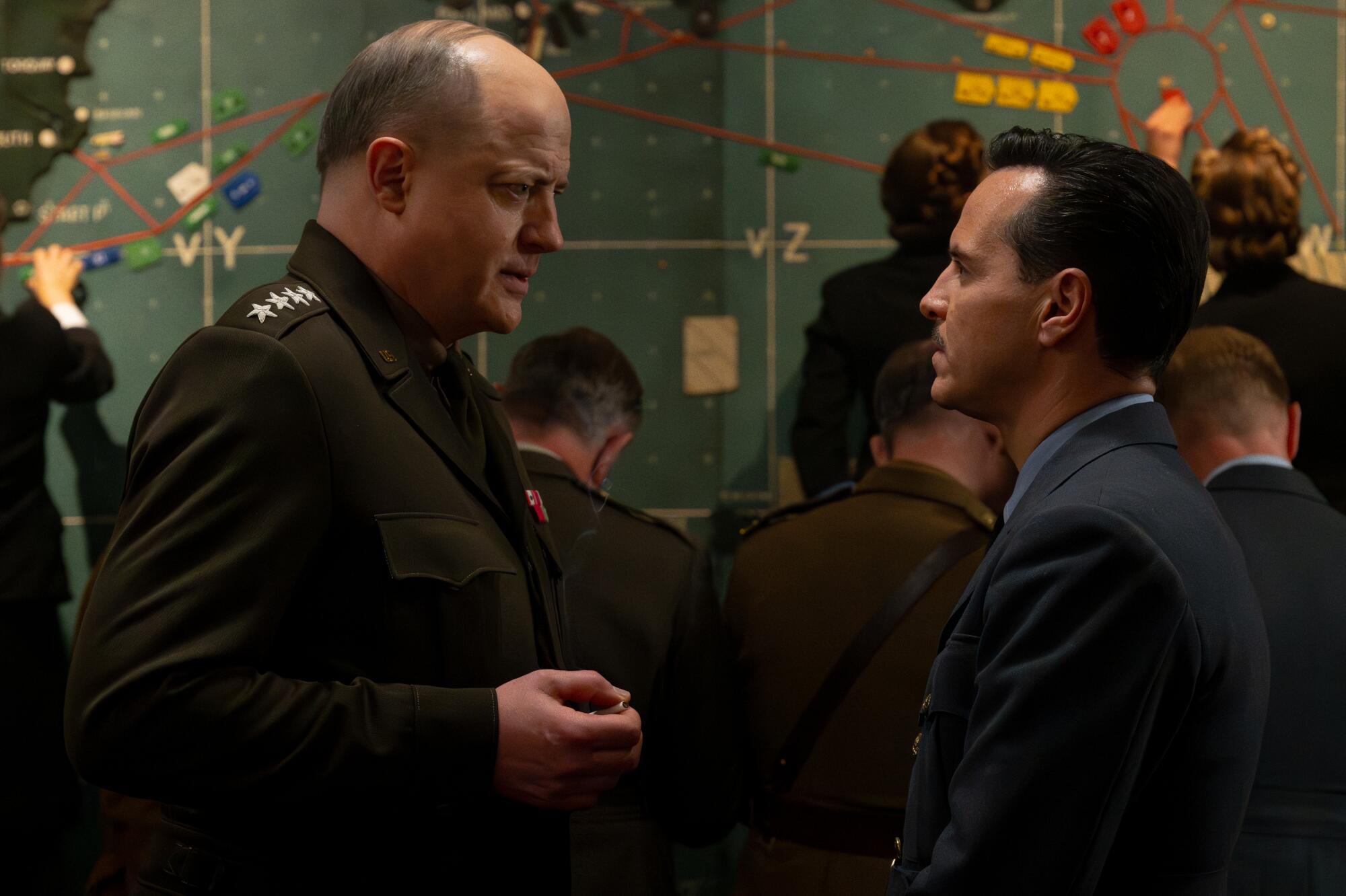
The film expands Haig’s play and includes additional characters and sequences, including the actual D-day invasion. It stars Andrew Scott as Stagg, Brendan Fraser as Eisenhower, Kerry Condon as Eisenhower’s secretary Kay Summersby, Chris Messina as U.S. Air Force meteorologist Irving P. Krick and Damian Lewis as senior British army officer Bernard Montgomery.
Both Haig and Maras strove to be as historically accurate as possible, even including archival footage from the war. “It is inevitably heightened, as any stage play or film is,” Haig says. “But it is very true.”
“It is absolutely as true as we could get it within the confines of a two-hour runtime,” Maras adds. “We took great lengths to try and be as accurate to the history but also to the deeper story as possible.”
Here’s what is true and what is dramatized in “Pressure.”
The importance of the weather
Brendan Fraser, left, and Andrew Scott in the movie “Pressure.”
(Alex Bailey / Focus Features / StudioCanal)
D-day, secretly known as Operation Overlord, was timed based on several factors, including the weather, the tides and the moonlight. Because the assault was multipronged, with Allied forces coming by sea, land and air, they required good visibility at night and a high tide to ensure less distances between the boats and the defending Germans.
“There were hundreds of meters between low tide and high tide,” Maras says. “So depending on where the boats landed, you either had 50 meters until you made it to the dunes and then the bunkers, or you had to make it 300 meters if it was low tide.”
A clear forecast with low winds and no rain was essential.
“The landing craft were antiquated and flat-bottomed,” Haig says, “and if they had gone on May 5 with the storms that Stagg anticipated coming in with the jet stream, those landing craft would have capsized. The war wouldn’t have been lost, although we do posit that it might have been in the film. In reality, failure would have elongated [the war] and caused countless extra deaths.”
To shoot “Pressure,” the filmmakers used real charts and meteorological instruments. The production design team re-created the famous D-day map from the Allied headquarters in Southwark House. The real one was made in two pieces by separate manufacturers to ensure secrecy.
“When you see that map, it’s a little bit mismatched and our team re-created that,” Maras says. “We got the paper they used to draw the maps from the same mill they used for those maps 80 years ago. A lot of effort was put into the minutiae that adds to the accuracy.”
Exercise Tiger
The film opens with a depiction of an Allied training operation called Exercise Tiger, which took place over several months on England’s Slapton Sands. Because many of the soldiers were young and untested, the Allied leaders wanted to prepare them for the sights and sounds of battle.
“They did a whole series of exercises to try and get together a full-scale dress rehearsal of what D-day would be,” Maras says.
These rehearsals, still widely unknown and spanning from late 1943 through April 1944, involved dangerous friendly fire and suffered from serious coordination errors, resulting in the real-life deaths of at least 700 American and British soldiers.
“That was an absolute disaster and yet we remember D-day as one of the great military triumphs in history,” Haig says.
Maras wanted the film to begin with this moment to emphasize the headspace of the Allied leaders.
“How do you establish what the true consequences of failure are for a story like this?” Maras says. “When we’re in the war room with all of those commanders and officers, they know what the implications of their words mean because they’ve seen it. They’ve lived it. The image of the blood in the water and the young men in that water was to tattoo in the audience’s brain that if these commanders mess up, this could happen again.”
Eisenhower, in particular, felt the magnitude of D-day. “He wrote two letters on the eve of D-day: what happens in success and what happens in failure,” Maras says. “He was sleeping two hours a night. He was a nervous wreck.”
Stagg vs. Krick
In the film, Scott’s Stagg arrives at Southwark House from Dunstable four days before D-day is planned. He is confronted by the American meteorologist Krick, who disagrees with him about the potentially disastrous forecast. Krick believes sun and calm seas are on the horizon thanks to historical analogue charts, but Stagg, using more comprehensive prediction methods, thinks a major storm is coming.
“In actuality, Stagg came onboard in about November 1943 and got to Southwark House a few months earlier,” Maras says. “His transfer came a few months earlier, not a few days earlier. The contours of the relationships between Stagg and Krick and the others are accurate, but they took place in a more compressed timeline.”
Both Stagg and Krick have recounted their version of events in various books, both claiming they were right about the weather. Although Haig and Maras imagine their dialogue and how these conflicts may have played out, the conflicts were real.
“They both adhered to their own meteorological vision,” Haig says, explaining the differences in prediction models from continent to continent. “In the United States, Krick’s system of weather forecasting was viable. If you come to the U.K., you can’t rely on the weather for more than five minutes, so that method doesn’t apply.”
Adds Maras, “They thought, ‘The weather is going to be good. We should hold our nerve and go.’ There was a rhetorically violent disagreement between him and the others.”
In the film, Krick claims that he has never inaccurately predicted the weather ahead of a battle, using his successes in North Africa as evidence. This was technically true.
“He was very good at his job within the context of certain geographical landscapes,” Haig says. “He didn’t make a mistake in North Africa. When Eisenhower challenges Stagg, he says, ‘This man never got it wrong.’ And he didn’t. In the whole of the North African campaign, Krick was spot on.”
After Stagg convinces the leaders to postpone D-day, he is vindicated by a deluge of rain that arrives while everyone is attending church at Southwark House on June 5. There was a church on site, although this moment in the film was dramatized.
“Whether it began raining precisely at that moment I have my doubts,” Haig says. “But it has the framework of truth.”
Ike and Kay
Andrew Scott and Kerry Condon in the movie “Pressure.”
(Alex Bailey / Focus Features / StudioCanal)
Kay Summersby had been an ambulance driver during the Blitz. The film hints at a less-than-professional relationship between Eisenhower and his personal secretary. She was certainly with Eisenhower at Southwark House, although there is less evidence that she had any kind of association with Stagg.
“The biggest fictional thing I did with both the play and the film was to join the third point of the triangle so you’ve got Stagg, Eisenhower and Kay,” Haig says. “The link between Stagg and Kay historically would be tenuous.”
There are differing opinions about Eisenhower and Kay’s relationship. “We know that they were extremely close and they shared a trustful bond,” Maras says. “There are many photos of them together. She was definitely a big force in Ike’s life at that time, and we wanted to pay respect to that.”
“Whatever one’s interpretation of the relationships that she inhabits within the story, her influence was substantial,” Haig adds.
After seeing Peter Jackson’s 2018 World War I documentary “They Shall Not Grow Old,” Maras had the idea to use colorized archival footage in “Pressure.”
“In the D-day sequence at the end, there are various real-life shots of the soldiers landing on the beaches,” Maras says. “We were able to cut between the archival [material] and our footage to increase the scope. And it wasn’t just to get the scale. Yes, we have shots of massive flotillas and ships and trucks, but sometimes it was just for a glance of a soldier where you can see death in his eyes.”
The team ultimately acquired more than 50 hours of archival footage. They hired research editors to go through it and, after a few days, Maras asked if any of the editors could recommend additional crew to help.
Then a man named James Stagg showed up to work. “Stagg’s grandson, 80 years later, walked into our offices and helped edit the archival movie footage that we put in his grandfather’s film,” Maras says.
Stagg’s wife
Andrew Scott in the movie “Pressure.”
(Alex Bailey / Focus Features / StudioCanal)
The play doesn’t include scenes with Stagg’s wife, Elizabeth, but Haig purposefully bookends the film with the couple together. “When he arrives at Southwark House as a terse, brusque, tricky man, you’ve already experienced his level of affection with his wife and that’s really important contextually,” Haig says. “You’re waiting for the end when he goes back to see her and the baby.”
At the time when Stagg went to Southwark House, his wife was pregnant. Stagg was not allowed to make phone calls to her because of the secrecy surrounding D-day. In reality, the hospital where she gave birth was not bombed, as it is in the movie.
“The bombing of the hospital was more reflective of the times that Stagg and his wife had gone through in the lead up to D-day,” Maras says. “That element is to encapsulate that Stagg was fearing for his wife. As he walks down this corridor, he is faced with: Is she alive? Is she dead?”
Truth to power
Ultimately, Stagg tells a room full of military leaders that they have to pause on D-day because of the weather — a truthful inclusion. It was important to Maras to emphasize how he stood up to power.
“Here’s a protagonist who’s not afraid to speak his mind and has the courage to get up in front of a room full of the most powerful military on Earth at that point and tell them something they don’t want to hear,” Maras says.
“When Eisenhower was passing on the baton of leadership at the inauguration for JFK, JFK asked, ‘What gave you the edge on D-day?’ Eisenhower said, ‘We had better meteorologists than the Germans.’ He had the wisdom to trust in the experts. It’s worth heeding that lesson from history.”