Here’s another quintessential L.A. walk through the Hollywood Hills’ High Tower neighborhood, the Hollywood Bowl and Whitley Terrace inspired by “
Walking Los Angeles” Walk 15.
The roughly three-mile route winds through historic neighborhoods with excellent views, incredible century-old homes and (literally) breathtaking climbs along with an intriguing collection of gates and doors. The walk also gives you a chance to admire the Hollywood Bowl without jillions of people milling around (and, if necessary, visit its lovely restrooms without waiting forever in line), but be sure to check the Bowl’s schedule ahead of time. The route won’t be possible when it’s having a concert.
Traffic and parking are always a challenge in this part of L.A. and nearly impossible in the High Tower area. I recommend finding a place to park across Highland Avenue on Milner Road because it’s less traveled (and very lovely). One final note: This route has few sidewalks, and those that exist are uneven, so keep an eye open for traffic and trip hazards, which is tougher than it sounds, because there are plenty of lovely sights to distract.
Here’s how to get there:
1. Start your walk at the corner of Camrose Drive and Highland Avenue, next to the Highland-Camrose Bungalow Village (which we’ll visit later.) Walk straight up Camrose past Woodland Way to Rockledge Road, where you’ll turn right and continue your climb.
This Hollywood Heights neighborhood has a real Mediterranean feel, with brilliant white villas clinging to the hills. The narrow winding street offers charming views of balconies and towers and the soothing tinkle of running water, so it’s easy to forget the cacophonous traffic and looming billboards nearby. The views get better as you climb until you reach the top of the hill and the end of Rockledge — at least for vehicles.
2. Continue walking to the end of the cul-de-sac, where you’ll find Los Altos Place, a pedestrian-only street. At the start of the walkway is a beautiful mosaic bench, where you can stop to catch your breath and then descend the first set of stairs, just 12 steps down.
3. This narrow walk takes you past many impressive doors and gates until you reach High Tower Drive. You’ll cross this road to stay on Los Altos Place, but as you cross, take a moment to wonder at the tiny garages built into the bottom of the hill and the High Tower elevator built like a freestanding Italian bell tower (a.k.a. campanile) rising 100 feet above. The elevator tower was designed by architect Carl Kay in the 1920s to provide the neighborhood’s tony residents elevator access to their hilltop homes, which are inaccessible by car.
4. Alas, only residents have a key to the elevator, so you must admire from afar and continue your walk along Los Altos Place, which includes a short set of 23 steps, to another pedestrian walkway called Broadview Terrace, where you will turn right and climb 37 steps toward the tower. At the top you’ll see more mostly white houses, bristling with balconies and to your right, a clearing with some gorgeous views of Hollywood.
5. Keep walking on Broadway Terrace, past the back side of the tower, to the next pedestrian walkway, Alta Loma Terrace, where you will turn right. It’s easy to get confused here, because the narrow walkway seems to have many passages that lead to front doors. After you pass the tower and a large, white Streamline Moderne home on your right, look for the street sign to Alta Loma Terrace on your left, partially hidden by shrubs and turn right.
6. This is another narrow, shaded walkway where you will see more interesting gates and fences than actual homes, but at No. 6881, you’ll pass a boarded-up 1921 Craftsman-style home with Japanese influences peppered with graffiti and “keep out” notices. The home once belonged to pioneering Asian American actor Philip Ahn, but it’s mostly famous now for being the home where Kurt Cobain and Courtney Love lived from 1992 to 1993. It’s sometimes known as the “In Utero” house, because Cobain wrote most of Nirvana’s third and final studio album, “In Utero,” there. Now the most notable thing, beyond the warnings, are the squirrels and bees buzzing around the property’s lovely overgrown landscape.
7. Follow Alta Loma Terrace as it slopes downhill and turns to the right. It’s mostly walkway along here, with intermittent series of short steps, but the descent is steep enough that you’ll feel it in your legs. After a short four steps down to No. 6836, where a beautiful pink bougainvillea drapes near a blue gate, the walkway turns left, and the descent feels faster over a series of four 14-step stairs separated by segments of straight walkways until you finally take 10 steps down into a parking lot and turn left.
8. You’ll be walking beside those adorable little garages on your left, barely big enough to hold a small modern sedan, and exit onto Highland Avenue through a black gate (that is locked from the parking lot side, so be sure you’re ready to leave).
9. Now turn left toward the Hollywood Bowl, and you can walk through the parking area, which is shaded by many beautiful trees and much more pleasant than walking alongside Highland Avenue’s unrelenting traffic. Walk up to the main entrance to admire the lovely Art Deco George Stanley fountain created in 1940, then walk over to the Peppertree Lane walkway — yes, lined by pepper trees — to the amphitheater. which is open to visitors who want to admire.
10. You won’t find much else open except for clean restrooms, which we were happy to visit. After gaping at the shell-shaped stage and the venues towering, arched rows capable of seating 18,000, retrace your steps back toward Highland. And near the place where you exited from the Alta Loma Terrace parking lots, step inside the gates to the Highland Camrose Park Pathway, around 2153 Highland Ave. On concert nights, this park is usually full of people eating their picnic dinners before entering the theater, but the park is usually empty and quiet when the Bowl is closed.
11. Follow the path heading east toward Camrose, and take a few minutes to wander through the cobble-stoned Highland-Camrose Bungalow Village of 14 Craftsman homes built between 1900 and 1924, according to an informational sign at the village. The cute houses were designed to be working-class housing for film-industry folks — what a concept! — and today mostly house offices for organizations affiliated with the Hollywood Bowl as well as the Los Angeles County Sheriff’s Department Parks Bureau.
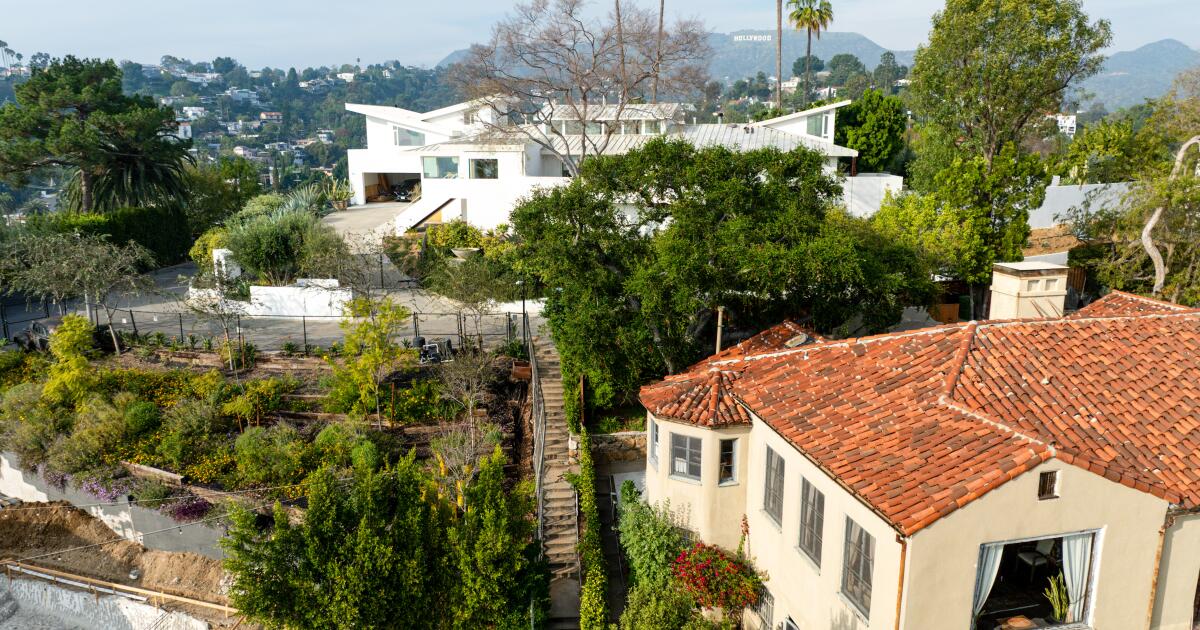
12. Exit onto Camrose and turn left to Highland Avneue, where you’ll cross to the other side, where Camrose becomes Milner Road and start walking uphill into the Whitley Heights Historical Preservation Overlay Zone, created by developer H.W. Whitley and architect A.S. Barnes. The majority of the stately homes were designed between 1918 and 1928 to resemble a Mediterranean village and quickly became the home of Hollywood’s elite, including Rudolph Valentino, Tyrone Power, Gloria Swanson and Marlene Dietrich, according to the Los Angeles City Planning website.
13. Follow Milner Road as it winds and climbs up the lushly landscaped hill. After the road curves left, watch for La Scène Idéal, an adorable yellow 1923 cottage that hugs the next curve. At Watsonia Terrace, bear right to stay on Milner Road and continue walking uphill, past several grand Spanish Colonial Revival-style homes, the neighborhood’s favored design. It’s the details on these homes that really captured my eye — arched doorways and windows (some with stained glass), tile inlays, elaborate garage doors and wrought iron light fixtures.
14. At the end of Milner, turn right onto Whitley Terrace, with some breathtaking views on your right, along with many more lovely homes. The book mentions a short stair just past 6681 Whitley Terrace, before a stretch of low slung freestanding garages, but it’s apparently been removed. A small plaque marks the spot where the Mary Jackson Staircase was rebuilt in 2000, but it no longer exists, so keep walking a short distance more to Grace Avenue and turn left to continue climbing the hill.
15. The higher you go, the more houses seem to become more stately. At the top of the hill, you’ll see Kendra Court to your left, a gated street closed to the public. Follow Grace Avenue as it turns right and heads downhill.
16. Turn right at the next street, which is Whitley Terrace, and follow it down past Bonair Place, where the road starts curving to the right. Follow the curve to the Whitley Terrace Steps, between 6666 and 6670 Whitley Terrace, and your final stairs, a twisting, 159-step descent with various short landings under shady trees, wrought-iron fences and tiled roofs. At step 66, pause to admire a charming yellow gate and then carry on, through a charming wrought iron gate back to Milner Road and wherever you parked your car.