antiSemitism

Australia, don’t conflate anti-Semitism with criticism of Israel | Racism

Suggestions that criticism of the State of Israel is anti-Semitic in Australia risk hardwiring a dangerous confusion. Questioning the behaviour of a foreign state is not the same as denigrating or attacking a people who may have links with that state. The State of Israel is represented by its embassy in Canberra, not by the Jewish community in our cities and suburbs.

But the knee-jerk reaction to the attack on a Jewish celebration in Sydney is solidifying that confusion. On December 14, 2025, as Jewish families gathered near Sydney’s Bondi Beach to celebrate Hanukkah, two gunmen opened fire, killing 15 people and injuring many others in one of the worst attacks in Australia’s history. In response, the federal government set up a Royal Commission on Antisemitism and Social Cohesion, led by former High Court justice Virginia Bell. On April 30, 2026, the commission delivered its interim report, raising serious concerns about how we define anti-Semitism.

The commission has adopted the International Holocaust Remembrance Alliance (IHRA) working definition of anti-Semitism. The IHRA offers examples that include criticism of Israel as evidence of anti-Semitism. But such a broad definition collapses critical commentary on Israel’s policy in Gaza, its treatment of Palestinians in the West Bank and Israeli officials’ dehumanising comments about Palestinians into a racist attack on Australia’s Jews. How does that make sense to anyone?

This is not an abstract question. The blurring of these categories acts as a brake on public debate. It narrows the range of permissible language used to describe Israel’s conduct in Gaza, where Australians have watched entire neighbourhoods destroyed and tens of thousands of civilians killed.

The official line from governments in relation to Israel is that Israel has a “right to exist” and an obligation to defend its citizens, which appears to give Israel carte blanche to decimate the entire Gaza Strip and kill tens of thousands of Palestinians. But no other state enjoys this exceptional treatment. No other state can do what it wishes simply because it has a “right to exist”. Australia has that right, but that right has never shielded governments in Canberra from fierce criticism, whether over First Nations dispossession, offshore detention or climate inaction. When Prime Minister Kevin Rudd apologised to the Stolen Generations in 2008 for the wrongs past governments had done to Aboriginal and Torres Strait Islander people, Australia’s legitimacy as a state was not under threat. Rudd was reflecting the public mood by distancing his government from the policies of the past. It was not seen as challenging Australia’s right to exist.

Yet in debates about Israel, the invocation of the “right to exist” and anti-Semitism operates as a conversation stopper. It closes the door to a frank discussion about the State of Israel and its behaviour. We cannot talk about occupation, apartheid and war crimes because that is anti-Semitic. This is a troubling precedent that insulates Israel from moral and political accountability.

The commission was established in response to a real and deeply upsetting surge in anti-Semitic violence. But its framework could cast suspicion on genuine inquiry into the behaviour of Israel. It entrenches a form of exceptionalism that actually weakens Australia’s democratic norms.

A liberal society must be able to draw a clear line: hatred, discrimination or violence against Jews is anti-Semitic and unacceptable; criticism of a foreign government is not.

There is also a cost to Jewish Australians when that line is blurred. Public debate routinely treats “the Jewish community” as a single, pro-Israel bloc, represented by a handful of bodies. This is simply not true. Many Australian Jews are alarmed to see the destruction of Gaza in their name. Some have mobilised against Israel’s actions.

To assume unanimous Jewish support for Israeli actions is to deny Jewish Australians their agency. Worse, it risks casting Jewish dissenters as inauthentic. If the policy settings shaped by this commission casts such voices as anti-Semitic, they will be erased twice over: excluded from the definition of the community and penalised for speakingup. This is silencing dissent, masquerading as protection.

If public institutions reinforce the idea that criticism of Israel is criticism of Jews, they risk feeding anti-Semitism.

Images of Gaza’s destruction on the news have galvanised global public opinion. Many young Australians have marched for an end to Israeli policies and freedom for Palestine. The message that such protests against Israel are anti-Semitic could not be any more counter-productive and harmful for Australian democracy. That will only breed resentment against the Australian political system for ignoring what everyone sees on their TV screens, and, dangerously, feed the very anti-Semitic narratives the commission should be challenging. Those who already hold anti-Semitic views will feel confirmed in their belief that Jews act collectively through Israel. The commission cannot afford to fall into this trap.

To the credit of the Australian Broadcasting Corporation (ABC) and the Special Broadcasting Service (SBS), they have avoided the conflation of Israel and Jewish people and have not adopted the IHRA definition. The interim commission report has not embraced the most heavy-handed proposals in circulation; there is no rush to ban protest slogans or criminalise political expression. There is room for optimism that the commission can still address the issue in its final report.

Here are the standards it needs to uphold to protect social cohesion in Australia:

First, an unambiguous distinction between anti-Semitism and criticism of Israel. Second, a recognition of the diversity of Jewish opinion, including among those who oppose Israel’s actions, and the inclusion of those voices in efforts to combat anti-Semitism. Third, a defence of political space for Palestinians and their allies to describe their experiences of occupation, dispossession and siege in their own terms, while  rejecting any dehumanising or racist language about Jewish people.

Anti-Semitism in Australia is a threat to the Jewish community (regardless of political views) and the very foundation of our social cohesion. But seeking to address the scourge of anti-Semitism by conflating critical views of the State of Israel with hatred of Jews will only make matters worse. Such approach will suppress debate, limit freedom of speech and inquiry that has already led to self-censorship at our universities and entrench the very confusion that sustains anti-Semitism.

The views expressed in this article are the author’s own and do not necessarily reflect Al Jazeera’s editorial stance.

Source link

DOJ sues UC over alleged antisemitism in UCLA protests

May 27 (UPI) — Federal prosecutors are suing the University of California, alleging civil rights violations were committed in connection with pro-Palestinian campus protests, the latest lawsuit by the Trump administration, which has targeted universities over issues from antisemitism to their hiring practices.

The Trump administration has taken dozens of actions against higher education institutions, including investigations, lawsuits and funding freezes, in what critics describe as an effort to crack down on left-leaning ideology in public and private spaces.

The lawsuit, filed Tuesday in the Western District of California, focuses on the encampment erected on the University of California, Los Angeles, campus in April 2024 as pro-Palestinian protests erupted across U.S. universities against Israel’s war in Gaza as students sought to pressure their schools to divest from Israel.

Federal prosecutors allege the school failed to protect its Jewish and Israeli students through its inaction concerning the encampment, which was erected April 25, 2024, and torn down May 2, 2024, when the school permitted police to clear the campus of protesters.

“Universities have an obligation to maintain safe and inclusive campuses for all students,” First Assistant U.S. Attorney Bill Essayli of the Central District of California said in a statement.

“Universities that violate our nation’s civil rights laws by repeatedly failing to shield Jewish students from antisemitism will be held accountable.”

The lawsuit is similar to the one federal prosecutors filed against UCLA in February, accusing the institution of creating a hostile work environment for Israeli and Jewish faculty and staff over its inaction with regard to the encampment.

UCLA Chancellor Julio Frenk on Tuesday rejected the accusations.

“Let me be direct: The suggestion that UCLA has been passive in the face of antisemitism is simply wrong. Combating antisemitism is a moral imperative — one rooted, for me, in personal history that makes indifference unthinkable,” he said in a statement.

Frenk highlighted a series of actions the school has taken over the past year, from recruiting an associate vice chancellor for campus and community safety to reorganizing its civil rights office, as proof of the school’s commitment to stand against antisemitism.

The Justice Department is seeking a court declaration that UCLA unlawfully discriminated against Jewish and Israeli students, an order forcing it to institute a series of changes and a declaration that the federal government does not need to make additional grant payments to the university.

Earlier this month, the Justice Department announced the results of an investigation into UCLA’s medical school admissions process, saying it discriminated by race to favor Black and Hispanic applicants.

Critics have accused the Trump administration of using the Justice Department to crack down on disfavored speech and ideology.

In April 2025, more than 200 college and university leaders issued a joint statement condemning the actions of the Trump administration targeting higher education institutions as “unprecedented government overreach and political interference.”

President Donald Trump leaves the White House on Tuesday. Trump is traveling to Walter Reed National Military Medical Center for his annual physical. Photo by Will Oliver/UPI | License Photo

Source link

Trump panel takes aim at separation of church and state

One member calls for a Presidential Medal of Freedom for a baker who refused to create a wedding cake for a same-sex couple.

Another calls for court interventions by the Department of Justice on behalf of Amish parents fighting New York vaccine requirements and Catholic nuns challenging that state’s requirement that they accommodate hospice patients’ gender identities.

And the chair of the Religious Liberty Commission is calling for a federal hotline with this automated recording: “There is no separation of church and state.”

These are just some of the recommendations that members of the advisory panel formed by President Trump last year want to see included in the commission’s final report.

That report is still in the works, but commissioners had an opportunity to describe their wish lists during their most recent meeting in April. There was little dissent as the commissioners, most drawn from Trump’s base of conservative Christian supporters, covered the items they want in the report.

Their ideas reflect the prevailing perspectives on the definition of religious liberty among many conservative Catholic and evangelical activists: increasing avenues for religious expression in public schools, expanding opportunities for faith-based organizations to receive public money, and allowing for religious-based exemptions in areas ranging from labor law to classroom lessons to healthcare mandates.

Such views have also been reflected in Supreme Court decisions issued in recent years by its conservative majority.

Commission’s views criticized

Critics of the commission say it embodies a one-sided perspective of Trump’s supporters and is threatening a well-established constitutional separation of church and state.

A lawsuit by a progressive interreligious coalition argues that the commission fails to comply with federal law requiring advisory panels to feature diverse members and viewpoints.

The lawsuit echoes criticism that most commissioners are conservative Christian clerics and commentators; one is an Orthodox Jewish rabbi. The coalition says members have asserted that America is specifically a Judeo-Christian or Christian nation and notes that most commission meetings took place at the Museum of the Bible in Washington, an institution with Christian leadership.

The Republican administration is asking a federal court to dismiss the lawsuit. The government is citing legal technicalities and contending that the law does not define how a commission should be fairly balanced or whose viewpoints should be represented.

Another entity created by Trump — the Task Force to Eradicate Anti-Christian Bias — issued a report saying Christians faced discrimination under the administration of President Biden in areas such as education, tax law and prosecution of antiabortion protesters. Progressive groups said that report failed to document systemic discrimination, focused on causes favored by conservative Christians and amounted to advocacy rather than an investigation.

In a further interlocking of Trump-related initiatives, several members of the Religious Liberty Commission are scheduled to take part in a May 17 prayer event marking the country’s upcoming 250th birthday. Several also participated in a recent Bible-reading marathon staged largely at the Museum of the Bible.

Harmony and tension

The commission has mostly featured agreement among members, with one dramatic exception. One commissioner, Carrie Prejean Boller, was ousted in February after a contentious hearing on antisemitism.

Commission Chair Dan Patrick said Prejean Boller sought to “hijack” the hearing, in which she had sharp exchanges with witnesses about the definition of antisemitism and defended commentator Candace Owens, denying her record of antisemitic statements. Prejean Boller, a Catholic, contended that she was wrongly ousted for expressing her beliefs.

In other hearings, witnesses described how they defied workplace regulations that they said conflicted with their conservative religious values on gender, abortion, COVID-19 vaccines and more. Some said they were prevented, at least temporarily, from displaying a religious symbol at work or trying to sing a Christian song at a school talent show.

At the hearing devoted to antisemitism, Jewish witnesses spoke of being harassed and threatened at campus pro-Palestinian protests against Israel. The commission has also heard from Hindu, Muslim, Sikh and other witnesses.

Even so, critics said the commission mostly focused on conservative Christian and right-leaning political grievances.

The Rev. Paul Brandeis Raushenbush, president of the progressive Interfaith Alliance, one of the groups suing over the commission’s composition, said the panel’s omissions are as significant as what it focuses on.

He said the commission has failed adequately to address such issues as anti-Muslim efforts in Texas and elsewhere, and also the rise of antisemitism on the right, not just the left.

Separation of church and state

Raushenbush said he is especially worried about the commission chair’s challenging the very notion of church-state separation.

Patrick, a Republican who is the Texas lieutenant governor, repeatedly denounced a concept that is embedded in Supreme Court precedent.

“We need to say there is no separation of church and state,” Patrick said at the April meeting. “That’s a lie.” He suggested printing “a million bumper stickers” to that effect.

No one at the commission meeting disagreed.

Trump made similar comments at a prayer event at the White House in 2025. “They say separation between church and state,” he said. “I said, all right, let’s forget about that for one time.”

While the phrase “separation of church and state” does not appear in the Constitution, 20th century decisions by the Supreme Court cited Thomas Jefferson’s description of the 1st Amendment as creating “a wall of separation between church and state.” The court applied the 1st Amendment’s prohibition of any church “establishment” to the states in addition to the federal government, citing the 14th Amendment’s ban on states denying citizens’ rights.

Courts have since wrestled with how to balance freedom of religion and freedom from government-sponsored religion.

Schools, vaccines and workplaces

Patrick has advocated for prayer and Ten Commandments postings in public schools.

“I don’t have any malice towards anyone that doesn’t believe in any type of faith,” Patrick told fellow commissioners. “That’s fine. That’s what America is about. But these organizations that are pushed by some ideology and pushed by someone’s bank account who wants to remove God from our country? We need to push back.”

On other issues, various commissioners called for requiring schools and workplaces to post notices of the rights of religious expression and exemptions.

Some called for restoring full pay and pension benefits for military service members who were discharged for refusing COVID-19 vaccines.

Bishop Robert Barron of the Catholic Diocese of Winona-Rochester, Minn., called for allowing religious groups such as Catholic Charities to receive federal money without compromising on traditional church teachings about the family.

He also said Catholic immigrants in detention should have humane treatment and access to sacraments and that immigration agents should not disrupt worship services in enforcement actions. The administration last year eliminated a policy against immigration enforcement in sanctuaries, which other religious leaders said should not occur at any time.

Kelly Shackelford, president and chief executive officer of the legal organization First Liberty Institute, called for new requirements that governments pay all legal bills if they lose a religious liberty case. He said many individuals lack the money to challenge the government in court.

“That would be a huge shifting of power in favor of citizens,” he said.

Smith writes for the Associated Press.

Source link

French police arrest students protesting anti-Semitism law | Protests News

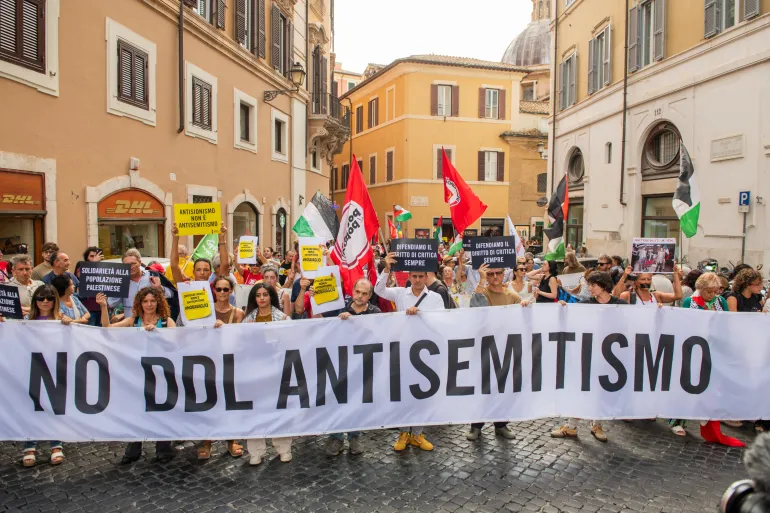
Police in France have arrested students at Sorbonne University, Sciences Po and Paris-Saclay University during a sit-in against a controversial anti-Semitism bill that could outlaw criticism of Israel. Lawmakers are set to vote on the ‘Yadan law’, named after a pro-Israel French MP who sponsored the bill, on April 16.

Source link