Anti-tourism

I visited ‘fed up’ Canary Islands – I know why it’s on the ‘no travel’ list

The Canary Islands have been put on a ‘no go’ list for 2026, and even as a big fan of the beautiful archipelago, I can see why the surge in visitor numbers might be putting people off

It’s not often you see a warning against a holiday destination you’ve repeatedly visited, but this week, American travel guide producer Fodor released their annual ‘No List’, a guide to all the destinations they recommend against visiting in 2026.

Among the crowded cultural sites and areas of natural beauty being ruined by overtourism, there was a Spanish addition: the Canary Islands. Beloved by Brits thanks to a microclimate that has made them a major winter sun destination, with almost 18 million visitors last year, tourism is at the heart of the Canaries. This is one area that I never thought I’d see on a do-not-visit list.

Yes, the islands have had a fair share of problems and negative attention this year, from overtourism protests in the summer to reports of delays at airports due to new EU passport checks. But with warm weather, relatively inexpensive living costs, and natural beauty in abundance, will Brits really want to abandon the Canary Islands?

READ MORE: Warning to Brits as Canary Islands placed on ‘no travel’ listREAD MORE: I found a beautiful UK seaside town packed with independent shops — it’s perfect for winter

My most recent trip to the Canaries was in March of this year, when I visited Lanzarote. The weather in the UK was grim at the time, and Ryanair flights were cheap, so my travel companion and I decided it would be the perfect last-minute break to escape the gloom.

And it seems like many others had the same idea. Our flight was full, which surprised me at first, given that it was midweek in March. But of course, the Canaries are a year-round destination, so others were like us trying to escape the wintery weather. Arriving late in the evening, thankfully, the queues through the airport were quick.

My first indication that the island’s popularity had skyrocketed was the difficulty in booking a hotel and the corresponding rise in prices. Having visited at off-peak times in the past, there are usually plenty of hotels and apartments to choose from, even at the last minute. However, this time, most of the cheaper spots had booked up, leaving us with out-of-budget luxury accommodation or places with terrible reviews.

Luckily, we did get a good deal at a hotel called Caybeach Sun in Playa Blanca. It had mixed reviews, so I was nervous, but it actually turned out to be lovely. With a heated pool, decently sized apartments, and close proximity to the beach, it was a surprising hit at just over £60 a night.

The Canaries have recently seen a crackdown in holiday lettings, and while this was before I arrived, the changing regulations over the past year could have impacted the amount of choice on offer and the prices.

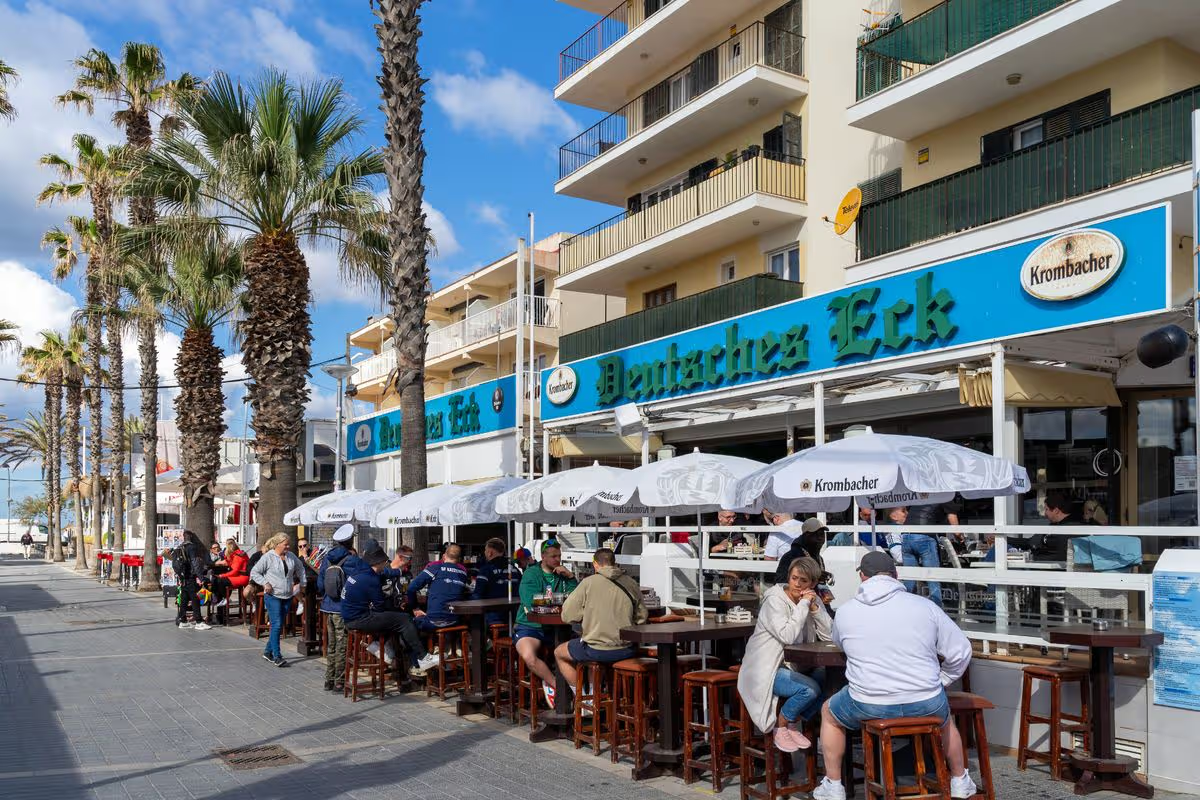
After dropping off our bags, we headed to Playa Blanca’s beachfront, which has lots of bars and restaurants. In the past, the number of places to eat meant that finding a table was easy, but even late at night, we found many restaurants full to capacity. The only places with seats were a couple of dodgy bars that had men outside practically trying to pull you in, which is never a good sign.

This was a common theme during our stay, whether we visited the town or the marina, everywhere seemed full. While it wasn’t quite the crowds you’d find in Venice or Santorini, it felt like the sort of crowds you’d usually only see in Spanish resorts in the summer. It was good to see people supporting the local restaurants and shops, but I could see how year-round crowds would be having an impact on islanders.

John Dale Beckley, founder of the sustainability platform CanaryGreen.org, told Fodors: “Residents have started protesting because they’re genuinely fed up. Traffic is one of the biggest issues. What used to be a 40-minute drive from the north can now take well over an hour each way. The government previously changed regulations that allowed residents to rent out their properties on Airbnb and Booking.com. This has driven up both rental prices and property values. Many young people now find it almost impossible to rent or buy a home.”

There have been reports of an increase in violent crime on the Canaries, and warnings that thefts get worse in the winter season, as organised gangs visit hotspots such as Tenerife, knowing it will be packed with visitors. The increases in rent caused by the tourist surge have also led to locals moving away from popular areas, reportedly leaving businesses struggling to recruit workers.

Of course, lots of people will point out that I’d chosen to go to a popular destination, so what could I expect? However, March is usually a quiet time on Lanzarote as the winter sun crowds are heavier in December and January, while the summer rush is still a long way off. If the island is this busy in March, I can imagine it becoming extremely crowded during the peak months.

READ MORE: Holiday chief slams huge ‘blow’ for Brits as UK tourism taxes set to be introducedREAD MORE: Flight attendant shares ‘genius’ method to sneak extra bag on board

So, should Brits avoid the Canaries? Personally, I’d think twice if you’re the sort of person who doesn’t like crowds and prefers a quieter break. There are many winter sun alternatives emerging as contenders to the Canaries, such as the Azores and Cape Verde. However, I did still have a great time in Lanzarote. I love its unique volcanic landscape, the beaches are wonderful, and I’ve never received a less than friendly welcome, so I’m very much in two minds about whether I’d go back in 2026.

Have a story you want to share? Email us at [email protected]

Source link

Brits defy anti-tourism protests in Spain and flock to Balearics in record numbers

Despite reports of tourist numbers being down in summer, the Balearics saw a year-on-year increase in passenger numbers, with Palma Airport in Majorca remaining one of Spain’s busiest airports

After two summers of anti-tourism protests, it appears Brits are undeterred from visiting the popular Balearic Islands.

Airports in the Balearics saw a year-on-year increase in passenger numbers of 2.4% between January and October 2025, with 15,628,717 international passengers landing on the islands’ runways, according to Majorca Daily News. However, October did see a slight decrease of 0.1% in passenger numbers compared to 2024.

Most passengers arrived on low-cost airlines, with 10,903,152 travellers arriving using services such as easyJet and Ryanair, while 4,725,565 flew on traditional airlines such as British Airways.

The data, which was released by Turespaña – the Tourism Institute of Spain – also showed that the UK made up the majority of tourists, with 2.2 million Brits arriving in Spain in October, a year-on-year increase of 4.4%, accounting for 21.7% of the total number of visitors arriving across the mainland and islands combined. The same month also saw a 14.6% increase in visitors from Ireland.

Brits are also the tourists most likely to use a budget airline. According to the data, over 30% of them arrive on this type of service.

Palma airport in Majorca is now the third busiest airport in all of Spain, with only Madrid-Barajas and Barcelona El Prat seeing more visitors. The island airport has welcomed 11,936,115 tourists this year, an increase of 2.3% compared to 2024.

Turespaña also revealed that tourist spending was on the rise. Visitors who arrived in Spain stayed on average for a week and spent €1,380 (about £1,217) per person.

Tourist officials in Ibiza were left panicking over the summer, as 20,000 fewer Brits visited the island during the peak months. Speaking at a conference in London, Ibiza’s Minister of Tourism, Jaume Bauza admitted the numbers were “worrying”. However, the rise in overall visitors seems to suggest that while Brits may be avoiding the islands in the summer, they’re likely shifting their breaks to the shoulder season of September and October, where it’s cheaper and less busy.

Jaume Bauza reiterated that he was keen for Brits to visit Ibiza: “I want the British who visit our islands who are, and will always be, warmly welcome, to be aware of and familiar with this transformation process, because I want them to be aware and participate in the changes we are undertaking.”

READ MORE: I’m ex cabin crew – there’s one drink you should never have on a planeREAD MORE: Ryanair is ending flights to popular winter sun islands blaming ‘rising costs’

Like many areas of Spain, the Balearic Islands have seen anti-tourism protests, especially in Majorca, which is the most popular island for visiting Brits.

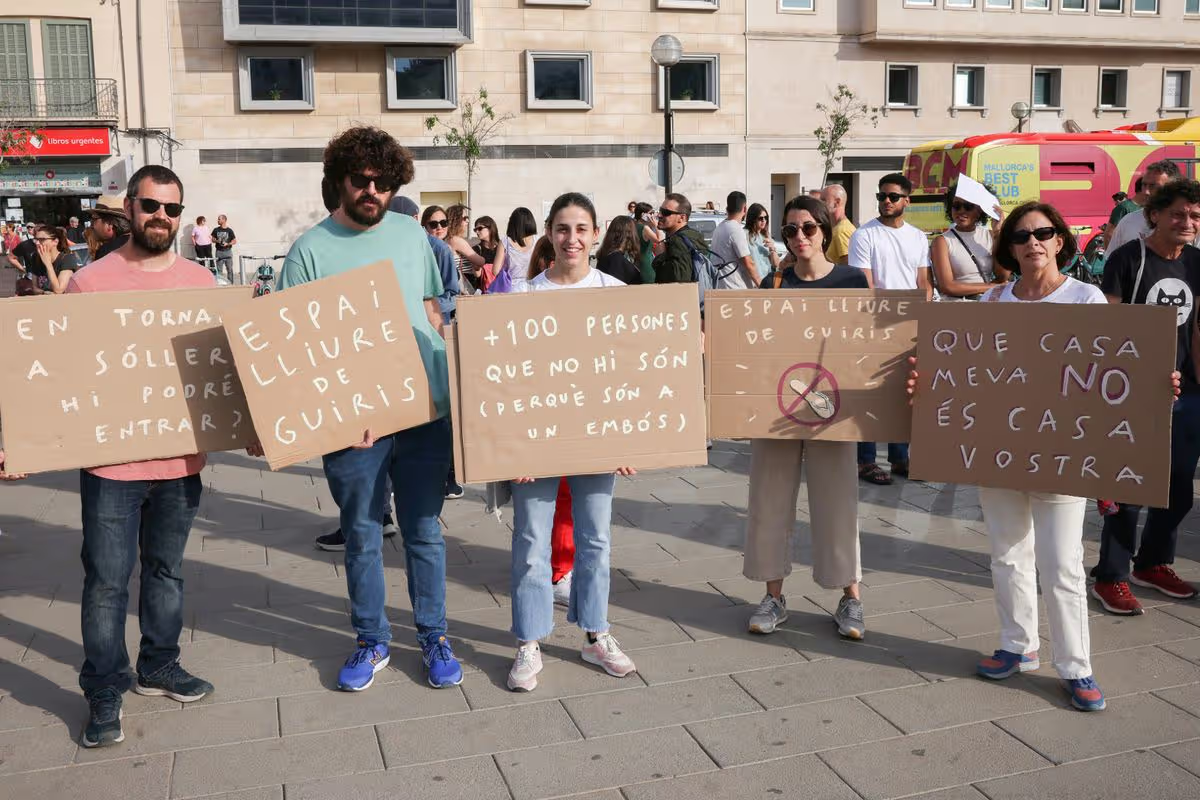
In June, around 10,000 people marched through the island’s capital of Palma, protesting overtourism and its effects on locals, such as rising house prices. There were also reports of anti-tourist graffiti with slogans such as ‘tourist go home’ and ‘rich foreign property buyers go to hell’ daubed on walls and monuments over the summer.

Have a story you want to share? Email us at [email protected]

Source link

Record numbers of Brits flock to Spanish hotspot despite protests

Despite reports of tourists being driven away from Spain by protestors, one Spanish airport has reportedly seen a rise in the number of passengers passing through, with a third coming from the UK

Warnings of Spanish ghost towns and holidaymakers ditching the country do not apply for one popular region where visitor numbers are spiking.

A Spanish airport in the popular Costa Blanca region has reported its tenth consecutive record-breaking month for passenger numbers, almost surpassing last year’s passenger total with a fair few weeks remaining in 2025.

Alicante-Elche Airport welcomed 1.9 million passengers in October, an increase of 5.9% compared to last year, and 631,771 of those passengers were Brits, representing over a third of passenger traffic. This was followed by Germany, which represented 129,127 passengers and the Netherlands with 118,996.

So far in 2025, the airport has had 17.2 million people pass through its doors, and it’s estimated it could reach the 20 million mark by the end of the year, according to Spanish expat news outlet Olive Press. They also reported that the airport had its busiest October for flights yet with 11.931, an increase of 6.1% year on year.

Some of the additional traffic could be down to new routes opening up to Alicante. Ryanair recently announced new connections to and from Cardiff, Aberdeen, Bratislava, Linz, Salzburg, Bydgoszcz, Rzeszow, Stockholm Västerås, Småland, and Lanzarote.

Ryanair also added additional flights on 29 of their existing Alicante routes for its winter 2025 schedule, noting the destination’s popularity during the colder months. The airport is serviced by several budget airlines popular with Brits including easyJet, Jet2, Vueling, and Wizz Air, making it easily accessible from across the UK.

Alicante-Elche is the fifth busiest airport in Spain, and the largest in the Valencian Community. One of the reasons it’s a popular destination for Brits is its close proximity to Benidorm, with a direct bus from the airport to the holiday hotspot taking just 45 minutes.

It’s also just 20 minutes away from the centre of Alicante, which has cultural attractions and beautiful beaches. The Telegraph dubbed Alicante ‘Spain’s most underrated city break’ in a 2024 article.

READ MORE: ‘I’m a travel agent of 30 years and everyone must visit these 5 Spanish destinations’READ MORE: Major UK airport to see Emirates and easyJet update on November 18 and 19

The news comes amid speculation that the anti-tourism protests of 2023 and 2024 would deter tourists from taking Spanish holidays. While the majority of protests took place in cities such as Barcelona and on island locations like Majorca, it was speculated that anti-tourist sentiment could lead visitors to choose alternative destinations, such as Greece or Turkey.

Benidorm has also implemented some strict restrictions to keep rowdy Brits under control. Swimming in the sea is banned between the hours of midnight and 7am, with fines between €300 and €1,500 ( approx. £255 – £1,278). Reserving your spot can also land you in trouble, with sunbeds, towels, or umbrellas left on the sand before 9.30am removed, and potential fines of up to €250 (about £220.33) for leaving your belongings behind.

Smoking and vaping have also been banned from the beach, with reports of fines reaching the thousands.

Have a story you want to share? Email us at [email protected]

Source link

I visited European ‘anti-tourist’ city – I can see why locals are so angry

This gorgeous city is better in November, but in summertime huge anti-tourism demos took place – and I understand why residents in this stunning place are so angry.

I’ve just touched down in the UK from a Spanish city that was basking in a balmy 26C in November, with hardly any tourists in sight. The destination has recently been dubbed an anti- tourism holiday spot, but all the locals I encountered were incredibly welcoming – and I got a glimpse into why some holidaymakers might not be as welcome.

Having visited Palma in Mallorca several times over the years, this was my first off-peak trip to the largest Balearic island, but I’d certainly consider a November visit again. The weather was still delightfully warm and sunny, the Mallorcan people I met were extremely friendly, and it was a real treat to explore the city and the island without the usual throngs of tourists.

During the summer of 2025, the height of the tourist season, large-scale anti-tourism protests erupted on the streets of Palma, with locals brandishing signs telling holidaymakers to go home – and frankly, I can’t blame them.

I can empathise with their tourism grievances, having grown up in Devon where similar issues arise – and I’ve even had the experience of living next door to an Airbnb a few years back which brought its own set of problems with non-locals.

Mallorca grapples with over-tourism during the summer months when the island is swamped with visitors. However, travelling off-peak is a more sustainable way to appreciate the island while respecting the locals – and it offers a genuine taste of Mallorcan life, reports the Express.

Despite being a Brit myself, I can’t help but acknowledge that some of our fellow countrymen can be quite the nuisance in popular holiday destinations, with their excessive drinking and disruptive behaviour tarnishing the reputation of many a Spanish resort.

Adding to this, the surge in short-term holiday rentals has spiralled out of control in numerous sought-after locations, including the Mallorcan city of Palma and other Spanish hotspots like Barcelona.

This issue of residential properties being converted into holiday cottages or Airbnb lettings is a global phenomenon, affecting places from Cornwall to London, Spain to America, and everywhere in between.

A local family residing in Mallorca shared with me that the island’s peak season is a living nightmare for them, with parking woes and a significant increase in traffic causing chaos.

The family expressed their struggle to enjoy the summer months as the beaches become “too crowded”, parking becomes a mission impossible, and many eateries, particularly in Palma, are “too busy”.

One native Mallorcan woman voiced her frustration, stating that many locals are irate due to skyrocketing rents – a consequence of mass holiday rentals like Airbnb in a neighbourhood which inflate the ‘average’ rent due to an overall comparison (which includes high holiday home rents).

She also highlighted a “worrying shortage of affordable housing”, particularly in the capital, Palma. Given that Mallorca is a relatively small island, about 62 miles wide, constructing more “affordable” homes isn’t a straightforward solution.

One can’t help but ponder: if all these holiday homes were converted back into residences for locals, would there still be a housing crisis in the UK – or indeed in Mallorca?

Prioritising tourism creates environments that become nearly uninhabitable for local residents, which seems nonsensical. It’s clear that something is amiss when governments aren’t prioritising housing for locals – and the need to protest is entirely understandable.

Over-tourism also results in excessive traffic, unmanageable crowds and significant parking issues, creating an unpleasant environment for both residents and visitors. During my time in Mallorca, I navigated the island by bus, which was simple and efficient.

Strolling through Palma’s tree-lined streets in November, when tourists are few and far between, is my idea of a city break. Although the Christmas lights haven’t been switched on yet, they will be soon (on Saturday, November 22, 2025, at 8pm).

I can envision how stunning the festive lights will look once the official Christmas lights switch-on takes place in Palma, as star-shaped decorations were already adorning the streets in preparation for this event.

The streets of Palma were so pristine and clean, I didn’t spot a single person littering, whereas in the UK, it’s not uncommon to see adults – and children – discarding rubbish on the roads or in scenic areas.

During my stay in Mallorca, I lodged at the HM Palma Blanc hotel, a truly friendly and luxurious place that offered comfort and an incredible breakfast. I tend to steer clear of Airbnb-style holiday lets as much as possible, recognising the havoc they can wreak in tourist-heavy areas.

With a plethora of markets in the capital city, independent shops, and fantastic eateries, I’d certainly consider another winter visit to Mallorca – it was genuinely delightful.

Source link