announcement

Dodgers’ Edwin Díaz to pitch for Puerto Rico in World Baseball Classic

New Dodgers closer Edwin Díaz will pitch for Puerto in the World Baseball Classic in March, it was announced Monday.

Díaz, who signed a three-year, $69-million contract in December as the most sough-after reliever in free agency, pitched for Puerto Rico in the 2023 WBC but sufferd a right patellar tendon tear while celebrating a win over the Dominican Republic that pushed the team into the quarterfinals. He missed the entire 2023 MLB season as a result.

His announcement comes days after it was revealed Dodgers teammate Shohei Ohtani will not pitch in the WBC in order to focus on ramping up to pitch during the season without restrictions. Yoshinobu Yamamoto will pitch for Team Japan and catcher Will Smith and recently-retired left-hander Clayton Kershaw will be on the Team USA roster.

Source link

Kennedy Center to close for 2 years for renovations, Trump says

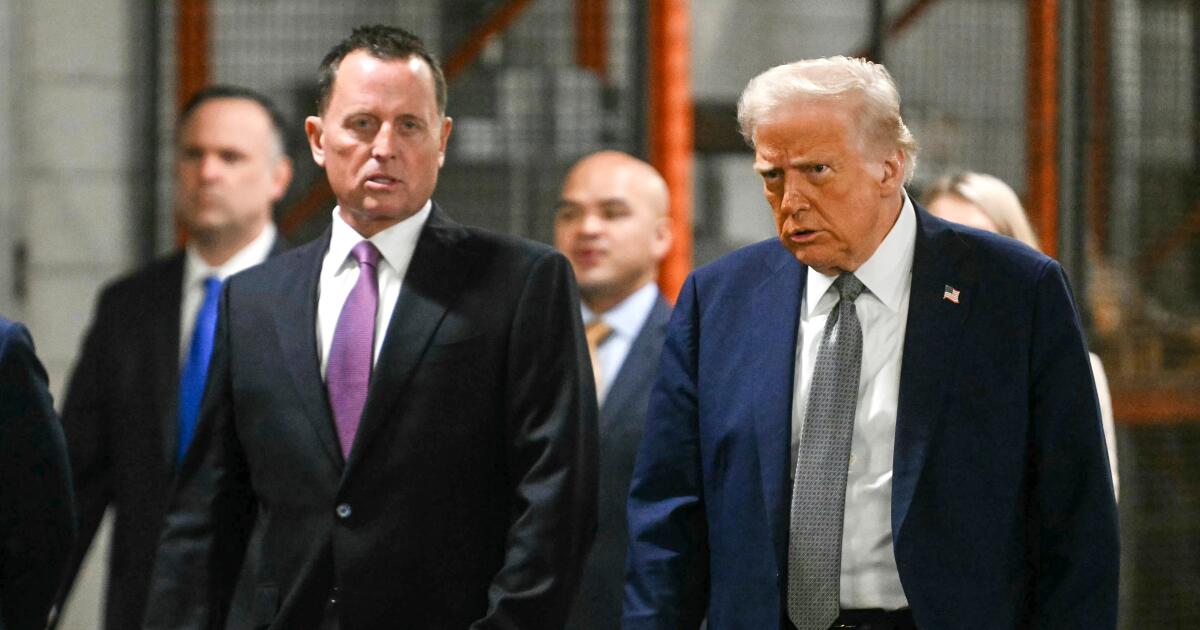
President Trump said Sunday that he will move to close Washington’s Kennedy Center for the Performing Arts for two years starting in July for construction, his latest proposal to upend the storied venue since returning to the White House.

Trump’s announcement on social media follows a wave of cancellations by leading performers, musicians and groups since the president ousted the previous leadership and added his name to the building. Trump made no mention in his post of the recent cancellations.

His proposal, announced days after the premiere of “Melania,” a documentary about the first lady, was shown at the center, is subject to approval by the board of the Kennedy Center, which has been stocked with his handpicked allies. Trump chairs the center’s board of trustees.

“This important decision, based on input from many Highly Respected Experts, will take a tired, broken, and dilapidated Center, one that has been in bad condition, both financially and structurally for many years, and turn it into a World Class Bastion of Arts, Music, and Entertainment,” Trump wrote in his post.

Neither Trump nor Kennedy Center President Ric Grenell, a Trump ally, have provided evidence to back up their claims about the building being in disrepair, and in October, Trump had pledged the center would remain open during renovations. In Sunday’s announcement, he said the center will close July 4, when he said the construction would begin.

“Our goal has always been to not only save and permanently preserve the Center, but to make it the finest Arts Institution in the world,” Grenell said in a post, citing funds Congress approved for repairs.

“This will be a brief closure,” Grenell said. “It desperately needs this renovation and temporarily closing the Center just makes sense — it will enable us to better invest our resources, think bigger and make the historic renovations more comprehensive. It also means we will be finished faster.”

The sudden decision to close and reconstruct the Kennedy Center is certain to spark blowback as Trump revamps the popular venue. The building began as a national cultural center and Congress renamed it as a “living memorial” to President Kennedy — a champion of the arts during his administration — in 1964, in the aftermath of his assassination.

Opened in 1971, it serves as a public showcase year-round for the arts, including the National Symphony Orchestra.

Since Trump returned to the White House, the Kennedy Center is one of many Washington landmarks that he has sought to overhaul in his second term. He demolished the East Wing of the White House and launched a massive $400-million ballroom project, is actively pursuing building a triumphal arch on the other side the Arlington Bridge from the Lincoln Memorial, and has plans for Washington Dulles International Airport.

Leading performing arts groups have pulled out of appearances at the Kennedy Center, most recently composer Philip Glass, who announced his decision to withdraw his Symphony No. 15 “Lincoln” because he said the values of the center today are in “direct conflict” with the message of the piece.

Last month, the Washington National Opera announced that it will move performances away from the Kennedy Center in another high-profile departure after Trump’s takeover of the U.S. capital’s leading performing arts venue.

The head of artistic programming for the center abruptly left his post last week, less than two weeks after being named to the job.

A spokesperson for the Kennedy Center could not immediately be reached and did not respond to an emailed request for comment.

Late last year, as Trump announced his plan to rename the building — adding his name to the building’s main front ahead of that of Kennedy — he drew sharp opposition from members of Congress, and some Kennedy family members.

Kerry Kennedy, a niece of John F. Kennedy, said in a social post on X at the time that she will remove Trump’s name herself with a pickax when his term ends.

Another family member, Maria Shriver, said at the time that it is “beyond comprehension that this sitting president has sought to rename this great memorial dedicated to President Kennedy,” her uncle. “It is beyond wild that he would think adding his name in front of President Kennedy’s name is acceptable. It is not.”

Late Sunday evening, Shriver posted a new comment mimicking Trump’s own voice and style, and suggesting the closure of the venue was meant to deflect from the cancellations.

She said that “entertainers are canceling left and right” and the president has determined that “since the name change no one wants to perform there any longer.”

Trump has decided, she said, it’s best “to close this center down and rebuild a new center” that will bear his name. She asked, “Right?”

One lawmaker, Rep. Joyce Beatty, an Ohio Democrat and ex-officio trustee of the center’s board, sued in December, arguing that “only Congress has the authority to rename the Kennedy Center.”

Price and Mascaro write for the Associated Press. AP writer Darlene Superville contributed to this report.

Source link

Sen. Susan Collins announces end to ICE large-scale operations in Maine after talks with Noem

U.S. Sen. Susan Collins of Maine said Thursday that immigration officials have ceased their “enhanced operations” in the state, the site of an enforcement surge and more than 200 arrests since last week.

Collins, a Republican, announced the development after saying she had spoken directly with Secretary of Homeland Security Kristi Noem.

“There are currently no ongoing or planned large-scale ICE operations here,” Collins said in a statement, referring to U.S. Immigration and Customs Enforcement. “I have been urging Secretary Noem and others in the Administration to get ICE to reconsider its approach to immigration enforcement in the state.”

The announcement came after President Trump seemed to signal a willingness to ease tensions in Minneapolis after a second deadly shooting there by federal immigration agents.

Collins said ICE and Border Patrol officials “will continue their normal operations that have been ongoing here for many years.”

An email seeking comment was sent Thursday to the Department of Homeland Security.

Collins’ announcement comes more than a week after immigration officers began an operation dubbed “Catch of the Day” by ICE. Federal officials said about 50 arrests were made the first day and that roughly 1,400 people were operational targets in the mostly rural state of 1.4 million residents, 4% of whom are foreign-born. ICE said more recently that more than 200 people have been arrested since the operation started.

In Lewiston, one of the cities targeted by ICE, Mayor Carl Sheline called the scale-down welcome news, describing the agency’s operations as “disastrous” for the city and others.

“ICE operations in Maine have failed to improve public safety and have caused lasting damage to our communities. We will continue working to ensure that those who were wrongfully detained by ICE are returned to us,” said Sheline, who leads a city where the charter requires the mayoral position to be nonpartisan.

Homeland Security Assistant Secretary Tricia McLaughlin last week touted that some of the arrests were of people “convicted of horrific crimes including aggravated assault, false imprisonment, and endangering the welfare of a child.” Court records painted a slightly different story: While some had been convicted of felonies, others were detainees with unresolved immigration proceedings or who were arrested but never convicted of a crime.

Collins, a veteran senator, is up for reelection this year. Unlike a handful of Republican senators facing potentially tough campaigns, Collins has not called for Noem to step down or be fired. She’s also avoided criticizing ICE tactics, beyond saying that people who are in the U.S. legally should not be the target of ICE investigations.

Democratic Gov. Janet Mills, who announced her Senate candidacy in October and could face Collins in the general election, has challenged immigration officials to provide judicial warrants, real-time arrest numbers and basic information about who is being detained in Maine. She also called on Collins to act after the House’s GOP majority defeated Democrats’ efforts to curtail ICE funding.

Mills’ office did not immediately respond to an Associated Press email seeking comment on Collins’ announcement.

Meanwhile, first-time Democratic candidate Graham Platner — who is running against Mills in the primary — has criticized both Mills’ and Collins’ handling of ICE and has demanded the agency be dismantled. Platner organized a protest Thursday outside Collins’ office in Portland, Maine, where dozens of supporters held signs and sang along with him.

Platner said he would host a separate protest later outside Collins’ Bangor, Maine, office.

Several prominent Maine Democrats expressed guarded optimism about the ICE drawdown while also criticizing the agency’s actions.

“If these enhanced operations have in fact ceased, that may reduce the visible federal presence in our state,” said U.S. Rep. Chellie Pingree, who represents the Portland area. “But I think it is important that people understand what we saw during this operation: individuals who are legally allowed to be in the United States, whether by lawful presence or an authorized period of stay, following the rules, and being detained anyway.

Whittle and Kruesi write for the Associated Press. Kruesi reported from Providence, R.I. AP writer Kathy McCormack in Concord, N.H., contributed to this report.

Source link