A MEMBER of a huge girlband has teased a reunion tour – and fans will likely be bursting with excitement over the potential slew of gigs should they set plans in motion.
The Saturdays are approaching their 20th anniversary, with a reunion tour now on the cards for the girls, as per one of the members.
Sign up for the Showbiz newsletter
Thank you!
The Saturdays are approaching their 20th anniversaryCredit: RexThe hit girlband, who had hits with What About Us and Ego, was made up of Molly King, Frankie Bridge, Rochelle Humes, Vanessa White and Una HealyCredit: GettyUna has hinted at a possible reunion tourCredit: Alamy
At the time, the girls insisted they were not splitting up, but instead taking a “break”.
Speaking on 2FM Morning with Laura Fox, Una said now would “be a good time” to get reunion plans in the works.
Una said: “I hope so, you know that it has been 18 years now.
“So only two more to go. It was 2008 since the first single.
“The years are flying by it’s scary.”
She then added: “I was recently talking to Molly and she just reminded me. She was like ‘you know it’s the big 20th now, in two years’.
“I always think that the noughties was ten years ago. So I think that it would be a good time. It would take time to get a tour together.”
Una then revealed: “I am trying to rally them all up and I want it to be all of us as well. We all do. That’s how we all collectively feel.
“If we ever do anything again it would have to be all five or it wouldn’t be the same.
“I would just love if it was all of us.”
Last summer, we reported the mysterious ‘feud’ between two of the bandmates as the stars ‘snubbed’ each other at Wimbledon after a 24-year friendship.
Rochelle and Frankie grew up in the spotlight together but last summer they mingled with celebrities just yards from each other yet failed to speak between them.
At the time, an insider told The Sun: “It was clear the women were keeping their distance. They sat on opposite sides of the suite and kept to themselves.”
EMOTIONAL Kelsey Parker has confessed “her pain will never go away” as she opened up on grief on the fourth anniversary of her husband Tom’s death.
Kelsey unexpectedly found herself a widow at age 32 after her late husband Tom Parker from the boyband The Wanted tragically died.
Sign up for the Showbiz newsletter
Thank you!
Emotional Kelsey Parker opened up on her grief four years after her late husband Tom Parker tragically diedCredit: InstagramThe Wanted’s Tom Parker tragically died in March 2022 after being diagnosed with an inoperable brain tumourCredit: Getty
The famous singer passed away in March 2022 at the age of 33 after being diagnosed with an inoperable brain tumour.
Kelsey has been open with fans on grief and juggling life as a mum – her and Tom have two children together, Aurelia and Bodhi.
Speaking on the Cbeebies HQ Parenting Helpline podcast, Kelsey shared how she’s been dealing with the grief of losing her husband four years ago.
Addressing a parent in a similar situation, Kelsey said: “Your pain is never going to go away. That pain is never gonna go away. What you learn to do is live around your pain.”
Kelsey continued: “I am grieving and I am getting out of bed and I am being a parent because I have no other choice.”
Recalling the day Tom died, she said: ” I told the kids I need to go to the hospice to make sure that the angels come for daddy today, so that’s when I knew he was gonna die.
“He’s never coming back we will never see him again.”
Talking to Tom in his last days, Kelsey remembered saying: “I said ‘I know you’ve put me on this path and I will walk this path for you now, and I will do everything to bring your children up the way you wanted to bring your children up’.”
The motivational speaker told podcast host Holly Hagan that she had no choice but to get up everyday and be a mum – her kids needed her.
Grieving Kelsey Parker has told how she put on a brave face for kids, saying she ‘had no choice but to be a mum’Credit: InstagramMotivational speaker Kelsey confessed she told her kids ‘the angels are coming for daddy,’ the day he passedCredit: Instagram
She explained they were obviously going “mummy, mummy can you come make me breakfast? and Kelsey said she’s not going to turn around and say, “no I’m grieving. I’m devastated your dad’s died.”
Despite having dealt with grief so young, Kelsey felt her kids had developed strong resilience.
Geordie Shore‘s Holly captioned the podcast clip: “This episode with the fabulous @being_kelsey was so incredibly empowering. It actually ran over about an hour because we just could not stop talking.”
Since the death of her husband Kelsey has become host of the Mums The World podcast and a motivational speaker diving into the world of unexpected grief.
Kelsey has also found love again with tree surgeon, Will Lindsay, after hard-launching their relationship back in September 2024.
Kelsey Parker went Instagram official with new boyfriend in September 2024 – after admitting Tom will always be the love of her lifeCredit: being_kelsey/Instagram
Reflecting on the last tour, she added: “When I look at that and at the feeling it gave me, I was in my element, but there comes a time… I’m 50.
“You can’t be nagging everyone to go on tour if they don’t want to. I laid that to rest when I turned 50.”
Asked if she would return to the stage if the others signed up, Mel admitted she is unsure.
The 50-year-old said, “I honestly don’t know. I’ve got a lot of respect and love for those girls. I wouldn’t be sitting here if it wasn’t for me being part of the Spice Girls.
“They’ve done a lot for me as a person and in my life. I’ve got fond memories, but I don’t know if I would want to go back up on stage.”
The Spice Girls in one of their last performances as a five piece in 2008Credit: GettyMel B is currently working on America’s Got TalentCredit: Getty
She added: “I can’t even begin to tell you what our bond is – it’s just something that will always be there.
“We’re like family; our umbilical cords are all tied together.”
For now, fans may have to settle for a potential Netflix documentary, in the style of recent Beckham projects.
Mel said: “I think we’ve all been asked and we’re all thinking about it at some point.
“But it has to be done in the right way, and it has to be honest – and not everybody wants to be honest.”
A plannedNetflixdrama based on the group was shelved last month amid tensions in the group.
Reports in 2024 claimed Geri had concerns about the deal, which is said would have netted the girls a cool £1 million each.
Sources also alleged tensions between Geri and Mel are making any Spice Girls comeback nearly impossible.
The infamous rift exploded in 2019, after Mel sensationally claimed that she had a secret fling with Geri during the band’s early years in an interview on Piers Morgan’s show.
Geri denied the claim, saying that Mel ‘dreamed it up’ to sell more copies of her Brutally Honest biography.
The Sun told last April how Geri, 53, was back in touch with the band’s former manager Simon Fuller and had flown out to Miami to try and agree on a deal.
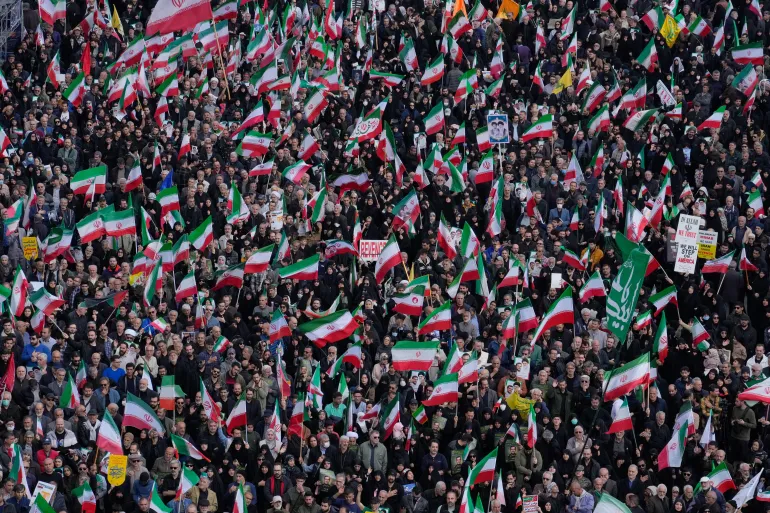
Tehran, Iran – Government supporters have taken to the streets in Iran to celebrate the anniversary of a referendum nearly half a century ago that solidified the Islamic Republic’s hold on power, even as the United States and Israel continued their attacks on the country.
President Masoud Pezeshkian and Foreign Minister Abbas Araghchi were among officials who joined pro-establishment rallies on the streets of Tehran on Tuesday night to mark Islamic Republic Day, when the nascent theocratic system in 1979 announced it had garnered 98.2 percent of the popular vote shortly after an Islamic revolution.
Recommended Stories
list of 3 itemsend of list
Shortly after and in the early hours of Wednesday morning, Washington bombed the site of the former US embassy in Tehran, in an apparent move tied to the symbolism of Islamic Republic Day. Footage from state media showed destruction and debris and smoke in the area, which is guarded by the Islamic Revolutionary Guard Corps (IRGC).
On Wednesday afternoon, authorities hoisted what they said was Iran’s tallest and heaviest flag at 150 metres (492 feet) and 300kg (660 pounds) in an area of downtown Tehran.
Festivities began on Tuesday night, and more gatherings are expected on Wednesday night, as political, military and religious leaders say followers must ensure security on the streets, backed by armed forces, to fend off any local dissent and incitement towards regime change from opponents.
Araghchi, Tehran’s top diplomat, who told Al Jazeera in an interview on Tuesday that he has been exchanging messages with Washington but has not responded to requests for negotiations, told state television that he joined supporters to “gain spirit” and encouragement. The president was seen taking selfie photos with people on the streets while flanked by masked bodyguards.
Hassan Khomeini, the son of Ruhollah Khomeini, who led the 1979 revolution and became the first supreme leader before his death in 1989, said it was incumbent upon them from an Islamic standpoint to remain on the streets every night until the war is over, no matter how long it takes.
Mourners gather during a funeral procession in Tehran, Iran on April 1, 2026, for Alireza Tangsiri, head of Iran’s Islamic Revolutionary Guard Corps Navy, and others killed in Israeli strikes in late March [Vahid Salemi/AP]
“The enemy might make a thousand plots in order to cut off our communication, but our trenches are the mosques, alleys, squares and streets,” he said.
People shown by state media in various cities chanted “Death to America” and “Death to Israel” in addition to a series of religious slogans.
The authorities issued calls to action for people to participate in group marches while waving flags. Religious singers and eulogists also performed religious songs that drew on the influence of revered figures in Shia Islam.
The paramilitary Basij forces of the IRGC, as well as other armed forces, patrolled the streets and set up checkpoints and roadblocks across the city.
But they were not the only forces present.
Hamid al-Hosseini, a senior clerical and paramilitary figure affiliated with the IRGC and Iraq’s Hashd al-Shaabi, also known as the Popular Mobilisation Forces (PMF) of Iran-aligned fighters, confirmed that Iraqi nationals were widely situated on the streets of the Iranian capital.
While surrounded by those attending state-run festivities in downtown Tehran, he told the IRGC-linked Tasnim news agency that Iraqi “mokebs” or religious food and services stations are now located around “various squares” in order to “offer a little help to the Iranian people and learn resilience from them”.
This comes days after Hashd al-Shaabi fighters, while wearing military attire and in some cases, clerical turbans, proudly marched the streets of cities in southwestern Iran’s Khuzestan in dozens of pick-up trucks while delivering what they called “humanitarian assistance”. Pezeshkian later thanked them in a post online.
There were reports that they had already been spotted in Tehran, but there was no official confirmation from Iranian authorities. Opponents and human rights organisations have for years accused the Islamic Republic of systematically using fighters from Iraq and other aligned armed forces to crack down against local dissent, a claim the authorities have rejected.
‘We are waiting for you’
The Iranian state has remained defiant as Washington signals that it may soon deploy thousands of soldiers to the country.
Amid speculation that a ground fight could be aimed at occupying parts of Iran’s southern islands on the Strait of Hormuz, taking over oil and gas facilities, or even extracting highly enriched uranium from bombed nuclear facilities, Tehran says its defences are prepared.
Ahmad Reza Pourdastan, the head of the Iranian army’s research centre, said the armed forces have been drilling for the scenario of a US invasion since 2001, so any aggression will be met with “heavy casualties”.
The general staff of the Iranian armed forces and the Khatam al-Anbiya Central Headquarters of the IRGC, which manage the war, said Islamic Republic Day represents “fighting arrogance in order to realise the goals of independence, freedom and religious democracy”.
The armed forces will “make the enemies of the glorious nation of our dear country regret what they have done and be humiliated,” they said.
The police force added in a separate statement that the Islamic Republic “is on the verge of securing ultimate victory for the forces of good versus evil”.
Smoke rises after an air strike in central Tehran, Iran on April 1, 2026 [Abedin Taherkenareh/EPA]
Tasnim released a video that said, “Come close,” and “We are waiting for you,” in Farsi, English, Hebrew, and Arabic. The IRGC-linked Fars news agency showed footage of pro-state demonstrators calling for more missile strikes across the region.
The US and Israel again targeted Iran’s top steel manufacturing companies in a move that could cost thousands of jobs and deal another major blow to civilians living under economic malaise caused by a mix of local mismanagement and harsh US sanctions. Other attacks this week hit civilian nuclear sites, a university, and military installations, while also impacting a number of civilian homes.
Surviving the blackout
Iranians continue to be concerned about a highly uncertain future while battling an unprecedented near-total internet shutdown that has left them in the dark for over a month, aside from the news disseminated by state media.
“I simply cannot afford to buy VPNs [virtual private networks] any more,” said a resident of Tehran, who said they had so far spent nearly $300 for VPN access, more than two-months salary for minimum wage workers, while being squeezed by an inflation rate of more than 70 percent.
“I’ve purchased many proxies since the start of the war, and most of the connections were cut within hours or days. I’m tired of overspending money that I need for meat and eggs on something that should be available as a basic human right,” he said.
He told Al Jazeera that two of the anonymous online vendors he had paid money to for VPN access turned out to be scammers, with the lengthy digital blackout creating a profitable black market.
Some of the vendors have been apprehended and their servers taken offline by Iranian authorities, who have also said that they are actively pursuing anyone using contraband Starlink satellite internet in connection with national security charges. State television said on Wednesday that Starlink infrastructure in the region is among Tehran’s “legitimate”.
National security and espionage charges are also being levied against anyone who is found to have committed acts of dissent, including taking videos of missile impact sites. That could entail confiscation of assets and execution, the judiciary has warned.
The Fars news agency on Wednesday released footage of “confessions” from more arrested Iranians, including a young sobbing girl with a blurred-out face, who said she had cheered US President Donald Trump and Israeli Prime Minister Benjamin Netanyahu for attacking Iran in a clip released online, as she believed the war would help overthrow the Islamic Republic.
Amid the state-imposed information blackout, some Iranians have devised their own early warning systems, which include phone calls and text messages from people in the northern or western provinces.
“They hear the jets flying over first, so they warn us, and in many cases, we take cover and hear those jets completing their bombing runs over Tehran within minutes,” another resident of the capital said.
It was a devastating experience for Abdul Rahman Azzam, 65, to recently cut down the olive trees he had planted decades ago on his land south of Jenin in the occupied West Bank, following an Israeli decision to confiscate it for the construction of a road for an illegal Israeli settlement.
The land slated for confiscation last December spans more than 513 dunams (51.3 hectares), 450 of which belong to the village of al-Fandaqumiya alone, with the remainder belonging to neighbouring towns such as Silat ad-Dhahr and al-Attarra.
Recommended Stories
list of 4 itemsend of list
As Palestinians commemorate the 50th anniversary of Land Day this year, the challenges of illegal Israeli settlement expansions, land confiscations, and restrictions on access to their land, particularly in Area C, persist.
Meanwhile, Israeli government leaders continue to declare that the annexation plan is a fait accompli.
Land Day commemorates the events of March 30, 1976, when Israeli authorities announced the confiscation of vast tracts of Palestinian land in the Galilee region.
In response, widespread strikes and demonstrations were organised in several towns and villages, which were met with force, resulting in the deaths of six Palestinians and the injury and arrest of hundreds.
Since then, this day has become a national symbol, embodying the connection of the Palestinians to their land and the rejection of its confiscation.
Twice taken
Since childhood, Azzam had worked alongside his father, grandfather, and uncles, planting and ploughing the land with olive trees.
He developed a deep connection to it, which he continued to work on until 2002, when the illegal Israeli settlement of Tarsala and the Sanur military base were established on it, and he and his family were barred from accessing it.
Following the 2005 disengagement plan, the Israeli army withdrew from the camp and the settlement of Tarsala. Azzam and other landowners returned to their land, and their joy was indescribable.
However, after the recent Israeli decision, the Palestinian landowners were denied access to their land, which is now entirely under Israeli military control.
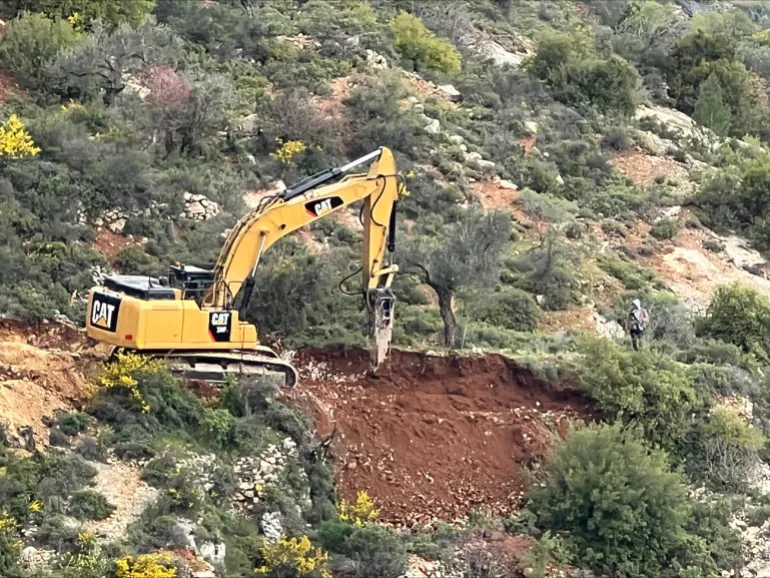
Palestinian land being bulldozed in the occupied West Bank town of Ein Yabrud [Mohammed Turkman/Al Jazeera]
“Suddenly, we found the land number in the official newspaper along with a confiscation order for the construction of a road connecting the settlements of Homesh and Tarsala, to which the settlers had returned after the 2005 withdrawal. We saw the Israeli army had already begun bulldozing the land,” Azzam told Al Jazeera.
To prevent the Israeli army from cutting down his olive trees during the bulldozing, Azzam went to his land and cut them down himself. He wept as he did so. He then noticed that all the other landowners had done the same, fearing for their trees.
“It’s easier for us to cut them down ourselves than for the army or settlers to do it. This is our land, and our trees are like our children; we cherish them and treat them with kindness because we toiled to cultivate and care for them,” he added.
Confiscation in several ways
The Oslo Accords, signed between Israel and the Palestine Liberation Organization in 1993, divided the West Bank into three categories: Area A, under full Palestinian control, comprising approximately 18 percent of the West Bank; Area B, under joint Palestinian and Israeli control, comprising 22 percent; and Area C, under full Israeli control, comprising 60 percent.
Since October 2023, Israel has been issuing confiscation orders for Palestinian lands in Area C at an accelerated pace in the West Bank, in preparation for implementing its annexation plan, which Palestinians believe is already being carried out on the ground without a formal declaration.
According to data from the Palestinian Authority’s Commission Against the Wall and Settlements, Israel seized 5,572 dunams of Palestinian land in 2025 through 94 confiscation orders for military purposes, in addition to three expropriation orders and four declarations of state land.
These orders were not isolated or circumstantial, but rather geographically distributed to serve the expansion of settlements, secure their borders, and construct settlement roads that further fragment Palestinian land and sever its natural contiguity, as it said.
Concurrently, Israel allocated 16,733 dunams of previously confiscated land for settler grazing, a move that reveals a dangerous escalation in the tools of control, according to the commission’s annual report.
In another report, the commission stated that between October 2023 and October 2025, Israel confiscated 55,000 dunams of land, including 20,000 dunams under the pretext of modifying the boundaries of nature reserves, and 26,000 dunams through 14 declarations of “state land” in the cities of Jerusalem, Nablus, Ramallah, Bethlehem and Qalqilya.
A total of 1,756 dunams were confiscated through 108 orders for military purposes, aimed at establishing military towers, security roads, and buffer zones around settlements.
However, it has become increasingly apparent that many land seizures are carried out without official military orders. Soldiers or settlers prevent Palestinian landowners from accessing their land, leaving them surprised to find it seized without any prior notification.
Mohammed Fouad’s land was cleared without warning in the town of Ein Yabrud to make way for a road to an illegal Israeli settlement [Mohammed Turkman/Al Jazeera]
Mohammed Fouad, 56, was surprised on Wednesday to find an Israeli army bulldozer razing his land in the town of Ein Yabrud, east of Ramallah.
He went to the nearest point to the land and watched as the bulldozer removed trees, seemingly clearing a road for settlers.
“My land is 15 dunams … and is only 1km from the Beit El settlement, which is built on land north of Ramallah. I fear this bulldozing is a prelude to its annexation to the settlement, especially since it’s classified as Area C,” Fouad told Al Jazeera.
He was not notified of any decision regarding the confiscation of his land. A farmer who was nearby informed him of it. When he tried to inquire with the armed men accompanying the bulldozer, they told him they were from the Israeli army and intelligence services and expelled him from his land.
“I’ve always cared for this land, and now I’m watching it being bulldozed right before my eyes, unable to reach it. It’s as if they’re forcing me to leave. But I’ll try to reach it every day,” Fouad said bitterly.
Land confiscation procedures have been facilitated by several Israeli policies over the past two years to complete the annexation plan.
Raed Muqadi, a researcher at the Land Research Centre, told Al Jazeera that settlers have resorted to fencing off Palestinian lands to seize them, especially in the Jordan Valley.
This has affected thousands of dunams in the occupied West Bank that were used as pastures or agricultural land. Because of the fencing, Palestinians are prevented from entering or using it.
“The Israeli Knesset also recently approved what is called lifting the ban on data concerning landowners in the West Bank, which makes it easier for settlers to seize land and allows them to purchase it, even in Area A, with the help of settlement associations,” he explained.
Actual expulsion
The tragedy is not limited to land confiscation and seizure in the West Bank, but extends to the expulsion of entire Palestinian communities from their homes under the weight of attacks.
Qusay Abu Naim, 23, a resident of the Bedouin community of al-Khalail in the village of al-Mughayyir, east of Ramallah, told us that he and all other residents were forced to leave in February due to the intensity of settler attacks on the residents, some of whom were injured.
On February 21, Israeli settlers attacked the community intermittently, assaulting men, women, and children, resulting in injuries to an entire family of four, including two children. The Israeli army then joined the attack after the settlers filed a complaint that the Palestinians had resisted them. The soldiers opened fire, wounding the children, aged 12 and 13, further.
“This incident was the last straw. We decided to leave because the attacks were almost constant. When we returned from the hospital to dismantle our homes, we were shocked to find that the settlers had destroyed them and vandalised their contents,” Abu Naim explained.
The attacks against this community began in December 2024, intending to seize the lands of al-Mughayyir. The settlers deliberately targeted women, beating them and stealing sheep to force the residents to leave.
“Because of the numerous attacks, we sought help from international solidarity activists, but that didn’t stop the settlers. The activists were attacked several times in 2024 and 2025. Among the attacks, settlers broke my brother’s arm so severely that he needed a metal plate to repair the fracture. While he was receiving treatment, the Israeli army arrested him, even though he was the victim. He is currently being held in administrative detention without charge,” Abu Naim added.
In addition to the attacks, the homes of this community were repeatedly robbed by armed settlers. They would break into the houses and steal food from refrigerators, terrorising women and children.
The residents of the community were forced to leave for neighbouring villages, including Deir Jarir and areas within al-Mughayyir itself, but they still remember the years when they lived there in their communities, amid a beautiful Bedouin life, the images of which remain with them to this day, and they lament leaving it.
“Of course, it is now forbidden for any Palestinian to access the al-Khalail community area, which is under the control of settlers and the Israeli army. We left it, but the land will return to its original owners,” he concluded.
According to the Office for the Coordination of Humanitarian Affairs (OCHA), at least 4,765 Palestinians were displaced from 97 locations between January 2023 and mid-February 2026 due to settler violence.
Most of those displaced were from Bedouin and herding communities in Area C. At the beginning of this year alone, 600 people were forced to leave a single Bedouin village, Ras Ein al-Auja, in the Jordan Valley.
According to the United Nations Development Programme (UNDP), the number of Palestinian Bedouins in the West Bank is approximately 40,000. Most Bedouins are originally from the Naqab Desert, from which they were forcibly displaced or fled during the 1948 Arab-Israeli War, following further displacement after 1967, and then throughout the 1980s, they have continued to face waves of expulsion to this day.