‘Wildwood’ review: Laika’s stop-motion animation impresses
Move over, “Alice in Wonderland” and “The Wizard of Oz” — you too, “Spirited Away” and “The Chronicles of Narnia.” There’s a new eye-popping portal fantasy in town and its name is “Wildwood.”
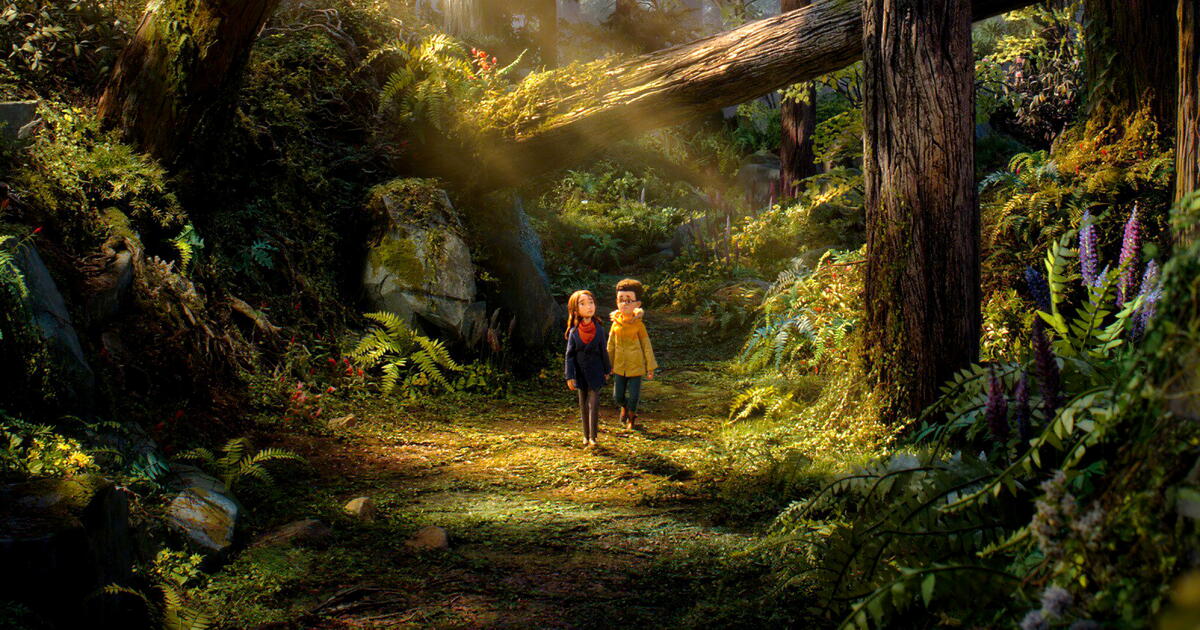
This is a thoroughly involving and captivating stop-motion adventure from Laika, the animation studio that made such other beautiful handmade works as “Coraline” and “Kubo and the Two Strings.” But it’s clear from the level of artistry on display here that the company, led by producer-director Travis Knight, has steadily advanced in technology, innovation and ambition. (We’re talking 233 handcrafted puppets and 132 practical sets.) That’s saying a lot given Laika’s previous top-tier output. In addition, Laika worked alongside New Zealand’s Wētā FX to create the movie’s stunning digital environments and visual effects. That magical ivy is something else.
The wondrous story was adapted by frequent Laika collaborator Chris Butler from the epic 2011 novel written by Colin Meloy (frontman for indie rock band the Decemberists, whose original music is featured here) and illustrated by Carson Ellis. The tale kicks off as intrepid young Portland, Ore., teen Prue (voiced by Peyton Elizabeth Lee) defies her worrywart parents and, in their absence, takes her baby brother, Mac, out for a bike ride around her city’s singularly quirky downtown. (Not for nothing, Knight is a Portland native and Laika is based just outside the city.)
But things quickly turn pitch dark as a murder of crows (take that collective noun how you will) swoops down and, quite terrifyingly, à la Alfred Hitchcock’s “The Birds,” abducts little Mac. This leads a desperate Prue and, soon, her nerdy but plucky classmate Curtis (Jacob Tremblay), into the forbidden “Impassable Wilderness” at the edge of town to rescue Mac. From there on it’s a roller coaster of magnificently rendered battles, chases, near-misses and escapes as Prue and Curtis — separately and together — navigate the enchanted, astonishing woods and its wildly assorted communities of rulers, warriors and underlings.
As Prue and Curtis struggle to unravel the twisty lore of the obstacle-laden forest in their search for Mac, their outsider presence inadvertently sets off a long-festering showdown for control of the forest between its warring factions. On the one hand, it’s Alexandra, the sinister, dangerously obsessed Dowager Governess (Carey Mulligan) and her marauding band of military-style coyotes (Tom Waits, Charlie Day and others) versus a wayward posse of bandits (led by Mahershala Ali’s formidable Brendan). Then there’s the Avian Principality, a bird-led kingdom also against Alexandra’s mounting power, including a stunningly majestic eagle known as the General (Angela Bassett) and the wise old Owl Rex (Richard E. Grant).
Vying for dominance as well are the haughty, self-serving bureaucrats of the area’s bustling capital of South Wood (Jemaine Clement, Marc Evan Jackson), who pull their political strings from the relative safety of the grand Pittock Mansion. Other characters Prue and the increasingly brave Curtis encounter along the way include the wry and resourceful rat Septima (Awkwafina), the courageous bandit Niamh (Amandla Stenberg), elderly mystic Iphigenia (Tantoo Cardinal) and the realm’s harried postmaster (Len Cariou). The talking animals feel right at home alongside the human figures and the voice work is excellent all around.
Needless to say, there’s a lot going on in Butler’s busy, occasionally dizzying script, though compressing the approximately 550-page source material was surely no easy task. (As it is, “Wildwood” runs more than two hours, long for an animated film, though it rarely lags.) Still, the narrative has its share of “just go with it” moments and explanations. Bits of connective tissue can sometimes feel missing amid the action and the story’s lessons, particularly for Prue, don’t always land as strongly or affectingly as they could.
It should also be said that there’s some fairly outsize violence along the way, particularly during the combat scenes, plus other potentially disturbing bits of mayhem that may be too extreme for younger children. Parents take note: The film more than rightly earns its PG-13 rating.
Nonetheless, for most audiences, especially animation-loving teens and adults, this should prove a spectacularly immersive ride, vibrantly shot by the great Caleb Deschanel (“The Right Stuff,” “The Natural”) and crafted by a reported 49 animators who brought the film to life one dazzling, painstaking frame at a time.
‘Wildwood’
Rated: PG-13, for strong fantasy violence/bloody images, thematic material, suicide-related material, brief partial nudity and language
Running time: 2 hours, 12 minutes
Playing: Opens Friday, Oct. 23 in wide release