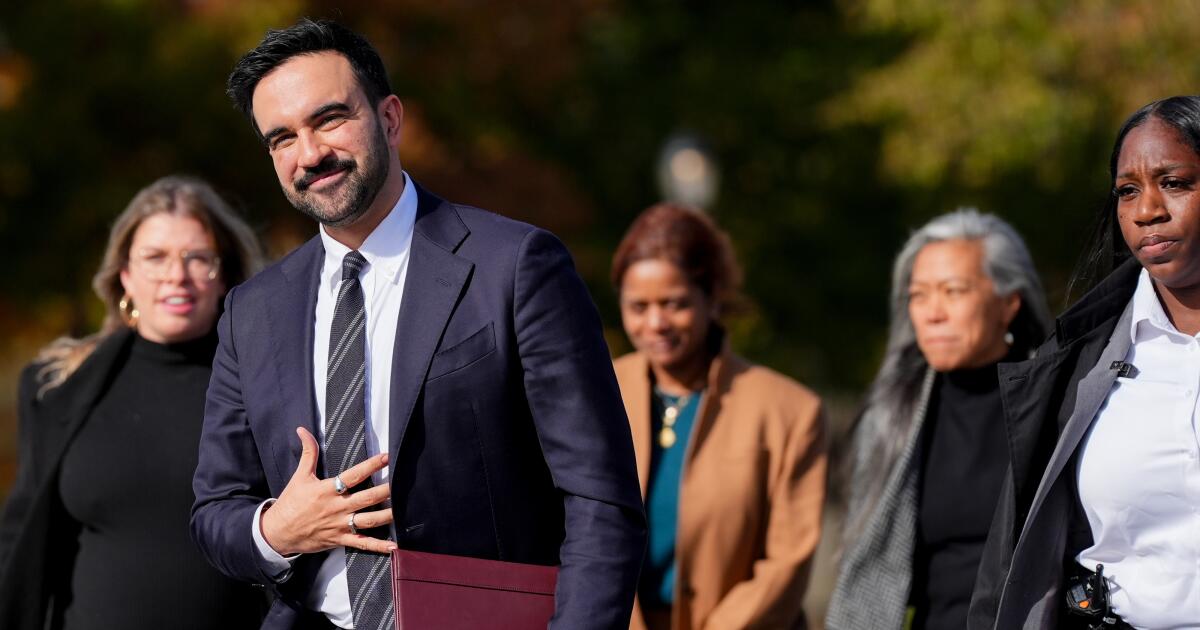
NEW YORK — At the top of his victory speech at a Brooklyn theater late Tuesday, Zohran Mamdani — the 34-year-old democratic socialist just elected New York’s next mayor — spoke of power being gripped by the bruised and calloused hands of working Americans, away from the wealthy elite.
“Tonight, against all odds, we have grasped it,” he said. “The future is in our hands.”
The imagery was apropos of the night more broadly — when a beaten-down Democratic Party, still nursing its wounds from a wipeout by President Trump a year ago, forcefully took back what some had worried was lost to them for good: momentum.
From coast to coast Tuesday night, American voters delivered a sharp rebuke to Trump and his MAGA movement, electing Democrats in important state and local races in New York, New Jersey and Virginia and passing a major California ballot measure designed to put more Democrats in Congress in 2026.
The results — a reversal of the party’s fortunes in last year’s presidential election, when Trump swept the nation’s swing states — arrived amid deep political division and entrenched Republican power in Washington. Many voters cited Trump’s agenda, and related economic woes, as motivating their choices at the ballot box.
The wins hardly reflected a unified Democratic Party nationally, or even a shared left-wing vision for a future beyond Trump. If anything, Mamdani’s win was a challenge to the Democratic Party establishment as much as a rejection of Trump.
His vision for the future is decidedly different than that of other, more moderate Democrats who won elsewhere in the country, such as Abigail Spanberger, the 46-year-old former CIA officer whom Virginians elected as their first female governor, or Mikie Sherrill, the 53-year-old former Navy helicopter pilot and federal prosecutor who won the race for New Jersey governor.
Still, the cascade of victories did evoke for many Democrats and progressives a political hope that they hadn’t felt in a while: a sense of optimism that Trump and his MAGA movement aren’t unstoppable after all, and that their own party’s ability to resist isn’t just alive and well but gaining speed.
“Let me underscore, it’s been a good evening — for everybody, not just the Democratic Party. But what a night for the Democratic Party,” Gov. Gavin Newsom said during his own remarks on the national wins. “A party that is in its ascendancy, a party that’s on its toes, no longer on its heels.”
“I hope it’s the first of many dominoes that are going to happen across this country,” Noah Gotlib, 29, of Bushwick said late Tuesday at a victory party for Mamdani. “I hope there’s a hundred more Zohrans at a local, state, federal level.”
On a night of big wins, Mamdani’s nonetheless stood out as a thunderbolt from the progressive left — a full-throated rejection not just of Trump but of Mamdani’s mainstream Democratic opponent in the race: former Gov. Andrew Cuomo.
Mamdani — a Muslim, Ugandan-born state assemblyman of Indian descent — beat Cuomo first in the Democratic ranked-choice primary in June. Cuomo, bolstered by many of New York’s moneyed interests afraid of Mamdani’s ideas for taxing the rich and spending for the poor, reentered the race as an independent.
Trump attacked Mamdani time and again as a threat. He said Monday that he would cut off federal funding to New York if Mamdani won. He even took the dramatic step of endorsing Cuomo over Curtis Sliwa, the Republican in the race, in a last-ditch effort to block Mamdani’s stunning political ascent.
Instead, city voters surged to the polls and delivered Mamdani a resounding win.
“To see him rise above all of these odds to actually deliver a vision of something that could be better, that was what really attracted me to the [Democratic Socialists of America] in the first place,” said Aminata Hughes, 31, of Harlem, who was dancing at an election-night party when Mamdani was announced the winner.
“A better world is possible,” the native New Yorker said, “and we’re not used to hearing that from our politicians.”
In trademark Trump fashion, the president dismissed the wins by his rival party, suggesting they were a result of two factors: the ongoing federal shutdown, which he has blamed on Democrats, and the fact that he wasn’t personally on people’s ballots.
Stephen Miller, one of Trump’s chief advisors, posted a paragraph to social media outlining the high number of mixed-status immigrant families in New York being impacted by the Trump administration’s immigration crackdown and mass deportation campaign, which Miller has helped lead.
Democrats in some ways agreed. They pointed to the shutdown and other disruptions to Americans’ safety and financial security as motivating the vote. They pointed to Trump’s immigration tactics as being an affront to hard-working families. And they pointed to Trump himself — not on the ballot but definitely a factor for voters, especially after he threatened to cut off funds to New York if the city voted for Mamdani again.
“President Trump has threatened New York City if we dare stand up to him. The people of New York came together and we said, ‘You don’t threaten New York,’” said Rep. Alexandria Ocasio-Cortez (D-N.Y.). “We’re going to stand up to bullies and thugs in the White House.”
“Today we said ‘no’ to Donald Trump and ‘yes’ to democracy,” New Jersey Democratic Chair LeRoy J. Jones Jr. told a happy crowd at Sherrill’s watch party.
“Congratulations to all the Democratic candidates who won tonight. It’s a reminder that when we come together around strong, forward-looking leaders who care about the issues that matter, we can win,” former President Obama wrote on social media. “We’ve still got plenty of work to do, but the future looks a little bit brighter.”
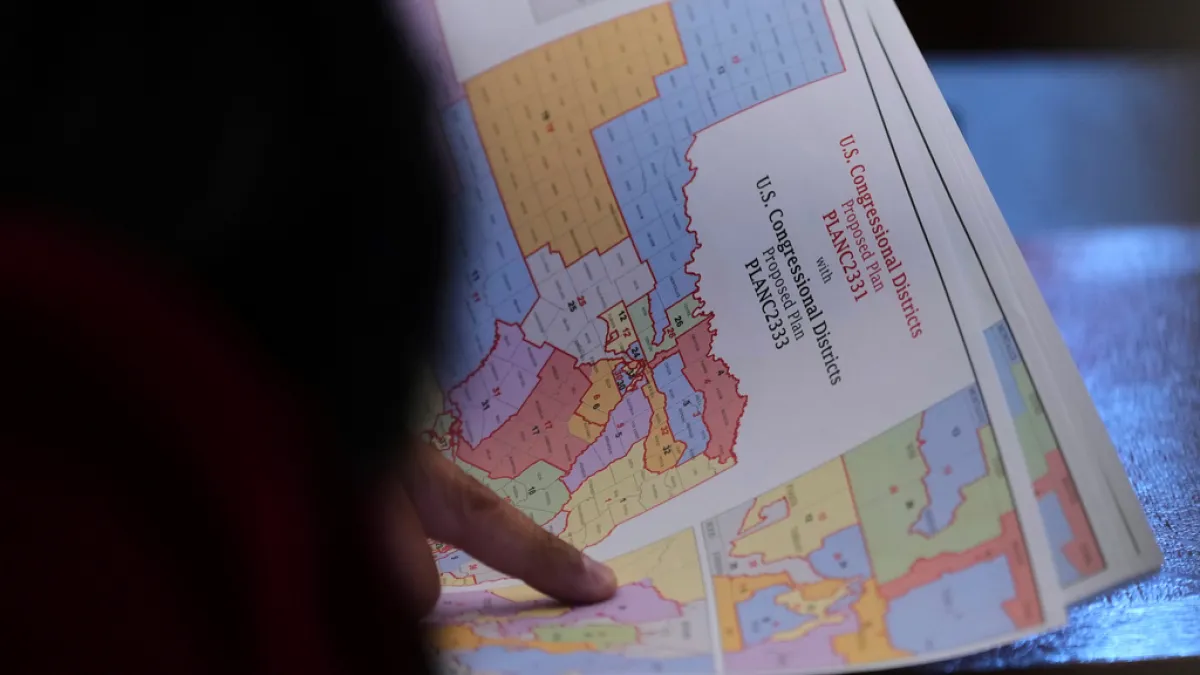
In addition to winning the New York mayoral and New Jersey and Virginia gubernatorial races, Democrats outperformed Republicans in races across the country. They held several seats on the Pennsylvania Supreme Court, and won the Virginia attorney general’s race. In California, voters passed Proposition 50, a ballot measure giving state Democrats the power to redraw congressional districts in their favor ahead of next year’s midterms.
Newsom and other Democrats had made Proposition 50 all about Trump from the beginning, framing it as a direct response to Trump trying to steal power by convincing red states such as Texas to redraw their own congressional lines in favor of Republicans.
Trump has been direct about trying to shore up Republicans’ slim majority in the House, to help ensure they retain power and are able to block Democrats from thwarting his agenda. And yet, he has suggested California’s own redistricting effort was illegal and a “GIANT SCAM” under “very serious legal and criminal review.”
Trump had also gone after several of the Democrats who won on Tuesday directly. In addition to Mamdani, Trump tried to paint Spanberger and Sherrill as out-of-touch liberals too, attacking them over some of his favorite wedge issues such as transgender rights, crime and energy costs. Similar messaging was deployed by the candidates’ Republican opponents.
In some ways, Trump was going out on a political limb, trying to sway elections in blue states where his grip on the electorate is smaller and his influence is often a major motivator for people to get out and vote against him and his allies.
His weighing in on the races only added to the sense that the Democrats’ wins marked something bigger — a broader repudiation of Trump, and a good sign for Democrats heading into next year’s midterms.
Marcus LaCroix, 42, who voted for Proposition 50 at a polling site in Lomita on Tuesday evening, described it as “a counterpunch” to what he sees as the excesses and overreach of the Trump administration, and Trump’s pressure on red states to redraw their lines.
“A lot of people are very concerned about the redistricting in Texas,” he said. “But we can actually fight back.”
Ed Razine, 27, a student who lives in the Bed-Stuy neighborhood of Brooklyn, was in class when he heard Mamdani won. Soon, he was celebrating with friends at Nowadays, a Bushwick dance club hosting an election watch party.
Razine said Mamdani’s win represented a “new dawn” in American politics that he hopes will spread to other cities and states across the country.
“For me, he does represent the future of the Democratic Party — the fact that billionaires can’t just buy our election, that if someone really cares to truly represent the everyday person, people will rise up and that money will not talk,” Razine said. “At the end of the day, people talk.”
The Associated Press and Times staff writer Connor Sheets contributed to this report.