
South Korean tech giant SK hynix on Wednesday introduced Honey Banana Mat chips, a crunchy snack meant to resemble semiconductors, in collaboration with 7-Eleven. Photo courtesy of SK hynix
SEOUL, Nov. 26 (UPI) — South Korean tech giant SK hynix, the world’s leading high-bandwidth memory chipmaker, announced Wednesday it launched a new semiconductor-inspired crunchy snack in collaboration with convenience store chain 7-Eleven.
The snack, called “HBM Chips,” is a play on the company’s high bandwidth memory — or HBM — technology. In this case, the acronym stands for “Honey Banana Mat,” using the Korean word for “flavor.”
The square corn chips, coated with sweet honey-banana chocolate, are meant to resemble semiconductors.
SK hynix said the product aims to make its complex technology more accessible to everyday consumers, particularly younger generations who may become future semiconductor industry talent.
“Semiconductors feel too distant for most people, but snacks are something everyone can enjoy,” SK hynix said in a statement. “We decided to explain technology through a new language of taste.”
The company also introduced a new sunglasses-wearing humanoid mascot “equipped with the latest HBM” that it said will appear in future brand communications, social media content and merchandise.
The collaboration marks the first foray into consumer packaged goods for the business-to-business chipmaker.
SK hynix holds approximately 50% of the global HBM market and recently surpassed Samsung to become the world’s largest dynamic random access memory maker for the first time, capturing 36% market share in early 2025. The company pioneered HBM technology, which stacks layers of memory vertically, in 2013 and currently supplies major tech companies including Nvidia, Amazon and Microsoft.
HBM chips are critical components in AI servers and high-performance computing, enabling faster data transfer between processors and memory.
SK hynix recently logged record-high quarterly profits and said much of its high-end chip supply has already sold out through 2026 due to surging AI demand.
The new snack chips are now available at 7-Eleven stores across South Korea.
Amazon shows off its new logo at a logistic and distribution center in Werne, Germany, in 2017. On Tuesday, the company announced the rollout of its satellite-based Amazon Leo Internet service for select enterprise customers, with a wider rollout planned in 2026. File Photo by Friedemann Vogel/EPA-EFE
Nov. 25 (UPI) — Online retailer Amazon has begun to roll out its Leo Internet service that offers gigabyte speed via its satellite network for businesses and other organizations.
Amazon’s enterprise customers will be the first to use the Amazon Leo Internet service that includes a new “Ultra” antenna, and a wider rollout is planned for 2026, Amazon announced on Tuesday.
Amazon officials said Leo is designed to extend reliable, high-speed Internet to those beyond the reach of existing networks, including millions of businesses, government entities and organizations that are located in areas where Internet service is unreliable.
“Amazon Leo represents a massive opportunity for businesses operating in challenging environments,” said Chris Webber, vice president of consumer and enterprise business for Amazon Leo.
“We’ve designed Amazon Leo to meet the needs of some of the most complex business and government customers out there,” Webber added.
“We’re excited to provide them with the tools they need to transform their operations, no matter where they are in the world.”
The Amazon Leo Internet service uses an innovative network design, satellites and “high-performance phased-array antennas” to support download speeds of up to 1 gigabyte per second and upload speeds of up to 400 megabytes per second.
A new antenna dubbed Leo Ultra enables users to attain such downloading and uploading speeds, which exceed those of the competing Starlink Performance Kit, according to The Verge.
SpaceX officials said a new V3 satellite will support faster uploading and downloading speeds next year.
Amazon also has more than 150 satellites orbiting the Earth to provide digital communications that are undergoing initial network testing that involves a small group of enterprise customers.
Commercial airline JetBlue is among Amazon Leo’s enterprise customers participating in the service’s initial rollout.
“We knew Amazon Leo would share our passion for customer-first innovation,” JetBlue President Marty St. George said.
“Choosing Amazon Leo reflects our commitment to staying ahead of what customers want most when traveling, such as fast, reliable performance and flexibility in our free in-flight Wi-Fi.”
Amazon Leo also enables enterprise customers to connect directly to their cloud-based accounts and establish private network interconnects so that they can connect and communicate with remote locations using their respective data centers and core networks.
The federal government seeks to develop tailored artificial intelligence (AI) solutions and drive significant cost savings by leveraging AWS’s dedicated capacity.
Published On 24 Nov 202524 Nov 2025
Share
Amazon is set to invest up to $50bn to expand artificial intelligence (AI) and supercomputing capacity for United States government customers, in one of the largest cloud infrastructure commitments targeted at the public sector.
The e-commerce giant announced the investment on Monday.
Recommended Stories
list of 4 itemsend of list
The project, expected to break ground in 2026, will add nearly 1.3 gigawatts of new AI and high-performance computing capacity across AWS Top Secret, AWS Secret and AWS GovCloud regions through new data centres equipped with advanced computing and networking systems.
One gigawatt of computing power is roughly enough to power about 750,000 US households on average.
“This investment removes the technology barriers that have held the government back”, Amazon Web Services (AWS) CEO Matt Garman said.
AWS is already a major cloud provider to the US government, serving more than 11,000 government agencies.
Amazon’s initiative aims to provide federal agencies with enhanced access to a comprehensive suite of AWS AI services. These include Amazon SageMaker for model training and customisation, Amazon Bedrock for deploying AI models and agents and foundational models such as Amazon Nova and Anthropic Claude.
The federal government seeks to develop tailored AI solutions and drive significant cost savings by leveraging AWS’s dedicated and expanded capacity.
The push also comes as the US, along with other countries such as China, intensifies efforts to advance AI development and secure leadership in the emerging technology.
Tech companies, including OpenAI, Alphabet and Microsoft, are pouring billions of dollars into building out AI infrastructure, boosting demand for computing power required to support the services.
On Wall Street, Amazon’s stock was up 1.7 percent in midday trading.
Other tech stocks surged amid the recent investments. Alphabet, Google’s parent company, closed in on a $4 trillion valuation on Monday and was set to become only the fourth company to enter the exclusive club. Its stock was up 4.7 percent.
Last week, Nvidia announced expectations of higher fourth-quarter revenue — a month after the tech giant announced a partnership to build supercomputers for the US Department of Energy — a deal that sent the company’s valuation topping $5 trillion.
Nvidia stock was up by 1.8 percent in midday trading.
Software engineering jobs are among the thousands Amazon cut in October amid a push to downsize and increase efficiency and innovation, the company reported on Friday. Photo by Friedemann Vogel/EPA-EFE
Nov. 21 (UPI) — Engineers formerly employed by Amazon accounted for about 40% of its 4,700 jobs cut in October as the online retailer and tech company seeks greater efficiency and innovation.
Amazon fired more than 1,800 engineers in October amid downsizing, while also seeking more rapid innovation, CNBC reported on Friday.
Amazon has 1,578,000 employees as of Sept. 30, which is twice as many as 2019, according to Stock Analysis. The $2.3 trillion market cap is fifth fifth-highest in the world, The Market Fool posted.
The company announced the job cuts in its respective Worker Adjustment and Retaining Notifications filed in California, New Jersey, New York and the state of Washington.
The jobs cut in one month are the largest reduction in Amazon’s 31 years in business and part of the more than 14,000 layoffs announced last month by Amazon officials.
The tech firm’s human resources leader, Beth Galetti, said Amazon needs more artificial intelligence engineers to enable it to better manage operations while reducing labor costs.
“This generation of AI is the most transformative technology we’ve seen since the internet, and it’s enabling companies to innovate much faster than ever before,” Galetti said in the memo notifying states of the job cuts.
“We’re convinced that we need to be organized more leanly, with fewer layers and more ownership, to move as quickly as possible for our customers and business.”
Most of the engineers fired this year are software specialists.
Amazon’s job cuts echo those of other tech firms, which combined for nearly 113,000 job reductions in total among 231 tech firms so far this year, according to Layoffs.fyi.
Amazon Chief Executive Officer Andy Jassy in recent years has emphasized downsizing to make Amazon more efficient by cutting its organizational fat, CNBC reported.
The virtual retailer is expected to announce more job cuts in January while revising its workforce to improve efficiency and reduce bureaucracy.
Belem, the host of COP30, is trying to show that the Amazon can generate jobs without clearing trees. Para state has launched a new Bioeconomy and Innovation Park to help locals turn traditional forest products from acai to Brazil nuts into export-ready goods. The project sits beside the century-old Ver-o-Peso market, linking long-standing Amazon trade with modern processing labs and equipment meant to boost production and income.
WHY IT MATTERS
Brazil wants to demonstrate that a “living forest” can be economically competitive with cattle, soy and mining. Early studies show forest-product value chains already rival livestock income in Para, and officials hope to expand that into a recognisable industrial sector. With Belem about to host the world’s biggest climate summit, the state is under pressure to prove that conservation and development can advance together.
Producers, small businesses and forest communities stand to benefit from better processing facilities and higher-value markets. Companies like Natura already rely on Amazon ingredients, while newer ventures are scaling up acai, oils and specialty foods through the park’s labs. Farmers and cooperatives are also using the facilities to improve packaging, blends and shelf life, hoping to reach premium buyers at home and abroad.
WHAT’S NEXT
Para will use COP30 to court investors and expand infrastructure so forest-based industries can grow beyond small-scale production. The Bioeconomy Park is expected to push more Amazon products into global markets, but lasting success will depend on keeping forests intact as demand rises. For Brazil, Belem’s progress will serve as a showcase of what a viable “rainforest economy” could look like on the global stage.
Nov. 19 (UPI) — Tech giant Nvidia on Wednesday posted record revenue and strong profit for the third quarter, beating Wall Street expectations, amid exploding growth in artificial intelligence.
Nvidia, which has the world’s largest market capitalization at $4.5 trillion, reported record sales. It said sales grew 62% in one year to $57 billion through Oct. 26. Wall Street had projected a $54.9 billion figure.
On Oct. 29, Nvidia became the first company worldwide with a $5 trillion cap one day before CEO Jensen Huang met with President Donald Trump in the White House.
“There’s been a lot of talk about an AI bubble. From our vantage point, we see something very different,” Huang said during a conference call with investors.
Fourth-quarter sales are estimated to be around $65 billion, contrasting with $61.66 billion by analysts.
Profit was up 65% from last year in the quarter to $31.9 billion or 78 cents per share, slightly ahead of expectations. The net income represents 58% of revenue.
NVIDIA will pay its next quarterly cash dividend of 1 cent per share on Dec. 26.
Nvidia builds chips and software platforms for the AI industry. The company, founded in 1993 in the Silicon Valley in California, pioneered the graphics processing unit, initially for 3D video games.
The chips are made in the United States by GlobalFoundries, Taiwan Semiconductor Manufacturing Company and Samsung in South Korea. Taiwan’s new factory in Arizona focuses on chips for Nvidia.
Most AI companies’ technology runs on Nvidia’s chip, CNN reported.
Its best-selling chip is the Blackwell Ultra, a second generation. The company is banned from selling the new ones to China.
“Blackwell sales are off the charts, and cloud GPUs are sold out,” Huang said in a statement about its best-selling chip.
“Compute demand keeps accelerating and compounding across training and inference — each growing exponentially. We’ve entered the virtuous cycle of AI. The AI ecosystem is scaling fast — with more new foundation model makers, more AI startups, across more industries, and in more countries. AI is going everywhere, doing everything, all at once.”
In October, Huang said there were $500 billion in AI chip orders for 2025 and 2026 combined.
“The number will grow,” Nvidia finance chief Colette Kress said during the earnings call with analysts.
Nvidia said there were $51.2 billion in revenue in data center sales, a 66% rise year-over-year.That includes $43 billion in revenue was for “compute,” or the GPUs. The company said most growth was from GB300 chips.
The stock, with the ticker symbol NVDA, initially traded at $12 per share, through its Initial Public Offering on Jan. 22, 1999.
The strong Nvidia report boosted after-hours trading of tech firms Meta, Microsoft, Amazon and Google.
“This answers a lot of questions about the state of the AI revolution, and the verdict is simple: it is nowhere near its peak, neither from the market-demand nor the production-supply-chain sides for the foreseeable future,” Thomas Monteiro, senior analyst at Investing.com, said in emailed commentary following the report.
In September, Nvidia announced a $100 billion investment in OpenAI in exchange for chip purchases.
On Monday, Anthropic committed to buying $30 billion in computing capacity from Microsoft Azure in exchange for an investment in the AI lab from both tech giants.
Nvidia announced a collaboration with Intel to jointly develop multiple generations of custom data center and PC products with NVIDIA NVLink.
Nvidia has reviewed plans to accelerate seven new supercomputers, including with Oracle to build the U.S. Department of Energy’s largest AI supercomputer, Solstice, plus another system, Equinox.
Nvidia said it had $4.3 billion in gaming revenue, which is a 30% boost from one year ago.
Despite the boom, CEO of one of the world’s largest independent financial advisory organizations warnsthere is a “real risk” because of complacency.
“Exceptional results don’t remove the need for discipline,” Nigel Green of deVere Group in Britain said in an email to UPI. “The AI ecosystem is growing fast, but fast growth doesn’t protect anyone from the consequences of over-extension.”
He said the path from deployment to real commercial returns “remains untested” in many industries.
“Investors must examine whether business models can convert this scale of capital investment into sustained earnings,” he said. “Complacency could be a real risk.”
Belém, Brazil — Two stark-white cruise ships loomed over a muddy Amazonian estuary, an odd sight from a beach where two children waded in the water.
The diesel-powered vessels towered over the impoverished riverfront neighborhood where trash littered the ground and a rainbow sheen from household and street runoff glistened on top of rain puddles.
The cruise liners — with their advertised swimming pools, seafront promenades and an array of restaurants and bars — were brought in to house thousands of delegates attending the 12-day United Nations COP30 climate summit in Belém, which ends Friday. The ships helped address a housing crunch created by an influx of roughly 50,000 people into the capital of Pará in northern Brazil.
Along with being a global economic powerhouse, Brazil is also one of the planet’s most important climate actors. The South American nation is home to tropical rainforests that absorb vast amounts of carbon dioxide but are increasingly threatened by deforestation and a drying Amazon.
A navy soldier patrols the Port of Outeiro, where cruise ships are docked to host delegations attending the COP30 U.N. Climate Change Conference in Belem, Brazil, on Nov. 8. Two cruise ships tower imposingly over a sleepy port in the Brazilian Amazon where some 50,000 people are gathering for a U.N. climate conference. With capacity for 6,000 people, the behemoths came from Europe to the riverine city of Belem on Brazil’s north coast to serve as floating hotels.
(Pablo Porciuncula / AFP via Getty Images)
The contrast — a climate conference relying on emissions-heavy cruise ships — has become the defining image of this year’s COP30, where wealth and scarcity sit side by side.
Belém residents said they felt a mix of curiosity and excitement watching the influx of foreigners, eager to show a culture that is often overshadowed by the country’s larger southern cities.
Many described COP30 as the first time the world had paused long enough to take notice of the people living at the mouth of the Amazon River, where locally grown açaí is sold on nearly every block. The region supplies the vast majority of Brazil’s açaí crop and much of what’s exported worldwide.
As humidity hung thick in the hot air, locals across the city of 1.3 million people pointed to expanded docks meant to attract future tourism, freshly painted walkways, restored colonial buildings with late-19th-century European touches and new cultural centers rushed to completion. But the sudden infusion of money layered atop long-standing inequality sharpened questions from residents about what will remain after the summit’s global spotlight fades.
Much of the summit footprint, they said, sits in areas where new structures were built fast, unevenly or only partly completed. Brazil’s government highlighted upgrades to Belém’s airports, ports, drainage systems, sanitation networks, parks and tourist areas, saying the work would leave a lasting legacy beyond COP30.
The BBC reported that a new four-lane highway built for COP30 resulted in tens of thousands of acres of protected Amazon rainforest being leveled, including trees locals relied on to harvest açaí berries to sell. One roadway to ease traffic to the climate summit remains unfinished and blocked by plastic orange netting.
“They cut all this forest to make that road and didn’t even finish it,” said Lucas Lina, 19, who works as an administrator at a Belém fire station, as he pointed to the unfinished road. “I don’t think they ever will. They will delay and delay.”
Lina said climate change is something locals feel acutely. The region has seen unpredictable rainfall, and in some years, receives little at all in an area used to its showers.
“The climate is going crazy,” Ana Paula, a government food safety inspector, said in Portuguese as Lina translated. “We can’t predict anything anymore.”
Even environmentalists acknowledge the optics are fraught, particularly as attendees flew more than 1,800 miles from events in Rio de Janeiro and São Paulo for satellite gatherings. That included members of California’s delegation and Gov. Gavin Newsom.
“It’s not well conceived because there’s not enough housing,” said Terry Tamminen, former California environmental secretary. “If we really cared about the climate, we’d have these events every year and they’d be 100% virtual.”
Such contradictions have often fueled demonstrations at climate summits, including on Friday when roughly 100 Indigenous protesters blocked the conference’s main entrance for more than 90 minutes. They formed a human chain as they denounced development plans they say would accelerate deforestation.
Indigenous activists participate in a climate protest during the COP30 U.N. Climate Summit on Saturday in Belém, Brazil.
(Andre Penner / Associated Press)
“Our forest is not for sale,” they wrote in a statement.
It was the second protest during the first week of COP30 after a brief clash inside the massive newly constructed facility resulted in two security guards suffering minor injuries.
“There are a lot of promises that the government made that are yet to be delivered,” said Lina, who taught himself English by watching YouTube and through online gaming. “We don’t know if these promises will actually be kept up after COP30.”
That tension — between symbolism and the city’s strained reality — defines this climate conference in a way that delegates say feels impossible to ignore.
Brazil remains one of the world’s top oil producers and recently approved new drilling near the rainforest. Many delegates argued that no setting better captures the stakes of the climate crisis than the Amazon, where Indigenous stewardship, extraordinary biodiversity and the consequences of deforestation are felt globally.
“I don’t know there’s a more important location than the rainforest,” Newsom told The Times. “The one area that consistently gets overlooked in the climate discussion is biodiversity.”
This aerial view shows a deforested area of the Amazon rainforest in the municipality of Moju, Brazil, on Wednesday during the COP30 U.N. Climate Change Conference.
(Mauro Pimentel / AFP via Getty Images)
With the summit came new investments that residents say they welcomed, including new bus routes, expansions at ports meant to increase future tourism and increased police presence to make streets safer.
“It’s very good for us,” said Maria Fátima in Portuguese while standing under an awning of a shuttered bar overlooking the cruise ships. She smiled and gave a thumbs up after saying she had never seen an American in Belém before.
“Everyone is very happy,” she said of the possibility that the newly expanded port will bring future tourism.
That port, which experienced an oil spill in April, is now being marketed as the Amazon’s next cruise-tourism hub. Its expansion cost $44 million and relied on nonstop work from construction crews in rotating shifts. The rush project doubled the pier’s capacity.
Room prices aboard the cruise ships soared to more than $1,400 a night for a balcony cabin, according to Times inquiries. On land, Belém’s modest supply of hotels and even seedy love motels that typically rent by the hour surged in price, pushing residents to rent their apartments and homes at rates many said they had never imagined.
People on a beach along the Guama River watch cruise ships docked at the Port of Outeiro, which will host delegations attending the COP30 U.N. Climate Change Conference in Belém, Brazil, on Nov. 6.
(Carlos Fabal/AFP via Getty Images)
One attendee said her hotel room typically goes for $85 a night. Her room cost $1,000 instead.
Newsom even joked about the costs. When a Brazilian journalist asked whether California would make climate investments in the country, Newsom said the price of his room at the Holiday Inn in Belém already felt like an “economic contribution.”
But those prices didn’t benefit everyone. Local media reported that some renters were evicted ahead of the conference in order to open up rooms to foreigners.
Inside the summit, Newsom operated as a proxy for the United States while attending COP30 for two days after President Trump, an outspoken climate skeptic, declined to send any high-level federal officials.
Long Beach resident Dominic Bednar, attending his fifth climate summit, said the contradictions of this year’s summit don’t diminish the importance of being there.
“It’s a double-edged sword,” said Bednar, an assistant professor in the Department of Urban Planning and Public Policy at UC Irvine. “On one hand, it brings understanding to the city and is driving a lot of economic investment. But I’m also curious: What is the carbon footprint of everybody coming into COP and the construction of this place? We are using energy, and we’re contributing to climate pollution.”
People riding in boats participate in a People’s Summit event on Guajara Bay during the COP30 U.N. Climate Summit on Wednesday in Belém, Brazil.
(Andre Penner / Associated Press)
Graduate students from UC San Diego’s Scripps Institution of Oceanography echoed that discomfort, but said not attending would only cede more ground to powerful energy interests that already dominate climate talks.
“We can empathize with not having our voices heard,” said graduate student Danielle McHaskell as she waited to take a photo with Newsom. “And that’s an important part of the climate movement — empathy for other people.”
Newsom, too, said he was aware of the contradiction of using fossil fuels to reach a climate summit.
Still, he defended the decision to hold COP30 in the Amazon. He said it offered a chance to “see what I’ve only seen on TV or could see disappear in my lifetime.” He added that he was particularly excited about venturing into the Amazon rainforest with a small delegation to learn in person about conservation efforts and connect with something beyond policy and negotiations.
“I think that spiritual element really matters in a world that can use a little bit more of that,” he said before returning to California on Sunday. “That’s one of the reasons I’m looking forward to getting deeper into the Amazon.”
Nov. 14 (UPI) — Tech giant Anthropic confirmed Chinese actors managed to seize control of its AI model Claude to execute a large cyberattack with little human interaction.
On Thursday, Anthropic officials said in a blog post in mid-September it detected “suspicious activity” that a later investigation determined was a “highly sophisticated espionage campaign.”
It added Anthropic had “high” confidence it was a China-backed cyber group.
The Chinese state-sponsored syndicate, which Anthropic called “GTG-1002,” reportedly hijacked its artificial intelligence tool Claude in order to handle between 80% to 90% of a cyberattack on about 30 global targets.
According to Anthropic, it targeted a slew of government agencies, financial institutions, chemical-manufacturing plants and big tech firms.
In a “small number” of cases, the company added, the cyber infiltration was successful.
AI-related hacking has been seen in recent years to a limited degree. But Amazon-backed Anthropic says it believed this recent episode is the first documented “large-scale” case primarily run by AI capability.
Anthropic claimed safeguards in place were designed to prevent abuse of its product.
But it said hijackers, claiming to be acting as defense testing for a legitimate cybersecurity firm, jailbroke Claude by breaking down prompts into smaller requests to avoid detection.
Anthropic said it opted to share the information in order to help the cybersecurity industry improve its defense mechanisms against similar attacks in the future by AI hackers.
“The sheer amount of work performed by the AI would have taken vast amounts of time for a human team,” according to California-based Anthropic.
The tech company said it’s likely the attack only required sporadic human interaction at “perhaps” four to six “critical decision points” per hacking campaign.
“The AI made thousands of requests per second — an attack speed that would have been, for human hackers, simply impossible to match,” the blog post continued.
“Automated cyber-attacks can scale much faster than human-led operations and are able to overwhelm traditional defenses,” Jake Moore, global cybersecurity advisor for internet security firm ESET, told Business Insider.
Last year in February, Microsoft and OpenAI publicly revealed that its artificial intelligence tools were being deployed by foreign government hackers in China, Russia, Iran and North Korea to improve cyber warfare.
Moore indicated Thursday that not only is an example of Anthropic’s attack what many have feared, but the “wider impact is now how these attacks allow very low-skilled actors to launch complex intrusions at relatively low costs.”
“AI is used in defense as well as offensively, so security equally now depends on automation and speed rather than just human expertise across organizations,” he stated.
TRYING to figure out what to get someone for Christmas often feels like a part-time job – but if they love to travel, then they will love these finds for less than £15.
From frantic packers to document forgetters, travelling can sometimes be stressful.
Sign up for the Travel newsletter
Thank you!
It can be hard to know what to get someone at Christmas – but if they love travelling, they will love these findsCredit: Amazon
On the other hand, it is the perfect time to indulge and get something for someone else that will make their holiday even more special.
Here are Sun Travel’s top gifts for under £15… bargain!
Cyann Fielding, Travel Reporter
Important documents case
After leaving my home to catch a flight, I have already unzipped my bag to check I have my passport at least five times.
But it can get lost in my bag, and often this is when the panic sets in.
Add to it trying to find you debit and credit cards, printed documents such as booking references and insurance and of course, once you’re at the airport, your boarding pass – it becomes a flustered nightmare.
All of this stress goes when you have a documents purse.
This sleek travel wallet from Amazon for just £13.98 is ideal.
It has several pouches and pockets for all your important bits, meaning they don’t get lost.
And the wrist strap means important documents are right in your hand.
A travel wallet is ideal for keeping your passport and important documents in one placeCredit: Amazon
Reusable travel cup
If you are anything like me, you will never be able to face the day or journey ahead without a good old cup of coffee.
And often, when I am rushing between airport, train, hotel and attractions, there is nothing I want more than a caffeine hit.
Paper cups just don’t do it for me – I am fed up of the dribbles down the side thanks to a loose fitting lid, having burnt hands when no coffee collars are available and of course, my drink going cold in a matter of seconds.
Husk’s reusable 12oz travel cup is simple and stylish.
It is made from the husks of coffee beans, hence the name and is super lightweight to throw in a bag.
The cup itself is super durable and keeps my coffee hot for much longer.
For £12, it’s a steal.
A reusable coffee cup is perfect for drinks on the goCredit: HUSK UK
Alice Penwill, Travel Reporter
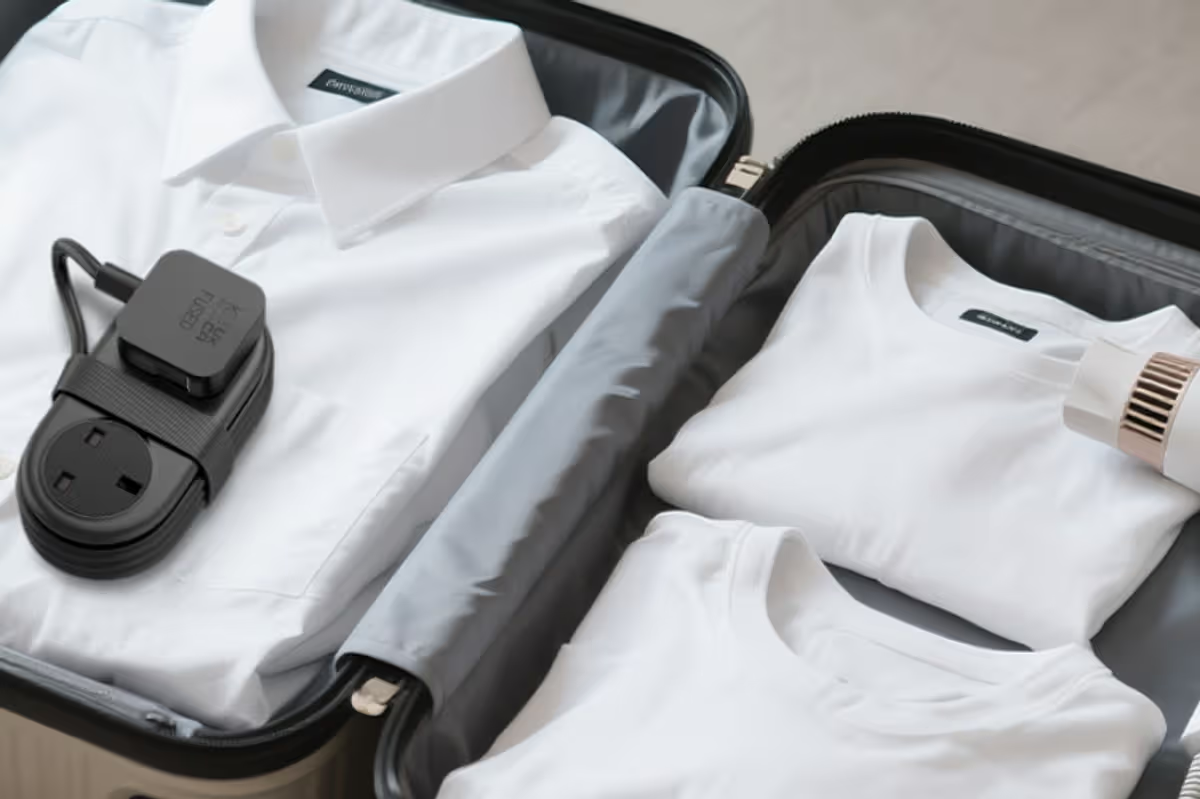
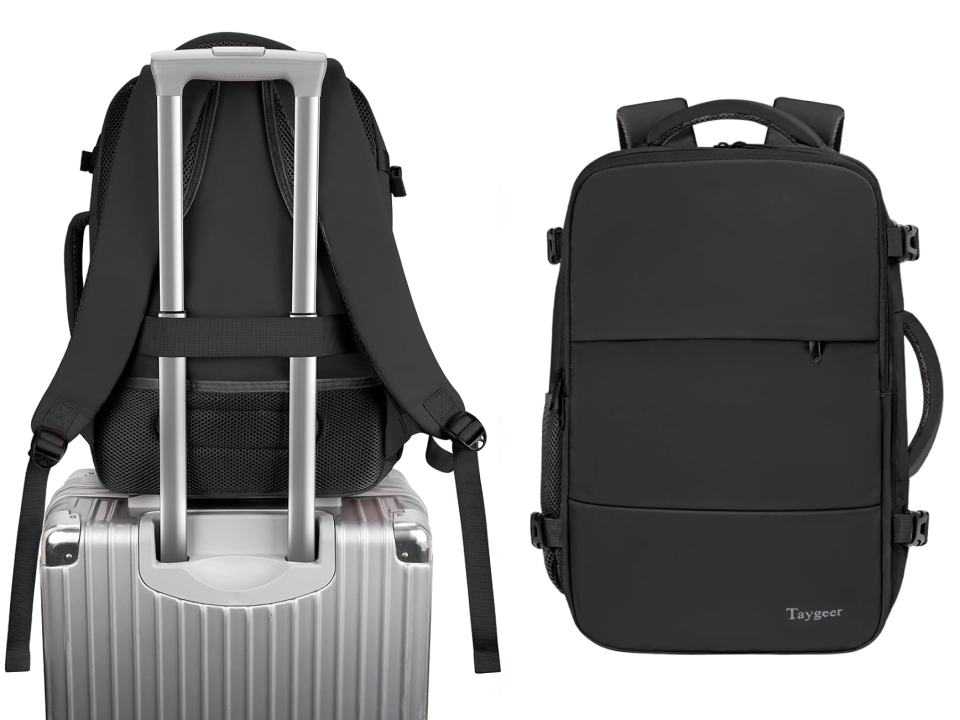
Pretty hand luggage bag
After a series of unfortunate events in which my suitcase was misplaced twice during one trip, I’ve learned that one essential every holidaymaker needs is a sizable hand luggage bag.
Any seasoned traveller will know that to take just a handbag on a flight is unwise, especially if you’re taking a connecting flight.
You need at least a day’s worth of clothes and your essentials on the plane with you.
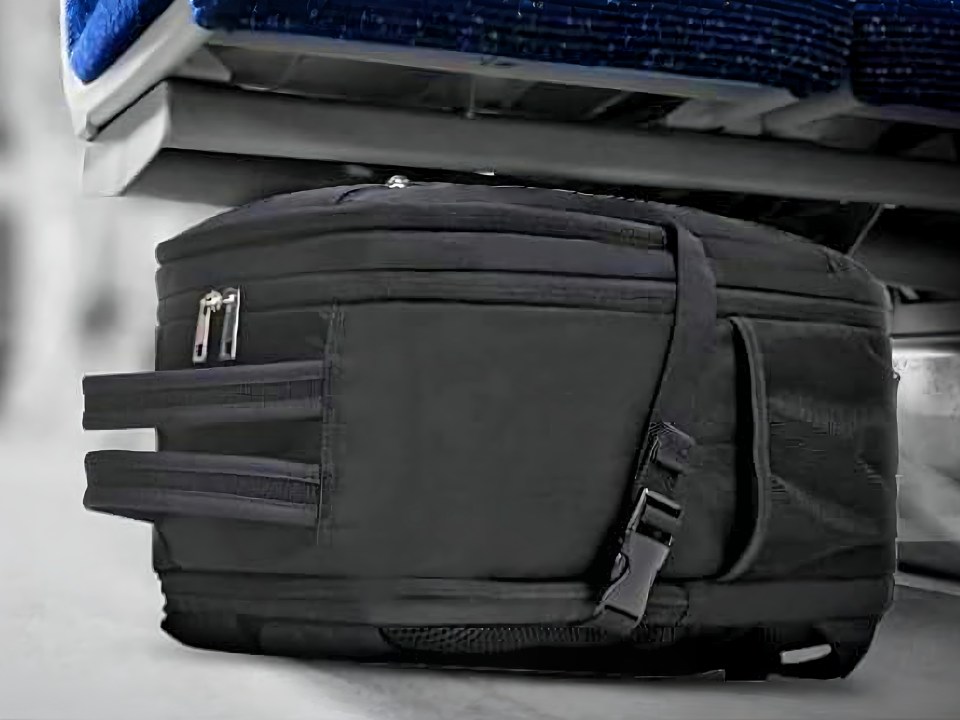
So a stylish bag for taking on the plane that you can slide under the seat in front of you is a great Christmas gift.
This one from Amazon fits airline dimensions of 40x20x25 and even has a separate compartment for shoes.
Or opt for this navy duffel bag which is water-repellent, tear-resistant with various pockets and strap options too.
And both are under £15.
A good hand luggage bag is a no brainerCredit: Amazon
World scratch map
Whether you know someone who is a casual jetsetter, loves a family holiday or a keen solo traveller, a scratch map is a great gift.
It’s incredibly satisfying to mark off everywhere you’ve been across the world, and if you get the right one, it can make for some fun wall art too.
Scratch The World Map Print from Not on the High Street is A2 size and has all the countries covered in gold until you scratch them off leaving colourful destinations underneath.
Plus, whoever you gift it to can even pop it in a frame and put it on the wall if they like – and it’s just £13.59.
Scratch maps allow you to mark each destination you have been to in a fun wayCredit: Amazon
Jenna Stevens, Travel Writer
Hot drinks flask
When you’re dragging yourself out of bed at 4am to catch a flight, a hot cup of coffee is essential to kick you into gear – especially if it is cold.
And if you’re choosing between downing a rushed cuppa out the door or forking out on an expensive airport latte, neither sound particularly appealing.
That’s where this simple gift becomes a travel lover’s saviour.
A reusable coffee flask is the underrated travel lover’s best friend.
From the airport journey, to filling up at the hotel for a day of exploring – and it’s especially handy for a caffeine hit mid-hike.
For skiers and snowboarders, a flask is a life saver when battle sub zero temps too.
Also, coffee shops like Pret a Manger and Starbucks discount your coffee if you bring your own cup – so they’ll be chuffed that you’re saving them money in the long run, too.
This bright choice from Smash is only £8.50 from Argos.
A flask can help you keep your drinks warm in colder destinationsCredit: Argos
Power bank
Let’s be honest. No one is ever going to be mad that you’ve bought them a power bank.
It’s one of those gifts that can only be useful – whether you’re travelling, commuting, or stuck at a festival when your phone hits one per cent.
It’s a perfect choice for jet-setters, concert lovers and anyone who’s glued to Google Maps while exploring a new city.
A decent power bank means no more desperate searches for plug sockets in airports or cafés – and no missed photo ops because your phone’s dead.
It’s a small gadget that makes a big difference – the kind of gift they’ll be super thankful for when their phone survives a 12-hour travel day.
Just make sure that they are aware of the rules as to taking power banks on flights – they must be in your carry-on luggage, and some airlines don’t allow them.
This one from HMV is small and sleek, perfect to slide straight into your bag and it costs less than a tenner (£9.99).
Power banks always come in handy when keeping your phone charged on the moveCredit: HMV
Sophie Swietochowski, Assistant Travel Editor
Lavender pillow spray
I have an overnight bag that I bring with me absolutely everywhere.
In it are several pairs of ear plugs, an eye mask and the most important (and giftable) item of all: lavender pillow spray.
As a self-confessed insomniac, there are few things that soothe me more ahead of a snooze than a cuppa and a spritz of my spray, whether that’s on an overnight flight or in an unfamiliar hotel room.
ThisWorks is my favourite brand, made from a dreamy combination of lavender, chamomile, and vetivert essential oils.
The mini 10ml spray costs just £10.80 in the Black Friday sale and is diddy enough to fit into a pocket.
I find them to be incredibly useful on short trips where I’m trying to cram a lot in.
They’re also great for more intrepid adventures where I’m travelling around a lot – that way I can keep track of where everything is without needing to fully unpack when I reach the hotel.
I use one for socks and underwear, one for trousers, one for tops and one for gym gear.
This Amazon bunch is an absolute steal at less than a tenner (£9.98) and it’s got a cube for everything: toiletries, shoe bag, cubes of varying sizes and even a laundry bag.
Packing cubes are the ultimate tool for keeping your suitcase organisedCredit: Amazon
Kara Godfrey, Deputy Travel Editor
Eye mask
If there is one thing I cannot do on a flight, it’s sleep.
And with my job taking me around the world 10+ times a year, I’ve tried everything to try and make that long-haul overnight flight easier.
But one game-changer I’ve found is ditching the travel pillow for an – albeit strange looking – eye mask that you attached to your head rest.
The contraption might look bizarre at first, but once you tie the straps around the seat behind you, it quickly looks like a normal eye mask.
Also padded, this means your head is kept in a much comfier upright position once you tie it around your head while blocking out any cabin light.
So if you care more about sleeping than how you look? Try this editor-approved bit of kit for just £9.99 on Amazon.
This twist on a regular eye mask helps you get some good shut eye on a flightCredit: Amazon
Toiletries set
I love to treat myself to a small kit of travel toiletries before I go on holiday, to get me in vacation mode.
And there are loads you can find for under £15 this Christmas that fit in your stocking.
There is the Space NK Caribbean Shores Body Duo, with body wash and lotion for £12, with smells that will take you straight to the beach.
I wouldn’t blame you if you ended up keeping them for yourself this Christmas…
A good toiletries set is always usefulCredit: Space NK
Caroline McGuire, Head of Travel
Travel gifts don’t have to just be for adults… these are all great stocking fillers, and I’ve tried and tested each of them on multiple trips with my child.
Wikki Stix
These Wikki Stix are excellent for keeping kids occupied on planes.
You can mould them into all sorts of objects and animals and they pack away easily at the end for another use.
Plus, it’s super fun to use as an adult.
Pack of two for £13.99.
Wikki Stix can be bent into all sorts of shapes, ideal for keeping little ones occupiedCredit: Wikki Stix
Magnetic ball drawing board
This magnetic ball drawing board has come on at least 20 holidays with my son, since he was just three years old.
It’s great from an early age, as they don’t have to be good at drawing to create good designs.
Then as they get older, the creations can get more intricate.
As a family, we also play, guessing the drawing – where you have to guess quickest in order to have the next turn.
This works on planes, in cars, at restaurants – anywhere apart from the beach really.
Available on Amazon from £6.99.
A magnetic ball drawing board allows kids to create endless designsCredit: Amazon
Magnetic chess board
Ok, hear me out.
I never pictured myself as a chess player either.
But a friend taught my six year old a year ago and it has transformed mealtimes at restaurants on holiday.
We’ve sat there for an hour as we battle it out, which gives me extra time to enjoy my wine.
Definitely get a magnetic version though, as you’ll have a nightmare keeping track other the pieces otherwise.
If you fancy spending a little more money, you could get the item that travel reporter Cyann Fielding swears by – it’s a lifesaver and takes up very little room.
Amazon Prime subscribers have been urged to check out a new psychological thriller that’s set to be released onto the streaming service on November 14 – are you going to give it a watch?
12:06, 12 Nov 2025Updated 12:35, 12 Nov 2025
Amazon Prime Video fans can’t wait to check the show out (stock image)(Image: Nathan Stirk/Getty Images)
Amazon Prime viewers are being urged to check out a gripping new psychological thriller that showcases a well-known comedian in an entirely different role. Malice, launching on Amazon Prime Video on November 14, centres on “a charming tutor who infiltrates a wealthy family’s life”.
As the episodes progress, his dark intentions become apparent when his “vengeful plot unfolds, the family must confront the enemy living under their own roof”. Featuring David Duchovny, Carice van Houten, and Jack Whitehall, audiences are eagerly anticipating the programme, with numerous people sharing their excitement about Whitehall’s role. After seeing the trailer, one viewer commented: “I’ve never thought of Jack as a villain, but now I can’t unsee it. There’s something unhinged about him that I love.”
While another added: “Comedians make the best dramatic actors, Jack Whitehall looks like he’s gonna be amazing in this! Holy Cow!”.
A third remarked: “Jack Whitehall went from Comedian movie actor to drama movie actor.”
While someone else concurred: “Comedians being killers just works cause they got the charisma to lure people in. I think out of the bunch of these types we’ve gotten this’ll be one of the better ones.”
Content cannot be displayed without consent
A further viewer wrote: “Man, even Jack Whitehall can contribute to the British villain trope!”
While another enthusiastic fan remarked: “That’s Jack Whitehall? ! Wow impressive!”
A final viewer commented: “A villainous Jack White? Outstanding! I can’t wait. Woo-hoo!”
Jack Whitehall launched his professional stand-up comedy career in the mid 2000s, making his first major television appearance in 2008.
Since then, he’s gone on to feature in numerous shows and films including Fresh Meat, The Queen’s Corgis, Night at the Museum: Kahmunrah Rises Again, and Bad Education.
The 36-year-old secured the King of Comedy title at the British Comedy Awards in 2012, and has received seven other nominations including the Breakthrough Award at the Broadcasting Press Guild Awards in 2013, and Comedy Performance at the Royal Television Society in 2013.
Plot of Malic
Discussing Malice’s storyline, an Amazon Prime statement reveals: “Adam (Jack Whitehall) is a charismatic tutor who charms his way into the life of the wealthy Tanner family while they’re on holiday in Greece.
“When the family’s nanny falls dangerously ill, Adam orchestrates his way into their London home, and his true vengeful nature begins to emerge..
“Adam now starts to turn Jamie Tanner (David Duchovny) and Nat (Carice Van Houten) against each other and secretly plots to bring down the entire family.
“When Adam’s obsession with the family raises questions, those who dig deeper into his past find themselves playing a dangerous game.
“With his world collapsing around him, Jamie starts to realise that Adam may be responsible for all their recent disasters – but is it too late to save his family?
“In this revenge thriller that proves the past never stays buried, one question remains: how do you protect your family from the enemy within.”
Malice will be streaming on Amazon Prime Video in the UK from midnight GMT on Friday, November 14, 2025.
In an open-air market in the Brazilian city of Belém, I had a problem. It was breakfast time and I wanted a drink, but the long menu of fruit juices was baffling. Apart from pineapple (abacaxi) and mango (manga), I’d never heard of any of the drinks. What are bacuri, buriti and muruci? And what about mangaba, tucumã and uxi? Even my phone was confused. Uxi, it informed me, is a Zulu word meaning “you are”.
But then I started to recognise names that I’d heard on my six-week voyage from the Andes to the mouth of the Amazon. There was cucuaçu. I’d picked one of those cacao-like pods in a Colombian village about 1,900 miles (3,000km) back upriver. And even further away, in Peru, there was açai: a purple berry growing high up on a wild palm. The Amazon, it seems, is vast and varied, but also remarkably similar along its astonishing length.
My six-week Amazon adventure had begun with a conference on sustainable tourism in Peru. It was 2023 and Belém, on the other side of South America, had been declared the location for the Cop30 conference. Determined to cut down on air miles, I set off downriver, heading towards Belém, using public river boats, all the time seeking out people who were working to preserve this incredible environment. I did night walks with guides who blasted powdered concoctions up my nose to make me “alert” (not that kind of concoction – herbal stuff). I swam across the river (then enjoyed lots of electric eel stories) and repeatedly had the disorienting experience of not knowing which country I was in. Until I reached Manaus, I met only a handful of visitors, but I was always wondering about tourism and its potential role in the Amazonian future.
The idea that tourism might help in the battles against the climate crisis and biodiversity loss is one fraught with problems. Flying is the most CO2-intensive way of travelling. Tourism is a luxury. Surely the only way to save the planet is to stop privileged outsiders flying around the globe, especially for self-indulgent rainforest tours?
On the Mamori, a tributary of the great river in central Brazil, surrounded by the smoke from forest fires, I was given a salutary answer to this by a schoolboy. “My father is a rancher,” he told me. “We burn the forest to get grass to feed our cattle. In emergencies we can also sell the cleared land, but not the jungle. That’s worthless. But I don’t want to be a rancher, I want to be a tour guide.”
An old port area of Belém. Photograph: Ricardo Lima/Getty Images
When I later met his school teacher, he confirmed that other local teenagers felt the same. “To be honest, this generation don’t want the hard physical work of clearing land; they’d prefer tourism jobs. The problem is we don’t get many visitors and never see any NGOs or nature projects.” The ranching life for these people is brutally hard and unrewarding. They want a way out, but are trapped in a cycle of deforestation.
Back in Belém, having downed my juice, I moved on through the market, looking for food. My local guide was Junior who recommended the local favourite: fried fish and açai berry sauce. “Açai is making good money for small farmers,” he told me. “They can grow it around their houses mixed in with other trees.”
In the Peruvian village where I had first come across açai, the people explained that the fruit had only ever been an “emergency” wild food for them, but they were happy to find that it now commanded good prices. Their old way of life, hunting river turtles, had ended because of declining numbers and a government ban. Poaching inside the national park had been the only alternative until açai saved them.
Junior and I went off to explore the various river islands beyond the Belém waterfront, heading for the tiny green atoll of Ilha do Combu. The little wooden ferry took us up a narrow creek lined with abundant vegetation and watchful kingfishers where we met Charles, who runs a small handicraft shop and sells his own açai. “It goes with anything,” he told me. “We can eat it with fish or make ice-cream.”
Ilha do Cumbu, off Belém. Photograph: Kevin Rushby
We walked through mixed groves of palms, cacao and dozens of other tree varieties. Up above, scarlet macaws clattered around and a family of giant fruit bats complained about the noise. This productive mosaic is a way to provide income and benefit nature. I picked up a beautiful seed the size of an egg. “Rubber,” said Charles, “We do collect it, but not in commercial quantities.”
In the second half of the 19th century, the discovery of rubber triggered a catastrophic series of events that still haunt the Amazon. Hailed as a wonder product, it started an exploitation stampede. Fortunes were made. At Iquitos, 2,700 miles upriver from Belém, merchants imported bottled drinking water from Belfast and sent their laundry to Lisbon.
Harvesting açaí berries involves having a head for heights. Photograph: Kevin Rushby
For most Amazonian people, however, rubber was a disaster. Forced into ever harsher labour conditions, tribes became dispersed and broken, their languages and cultures mangled. After seeds were smuggled out to Asia in 1876 – via Kew Gardens, where they were germinated – the boom ended, but the aftermath was bitter resentment and suspicion.
Açai has not had the same impact, but is not without controversies. Overblown hyperbole about superfoods has dented its reputation. On Ilha do Combu, however, Charles wasn’t worried. Local demand was strong and prices good.
Next day, I took the ferry out to Ilha Cotijuba near the mouth of the river. The Amazon had one last novelty to impress me with. On the far side of the island I found a small cafe on a beach. The owner, Lena, served a delicious lunch: river fish baked in banana leaves, a pineapple ceviche and a dessert with some pale green berries that I’ve never seen before.
“Like açai,” she told me. “But different.”
Hidden away on those islands, the Amazon still holds secrets.
The trip was provided by sustainable tourism specialistSumak Travel, which offers tailor-made trips to Brazil and the rest of Latin America
On Marajo Island, at the confluence of the Amazon River and Atlantic Ocean in northern Brazil, life ebbs and flows with the tides.
For more than four decades, Ivanil Brito found paradise in her modest stilt house, just 20 metres (65ft) from the shoreline, where she and her husband Catito fished, cultivated crops, and tended to livestock.
“I was a very happy person in that little piece of land. That was my paradise,” she says.
That paradise vanished during a violent storm in February 2024, when relentless waters surged through Vila do Pesqueiro town, eroding the coastline that had nourished generations. “Even though we didn’t move far, it feels like a completely different world,” says Ivanil from their new settlement less than a kilometre (half a mile) inland. “This is a mangrove area – hotter, noisier, and not a place where we can raise animals or grow crops.”
Vila do Pesqueiro, home to about 160 families, lies within the Soure Marine Extractive Reserve, a protected area under the Chico Mendes Institute for Biodiversity Conservation. Established to preserve traditional ways of life and sustainable resource management, the reserve now confronts the harsh realities of climate change. While fishing remains the primary livelihood, local cuisine and tourism provide supplementary income to the residents. Yet, intensifying tides and accelerating erosion threaten their existence.
For Ivanil’s son Jhonny, a fisherman studying biology at Universidade do Para, in the Marajo-Soure campus, these transformations are worrying. “The place where our houses used to be is now underwater,” he says. “For me, moving isn’t just about safety – it’s about protecting the place and the people who shaped my life.”
Meanwhile, residents like Benedito Lima and his wife Maria Lima have chosen to remain, despite their home now standing perilously close to the water’s edge. Leaving would mean surrendering their livelihood. “Every new tide shakes the ground,” Benedito says, gazing towards what used to be a safely distant canal. “This isn’t even the high-tide season yet.”
Climate adaptation here takes various forms. Some rebuild farther inland, while others adjust their daily routines to accommodate the sea’s advance. Community leader Patricia Ribeiro believes a collective resilience sustains Vila do Pesqueiro. “Our stories have always been passed down through generations,” she says. “This is our home, our ancestry. We want to stay here to protect what our families built. As long as we’re together, we won’t give up.”
As Brazil prepares to host the 30th United Nations Climate Change Conference (COP30) in nearby Belem, communities like Vila do Pesqueiro exemplify what is at stake. Through its initiatives, the International Organization for Migration (IOM) says it supports efforts to enhance resilience, protect livelihoods, and ensure these families can continue living safely on their ancestral lands.
Nov. 5 (UPI) — The crash of a UPS plane in Louisville, Ky., has disrupted the shipper’s air cargo headquarters, delaying some deliveries.
UPS Worldport halted processing of packages on Tuesday night after the crash.
The first flights resumed about 24 hours after the crash. CNN reported 10 flights took off within 30 minutes just before 5 p.m. CST.
The Louisville site serves as UPS’ main processing location in the United States. Planes arrive from throughout the nation. The packages are sorted and then they go on other planes to their destinations.
The air cargo operations are also connected to the ground network.
On a typical day, more than 300 UPS flights depart from Louisville Muhammad Ali International Airport with about 2 million packages.
They are processed at the 5.2 million-square-foot facility, according to UPS.
Each hour, more than 400,000 packages are sorted with 20,000 workers at the site.
A spokesperson told The New York Times that the company’s goal is to be back to normal Thursday morning.
On Wednesday morning, the carrier said its Second Day Air shipping service was canceled for the day.
Later Wednesday, UPS said delivery commitments were pushed back.
The money-back guarantee “is suspended for all packages either shipped from or delivered to the United States until further notice,” UPS said.
UPS said contingency plans are in place “to help ensure that shipments arrive at their final destinations as quickly as conditions permit.” The plans weren’t explained.
The company has regional hubs in Atlanta, Dallas, Miami, Philadelphia and Rockford, Ill. In past disruptions, including bad weather, flights were rerouted to other facilities, the Lexington Herald Tribune reported.
“UPS is committed to the safety of our employees, our customers and the communities we serve,” the carrier said. “This is particularly true in Louisville, home to our airline and thousands of UPSers. Everyone in our company is deeply saddened by this horrible aircraft accident and our airline’s first duty is to recovery, aid and victim support.”
The U.S. Post Office and Amazon use UPS for some of their shipments.
The disruption occurred ahead of the busy holiday shipping season.
The other main carrier, FedEx, has a hub in Memphis, Tenn., with 484,000 packages handled each day. Last October, the company unveiled a new automated sorting facility that spans 1.3 million square feet, including handling bulky, non-conveyable shipments.
A wall shows the phrase “No stealing in the community,” signed by the criminal gang CV, or “‘Comando Vermelho” at the entrance to the community in the Vila da Barca neighborhood in Belem, Brazil, on Friday. Photo by Sebastiao Moreira/EPA
Nov. 4 (UPI) — Indigenous communities in the Yurúa district, on the remote border between Peru and Brazil, have raised the alarm over the growing presence of members of Brazil’s Comando Vermelho criminal organization in their territory.
They say the group is exploiting what they describe as a “state vacuum” that leaves those living there unprotected against the advance of organized crime.
The armed Brazilian group has been crossing from Brazil into the Peruvian Amazon, taking part in drug-trafficking routes, illegal logging and other illicit activities that threaten the physical, cultural and territorial integrity of the Amazonian peoples, according to reports.
Those reports come from the Interethnic Association for the Development of the Peruvian Rainforest, the Regional Organization AIDESEP Ucayali and the Association of Native Communities of the Yurúa-Sheshea District.
In the Yurúa and Breu river basins, residents have reported sightings of small planes landing on improvised airstrips in the early morning hours, establishment of unfamiliar camps inside Indigenous reserves and movement of boats carrying cargo without government oversight.
The situation has reinforced perceptions that Comando Vermelho and allied criminal networks are operating with relative impunity in the region.
After a large-scale operation at the end of October against organized crime in Rio de Janeiro, the Comando Vermelho’s main base of operations, alarms sounded over possible attempts by senior members of the criminal organization to seek refuge in neighboring countries.
Indigenous organizations are not only denouncing the problem but also demanding immediate and coordinated action from the Peruvian government, La República reported.
To that end, they have outlined five key areas for response: maintaining a permanent security presence, coordinating efforts between the Interior and Defense ministries, protecting Indigenous leaders, promoting alternative development for local communities and granting legal recognition to a “Transborder Indigenous Guard” to monitor the frontier with Brazil.
Former Interior Minister Rubén Vargas warned in an interview with Radio Exitosa that Comando Vermelho is conducting criminal operations in Peru, mainly along the Amazon River route, reinforcing community warnings in Yurúa and surrounding areas.
And the reach of this criminal network has expanded into the regions of Pasco and Huánuco, in the area known as Puerto Inca, a hub for drug trafficking and illegal mining.
“There are two businesses that interest Comando Vermelho: cocaine and illegal mining,” Vargas said.
Although press reports dating to 2019 have documented the activities of the criminal organization in Peru’s Amazon territories, many details about Comando Vermelho’s operations along the Peru-Brazil border remain unclear because of the region’s inaccessibility, lack of disaggregated official data and clandestine nature of the networks.
The announcement comes less than week after Amazon laid off 14,000 people.
OpenAI has signed a new deal valued at $38bn with Amazon that will allow the artificial intelligence giant to run AI workloads across Amazon Web Services (AWS) cloud infrastructure.
The seven-year deal announced on Monday is the first big AI push for the e-commerce giant after a restructuring last week.
Recommended Stories
list of 4 itemsend of list
The new deal will give the ChatGPT maker access to thousands of Nvidia graphics processors to train and run its artificial intelligence models.
Experts say this does not mean that it will allow OpenAI to train its model on websites hosted by AWS – which includes the websites of The New York Times, Reddit and United Airlines.
“Running OpenAI training inside AWS doesn’t change their ability to scrape content from AWS-hosted websites [which they could already do for anything publicly readable]. This is strictly speaking about the economics of rent vs buy for GPU [graphics processing unit] capacity,” Joshua McKenty, CEO of the AI detection company PolyguardAI, told Al Jazeera.
The deal is also a major vote of confidence for the e-commerce giant’s cloud unit, AWS, which some investors feared had fallen behind rivals Microsoft and Google in the artificial intelligence (AI) race. Those fears were somewhat eased by the strong growth the business reported in the September quarter.
OpenAI will begin using AWS immediately, with all planned capacity set to come online by the end of 2026 and room to expand further in 2027 and beyond.
Amazon plans to roll out hundreds of thousands of chips, including Nvidia’s GB200 and GB300 AI accelerators, in data clusters built to power ChatGPT’s responses and train OpenAI’s next wave of models, the companies said.
Amazon already offers OpenAI models on Amazon Bedrock, which offers multiple AI models for businesses using AWS.
OpenAI’s sweeping restructuring last week moved it further away from its non-profit roots and also removed Microsoft’s first right to refusal to supply services in the new arrangement.
Image hurdles
Amazon’s announcement about an investment in AI comes only days after the company laid off 14,000 people despite CEO Andy Jassy’s comment in an earnings call on Thursday saying the layoffs were not driven by AI.
“The announcement that we made a few days ago was not really financially driven, and it’s not even really AI-driven, not right now at least,” Jassy said.
OpenAI CEO Sam Altman has said the startup is committed to spending $1.4 trillion to develop 30 gigawatts of computing resources – enough to roughly power 25 million United States homes.
“Scaling frontier AI requires massive, reliable compute,” said Altman. “Our partnership with AWS strengthens the broad compute ecosystem that will power this next era and bring advanced AI to everyone.”
This comes amid growing concerns about the sheer amount of energy demand that AI data centres need to operate. The Lawrence Berkeley National Laboratory estimates that AI data centres will use up to 12 percent of US electricity by 2028.
An AP/NORC poll from October found that 41 percent of Americans are extremely concerned about AI’s impact on the environment, while another 30 percent say they are somewhat concerned as the industry increases its data centre footprint around the US.
Signs of a bubble
Surging valuations of AI companies and their massive spending commitments, which total more than $1 trillion for OpenAI, have raised fears that the AI boom may be turning into a bubble.
OpenAI has already tapped Alphabet’s Google to supply it with cloud services, as Reuters reported in June. It also reportedly struck a deal to buy $300bn in computing power for about five years.
While OpenAI’s relationship with Microsoft, which the two forged in 2019, has helped push Microsoft to the top spot among its Big Tech peers in the AI race, both companies have been making moves recently to reduce reliance on each other.
Neither OpenAI nor Amazon were immediately available for comment.
On Wall Street, Amazon’s stock is surging on the news of the new deal. As of 11:15am in New York (16:15 GMT), it is up by 4.7 percent.