USAF Confirms Bombers Could Have A Major Air-To-Air Combat Role
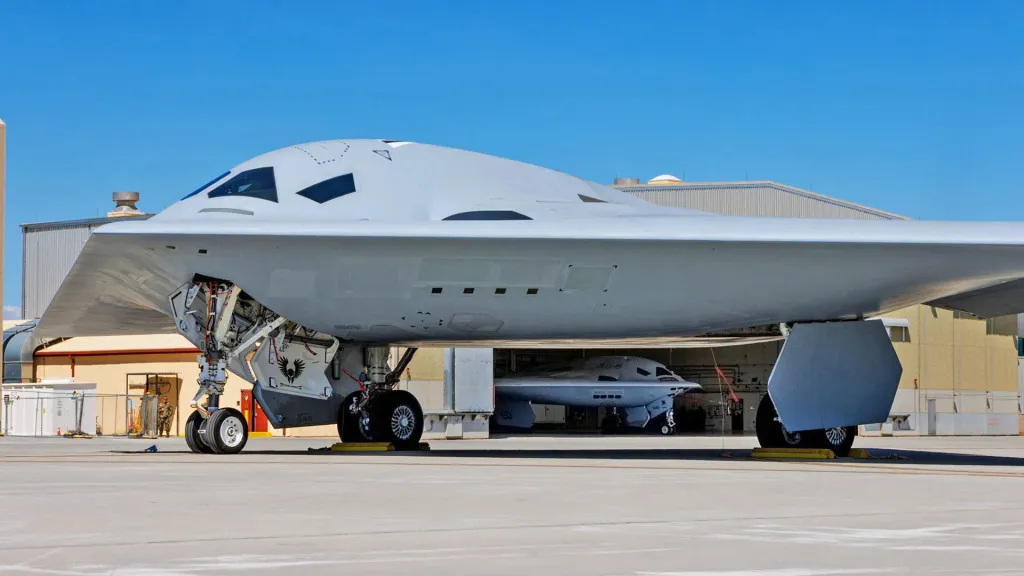
The U.S. Air Force is exploring options for adding air-to-air combat capabilities to its bombers as part of efforts adjacent to its latest fighter force structure plans. The service has raised the possibility of the B-21 Raider, specifically, taking on an air-to-air role, and potentially doing so in cooperation with Collaborative Combat Aircraft (CCA) drones, in the past. As TWZ has explored for years, the B-21’s inherent attributes – size, extreme range, high operating ceiling, broadband low-observability (stealthiness), and advanced sensors – could actually make it especially well suited to taking part in air-to-air combat missions. The Air Force’s other bombers could also be part of these future plans.
Aviation Week was first to report on the potential for bombers to help bolster the Air Force’s air-to-air combat capacity after obtaining a copy of a new long-term fighter force structure report submitted to Congress last week. Media coverage of this report first began to appear earlier this week following a roundtable on Tuesday with Lt. Gen. David Tabor, the service’s Deputy Chief of Staff for Plans and Programs. The full report, which is unclassified, was not disseminated to reporters at that time.

The Air Force’s central goal now is having 1,509 combat-coded fighters in inventory by 2035, which is hundreds more than it has in service today. This will come from the acquisition of new F-35As, F-15EXs, and F-47s. There are already questions about how realistic this plan might be, and the service has acknowledged several hurdles it will need to overcome. You can read more about this in our initial reporting here.

“Accordingly, the USAF is also evaluating additional recapitalization options, including a new capacity fighter, increased reliance on CCAs [Collaborative Combat Aircraft], and developing air-to-air capabilities on bombers,” the latest fighter force structure report says, per Aviation Week.
“A new capacity fighter” may refer to the possible acquisition of new-production F-16 Vipers, which Lt. Gen. Tabor said at the roundtable could be an option in the future, according to an earlier story from Air & Space Forces Magazine. He also said making any such decision was not an “urgent” priority. This is just one possibility here. The Air Force has floated ideas for other new fighter concepts beyond the F-47 in recent years. Lockheed Martin has talked about the potential for expanding on the F-35 design.

At the roundtable on Tuesday, Tabor also made clear that the introduction of CCAs would influence future fighter force structure plans, but the expected scale and scope of those impacts remain unclear. He does not appear to have addressed the role bombers could play in this equation at that time. The new fighter report itself does not elaborate further on the potential use of bombers, based on Aviation Week’s story. TWZ is seeking more information.
When it comes to the possibility of Air Force bombers, and the B-21 more specifically, taking on an air-to-air role, this is not the first time the possibility has been raised, as mentioned earlier.
“As the NGAD [Next Generation Air Dominance] review goes forward, like, is it possible that what that ends up with could be the B-21 taking a larger role?” reporter Stephen Losey, working at the time for Defense News, asked then-Air Force Chief of Staff Gen. David Allvin at the Military Reporters & Editors (MRE) Conference in 2024.
“We have not taken that off the table,” the Air Force’s top officer said in response to Losey’s question, but did not elaborate.

B-21 Takeoff and Landing
At that time, the Air Force’s NGAD program was undergoing a deep review, and the future of the sixth-generation fighter component of the effort had come into question. The decision was ultimately made to continue pursuing plans for what has now become the F-47.
For years now, TWZ has been highlighting how the B-21 could serve in multiple roles beyond just that of a traditional bomber, including in an air-to-air capacity. Air Force officials have themselves described the Raider as having multi-mission capabilities, which could extend into the realm of air-to-air combat.
“If we were to characterize it [NGAD] as a fighter, we would be… thinking too narrowly about what kind of airplane we need in a highly contested environment,” then-Air Force Maj. Gen. Scott Pleus told what was then just Air Force Magazine back in 2019. This could be “a B-21 that also has air-to-air capabilities” and can “work with the family of systems to defend itself, utilizing stealth – maybe that’s where the sixth-generation airplane comes from.”
Pleus’ comments had tied in with adjacent discussions at the time and thereafter about how the B-21 might operate together with future CCA drones. Pleus, who was subsequently promoted to lieutenant general and whose lasting posting was as Director of Staff at the Air Force’s top headquarters at the Pentagon, retired in August of this year.

It remains unclear how the Air Force might be considering employing the B-21, or any of its other existing bombers, in air-to-air combat. This could entail loading out bombers for direct air-to-air engagements, or the integration of new capabilities to help them find targets or to otherwise enable new supporting roles, or a mix of all of the above. The process of achieving air superiority is not limited to neutralizing aerial threats, either.
As TWZ has written in the past in the context of an air-to-air role for the Raider in particular:
“The Raider has the potential to serve as a launch platform for air-to-air missiles, especially outsized very long-range types. Its payload capacity would give it the ability to carry a large volume of smaller air-to-air missiles, as well. B-21s could also employ air-to-ground munitions in support of the suppression and destruction of enemy air defenses mission (SEAD/DEAD), which is also part of the air superiority equation.”
“Maybe most significantly, the B-21s could also act as airborne nerve centers in support of counter-air missions, especially for controlling drones like the Air Force’s planned fleets of Collaborative Combat Aircraft (CCA), and have the ability to do so even in the most heavily contested of airspaces. Uncrewed aircraft, in turn, could feed targeting data back to Raiders with air-to-air loadouts. B-21s might even be able to launch some of those drones themselves.”

Deeply networked ‘kill webs’ that bring together distributed arrays of sensors and other supporting elements across vast distances and multiple domains, coupled with very-long-range air-to-air missiles, open up new operational possibilities more generally. This applies to Air Force bombers beyond the B-21.
When it comes to longer-range air-to-air missiles, the Navy has notably already fielded the AIM-174B air-launched version of the Standard Missile-6 (SM-6). The service more recently disclosed another such missile in flight testing now, the AIM-424 Malice.

The Air Force has pursued similar missile developments in the past and put out a call for a new anti-air missile with a maximum range of at least 1,000 nautical miles just in June. The service has been exploring multi-stage types with modular designs that could be configured for longer- and shorter-range engagements, as well. These are all just programs we know about, and do not speak to the developments the Air Force and others could have underway in the classified realm.
There is also the Defense Advanced Research Projects Agency (DARPA) LongShot program, which the Air Force, as well as the U.S. Army and Navy, have been involved with over the years. The aim of that effort is to demonstrate the concept of an air-to-air missile-carrying drone to help extend the reach and reduce the vulnerability of tactical fighters and bombers.

On top of all this, tactical fighters are generally ill-suited to, and in some cases outright incapable of, carrying the kinds of outsized payloads being discussed here. This underscores the potential value of incorporating bombers into this equation as a means to engage targets at extreme ranges.
Even in a closer proximity support role of fighter aircraft, B-21s, as well as B-52s, could contribute to air-to-air fight as arsenal ships for longer-range weapons, firing on demand from the rear in coordination with crewed and uncrewed platforms operating at the tip of the tactical edge. B-21s could also use their penetrating capabilities to command drones of their own that provide penetrating fighter-like capabilities.
New air-to-air capabilities on Air Force bombers could include self-protection systems, too. Years ago now, the B-21’s prime contractor, Northrop Grumman, patented an anti-missile defense system for stealthy aircraft designed to fire hard-kill interceptors. The Air Force, as well as the Navy, have openly expressed interest in similar defensive capabilities for aerial refueling tankers and other larger planes. Just being able to provide localized close-in defensive ‘bubbles’ around individual bombers could impact the calculus when it comes to future air-to-air combat requirements.

To reiterate, these are all concepts we have discussed in depth for roughly a decade.
Speaking more broadly about Air Force future fighter force structure demands, as we wrote previously:
“In recent years, sustainment costs, broadly, have only become an increasingly serious concern for the Air Force, as well as the other branches of the U.S. military, especially when it comes to complex manned platforms, such as the F-22 Raptor and the F-35 Joint Strike Fighter. Fleet size and the readiness of those fleets are also highly pressing issues. So, at least in the near term, it’s not surprising that NGAD may end up focusing more on exploring available lower-cost options with distributed capabilities as alternatives to traditional air combat assets with highly centralized capabilities, such as manned fighter jets packed with ‘exquisite’ technologies.”
Despite the decision in the end to proceed with the more exquisite F-47, these points have only become more pronounced as time has gone on. How many F-47s the Air Force ultimately intends to buy is another question that looks to remain unanswered by the latest fighter force structure report. At the same time, there are clear signs that the Air Force is planning to significantly increase its planned B-21 fleet size. The official acquisition target has long been at least 100 Raiders, but the Air Force and Northrop Grumman have said a new topline figure is expected to come in the Fiscal Year 2028 budget proposal next year. The service is now explicitly aiming to have at least 500 CCA drones in service by 2032, too. All of this will compete for funding and other resources, at least to a degree.

In the meantime, there has been a “persistent decline in AA [aircraft availability] rates across the USAF tactical fighter fleet,” which “is the direct mathematical consequence of operating an inventory with an average age exceeding 31 years,” the Air Force’s latest fighter force structure report says, according to Aviation Week. “As legacy platforms – such as the F-16C/D, F-15E, and A-10C – operate well beyond their original engineering service lives, they experience compounding structural fatigue, widespread corrosion, and subsystem degradation.”
“Achieving the mandated AA rates required for a peer-conflict scenario necessitates aggressive divestment of the oldest airframes to fund the procurement of highly available, modernized platforms like the F-35A and F-15EX,” the report adds, per that outlet. Furthermore, “to counter the [Chinese] industrial capacity and numerical advantage in fielding fighters like the J-20 and J-16, the USAF must embrace a hybrid force of manned and unmanned systems.”

With all this in mind, active consideration of new air-to-air roles for bombers, as well as the possibility of “increased reliance on CCAs” and the potential to acquire new current-generation F-16s, at least seems to reflect a hedge strategy on the part of the Air Force.
If nothing else, the door clearly remains open to bombers being a key part of the Air Force’s ‘fighter’ vision in the future.
Contact the author: joe@twz.com