South Korea signs deal to build first homegrown air-defense destroyer

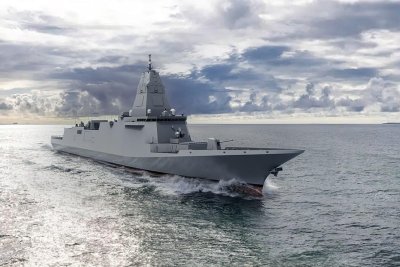
A front-view rendering of the KDDX next-generation destroyer. Photo courtesy of Hanwha Ocean
July 31 (Asia Today) — South Korea’s arms procurement agency signed a contract with Hanwha Ocean on Friday for the detailed design and construction of the first KDDX next-generation destroyer.
The agreement moves the long-delayed naval program into its full design and construction stage after nearly three years of disputes over the selection of a shipbuilder.
The lead ship is scheduled to be delivered to the South Korean Navy by the end of 2032.
The Defense Acquisition Program Administration said KDDX will be South Korea’s first large destroyer built with a domestically developed hull, combat management system, multifunction radar and other core weapons systems.
Although the vessel is sometimes described in South Korea as a Korean-style Aegis destroyer or a mini-Aegis ship, it is not expected to use the U.S.-developed Aegis Combat System.
Instead, the destroyer will combine a South Korean integrated combat system with an indigenous phased-array radar to detect, track and engage aircraft, missiles, ships and other threats.
The contract for the detailed design and lead ship is valued at about 882.1 billion won, or about $617 million.
The entire program, including five additional destroyers, is expected to cost about 7.8 trillion won, or $5.46 billion.
The government has not determined which companies will build the five follow-on ships or how those contracts will be awarded.
Contract ends prolonged shipbuilder dispute
Hanwha Ocean, formerly Daewoo Shipbuilding and Marine Engineering, completed the KDDX conceptual design.
HD Hyundai Heavy Industries later conducted the basic design, leading to expectations that it would receive a negotiated contract for the detailed design and lead ship.
Hanwha Ocean instead called for a competitive bidding process, citing a military-secrets case involving HD Hyundai Heavy Industries employees.
The acquisition agency accepted that request and held a competition.
Hanwha Ocean and HD Hyundai Heavy Industries were reportedly separated by less than 0.6 point in the final evaluation.
A 1.2-point security penalty imposed on HD Hyundai Heavy Industries was considered decisive.
Employees of the company had been convicted of photographing or improperly handling military secrets related to the KDDX program.
Hanwha Ocean was selected as the preferred bidder June 11. The company’s selection had previously been reported as part of a six-ship program valued at approximately 7.8 trillion won or $5.46 billion.
HD Hyundai Heavy Industries challenged the evaluation but its objection was rejected in early July. Negotiations between the acquisition agency and Hanwha Ocean then led to Friday’s final agreement.
The contract was signed before all cost data were finalized. The final value may therefore be adjusted to reflect verified construction expenses.
South Korean systems to replace foreign equipment
The KDDX is expected to displace about 7,000 tons when lightly loaded and will be larger than South Korea’s Chungmugong Yi Sun-sin-class destroyers.
It will be smaller than the Navy’s Sejong the Great and Jeongjo the Great-class destroyers equipped with the American Aegis system.
The ship will feature a low-observable design and an integrated mast intended to reduce its radar signature.
Planned armament includes a 5-inch naval gun and South Korean vertical launch systems capable of carrying surface-to-air, anti-ship, land-attack and anti-submarine weapons.
The exact number of vertical launch cells has not been officially confirmed.
The acquisition agency said major systems, including the combat management system, sonar, multifunction phased-array radar and ship-launched surface-to-air missiles, will be developed domestically.
South Korea plans to apply technologies developed since the basic design was completed, including digital-twin construction, layered counter-drone defenses and a communications environment using 5G and integrated wired and wireless networks.
A digital twin is a computerized replica of the ship that can be used to test design changes, construction procedures and equipment performance before work is carried out on the physical vessel.
The Navy is also considering integrated electric propulsion to reduce noise and improve anti-submarine survivability.
Automation is expected to reduce the number of sailors required to operate the ship compared with older destroyer classes.
Schedule remains a challenge
The KDDX basic design was completed in December 2023 and the detailed design and lead ship construction were originally expected to begin soon afterward.
Disputes between Hanwha Ocean and HD Hyundai Heavy Industries delayed the program by about two years.
The acquisition agency and Hanwha Ocean will now need to shorten portions of the development and construction schedule to meet the 2032 delivery target.
Jung Jae-jun, head of the acquisition agency’s force resources division, described KDDX as a national project bringing together South Korea’s shipbuilding and defense capabilities.
Jung said the government would examine several options for the construction of the follow-on vessels while seeking to deploy the new destroyers on schedule.
He said the program could also strengthen the international competitiveness of South Korean naval vessels.
Hanwha Ocean previously said it felt a significant responsibility after being selected as the preferred bidder and would work with the government to normalize the delayed program.
Competition between Hanwha Ocean and HD Hyundai Heavy Industries is expected to continue as the government determines how to award contracts for the five remaining destroyers.
— Reported by Asia Today; translated by UPI
© Asia Today. Unauthorized reproduction or redistribution prohibited.
Original Korean report: https://www.asiatoday.co.kr/kn/view.php?key=20260731010011621