The Latin Recording Academy unveiled the first slate of performers for the 26th annual Latin Grammy Awards, which will take place at the MGM Grand Garden Arena in Las Vegas on Nov. 13.
Among the artists announced were música Mexicana acts Carín León, Pepe Aguilar and Los Tigres del Norte; sad sierreño singer-songwriters Ivan Cornejo and DannyLux; Latin pop icon Gloria Estefan, and Colombian rock band Morat.
“Happy to be at the biggest Latin music festival! Even more so because it features music from my Mexico. Long live Mariachi!” Aguilar told The Times. His latest project, “Mi Suerte Es Ser Mexicano,” is nominated for ranchero/mariachi album.
“Very honored to be part of this musical celebration,” León wrote on Instagram. The 36-year-old singer nabbed three nominations, including for album of the year, contemporary Mexican music album for his LP “Palabra de To’s (Seca),” as well as regional song for “Si Tú Me Vieras,” which features Maluma. León will make history next year by being the first Latin music act to perform at the Sphere in Las Vegas. The one-of-a-kind venue features a 16K resolution wraparound LED screen.
.
“It’s crazy to even say that I’m performing at the Latin Grammys. I think of my parents, all their struggles, and how far we’ve come,” DannyLux shared in a statement. “This isn’t just my moment. It’s for every kid who grew up watching their parents fight for a better life.”
The 21-year-old Coachella Valley native celebrated his second Latin Grammy nomination (“Leyenda” is up for contemporary Mexican music album) by unveiling a billboard on Sunset Boulevard that paid tribute to his parents.
Spanish singer Raphael, who will receive the 2025 Person of the Year award, is also expected to grace the stage. The honoree’s career spans six decades, first wowing crowds during Eurovision Song contests in 1966 and 1967, where he gained recognition for his love-struck ballads “Yo Soy Aquél” and “Hablemos del Amor,” respectively.
As the Democratic Party searches for direction in the post-2024 landscape, its leaders seem bent on alienating their own base over Gaza. This is not a matter of nuance or tactical positioning; it’s a profound moral and political miscalculation.
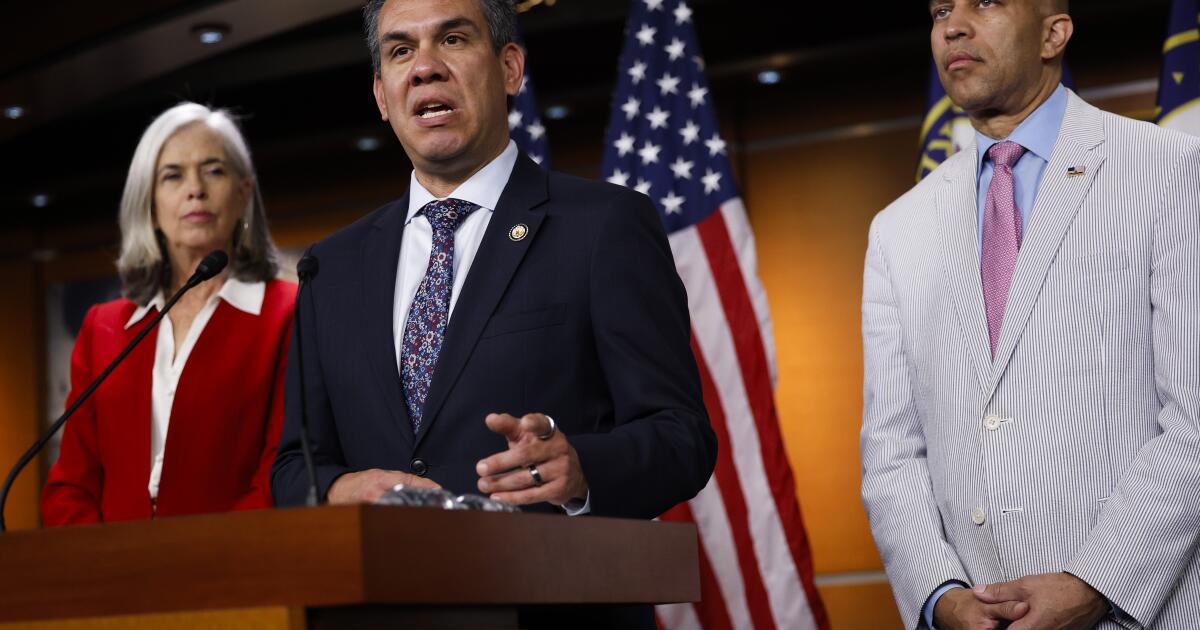
That failure is on vivid display in the decision by House Democratic Caucus Chair Pete Aguilar (Redlands) to help lead a delegation of mostly freshman Democratic representatives recently to Israel. The trip included meetings with Prime Minister Benjamin Netanyahu, who ison trial for corruption in Israel and isthe subject of arrest warrants from the International Criminal Court alleging war crimes and crimes against humanity.
Polling makes the disconnect impossible to ignore. In July,Gallup found that just 8% of Democrats approve of Israel’s military campaign in Gaza, with disapproval overwhelming.Pew Research Center reported in April that 69% of Democrats now hold an unfavorable view of Israel — a striking shift from just a few years ago. AndData for Progress has consistently found supermajority Democratic support for a permanent ceasefire; in May 2024, 83% of Democrats backed a permanent ceasefire, and ina June 12, 2024, poll a majority of Democrats said they believed Israel was committing war crimes in Gaza.
Aguilar’s role makes this especially galling. He isn’t a backbencher; he’s a high-ranking member of the Democratic Party leadership. That gives him a particular responsibility to model principled conduct for newer members. Instead, he’s showing them the wrong lesson: that obedience to the donor class matters more than representing constituents. The point is underscored by his fundraising:OpenSecrets reports Aguilar received about $678,000 from donors categorized as “Pro-Israel” in the 2023–24 cycle.
The mechanics of that influence are no mystery. The American Israel Public Affairs Committee and allied pro-Israel PACs reward loyalty with torrents of campaign cash and punish dissent with lavishly funded primary challenges. Reps. Jamaal Bowman andCori Bush — both outspoken critics of Israel’s conduct in Gaza — have been textbook examples: Bowman was unseated after record outside spending flooded his race, and Bush faced a barrage of super-PAC money that ultimately toppled her. The incentive structure is clear: Toe the line and your coffers swell; cross it and a financial juggernaut rolls over you.
There is a political price for complying with this pressure, however. TheInstitute for Middle East Understanding, using YouGov, found that among voters who backed Joe Biden in 2020 but chose someone else in 2024 “ending Israel’s violence in Gaza” was the top issue for 29% nationally — ahead of the economy — and 20% in battleground states. Those results point to a straightforward conclusion: Ignoring Democratic voters on Gaza depresses enthusiasm and peels away enough support to matter in close races.
Gaza is politically damaging not only because of the issue itself — though the moral stakes could hardly be higher — but also because it has become a measure of where leaders’ loyalties lie. Voters read it as a test of whether their representatives will stand with the people who elected them or with wealthy donors and foreign lobbies. Fail that test and many will assume you might betray them on other critical issues in the future.
The Democratic leadership’s unwillingness to adapt is not just bad politics; it’s a betrayal of basic democratic principles. Rank-and-file Democrats overwhelmingly want an end to the carnage, an end to unconditional military aid to Israel, and policies rooted in human rights and international law. Yet too many leaders seem more concerned with keeping favor in donor circles than with honoring the public’s will.
If Democrats hope to retain their coalition, they need to realign policy with their voters’ values: call for a permanent ceasefire; condition U.S. military assistance on compliance with international law; and replace photo-op delegations with diplomacy that centers on justice and accountability.
Until then, every AIPAC-sponsored trip led by a party leader will read like a declaration of priorities — and a reminder of the price the party will continue to pay at the ballot box.
George Bisharat is a professor emeritus at UC Law San Francisco and a longtime commentator on U.S. policy toward the Middle East.
Insights
L.A. Times Insights delivers AI-generated analysis on Voices content to offer all points of view. Insights does not appear on any news articles.
The following AI-generated content is powered by Perplexity. The Los Angeles Times editorial staff does not create or edit the content.
Ideas expressed in the piece
The Democratic Party elite continues to cling to pro-Israel policies despite a dramatic shift in voter sentiment, with DNC chair Ken Martin exemplifying this resistance by backing resolutions that maintain commitments to Israel’s “qualitative military edge” while pressuring pro-Palestine delegates to water down alternative proposals[3]. The party leadership’s obedience to pro-Israel lobbying groups like AIPAC and Democratic Majority for Israel contradicts the clear will of Democratic voters who increasingly oppose the status quo[3].
Polling data consistently demonstrates overwhelming Democratic opposition to Israel’s military actions in Gaza, with just 8% of Democratic voters approving of Israel’s military campaign according to recent Gallup surveys, down dramatically from earlier periods in the conflict[5][6]. This represents the lowest approval rating among Democrats since polling began on the issue, creating a stark disconnect between party leadership and base voters[5].
The influence of pro-Israel campaign contributions is evident in the behavior of Democratic representatives who continue to participate in AIPAC-sponsored trips to Israel despite their constituents’ opposition, with California representatives receiving hundreds of thousands of dollars from pro-Israel groups while ignoring polling showing 92% of Democrats oppose Israel’s actions[2]. These trips occur while Gaza faces unprecedented humanitarian devastation, with over 60,000 Palestinian civilians killed and two million people facing starvation[2].
The declining number of Democrats willing to participate in AIPAC trips reflects growing awareness among elected officials of their constituents’ opposition, with recent delegations representing the smallest ever congressional group of Democrats to visit Israel as many invited House members reportedly declined to participate[4]. This trend suggests that elected officials are beginning to respond to public pressure despite continued lobbying efforts[2].
Different views on the topic
Pro-Israel Democratic organizations argue that divisive resolutions calling for arms embargos and Palestinian state recognition would damage party unity and provide political advantages to Republicans, particularly as the party approaches midterm elections where maintaining cohesion is crucial for retaking Congress[1]. These groups contend that such measures fail to address the root cause of the conflict by not mentioning Hamas’s October 7 attacks or the terrorist organization’s role in perpetuating the war[1].
Supporters of continued military aid to Israel maintain that arms embargos would actually prolong the conflict and extend suffering on both sides, arguing that pressure should instead be directed toward Hamas to accept ceasefire deals and release hostages[1]. The Democratic Majority for Israel emphasizes that unilateral recognition of a Palestinian state would reward terrorism and embolden Israel’s adversaries in the region[1].
Pro-Israel advocates stress that the fundamental relationship between the United States and Israel remains strong due to shared democratic values and mutual security interests that have endured for over 75 years, suggesting that temporary political pressures should not override these longstanding strategic considerations[1]. Congressional delegations to Israel are defended as necessary to witness firsthand the aftermath of terrorist attacks and assess ongoing security threats[4].
What do Dead Kennedys’ Jello Biafra, Thurston Moore of Sonic Youth and Motley Crüe bassist Nikki Sixx have in common? They all dig Frankie and the Witch Fingers, an L.A.-based band whose irresistible garagey-psychedelic rock sometimes even invokes shades of Oingo Boingo and Devo thanks to a staccato freneticism and pointed lyrics. The diversity of FATWF’s peer-fans speak to the quintet’s wide-ranging appeal, and the title of their new 11-song album, “Trash Classic,” is a spot-on descriptor of the LP as a whole.
In their longtime rehearsal-recording room in a legendary Vernon warehouse, the band perch on a couch a few days before leaving for tour. There’s a whiteboard with a set list behind the sofa, and they share some “mood board” phrases written for the creation of “Trash Classic.” On posterboard, the bon mots include “Lord Forgive Us For Our Synths,” “Jello -B.Y.O.F. (Bring Your Own Fork) – Ra” and “Weenus.” Laughter ensues at the memories.
The lineup formed with Dylan Sizemore (lead vocals, rhythm guitar) and Josh Menashe (lead guitar, backing vocals, synthesizer) more than a decade ago, the pair meeting at college in Bloomington, Ind. In different bands, they’d seen each other’s gigs and run into each other at parties.
“I was just bored one day, and was like, ‘I wonder if this guy wants to jam.’ I had all these songs,” recalls Sizemore. “I just kind of showed up to his house, and I knew he was really good at guitar and really good at music in general.”
Josh Menashe, from left, Dylan Sizemore, Nicole “Nikki Pickle” Smith, Jon Modaff and Nick Aguilar, of the Los Angeles psych-rock band Frankie and the Witch Fingers get into character in their rehearsal space in Vernon on July 11, 2025.
(Genaro Molina / Los Angeles Times)
The San Diego-raised Menashe recalls, “I think by the time I met Dylan, I’d already dropped out [of college], though, and there were day jobs — at a screen-printing shop, I worked at a Turkish restaurant; whatever I could do to keep my music addiction going. I never really settled on a major because I just couldn’t think about what I wanted to do. Nothing made as much sense as music.”
Sizemore had been dabbling in music that was “power-pop-y, kind of like Tom Petty worship …”
“… he was in a band called Dead Beach,” Menashe adds, “and I would say it was garage rock, almost like Nirvana meets Tom Petty.”
“And Josh was in a more like surf rock, almost like mathy band. What would you describe [the band] Women as?” Sizemore asks.
“Angular, punky, buncha noise stuff,” affirms Menashe, who also played with acclaimed Bloomington-to-L.A. band Triptides starting in 2010.
In FATWF (the name comes from Sizemore’s cat Frankie) the pair’s experience and influences were varied enough to create something new that, over seven albums since 2013, has morphed into a wildly creative and raucous band with hooks, melodies, smarts, irreverence, loud guitars and wonderfully oddball synth and sounds.
A move to L.A. in 2014 and eventual changes in the rhythm section — Nikki Pickles (Nicole Smith), formerly of Death Valley Girls, joining in 2019; with drummer Nick Aguilar’s 2022 addition solidifying the band further. Jon Modaff, a multi-instrumentalist from Kentucky who played drums on tour with FATWF in 2021, joined on synth in 2024, giving the band an even broader sonic palette to realize their sometimes-oddball audio dreams.
“Trash Classic,” produced by Maryam Qudus (Tune-Yards, Alanis Morissette, Kronos Quartet) follows 2023’s “Data Doom,” which was the first album to feature Aguilar on drums. Songs are by turns epic, edgy, spacey and insistent. Some “Trash Classic” lyrics are topical and pointed: “(While the upper) class is feeding / (On the lower) babies’ food / (Microwaving) TV dinners / (With the porno) graphic news.” “Economy” minces no words: “This has got to be / The best economy / The plasma you sell / (The plasma you sell) / Buys money to eat.”
There was no grand plan or lyrical theme settled ahead of the new album’s creation. “We collectively talk about what’s going on in the world when we’re in rehearsal and stuff, and our feelings about it,” says Sizemore. “I think it’s just at a point now where talking about certain things just feels more — what’s the word? — it feels more part of the zeitgeist. Like ‘Economy,’ I wanted to write about being around abject poverty. But it makes more sense now, it fits into the context of where we are. Things that we talk about in here, about what’s going on, maybe weren’t so omnipresent, and now it feels like it is. Like, you can’t escape poverty. You can’t escape what’s happening to people less fortunate than you. It’s everywhere.”
In writing the lyrics, Sizemore thought about growing up, “seeing people trade in their food stamps to get alcohol because they’re addicted. Messy stuff like that. But it’s relevant now, it’s not just parts of the world. It’s gonna be everywhere if we don’t do something about it.”
Lyrics, while Sizemore-centric, are a collaborative process. Pickle, however, who came to bass in her 20s, says, “I just am happy to be along for the ride, and I’ll contribute where it’s helpful. I like to sit back; I guess I don’t feel qualified as a songwriter.” But, she says, “honestly, I think that that’s a helpful way to be, because if you have too many people with egos on top of each other, like, ‘no, no, no, do it my way.’ I like to listen and then insert where I can. That’s my vibe.”
Differing approaches and backgrounds serve FATWF well. Because of their “cohesive diversity and flexibility in the rock realm,” Aguilar observes, “I feel like we could play with almost anybody. At least a rock band, to any extent.”
While they’re mostly doing headlining tours, they’ve shared stages with Cheap Trick and ZZ Top. So where would FATWF overlap with the two elder statesmen classic rock lineups on the musical spectrum?
“I mean, we were really into the [13th Floor] Elevators, and…” Sizemore says.
“The Velvet Underground…” adds Pickle.
“…Roky Erickson, all that stuff. I think we tried to, like, gear our set more in that direction, just so we weren’t fully playing freaky, noisy funk stuff,” Sizemore continues. “But there’s an overlap, for sure. If we play in Atlanta or something, we’ll get someone saying, ‘Oh, the first time I saw you guys was with ZZ Top’ and that’s always cool.”
“We collectively talk about what’s going on in the world when we’re in rehearsal and stuff, and our feelings about it,” says Sizemore. “I think it’s just at a point now where talking about certain things just feels more — what’s the word? — it feels more part of the zeitgeist.”
(Genaro Molina / Los Angeles Times)
Most of Frankie’s members cite the DIY scenes in their areas as influential: Aguilar is from San Pedro and began drumming at the age of 10. He eventually played with that neighborhood’s most famous musician: bassist Mike Watt, and growing up, “discovered I don’t need to go to the Staples Center or Irvine Meadows to see a band. I could just go, like, 10 blocks away from my home on my bike to house shows,” he says, adding, “if there wasn’t the music scene in San Pedro, I probably wouldn’t be in this band. I’d probably be playing at the Whisky with some s— metal band that nobody cares about.”
An increasing number of people are caring about FATWF; Jello Biafra even joining them on stage. At a gig in Biafra’s hometown of Boulder, Colo., the punk provocateur met the band after their show. The next night, the singer showed up in Fort Collins.
“We have a lot of mutual friends,” explains Aguilar. “I work at Alex’s Bar in Long Beach. So I met him there a long time ago. He said he was gonna come see us at our Halloween show in San Francisco. I was like, ‘How would you feel if we learned some DK songs and you sang with us for Halloween?’”
He answered in the affirmative, so Frankie and the Witch Fingers learned the Dead Kennedys’ “Halloween,” “Police Truck” and “Holiday in Cambodia.” Biafra rehearsed with the band at sound check, and for the holiday show FATWF dressed up as “bloody doctors.” As for Biafra? “He changed his outfit in between every song! He was throwing fake bloody organs at the audience. You could tell half of the audience knew who he was. And half was like, ‘Yo, who the hell is this?’”
“Talking about all this like ancient history makes me feel, ‘Oh yeah, we’ve kind of come a long way,’” Pickles ruminates. Aguilar states his somewhat modest hopes for the band: “I think my realistic goal is the headline the Fonda Theater one day.”
But if larger-scale fame and fortune find Frankie and the Witch Fingers, beware: Menashe claims he’d get a face tattoo if the band sells a million records. His promise is captured by the reporter’s recorder, officially “on the record,” the band teases him. But in true FATWF fashion, Sizemore pushes it one further: “You gotta get a teardrop too!”
Storied Mexican singer Pepe Aguilar is using his platform to elevate the struggle and celebrate the dignity of the immigration experience in the U.S. with his latest single, “Corrido de Juanito.”
The track, which dropped Friday, explores the societal and emotional trials of being far from home while attempting to make the best of life. The song was originally written and recorded by former Calibre 50 vocalist and accordionist Edén Muñoz in 2017.
The “Por Mujeres Como Tú” singer’s track with a message also acts as a monetary service to the immigrant community of L.A. All the proceeds from the song will go to the immigrant rights organization Coalition for Humane Immigrant Rights of Los Angeles (CHIRLA).
“I’m not making a cent off this song. We’re giving away everything, not only from the song, but from my latest released album,” Aguilar told The Times following the single’s release. “[CHIRLA] is helping immigrants to fight this battle legally and peacefully and respectfully. That’s why I created this song, and that’s why I decided to donate whatever it makes and whatever my album makes, for the time that it’s more valuable.”
The advocacy group focuses on the human and civil rights of immigrants and refugees in L.A. and throughout the state of California. Its services include free and low-cost legal services and community education.
“We thank Pepe Aguilar for using his voice and platform to defend and support the immigrant community that is foundational to their fan base,” CHIRLA executive director Angelica Salas said in a statement. “Thank you for your invaluable support and for uplifting the presence and contributions of immigrants in the U.S.”
Following the onset of the ICE raids in June, the 56-year-old Grammy winner posted a message on Instagram in support of the immigrant community.
“I’m not going to fight the system; I’m going to peacefully resist it with art, with memory, with culture, with tradition, with respect,” said in the June 7 social media video.
In the same post, he announced that he would be working on a version of the song that was released today.
Aguilar, who is headlining at the Hollywood Bowl on Aug. 15 and 16, first heard the song at an awards show around the time of its initial release and felt deeply impacted by its message.
“I was really touched by the lyrics and the truthfulness of the song,” Aguilar said Friday morning. “I had a lump in my throat when I first heard it and then it was a hit.”
Flash forward to 2025 and he revisited the Calibre 50 track while singing bohemias with his family at his daughter’s house a few months back.
“Something called me in at that party to sing the song and I had never sang it before,” he said. “I didn’t know what it felt like to sing the song and when I sang it, I loved the way it sounded.”
It was after that experience that he knew he needed to record his own version.
“Now, with everything going on with all these deportations and with immigration, I think it’s a song that applies tremendously to create consciousness around this subject and to portray a reality that is lived by millions,” Aguilar said. “There are millions of Juanitos that are unable to go back home or unable to go to their loved ones funerals and are afraid of being deported, but at the same time they are working and helping the engine of America to remain stable.”
Aguilar channels the pain of homesickness and the worry of becoming forgotten that immigrants face on the daily.
“It’s been almost 14 years since I’ve gone back to the land I was born,” Aguilar sings in the single’s opening lines. “Everything has now changed, I beg God that they don’t forget about me.”
The “Perdonóme” vocalist shared a direct message to the people currently being most affected by the ongoing ICE raids.
“No están solos, we care for you, and when I mean ‘we,’ I’m talking about everybody that understands your situation, not only Mexicans, but I have a lot of friends that are not Mexican, even a lot of full-blooded Americans, who are tremendously worried about what’s going on,” Aguilar said. “[A] lot of associations want to do something about this unfair situation, a tremendously unfair and historically unfair for a country like the U.S. I believe in the principles that created the United States, and I hope that those principles are used in this tremendously sad situation.”