agencies

For crucial federal agencies, veneer of independence is stripped away

Federal agencies long regarded as pillars of nonpartisan stability are facing an identity crisis after the Supreme Court this week swept away nearly a century of precedent limiting presidential power.

The high court’s decision in Trump vs. Slaughter, allowing the president to remove members of historically independent agencies without cause, has sent shock waves through institutions that once believed their legal protections were secure. And it has raised concerns about the future credibility of agencies that serve crucial public functions, from the Securities and Exchange Commission, which protects investors, to the National Labor Relations Board, which safeguards the rights of private-sector workers.

Some experts question the ruling’s practical impact, noting that existing laws still require political balance on many agency boards. Presidents already wield significant influence over agency leadership. Still, most agree the decision could inject overt partisan politics into agencies that have traditionally resisted it, eroding public trust in their rules and judgment, chilling enforcement and kicking off a cycle of regulatory whiplash.

Already, President Trump has removed members of several independent regulatory bodies and appointed new leadership — including Brendan Carr as chair of the Federal Communications Commission — stoking fear among critics that these agencies are being used to advance the administration’s political priorities.

The ruling, Trump said, is the “greatest increase in presidential power in the last 100 years,” praising the decision as a necessary expansion of his authority.

Now, “the president can fire the principal officers heading these agencies at will,” said Gillian Metzger, a professor of administrative and constitutional law at Columbia University. “That will allow for dramatic swings in policy when administrations of different parties come into office, and seek to undo decisions and policies of prior administrations.”

The Slaughter decision overturned a 1935 ruling from the Supreme Court that found independent agencies — established and mandated by Congress, but housed under the executive — should have special removal protections, reflecting their hybrid roles between branches of government.

That ruling, Humphrey’s Executor vs. United States, found that Congress intended for members of independent bodies to be guarded against the winds of politics, providing long-term stability, professional consistency and nonpartisan expertise.

“Presidents will be more able to direct these agencies to implement particular policies and actions, and the independent decision-making and expertise-based decision-making that Congress intended these agencies to wield will be significantly undermined,” Metzger added. “That, it seems fair to say, is a real blow to the credibility of these entities as independent and expert regulators.”

In a separate opinion this week, the Supreme Court singled out the Federal Reserve as an exception to its otherwise sweeping rollback of protections for independent agencies.

But it leaves bodies like the SEC — created after the 1929 stock market crash to prevent market manipulation, enforce corporate transparency and maintain fair markets — vulnerable to accusations of political capture.

“The SEC has some Fed-like characteristics as a guardian of market confidence and financial stability, but it will not receive Fed-like protections under the two decisions released yesterday,” said George Georgiev, a law professor at the University of Miami and chair of the Investor Advisory Committee to the SEC.

“The practical consequences will depend on how aggressively future administrations use the removal power, and who is appointed to the Commission in the first place,” Georgiev added. “Yesterday’s decisions certainly upend how we think about independent agencies.”

John C. Coffee Jr., a leading authority on securities law at Columbia, said the decision will lead to “a loss of credibility for the SEC.”

“The lobbyists will redouble their attacks, and money will dominate good arguments in their approach,” Coffee said. “It is likely to become a much more politicized agency that has less interest in hiring independent professionals.”

“In such an environment, policy principles get ignored or shabbily distinguished, and marching orders come from the Executive Office Building,” he added.

Kristin Hickman, a distinguished professor and associate director of the Corporate Institute at University of Minnesota Law School, characterized public reaction to the ruling as “overblown.”

“Frankly, I don’t know if their function is going to be all that different,” Hickman said. “Statutorily, they still have to have members that are divided by party. Their statutory responsibilities don’t change. The president has always had the authority to change who serves as the chair of the agency upon coming into office.”

“On the one hand, doctrinally, Slaughter is a shift. You’re overruling a 90-year-old precedent,” she added. “On the other hand, it’s not clear to me that the everyday functioning of these agencies will change dramatically.”

Some of the agencies, such as the National Labor Relations Board, have no statutory requirement for political balance — and could simply cease functioning under an administration opposed to labor law enforcement.

But other experts share Hickman’s skepticism that the ruling will fundamentally change agency operations.

A study published two years ago in the Cornell Law Review examined the true independence of congressionally mandated agencies such as the Federal Trade Commission, FCC, SEC and others, and found that the independent agency design did not work particularly well, with presidents already exercising substantial control.

“By appointing the chair and general counsel, presidents had agenda setting power and some policy power. For agencies without independent litigation authority, the DOJ controlled legal arguments,” said Neal Devins, a professor of law and government at the College of William & Mary and an author of the study. “By the time presidents were able to have a majority of commissioners from their party — typically just over a year — presidents often called the shots.”

“Yesterday’s decisions certainly matter, as they give the president immediate direct control,” he added. “They are also significant symbolically. But the real story is taking presidential control from the shadows into a very public place.”
Source link

Supreme Court: Trump may fire heads of independent agencies, but not the Federal Reserve

The Supreme Court on Monday gave President Trump new power to fire the heads of most independent agencies created by Congress — but not the Federal Reserve.

Chief Justice John G. Roberts Jr. announced two opinions, one of which bolstered the president’s power as the chief executive and a second which said this authority did not extend to the Federal Reserve board.

The first was a 6-3 decision that had the support of five conservatives, while the second had a 5-4 majority that included the three liberals.

Roberts, a former White House lawyer, has long been skeptical of independent agencies whose officials may wield regulatory power in conflict with the views of the president.

Since the 1880s, however, Congress has at times created independent agencies led by a bipartisan board of experts. In 1935, a unanimous Supreme Court had upheld these multi-member boards and commissions.

But Roberts and the court overturned that precedent and declared it conflicts with the executive power of the president.

“Our Constitution creates three branches, but only one President,” he wrote. “To discharg[e] the duties of his trust, the President must have the assistance of officers he can trust. … Subordinates who exercise the President’s power are subject to removal by him. Then, and only then, can they remain accountable to the President, and the President to the people.”

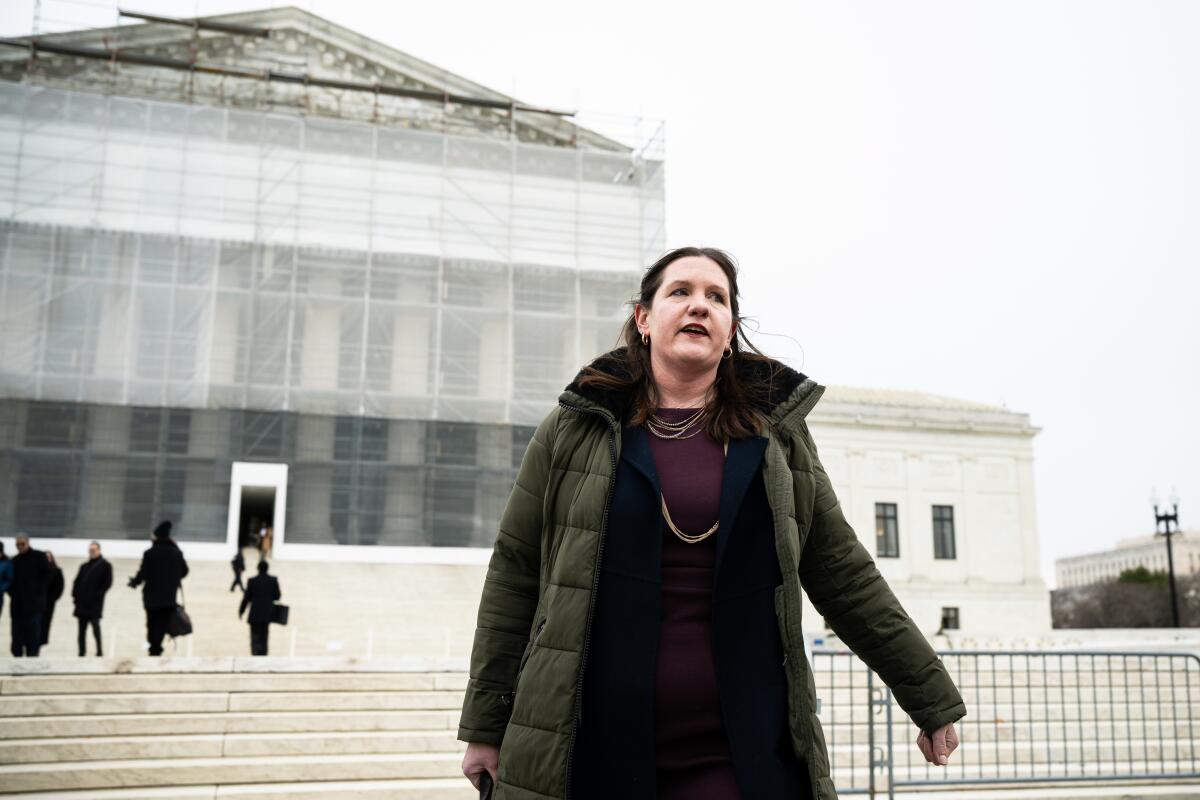
The decision upholds Trump’s firing of Rebecca Slaughter, one of two Democratic appointees on the five-member Federal Trade Commission.

Rebecca Slaughter leaves the Supreme Court in December.

The Supreme Court upheld President Trump’s firing of Rebecca Slaughter, a Democratic appointee to the Federal Trade Commission.

(Graeme Sloan / Bloomberg / Getty Images)

In dissent, Justice Sonia Sotomayor said that the ruling “distorts the structure of government to fit the majority’s theory of unitary, total executive control. The result is a President who emerges with far greater power than ever before. It is a power, however, that neither the People, nor Congress, nor the Constitution bestowed upon him.”

Under what has been dubbed the “unitary executive” theory, the court’s conservatives believe the president’s executive power in Article II of the Constitution overrides Congress’power in Article I to write the laws and structure the government.

The departments and agencies of the federal government exist only because Congress created them by law.

But in the second opinion, the court blocked Trump’s bid to fire Fed Governor Lisa Cook, an appointee of President Biden.

Roberts said the central bank dates back to the nation’s founding, and Congress created the Federal Reserve Board in line with “our Nation’s tradition of central banking protected from political interference.”

Trump tried to fire Lisa Cook in a social media post, he said.

But “the Federal Reserve’s Governors do not serve at the President’s pleasure — they instead serve staggered 14-year terms, and may be removed only ‘for cause’,” he wrote.

Justice Brett M. Kavanaugh cast a crucial vote to support the Fed’s independence. He said he joined the majority because it “confirms the longstanding historical practice and understanding that the Federal Reserve is an independent agency whose Governors enjoy for-cause removal protection consistent with Article II of the Constitution.”

The court did not finally decide on Cook’s case, except to say she deserved due process of law. She could not be fired without a hearing and evidence, the court said.

The setback for independent agencies came as no surprise, however.

Even prior to Trump’s election, Roberts has insisted agency officials must be accountable and under the control of the president.

Last year, the justices blocked lower court rulings that would have reinstated agency officials who were fired by Trump.

For most of American history, however, it had been understood that Congress had the power to structure the government and to create semi-independent agencies to carry out specific tasks like regulating railroad rates or the money supply.

These agencies and commissions were led by a bipartisan board of experts who were appointed with a fixed term. They could be fired only for cause, not because of a political disagreement with the president.

The Supreme Court upheld these multi-member commissions in 1935 on the grounds their work was more legislative and judicial than simply enforcing the law.

But the court’s current conservative majority has contended these commissions and boards wield executive authority and are therefore, subject to direct control by the president.

In creating such bodies, Congress often was responding to the problems of a new era.

The Interstate Commerce Commission was created in 1887 to regulate railroad rates. The FTC, the focus of the court case, was created in 1914 to investigate corporate monopolies.

The year before, the Federal Reserve Board was established to supervise banks, prevent panics and regulate the money supply.

During the Great Depression of the 1930s, Congress created the Securities and Exchange Commission to regulate the stock market and the National Labor Relations Board to resolve labor disputes.

Decades later, Congress focused on safety. The National Transportation Safety Board was created to investigate aviation accidents, and the Consumer Product Safety Commission investigates products that may pose a danger. The Nuclear Regulatory Commission protects the public from nuclear hazards.

Typically, Congress gave the appointees, a mix of Republicans and Democrats, a fixed term and said they could be removed only for “inefficiency, neglect of duty or malfeasance in office.”

Slaughter was first appointed by Trump to a Democratic seat and was reappointed by Biden in 2023 for a seven-year term.

Source link

Trump tells agencies to align with study calling for narrower childhood vaccine recommendations

President Trump on Friday gave his endorsement to a January study by the Department of Health and Human Services that calls for cutting the number of vaccines recommended for every American child.

An executive order from Trump directs federal agencies to align their policies behind the study, which recommended an overhaul long called for by Health Secretary Robert F. Kennedy Jr. The study found that the United States recommends more childhood vaccines than many peer nations.

The Trump administration previously moved to narrow the number of recommended childhood vaccines in response to the report, but the move was blocked by a federal judge in Massachusetts. The administration is appealing the decision.

The study recommends vaccinating all children against 11 diseases. Several others would be recommended only for high-risk groups or when doctors recommend them in what’s called “shared decision-making.” That includes vaccines for flu, rotavirus, hepatitis A, hepatitis B, some forms of meningitis and RSV.

Trump’s order adds weight behind the study at a time when the administration had appeared to be trying to shift focus away from Kennedy’s more contentious vaccine policies and toward topics with more widespread support among medical professionals, such as healthful eating.

The order directs the Centers for Disease Control and Prevention to review the study and “take any appropriate steps” to update its vaccine recommendations. It says the CDC should “provide maximum flexibility to parents and doctors” and directs agencies to make sure all actions, regulations and funding are aligned with the study.

The order adds that any changes should ensure that Americans retain their current access to vaccines.

States, not the federal government, have the authority to require vaccinations for schoolchildren. While CDC requirements often influence those state regulations, some states have begun creating their own alliances to counter the Trump administration’s guidance on vaccines.

Trump directed the Department of Health and Human Services to carry out the study in December.

Kennedy is a longtime activist against vaccines and has sought ways to inject his skepticism about the shots into national guidance, running counter to the overwhelming consensus of medical experts. Last year, he announced the CDC would no longer recommend COVID-19 vaccines for healthy children and pregnant women, though public health experts said they saw no new data to justify the change.

Last June, he fired a 17-member CDC vaccine advisory committee and later installed several of his own replacements, including vaccine skeptics.

The January report found that vaccine recommendations for American children had increased in recent decades. It also highlighted countries where no vaccines are required to attend school.

Binkley writes for the Associated Press.

Source link