LAFD tried to protect Bass from ‘reputational harm’ stemming from after-action report
Shortly before releasing an after-action report on the Palisades fire, the Los Angeles Fire Department issued a confidential memo detailing plans to protect Mayor Karen Bass and others from “reputational harm” in connection with the city’s handling of the catastrophic blaze, records obtained by The Times show.
“It’s our goal to prepare and protect Mayor Bass, the City, and the LAFD from reputational harm associated with the upcoming public release of its AARR, through a comprehensive strategy that includes risk assessment, proactive and reactive communications, and crisis response,” the memo states, referring to the acronym for the LAFD’s report.
The 13-page document is on LAFD letterhead and includes email addresses for department officials, representatives of Bass’ office and public relations consultants hired to help shape messaging about the fire, although it is not known to whom it was eventually distributed. The Times obtained the memo, titled “LAFD AARR: Strategic Response Plan,” from the LAFD through the California Public Records Act.
Labeled “for internal use only,” the memo, which is unsigned, aims to shape news media coverage of the report’s findings, including through efforts to “minimize tough Q&A” by asking to hold closed-door briefings with the Fire Commission and City Council. The memo is undated but notes that “This plan has been updated with the latest timeline as of 10/7.” The after-action report was released to the public on Oct. 8.
The Times disclosed in December that the report had been altered to deflect criticism of the LAFD’s failure to pre-deploy engines and crews to the Palisades ahead of the Jan. 7, 2025 fire, among other shortcomings in the city’s preparations for and response to the deadly disaster.

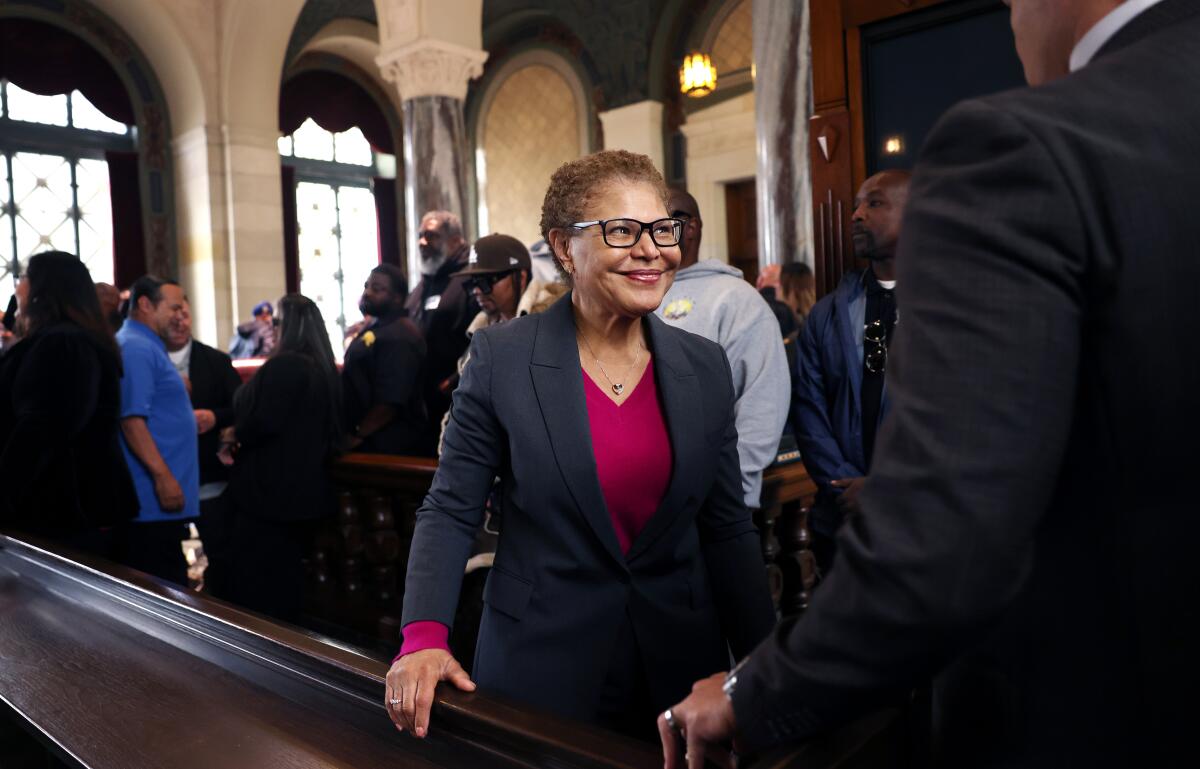
Mayor Karen Bass joins L.A. City Council and community safety leaders at City Hall in downtown Los Angeles on February 17, 2026.
(Christina House/Los Angeles Times)
Bass has repeatedly denied that she was involved in any effort to water down the report, which was meant to spell out mistakes and suggest measures to avoid repeating them after a fire that killed 12 people and destroyed thousands of homes. But two sources with knowledge of Bass’ office have said that after receiving an early draft of the report, the mayor told then-Interim Fire Chief Ronnie Villanueva that it could expose the city to legal liabilities.
Bass wanted key findings about the LAFD’s actions removed or softened before the report was made public, the sources told The Times early this month. The mayor has said that The Times’ story based on the sources’ accounts was “completely fabricated.”
Representatives of Bass’ office and the LAFD did not immediately comment this week on the 13-page “strategic response plan” memo.
The disclosure about the effort to protect the mayor’s reputation comes after other records revealed that she was leading damage control efforts around both the after-action report and an announcement by federal prosecutors that the Palisades fire was caused by a rekindling of a smaller blaze.
The LAFD was facing scrutiny over why it failed to put out the earlier blaze.
“Any additional interviews with the Fire Chief would likely depend on the Mayor’s guidance,” LAFD spokesperson Capt. Erik Scott wrote in an Oct. 9 email to a Bass aide, Villanueva and others. “Regarding a press conference, I would be cautious as it could invite a high volume of challenging questions, and this would also be contingent on the Mayor’s direction.”
Before releasing the after-action report, the LAFD formed an internal crisis management team and brought in the public relations consultants, Beverly Hills-based Lede Co., to help shape its messaging about the fire. In the 13-page strategy memo, Lede, whose fee was covered by the nonprofit Los Angeles Fire Department Foundation, is tasked with helping to manage and monitor news media coverage of the report.
The latest set of documents obtained by The Times includes a “Tough Q&A” with proposed answers to questions that news reporters might ask Bass and Villanueva. The questions for Bass centered around the budget and former Fire Chief Kristin Crowley’s claims that budget restrictions hampered the department’s ability to fight the Palisades fire, with the proposed answers emphasizing that the budget was not cut.

Ronnie Villanueva speaks during his appointment as interim LAFD Chief on Feb. 21, 2025.
(Drew A. Kelley / Long Beach Press-Telegram via Getty Images)
Villanueva’s proposed answers focused on the “unstoppable” nature of the fire and improvements LAFD has since made to ensure adequate staffing on red flag days.
Other internal emails reviewed by The Times show that Bass met with Villanueva about the after-action report in mid-July.
The mayor’s role in altering the after-action report and managing its release has become an issue in her reelection campaign. Bass previously said through a spokesperson that her office merely encouraged the LAFD to fact-check references in the report about city finances and the forecast of high winds leading up to Jan. 7. The mayor later told The Times that the report was “technical,” saying, “I’m not a firefighter.”
The changes that ended up in the final report were significant, with some Palisades residents and former LAFD chiefs saying they amounted to a cover-up.
A week after the fire, The Times exposed LAFD officials’ decisions not to fully staff up and pre-deploy all available engines and firefighters to the Palisades and other high-risk areas before the dangerous winds hit. Bass later removed Crowley, citing the failure to keep firefighters on duty for a second shift.
An initial draft of the after-action report said the pre-deployment decisions “did not align” with policy, but the final version said the number of companies pre-deployed “went above and beyond the standard LAFD pre-deployment matrix.”

Fire fighters work to extinguish flames during the Eaton fire on Wednesday, Jan. 8, 2025 in Altadena, CA.
(Jason Armond/Los Angeles Times)
The author of the report, Battalion Chief Kenneth Cook, declined to endorse the final version because of changes that altered his findings and made the report, in his words, “highly unprofessional and inconsistent with our established standards.”
Even with the deletions and changes, the report delivered a harsh critique of the LAFD’s performance during the Palisades fire, pointing to a disorganized response, failures in communication and chiefs who didn’t understand their roles. The report found that top commanders lacked a fundamental knowledge of wildland firefighting tactics, including “basic suppression techniques.”
Fire Chief Jaime Moore, an LAFD veteran whom Bass named as chief in November, has said he is focused on the future and not interested in assigning blame for changes to the report. But he said he will not allow similar edits to future after-action reports.
The after-action report included just a brief reference to the Lachman fire, a small Jan. 1, 2025, blaze that rekindled six days later into the Palisades fire.
The Times found that a battalion chief ordered firefighters to roll up their hoses and leave the Lachman burn area the day after the fire was supposedly extinguished, despite complaints by crew members that the ground still was smoldering.
After the Times report, Bass directed Moore to commission an independent investigation into the LAFD’s handling of the Lachman fire.
LAFD officials have said that most of the 42 recommendations in the after-action report have been implemented, including mandatory staffing protocols on red flag days and training on wind-driven fires, tactical operations and evacuations.
Pringle is a former Times staff writer.