Fishermen in Gaza are using dinghies made of reclaimed fiberglass, wood, and doorframes salvaged from rubble left by Israeli airstrikes to help revive the territory’s struggling fishing industry amid material shortages.
Francesco Caballero has been juggling a lot — quite literally.
When he’s not tending to his online studies at the California Virtual Academies, the 13-year-old can be found in the circus ring — hurling bowling pins, straw hats, hollow rings and rubber balls high up in the air, all in one harmonious cycle.
But the bright-eyed teen is also balancing something far greater: a legacy. The rookie showman is proving his mettle as part of the Caballero Circus, a five-generation family of performers, by enchanting audiences with his charismatic stage presence and sharp coordination.
“My family is a circus family. That’s what they did when they were kids and it just passed on to me,” said Francesco, hours before a Wednesday night performance in Santa Ana.
Though Francesco is only a month into his journey as a traveling cast member, he pranced about the ring Wednesday with the confidence of a seasoned ringmaster. For his act, the teen juggled up to five objects at a time; as a couple of stray balls fell to his side, he swiftly picked them up and tossed them into the air, as if it were part of the script all along.
And, once the thrill wore off, Francesco marched into center stage with a small motorbike — enclosing himself in a chamber known as the “Globe of Death”: a mesh sphere where riders ramp their bikes using the power of centripetal force to loop around the Globe. He also played the trumpet.
“In order to grow as a performer and to be better, you really have to be patient,” said Caballero. “It’s not something that’s easy, that you’ll be better in like a week.”
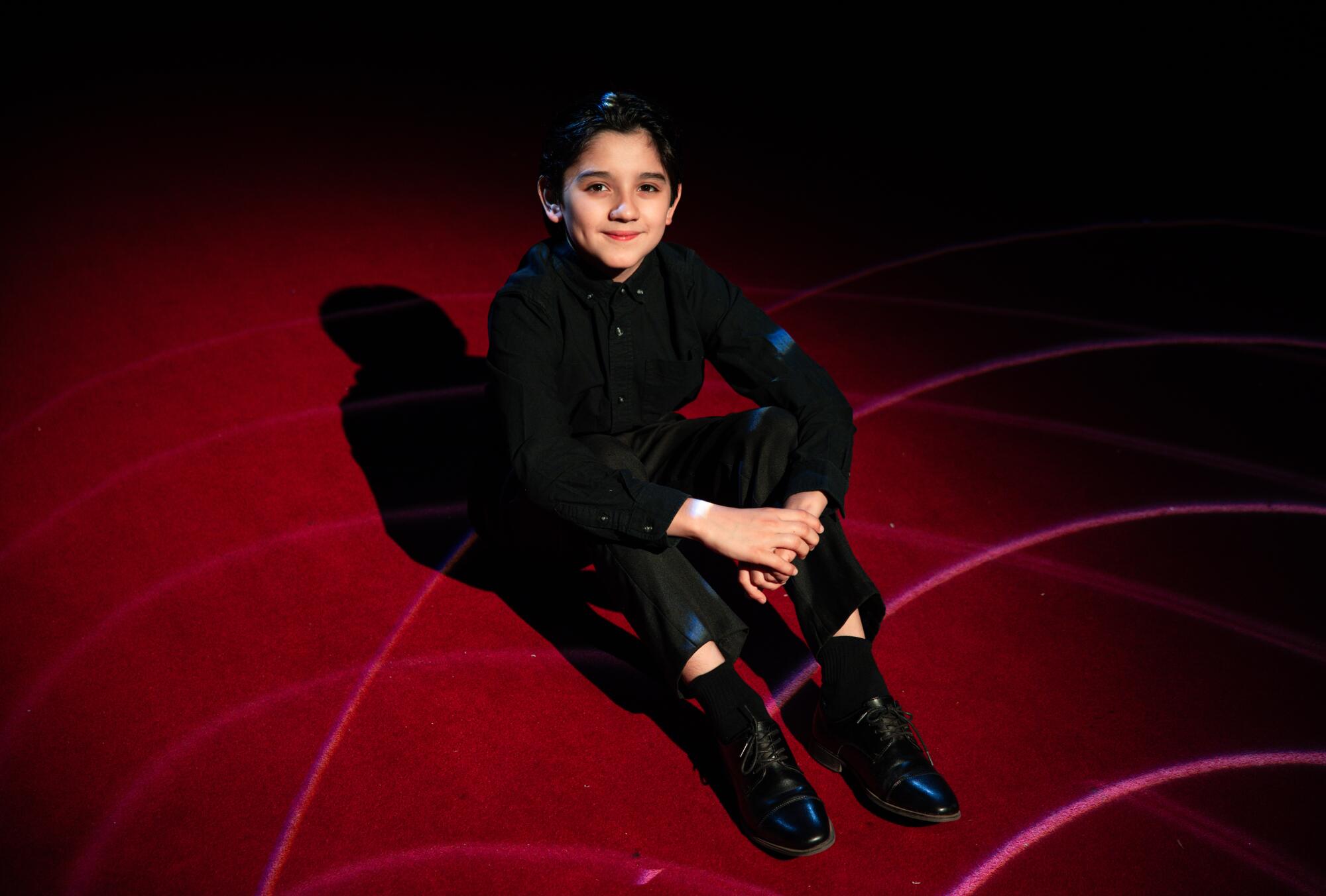
Francesco Caballero, 13, poses for a portrait at the Caballero Circus on Wednesday, May 13, 2026, in Santa Ana.
As boldly charismatic as Caballero appeared on stage, his path to performing in the family circus was hardly clear-cut.
At the age of 3, he was diagnosed with leukemia: a cancer that causes the body to produce too many abnormal white blood cells. This made it difficult for his body to fight infections, carry oxygen and stop bleeding. He was in treatment for four years, until he finally beat cancer by age 7.
This is why his mother, Liliana, a former flying trapeze artist, felt overprotective of him when he began showing interest in the performing world — which began with a small role in the Cirque du Soleil show “The Beatles Love,” in which he played one of the Fab Four in childhood.
At first, Liliana would watch closely to make sure Francesco didn’t get tired or bruised. Yet doctors eventually assured her that physical activity for a recovering pediatric leukemia patient would be beneficial to his quality of life.
“I was against it [at first], but he was so spoiled,” said Liliana. She joked that her son, the youngest of her three children, was “mimado” — a term in Spanish used to describe someone who receives excess attention. Back in the ring, as Francesco prepared his juggling act for another night of play, she stood farther back in the stands, being an ever-observant coach.
“When he told me that he wanted to be like my family, like his grandparents, it was a great satisfaction for me,” said Liliana. “After everything we’ve been through, and still my son dreams of being in the circus, it was a huge blessing for me.”
1/4
The Cartoon Poodles perform at the Caballero Circus on Wednesday, May 13, 2026, in Santa Ana. (Kayla Bartkowski / Los Angeles Times)
2/4
Chicharron performs at the Caballero Circus on Wednesday, May 13, 2026, in Santa Ana. (Kayla Bartkowski / Los Angeles Times)
3/4
Francesco Caballero, 13, juggles pins during his performance at Caballero Circus on Wednesday, May 13, 2026, in Santa Ana. (Kayla Bartkowski / Los Angeles Times)
4/4
Nicole Caballero, 15, second from left, Gianna Rios, 8, Francesco Caballero, 13, Judith Caballero, 15, and Chicharron perform at the Caballero Circus on Wednesday, May 13, 2026, in Santa Ana. (Kayla Bartkowski / Los Angeles Times)
The Caballero circus dynasty dates back to the turn of the 20th century in Guadalajara, with Adelaida Caballero was the first in the family to practice the joyous spectacle. Her daughter, Isabel, would be the first of the Caballeros to open her own circus, as a way to earn income during the Mexican Revolution. (They allegedly entertained Pancho Villa, a well-known circus-lover, in 1916.)
During this time, circus families blossomed all over Mexico, aided by the appearance of the steamship and railway systems, as the circus historian Julio Revolledo Cárdenas would detail in a 2018 article for the Fédération Mondiale du Cirque.
However, much of the Caballero family’s performance lore begins with Isabel’s son, 82-year-old Rubén: an apparatus connoisseur well-versed in the high wire, trapeze and hand balancing. Around 1981, Rubén would bring the entire Caballero family to the United States; all eight of his children performed for the esteemed Ringling Bros. and Barnum & Bailey circuses, with the flying trapeze as their specialty act.
Two members of the Caballero family, Rubén Sr. and Rubén Jr., are also recognized for being the first to execute the quadruple somersault under the big top tent in 1985. It requires extreme faith in the opposite catcher, as much as it does for the individual flipping multiple times over — they even recorded the groundbreaking stunt for posterity’s sake, along with other home videos.
In 1995, this risky act helped the family secure the esteemed Payaso de Oro: the top prize at the International Circus Festival of Monte-Carlo, an award comparable to soccer’s Ballon d’Or or music’s Grammy. Some of the Rubén’s direct descendants would win the award once again 30 years later.
By 2000, Rubén would open his own white-and-purple tent circus, Caballero Circus, where Liliana now oversees the concession stand. Her sisters Maria and Judith manage the circus and supervise show details, respectively.
“My father’s American dream was always to run his own circus,” said Liliana.
Rubén Sr., who continues to be the patriarch of the Caballero family, is teaching his youngest grandson everything he knows. “He wants me to be better,” said Francesco.
Nicole Caballero, 15, from left in the front row, Melody Caballero, 22, Francesco Caballero, 13, and Judith Caballero, 15, at the end of the show at the Caballero Circus on Wednesday, May 13, 2026, in Santa Ana.
Now carrying the family’s torch is the fifth generation of tumbling acrobats skilled in the art of balance and flexibility. Liliana’s 15-year-old daughter, Nicole, specializes in the Globe of Death, where she gets in the locked cage with her cousin Judith, also 15; together they maneuver the motorbikes around the globe at opposing-intersecting paths. This is a skill set she takes pride in, since many in the audience assume there are men underneath the protective gear.
“Once we come out, we take our helmets out and they see girls can do it too,” said Nicole before her Wednesday performance.
Melody, host of the bilingual show, competed as a contortionist on Season 8 of “America’s Got Talent,” which aired in 2013. “ We could have the worst day of our lives, but when we step on stage, we have to have the biggest smile in the world,” said Melody.
Two of Rubén’s older sons, who married Russian acrobats during international stints, broke off and founded their own troupe as Circus Caballero. They have their own touring show stationed in Bell through May 25.
Francesco Caballero, 13, gets ready in a mirror inside a trailer at the Caballero Circus on Wednesday, May 13, 2026, in Santa Ana.
Some of the Caballero family members also compete internationally as the Flying Caballero — something the youngest Caballero member, Francesco, hopes he can work his way up to.
“ I’ve been told that they’ve been to France, to Italy, Germany, everywhere,” he said. “My primos just went to one of the most prestigious festivals in Monaco and they won first place. I wanna be like my cousins and do what they’re doing.”
Francesco might still be learning the ropes of the circus world — but before he can compete on the glamorous world stage, he must first conquer his school’s virtual talent show. On June 8, he will participate in a nationwide competition by the virtual academy K12, which will showcase student talent from across the country.
Thankfully, he will have plenty of time to practice. The Caballero Circus will station itself in Lakewood between May 22 to June 7.
“Not a lot of kids do what I do,” said Francesco. “It teaches us to connect with the public, to connect with other people.”