Affordable Care Act

California counties unsure how how they’ll pay for uninsured

In 2013, before the Affordable Care Act helped millions get health insurance, California’s Placer County provided limited healthcare to some 3,400 uninsured residents who couldn’t afford to see a doctor.

For several years, that number has been zero in the predominantly white, largely rural county stretching from Sacramento’s eastern suburbs to the shores of Lake Tahoe.

The trend could be short-lived.

County health officials there and across the country are bracing for an estimated 10 million newly uninsured patients over the next decade in the wake of Republicans’ One Big Beautiful Bill Act. The act, which President Trump signed into law this summer, is expected to reduce Medicaid spending by more than $900 billion over that period.

“This is the moment where a lot of hard decisions have to be made about who gets care and who doesn’t,” said Nadereh Pourat, director of the Health Economics and Evaluation Research Program at UCLA. “The number of people who are going to lose coverage is large, and a lot of the systems that were in place to provide care to those individuals have either gone away or diminished.”

It’s an especially thorny challenge for states such as California and New Mexico where counties are legally required to help their poorest residents through what are known as indigent care programs. Under Obamacare, both states were able to expand Medicaid to include more low-income residents, alleviating counties of patient loads and redirecting much of their funding for the patchwork of local programs that provided bare-bones services.

Placer County, which estimates that 16,000 residents could lose healthcare coverage by 2028, quit operating its own clinics nearly a decade ago.

“Most of the infrastructure that we had to meet those needs is gone,” said Rob Oldham, Placer County’s director of health and human services. “This is a much bigger problem than it was a decade ago and much more costly.”

In December, county officials asked to join a statewide association that provides care to mostly small, rural counties, citing an expected rise in the number of uninsured residents.

New Mexico’s second-most populous county, Doña Ana, added dental care for seniors and behavioral health benefits after many of its poorest residents qualified for Medicaid. Now, federal cuts could force the county to reconsider, said Jamie Michael, Doña Ana’s health and human services director.

“At some point we’re going to have to look at either allocating more money or reducing the benefits,” Michael said.

Straining state budgets

Some states, such as Idaho and Colorado, abandoned laws that required counties to be providers of last resort for their residents. In other states, uninsured patients often delay care or receive it at hospital emergency rooms or community clinics. Those clinics are often supported by a mix of federal, state and local funds, according to the National Assn. of Community Health Centers.

Even in states like Texas, which opted not to expand its Medicaid program and continued to rely on counties to care for many of its uninsured, rising healthcare costs are straining local budgets.

“As we have more growth, more people coming in, it’s harder and harder to fund things that are required by the state Legislature, and this isn’t one we can decrease,” said Windy Johnson, program manager with the Texas Indigent Health Care Assn. “It is a fiscal issue.”

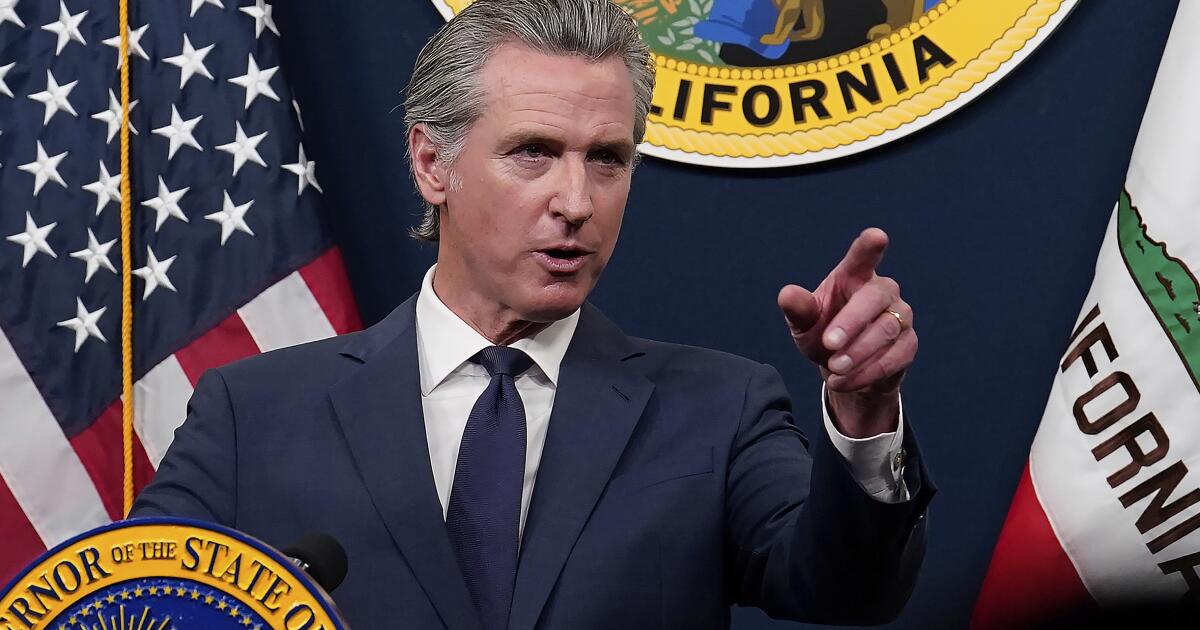
California lawmakers face a nearly $18-billion budget deficit in the 2026-27 fiscal year, according to the latest estimates by the state’s nonpartisan Legislative Analyst’s Office. Gov. Gavin Newsom, who recently acknowledged he’s mulling over a White House run, has rebuffed several efforts to significantly raise taxes on the ultrawealthy. Despite blasting the bill passed by Republicans in Congress as a “complete moral failure” that guts healthcare programs, the Democrat this year rolled back state Medi-Cal benefits for seniors and for immigrants without legal status after rising costs forced the program to borrow $4.4 billion from the state’s general fund.

H.D. Palmer, a spokesperson for the state’s Department of Finance, said that the Newsom administration is still refining its fiscal projections and that it would be premature to discuss potential budget solutions.

Newsom will unveil his initial budget proposal in January. State officials have said California could lose $30 billion a year in federal funding for Medi-Cal under the new law, as much as 15% of the state program’s entire budget.

“Local governments don’t really have much capacity to raise revenue,” said Scott Graves, a director at the independent California Budget & Policy Center with a focus on state budgets. “State leaders, if they choose to prioritize it, need to decide where they’re going to find the funding that would be needed to help those who are going to lose healthcare as a result of these federal funding and policy cuts.”

Reviving county-based programs in the near term would require “considerable fiscal restructuring” through the state budget, the Legislative Analyst’s Office said in an October report.

No easy fixes

It’s unclear how many people are enrolled in California’s county indigent programs, because the state doesn’t track enrollment and utilization. But enrollment in county health safety net programs dropped dramatically in the first full year of Affordable Care Act implementation, going from about 858,000 people statewide in 2013 to roughly 176,000 by the end of 2014, according to a survey at the time by Health Access California.

“We’re going to need state investment,” said Michelle Gibbons, executive director of the County Health Executives Assn. of California. “After the Affordable Care Act and as folks got coverage, we didn’t imagine a moment like this where potentially that progress would be unwound and folks would be falling back into indigent care.”

In November, voters in affluent Santa Clara County approved a sales tax increase, in part to backfill the loss of federal funds. But even in the home of Silicon Valley, where the median household income is about 1.7 times the statewide average, that is expected to cover only a third of the $1 billion a year the county stands to lose.

Health advocates fear that, absent major state investments, Californians could see a return to the previous patchwork of county-run programs, with local governments choosing whom and what they cover and for how long.

In many cases, indigent programs didn’t include specialty care, behavioral health or regular access to primary care. Counties can also exclude people based on immigration status or income. Before the ACA, many uninsured people who needed care didn’t get it, which could lead to them winding up in emergency rooms with untreated health conditions or even dying, said Kiran Savage-Sangwan, executive director of the California Pan-Ethnic Health Network.

Rachel Linn Gish, interim deputy director of Health Access California, a consumer advocacy group, said that “it created a very unequal, maldistributed program throughout the state.”

“Many of us,” she said. “including counties, are reeling trying to figure out: What are those downstream impacts?”

KFF Health News is a national newsroom that produces in-depth journalism about health issues and is one of the core operating programs at KFF, the independent source for health policy research, polling and journalism.

Source link

Jeffries vows to ‘pressure’ Senate on health care insurance subsidies

1 of 3 | House Minority Leader Hakeem Jeffries, D-NY, said Sunday that he expects the House to pass a three-year extension of tax credits for people buy health insurance through Affordable Care Act exchanges. Photo by Bonnie Cash/UPI | License Photo

Dec. 21 (UPI) — House Minority Leader Rep. Hakeem Jeffries, R-N.Y., said Sunday that he expects lawmakers to pass a bipartisan compromise on extending Affordable Care Act tax credits.

Jeffries said on ABC News’ “This Week” that lawmakers will pass a bi-partisan compromise to extend ACA tax credits extension in the House, potentially forcing Senate Republicans hand on health insurance subsidies for at least 22 million Americans who will face higher premiums in the new year.

Congress adjourned for Christmas without reaching a deal on extending on the tax credits, which Jeffries promised that House lawmakers will address in early January.

“That will put pressure on John Thune and Senate Republicans to actually do the right thing by the American people, pass a straightforward extension of the Affordable Care Act tax credits, so we can keep health care affordable for tens of millions of Americans who deserve to be able to go see a doctor when they need one,” Jeffries said.

Democrats have said if the two sides are unable to reach a deal on an extension, they will wield it against Republicans in next year’s midterm elections.

Rep. Pat Ryan, D-N.Y., has said access to affordable health care remains among the most pressing issues among voters.

“It’s just pathetic,” Ryan said. “The last time there was a major national Republican effort to repeal the ACA, we had an overwhelming wave where they got absolutely wiped out, and I think that’s likely what will happen here again.”

A handful of centrist Republicans in vulnerable congressional districts bypassed the authority of House Speaker Mike Johnson to team up with key Democrats to authorize a vote on a three-year tax credit extension when the House returns to Washington the week of Jan. 5.

Some Republican leaders have said they favor allowing Covid-era tax credits that made health care more affordable for millions of Americans to expire or be phased out over several years. Other members of the GOP, however, have said they favor extending the credits for longer.

By a vote of 51-48 Thursday, the Senate rejected a three year ACA extension with four Democrats joining the GOP to vote it down.

Source link

Beneath the rambling, Trump laid out a chilling healthcare plan

Folks, who was supposed to be watching grandpa last night? Because he got out, got on TV and … It. Was. Not. Good.

For 18 long minutes Wednesday evening, we were subjected to a rant by President Trump that predictably careened from immigrants (bad) to jobs (good), rarely slowing down for reality. But jumbled between the vitriol and venom was a vision of American healthcare that would have horror villainess M3GAN shaking in her Mary Janes — a vision that we all should be afraid of because it would take us back to a dark era when insurance couldn’t be counted on.

Trump’s remarks offered only a sketchy outline, per usual, in which the costs of health insurance premiums may be lower — but it will be because the coverage is terrible. Yes, you’ll save money. But so what? A cheap car without wheels is not a deal.

“The money should go to the people,” Trump said of his sort-of plan.

The money he vaguely was alluding to is the government subsidies that make insurance under the Affordable Care Act affordable. After antics and a mini-rebellion by four Republicans also on Wednesday, Congress basically failed to do anything meaningful on healthcare — pretty much ensuring those subsidies will disappear with the New Year.

Starting in January, premiums for too many people are going to leap skyward without the subsidies, jumping by an average of $1,016 according to the health policy research group KFF.

That’s bad enough. But Trump would like to make it worse.

The Affordable Care Act is about much more than those subsidies. Before it took effect in 2014, insurance companies in many states could deny coverage for preexisting conditions. This didn’t have to be big-ticket stuff like cancer. A kid with asthma? A mom with colitis? Those were the kind of routine but chronic problems that prevented millions from obtaining insurance — and therefore care.

Obamacare required that policies sold on its exchange did not discriminate. In addition, the ACA required plans to limit out-of-pocket costs and end lifetime dollar caps, and provide a baseline of coverage that included essentials such as maternity care. Those standards put pressure on all plans to include more, even those offered through large employers.

Trump would like to undo much of that. He instead wants to fall back on the stunt he loves the most — send a check!

What he is suggesting by sending subsidy money directly to consumers also most likely would open the market to plans without the regulation of the ACA. So yes, small businesses or even groups of individuals might be able to band together to buy insurance, but there likely would be fewer rules about what — or whom — it has to cover.

Most people aren’t savvy or careful enough to understand the limitations of their insurance before it matters. So it has a $2-million lifetime cap? That sounds like a lot until your kid needs a treatment that eats through that in a couple of months. Then what?

Trump suggested people pay for it themselves, out of health savings accounts funded by that subsidy check sent directly to taxpayers. Because that definitely will work, and people won’t spend the money on groceries or rent, and what they do save certainly will cover any medical expenses.

“You’ll get much better healthcare at a much lower price,” Trump claimed Wednesday. “The only losers will be insurance companies that have gotten rich, and the Democrat Party, which is totally controlled by those same insurance companies. They will not be happy, but that’s OK with me because you, the people, are finally going to be getting great healthcare at a lower cost.”

He then bizarrely tried to blame the expiring subsidies on Democrats.

Democrats “are demanding those increases and it’s their fault,” he said. “It is not the Republicans’ fault. It’s the Democrats’ fault. It’s the Unaffordable Care Act, and everybody knew it.”

It seems like Trump just wants to lower costs at the expense of quality. Here’s where I take issue with the Democrats. I am not here to defend insurance companies or our healthcare system. Both clearly need reform.

But why are the Democrats failing to explain what “The money should go to the people” will mean?

I get that affordability is the message, and as someone who bought both a steak and a carton of milk this week, I understand just how powerful that issue is.

Still, everyone, Democrat or Republican, wants decent healthcare they can afford, and the peace of mind of knowing if something terrible happens, they will have access to help. There is no American who gladly would pay for insurance each month, no matter how low the premium, that is going to leave them without care when they or their loved ones need it most.

Grandpa Trump doesn’t have this worry, since he has the best healthcare our tax dollars can buy.

But when he promises to send a check instead of providing governance and regulation of one of the most critical purchases in our lives, the message is sickening: My victory in exchange for your well-being.

Source link

Competing Senate healthcare bills fail to pass

Dec. 11 (UPI) — The Senate failed to approve either of two competing healthcare plans meant to address healthcare costs likely to rise in the new year with the expiration of Affordable Care Act tax credits.

Democrats and Republicans each put forth their own healthcare plans, but neither mustered the 60 votes needed to overcome the Senate’s filibuster rule with identical 51-48 vote totals, NBC News and The Hill reported.

Each proposal mostly received party-line support, with only Sen. Rand Paul, R-Ky. voting against the GOP proposal, which all Senate Democrats also opposed.

Senate Democrats received some GOP support for their proposal, with Sens. Susan Collins, R-Maine, Josh Hawley, R-Mo., Lisa Murkowski, R-Alaska, and Dan Sullivan, R-Alaska, voting in favor.

Sen. Steve Daines, R-Mont., did not cast a vote for or against either measure.

The Democrats’ plan included a three-year extension of enhanced ACA subsidies beyond the Jan. 1 expiration date. The proposal would also limit health insurance premiums under the ACA to 8.5% of the policyholders’ incomes.

The enhanced subsidies were put in place during the COVID-19 pandemic as part of the 2021 American Rescue Plan.

To pass, Democrats needed at least 13 Republicans to vote in favor of the plan.

The expiring subsidies were the crux of a six-week government shutdown this fall. Democrats refused to vote in favor of a House Republican-drafted stopgap funding measure without including language that would see the subsidies extended beyond December.

Without the subsidies, healthcare premiums through the ACA were forecast to more than double in some cases. The Congressional Budget Office projects about 3.8 million will drop coverage annually over the next eight years without the additional subsidies. In 2025, a record 24 million Americans got their health insurance through the healthcare marketplace.

“We have 21 days until Jan.1,” Senate Democratic leader Chuck Schumer said on the Senate floor Wednesday. “After that, people’s healthcare bills will start going through the roof. Double, triple, even more.

“There is only one way to avoid all of this. The only realistic path left is what Democrats are proposing — a clean, direct extension of this urgent tax credit.”

Republicans, however, refused to consider the subsidies as part of the continuing resolution. Ultimately, Republicans agreed to consider a separate healthcare vote as a tradeoff to reopening the government.

The Republican plan, unveiled Tuesday by Sens. Bill Cassidy and Mike Crapo, doesn’t extend the subsidies but provides $1,500 health savings accounts for those earning less than 700% of the poverty level.”

“It delivers the benefit directly to the patient, not to the insurance company, and it does it in a way that actually saves money to the taxpayer,” Senate Republican leader John Thune said.

He described the Democrats’ plan as a “partisan messaging exercise” and called the idea that it would lower healthcare costs a “tour of fantasy land,” according to ABC News.

President Donald Trump makes remarks during a roundtable meeting with high-tech business executives in the Roosevelt Room of the White House on Wednesday. The president announced that the United States has seized an oil tanker near Venezuela and a revealed a new special corporate immigration gold card focused on keeping students in the United States. Photo by Aaron Schwartz/UPI | License Photo

Source link