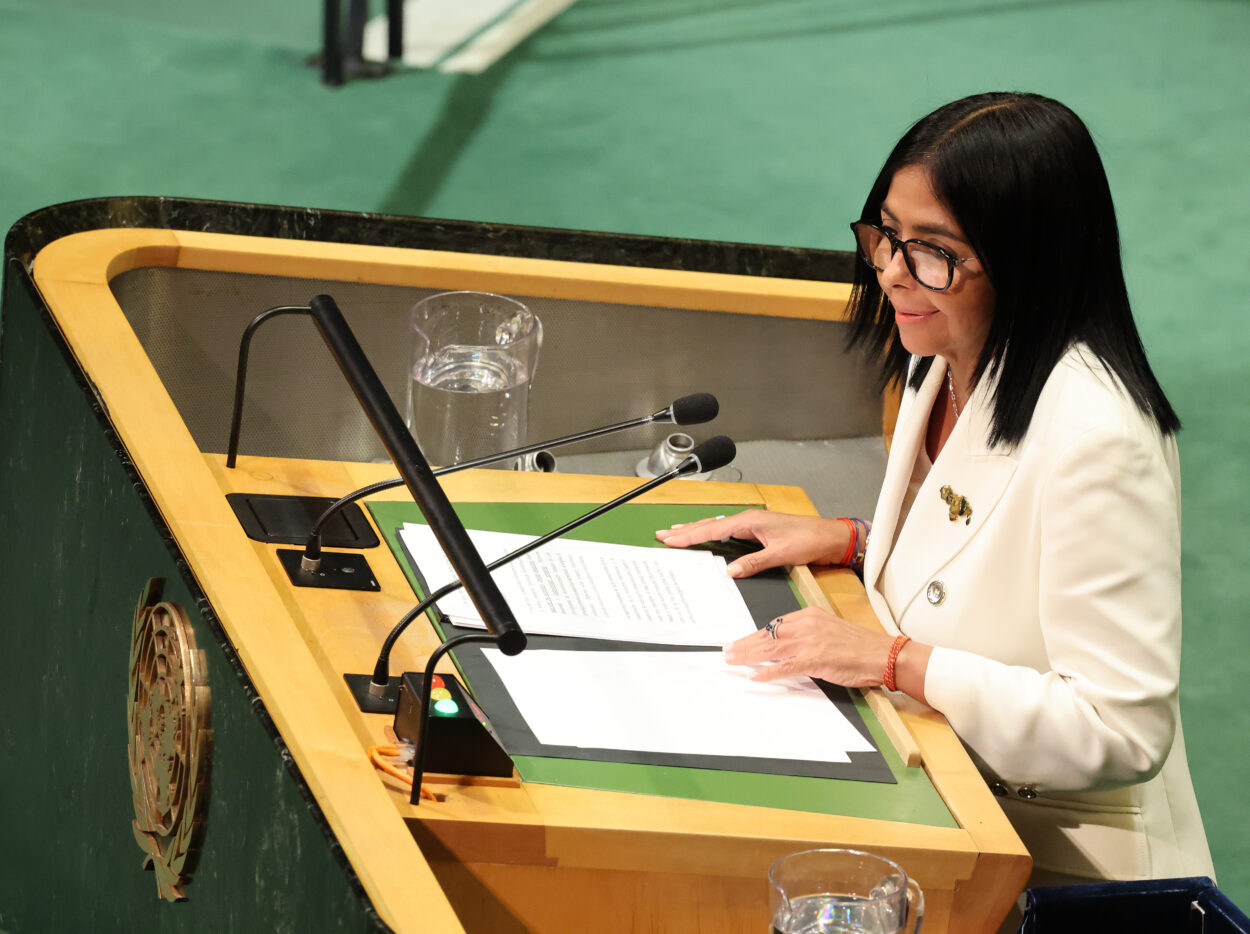
Acting President Delcy Rodríguez delivering her speech at the 81st United Nations General Assembly in New York. (Presidential Press)
Caracas, September 25, 2026 (venezuelanalysis.com) – Venezuelan Acting President Delcy Rodríguez outlined a foreign policy built on “peace” and “dialogue” in her address at the 81st session of the United Nations General Assembly in New York on Wednesday.
Speaking before world leaders, Rodríguez insisted on peace over conflict, thanked the Trump administration for diplomatic backing, and committed to international cooperation on environmental, energy, and AI regulation. She went on to urge young Venezuelan migrants to return home and laid out a proposal for structural “democratic transformation” of the Caribbean nation.
Opening her address, Rodríguez underscored Caracas’ rejection of warfare, linking global stability to diplomatic resolution.
“Venezuela, which today knows what it is to lift its children out from under the rubble, extends its deepest solidarity to all peoples who suffer from war, and reaffirms that peace […] is not a naive aspiration, but the only truly human path,” she declared.
Rodríguez explicitly addressed the diplomatic rapprochement with Washington after the January 3 US military strikes and kidnapping of President Nicolás Maduro and First Lady Cilia Flores. She expressed thanked Trump for aiding Venezuela’s reintegration into international forums following years of heavy economic sanctions and diplomatic isolation.
“I want to thank President Donald Trump and his government for their willingness to resume the path of diplomatic and cooperative relations with Venezuela,” Rodríguez stated, referencing the recent oil deal as “one of the largest ever signed” and pledging that it will contribute to regional energy stability.
Rodríguez refrained from condemning the US attack, calling it a “difficult moment” that resulted from the “exhaustion of domestic policies and heightened confrontation with the US.” She likewise made no mention of Maduro and Flores, presently detained 10-15 miles away from the UN headquarters and facing trial for charges including drug trafficking conspiracy.
The Venezuelan acting president had conveyed similar gratitude in a face-to-face meeting with Trump on Tuesday that she labeled as “historic.”
Turning to domestic affairs in her UN address, Rodríguez spoke of the severe wave of migration triggered by past political and economic crises, and vowed to the Venezuelan youth residing abroad that there will be improved conditions for their return.
“To the young people, who have grown up seeing a fractured country and who often decided to leave seeking what they could not find here: I tell you that it is worth believing again,” the acting leader affirmed. “This is the moment to build the country that many want to return to, and not just the one that many wanted to flee.”
This message was framed as part of what Rodríguez termed a “democratic transformation for a rebirth,” which she described as an institutional, orderly, and verifiable process.
“In Venezuela, there will be elections. We have already initiated a political dialogue with sectors of the opposition that leads to a process on equal terms for all,” she noted.
Though Rodríguez did not explicitly name unilateral sanctions from Washington and its allies, she stated that the country needs to be “free from economic restrictions” and pledged to “guide Venezuela toward an era of full democracy, recognized by its people and the world.”
The acting president’s UN speech came amid a flurry of diplomatic activity in New York, including meetings with International Monetary Fund (IMF) Managing Director Kristalina Georgieva, World Bank President Ajay Banga, and Inter-American Development Bank (IDB) President Ilan Goldfajn.
On the sidelines of the UN assembly, Rodríguez also held bilateral meetings with Chilean far-right president José Antonio Kast to discuss regional trade and stability, as well as with a delegation from Trinidad and Tobago, led by Prime Minister Kamla Persad-Bissessar, initiating a “new stage in bilateral relations” centered on joint offshore natural gas exploration and maritime security.
Venezuela had suspended cooperation with neighboring Port of Spain after Persad-Bissessar backed the US’ military build-up on the country’s shores in late 2025.
Rodríguez’s New York trip coincided with a second round of US-backed talks between government negotiators led by National Assembly President Jorge Rodríguez and a sector of the opposition led by former deputy Dinorah Figuera.
The latest negotiations reportedly focused on electoral guarantees, freedom of expression, institutional reform, including renewing the Supreme Court, and efforts to secure the unfreezing of Venezuelan assets abroad, including gold reserves worth approximately US $4 billion. The gold held by the Bank of England is set to be transferred to the US, to be released for post-earthquake recovery efforts under White House oversight.
Edited by Ricardo Vaz in Lisbon, Portugal.