The year was 1923, and thousands of people a month were flooding into Los Angeles in hopes of finding a job in the nascent film business.
Many planned to start as background actors, dreaming they’d be discovered by a director and finally get their big break. These behind-the-scenes actors would wander from studio lot to studio lot, lining up in hopes of being cast.
But the chaos of aspiring actors searching for jobs eventually became too much. Even silent screen star Mary Pickford took to warning wide-eyed newcomers that they should save enough money to survive for five years before coming out to Hollywood.
Out of calls to create safeguards around this fledgling business, and more order around background acting opportunities, emerged the Central Casting Corp.
Central Casting — now so eponymous that its name has become a cultural phrase — celebrated its 100th anniversary earlier this month.
I recently spoke with Mark Goldstein, president and chief executive of the Burbank-based company, to talk about changes in the industry, including the threat of artificial intelligence, runaway production and the role of a background actor in 2025.
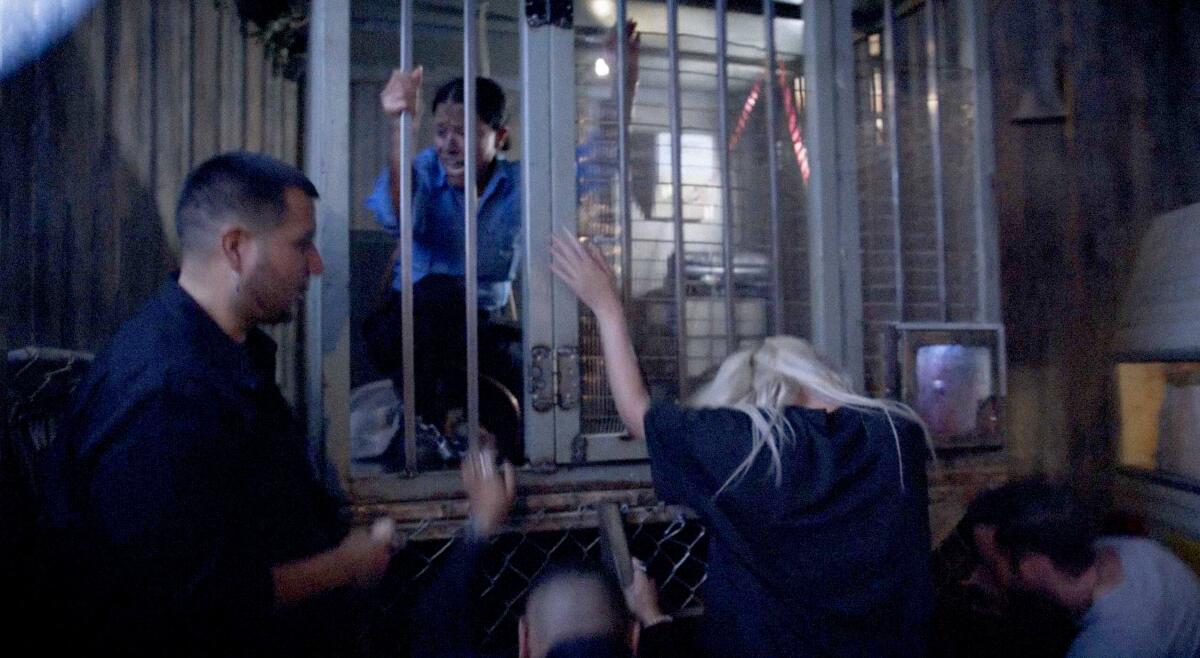
Goldstein acknowledged the tough environment for background performers, also commonly known as extras, who populate restaurants, parks and other film and TV scenes to make the environment seem more realistic — all without saying a word.
After the lows of the pandemic, and then the explosion of content during the peak TV era, one of the main challenges for Central Casting’s members is just finding new roles, he said.
“There’s been a little bit of a pullback in production over the last year,” said Goldstein, who serves as president and CEO of Central Casting as well as production finance and management tools firm Entertainment Partners, which owns the agency. “It’s really just constantly finding the right roles for people.”
In Southern California, of course, jobs have been more scarce as production has flowed to other states and countries offering steeper film incentives.
Then there is the advent of computer-generated imagery, which has lessened the need for massive crowd scenes that were once standard.
“Before [CGI] technology, we may fill up an arena, like we may fill a 5,000-person shoot or a 10,000-person shoot,” Goldstein said.
Remember the long lines for casting calls?
No more.
More recently AI has been a key concern for background actors, though Goldstein said he doesn’t think the new digital tools and the rise of synthetic characters will eliminate the need for background actors.
“There’s a lot of conversation [about] is it human or technology? And we kind of view it as human and technology,” he said. “The consumer wants believability, and so there’ll be situations where it’s really important to have the human role involved, but there may be other situations where AI and technology can be helpful.”
He added: “We have legendary people that started their career because they wanted to follow their dream to become an actor in Hollywood,” he said, ticking off the names of famous alumni such as Clark Gable, Carole Lombard, Eva Longoria, Will Ferrell and Brad Pitt. “And we don’t see that changing.”
Despite the challenges, aspiring actors still register with Central Casting every day, Goldstein said. The company has 200,000 background actors in its database, with more than 20,000 new names added a year. About 3,000 are placed in roles each day, the company says.
One of those is Jaylee Maruk, 38, who signed up with Central Casting in 2009 and has worked steadily ever since.
Maruk works often on “Grey’s Anatomy” and has credits on Hulu’s “Paradise” and Apple TV’s “Shrinking.” She once stood in for Greta Lee in Apple TV‘s “The Morning Show.”
You’re reading the Wide Shot
Samantha Masunaga delivers the latest news, analysis and insights on everything from streaming wars to production — and what it all means for the future.
“What I love about doing background is it really gives a solid foundation about what it’s like to be on set and what the expectations are,” Maruk said.
But she worries about her future, especially with the rise of AI and the migration of production.
“Productions will pack up and leave,” she said. “They’ll go somewhere cheaper, and it’s becoming harder and harder for us. That’s really the biggest concern, trying to entice and support productions staying here.”
Towns in far-off countries like Hungary and Turkey can be made to look just like places in America, she says. And they can cast local residents instead of U.S.-based performers like Maruk. After all, background actors don’t have speaking roles, so not speaking English isn’t a problem.
“We want our work to be here,” said the Lake Balboa resident. “Our families are here, our lives are here.”
Last year, I got a glimpse into the world of background acting when I covered the annual Los Angeles Union Background Actors Awards. Though tongue-in-cheek at times — the awards themselves are called Blurries — the ceremony and winners’ speeches also highlighted these actors’ key roles in Hollywood.
I met background actors who had done the job for years, including one who got his first role as a 12-year-old in “Hello, Dolly!” Many talked about the difficulty of the last few years and the desire for respect for their professional work. Some were full-time background actors; others did the work part time. All were passionate about what they did.
“It really is just preparedness and luck, as they say,” Maruk said. “And also just having a lot of motivation and resilience.”
Stuff We Wrote
Film shoots
Number of the week
James Cameron’s “Avatar: Fire and Ash” brought in $89 million in the U.S. and Canada during its opening weekend. Globally, the film made $346 million, with big hauls in China and France.
That opening total came in at the lower end of box office analysts’ expectations and is also less than the massive opening weekend for its predecessor film, 2022’s “Avatar: The Way of Water,” which grossed $134 million in its domestic debut. But “Avatar” films tend to build momentum at the box office over subsequent weekends, so the Na’vi aren’t vanquished yet.
In addition to “Avatar,” this past weekend also saw strong performances from Angel Studios’ animated “David,” as well as Lionsgate’s thriller “The Housemaid,” pushing the year-to-date domestic box office total a slim 1% above the same time period last year. That’s helpful for theaters but doesn’t bode well for the box office’s overall performance this year.
Finally …
My colleague Josh Rottenberg looks at what movie stardom will mean in an age of AI. In that story, he has an interview with the creator of Tilly Norwood, the AI-generated character that recently sparked a furious debate in Hollywood about the role of synthetics in film and TV.
Have you ever wondered what movie might draw praise from Jacob Elordi and Benicio Del Toro for its cinematic reverie?
When you gather six actors from some of this year’s most acclaimed films, a thoughtful discussion about their roles and the craft is to be expected. But in kicking off The Envelope’s 2025 Oscar Actors Roundtable, the talent reminded us that they’re movie fans like the rest of us, picking the films they wish they could experience again for the first time.
“I’d like to watch ‘The Dark Knight’ again in the exact same circumstance that I watched it,” Elordi said, referring to Christopher Nolan’s dark retelling of Batman’s battle with the Joker. “I was 11 and I was with my dad. I’d been told by my mother that I wasn’t allowed to see it because there’s a horrific sequence with a pencil and a magic trick. My dad — when my mum was away — took me to the cinema to see it. I remember the first time I saw Heath [Ledger, as the Joker] onscreen and really feeling just totally moved by something.”
Then Del Toro chimed in with his pick, “Papillon,” Franklin Schaffner’s 1973 prison film starring Dustin Hoffman and Steve McQueen: “I saw it when I was a kid. We got in late in the movie, and it was a scene where they’re trying to get a gator. And they’re running around the crocodile. I’ve always really enjoyed that film.”
“And you really see Steve McQueen do more in that movie than ever before,” Elordi says. “When he starts going mad in that cell.”
Jesse Plemons is more sheepish when coughing up his selection.
“Everyone’s listing serious movies. The movie that popped into my head was ‘Nacho Libre.’ In life, some things just give you simple pleasures that aren’t necessarily elevated or high art. But that movie makes me very happy, guys.”
There was no judgment. An atmosphere of friendly sharing and mutual understanding was felt throughout the conversation, which brought together Elordi, who portrays the misunderstood and abused Creature in Guillermo del Toro’s “Frankenstein”; Plemons, in his turn as Teddy, a conspiracy theorist who is convinced that aliens live among us in “Bugonia”; Benicio Del Toro, who plays Sergio St. Carlos, a karate sensei and revolutionary immigration activist in “One Battle After Another”; Will Arnett, who stars as Alex Novak, a middle-age suburbanite whose crumbling marriage inspires him to try stand-up comedy in “Is This Thing On?”; Wagner Moura, who portrays Marcelo Alves, a teacher trying to escape the Brazilian dictatorship in “The Secret Agent”; and Stellan Skarsgård, who plays Gustav Borg, a veteran film director and absentee father who decides to make a movie about his family in “Sentimental Value.” Read on for excerpts from our discussion.
These roles take you to intense places — emotionally, physically, mentally. But what’s the furthest you’ve gone to book a role because you really felt like it was something you were meant to play?
Moura: “Narcos” was a crazy adventure for me because I was cast to play that part that had nothing to do with me. I was a skinny Brazilian guy who didn’t speak Spanish at all. So I had to go through a very intense thing. I had to learn a language in order to play a character. That was crazy. That was the the furthest I’ve [gone] to play a part.
Plemons: Those early weeks are a lot of fun, right? The beginning. It’s like Christmas every day.
Moura: The beginning is always like, “What am I doing?” And you go to bed and go like, “Jesus Christ, this is … There’s no way I can pull this off.” At the same time, I remember going to bed and thinking, “Have I done everything I could?” And then I was like, “Yeah, go to bed. Sleep.”
Arnett: Did you ever think about quitting, about not doing it?
Moura: No. I had to go ahead and do it. That director trusted me, and he was like, “You can do it.” I didn’t want to disappoint him.
Have you gotten to that point, Will? Wanting to quit something because it felt like too much?
Arnett: All the time. Doing [“Is This Thing On?”], I felt like I was at the bottom of a mountain. Every day, I thought, “There’s no way I can do it.” I would come home and just think, “That was probably the worst day that anybody’s ever filmed a scene,” then just have to let it go.
With “Is This Thing On?,” you did a stand-up act in front of people, and they were tourists. Some of them didn’t know who you were. And you bombed a few times, right? Place me in that moment, and what does that do for your performance.
Arnett: I had them introduce me by my character name. So the people who did know who I was, we were saying that [they] thought I was probably having a midlife crisis or something, which I was, but for different reasons. I’d never done stand-up before, so going up and doing this in front of people and bombing was super vulnerable. There’s nowhere to hide, and you can’t just walk off. There was one time where I’d done a set at the Comedy Cellar, in the main room, and it was great. And went around the corner, like five minutes later, onto a different stage, with the same material, and it was dead silent. And the only person laughing was Bradley. I could see him laughing, and [I was] thinking, “Can I just walk off stage right now?” That was ego-stripping. It becomes kind of absurd. You end up kind of laughing at yourself, at the absurdity of it. It’s not out-of-body, but you separate yourself from the words as they’re coming out.
Stellan, “Sentimental Value” is, in some ways, about how the choices a parent makes in the service of their job or their art shape the lives of your children. How did it make you reflect on the choices you’ve made in your career and the impact it had on your family?
Skarsgård: I thought it had nothing to do with me. This was a good escape. But my second son, he called me and said, “You recognize yourself?” And I went, “Uh, no.” And of course I don’t recognize myself because he’s a different kind of man. He’s an old-fashioned man in a sense, a 20th century man. And I’m a 21st. [Laughs.] But it reminded me — since I stopped at the Royal Dramatic Theatre [in] 1989, I spent four months a year in front of the camera and eight months a year changing diapers and wiping asses. I don’t think I’ve been away a lot, but it made me think about, “Have you been present?” Not really. I have eight kids, which means there are eight different personalities, and some kids need a lot of attention and some don’t. You’re imperfect, but I’m sort of settled with that. My kids have to settle with it too. They’re not perfect either.
We often hear from the women who are mothers, how they balance their work with their careers. Many of you are fathers. How have you learned to navigate it?
Moura: For me, it’s the most difficult thing ever. I was thinking the other day, “What are the things that really define me as a human being?” Being a father is the strongest one, but being an artist is almost there. It’s hard because with our job, we have to travel a lot, and you’re not always able to bring your kids with you. They have school, and they have their own lives and their own things. I kind of think this is sort of an impossible perfect balance. But like Stellan said, it is what it is. And when I’m with them, I try to be with them. But being aware that, of course, there will be parts of their lives that I won’t be able to be there for them and sort of accept that.
Arnett: It’s funny, I’ve been traveling a lot doing this stuff. I’ve been back for a couple of days, but I’ve been busy. I’ve been going out all day, doing work and doing these things, and my 15-year-old said to me — I checked in on him. He’s doing his homework. I said, “How are you doing?” He said, “Good,” and he said, “I miss you.” And I was in the same place with him. I don’t even know if this is appropriate for this forum, but it really struck me. Him saying that stayed with me all day. And I woke up thinking about [that] this morning, and even this [round table], and saying, “Hey, we’re gonna have dinner tonight.” I had those moments of thinking, “Am I that guy?” Now I’m saying, “Let’s have dinner after … I gotta go do this thing.” It weighs on you. It is the most difficult balance.
Del Toro: I’ve tried to include my daughter in the process sometimes, you know? Sit her down, bounce lines with her, go see the movie when I’m done with the movie. Make her part of it too.
Jacob, so often when you’re talking to an actor, at least on my end, there’s curiosity about the research process and what you’ve had to learn to prepare for a role. But in playing the Creature in “Frankenstein,” this amalgamation of parts, your character’s really in a process of discovery. Did you have to unlearn things? How did you approach that?
Elordi: The nature of the character actually gives you an excuse to be absolutely free because he’s sort of the first man, in a lot of ways. You can really draw from everything and anything, like a smell or light, because he hasn’t felt the sun on his face. But there’s so many things that you can go back on and reconsider. A lot of the process was just closing the world off for the time of filming — not eating a cheeseburger when I wanted to eat a cheeseburger or just little stuff that made me feel Other. But strangely enough, because he’s made of so many different parts, and you get to go from being born to finding consciousness to the death of consciousness at the end, it’s like shooting fish in a barrel. You can’t really miss because everything is happening to him all the time. It’s interesting because you say you want to ask someone about the process, but the process is so f— boring.
Plemons: You studied some form of Japanese dance or movement?
Elordi: Guillermo had this idea to study Butoh. It’s a movement thing, like you’re in drama school again where [the instructor]’s like, “Imagine fire in your fingertips and a hurricane in your lungs, and your foot is a steam train.” And then you walk around the room for 40 minutes … I remember being in drama school, and I had to carry a stick that was called my Intellikey for two hours. It was a piece of bamboo. And move around the room as if that stick was a part of my soul or something. Something completely f— absurd. It was a similar process to that, but it was actually helpful because I had something to apply it to that was sort of physically not so human.
Do any of you have a thing that really helped you find your way into a character? Jesse, I feel like you have gone to some dark places.
Plemons: I guess the most curious is I do dream work. There are symbols and whatnot that you are gifted with that may not make sense on a conscious level, or they may. That’s something that’s hard to talk about. Anything that makes me feel like I’m just following my curiosity and I’m not working; I’m just following some trail that I don’t necessarily know where it’s leading — it’s hard to describe because the way I like to work is where anything goes.
Elordi: You kind of know when you get onto that thing too. When a dot does connect. Something happens, then, all of a sudden, you’re six hours down this little road on this sound that you heard in a song or something like that. You also know when it’s not working. But to be conscious about it can mess it up as well, if you’re like, “I’m gonna do this kind of thing and this. And this is gonna go to this voice.”
Does the work need to feel hard in order for you to feel like you’re challenging yourself?
Skarsgård: No. [I need] to not be afraid and not to be blocked; I need to feel safe. And I need [for] everybody on the set, they want me to be good, and I feel it. Then I can be free. I’m with you [Jesse], you have to be in a state where anything is possible. I don’t do backstories for my characters, ever, because it reduces the possibilities. Then you have to follow the backstory — so he couldn’t do that. You, as an actor, say to the director, “No, my character wouldn’t do that.” “How do you know?” Your character might be more interesting than you are.
Plemons: And this thing doesn’t exist yet, this moment —
Moura: There’s no better thing than being in a scene with another actor, and you look at the other guy or the other actors, and you go, like, “This can go anywhere.” Because these other guys, or this other actor, she’s ready to do whatever, to take this wherever. This is the thing that really moves me in a scene. It’s really hard when you work with an actor or with a director that sticks with the thing that they want the scene to be, that thing they thought at home, that they prepared for, and you can’t really move into that space.
Benicio, you really know how to make a character memorable and leave a lasting impression. With Sensei Sergio and what we see onscreen, what were you working with on the page and how much came from you in collaboration with Paul [Thomas Anderson, the film’s director]?
Del Toro: I just asked questions. Paul wants to hear what the actors have to say. I just bombard him with questions. Paul was very flexible … He’s very quick, and if he likes something, he would jump on it. My character was introduced by killing someone in my dojo. So, I asked him, “OK, so I killed this guy in the dojo … I’m not gonna drive Leo anywhere. I have to get rid of the body. And we’re gonna have to clean the dojo or set it on fire. And why am I doing that?” So, from there, it evolved into, like, “We’re not killing anybody.” I approach it a little bit like that — common sense. Logic. But every character is different and every story is different, and every director is different. I’ve been in movies where you just have to find yourself in there. And those are challenging, and they make you better.
“The Secret Agent” really explores how brutal a dictatorship can be on regular people. Wagner, your character Marcelo is not trying to overthrow the government. He’s just a man who’s trying to stick with his values. Tell me about portraying a person in that situation.
Moura: The dictatorship in Brazil was from ’64 to ’85. I was born in ’76, so the echoes of the dictatorship were still there. I remember my parents speaking like [mimics whispering] because they didn’t want people to hear what were they talking about. It’s important that Brazilian cinema is going back there to look at that big scar in our country. I directed a film [2019’s “Marighella”] about a freedom fighter, a guy who wanted to overthrow the government. But this one is different. Like you said, it’s just someone who’s trying to stick with the values that he has. And I think that this is a reality in many different parts of the world, where just the fact that you are who you are makes your life difficult or puts your life in danger, just by the color of your skin or your sexual orientation. You see the dictatorship and and what a dictatorship can do, but not in a obvious way.
Do any of you read reviews?
Skarsgård: Yes, sometimes. I prefer to read the good ones.
Has there been a bad review that propelled you or motivated you or helped you?
Skarsgård: Once I read a theater review that was really bad and that pointed out a grave mistake I made in the show, so I corrected it afterwards. But otherwise —
Elordi: You took the advice?
Skarsgård: Yeah.
Arnett: I did this show for Netflix like 10 years ago, and this guy wrote this review, and I’m embarrassed to say I wrote a point-for-point rebuttal email. I sent it as a draft to Mark Chappell, my partner, and he said, “Oh, hold on. Don’t send it. I’m gonna come over. Let’s talk for a minute.” And I didn’t send it.
Plemons: I’ve got one journalist — I am not gonna say their name — but …
Arnett: Who’s got it out for you?
Plemons: In a way that wasn’t even that intense, but said it [a performance of mine] was “misguided” — which, is just like, “What?” And then I started reading more of his reviews, and everything’s “misguided” to this guy. It’s like, “What do you mean?” So, I’m trying to be less misguided.
Can I jump in with a question for anyone? Talking about that balance between preparation — in certain cases, it’s necessary — then your experience where you rethink all of that. Given the fact that we’re not machines, that on any given day there are a number of variables that influence your mood and influence your mind and influence your ability to relax and do the scene, I’ve thought a lot about that ideal baseline place of being fully relaxed and in your [element]. I wish acting teachers had told me that when I was younger, that that’s like over half of the battle. I’m curious if you have any —
Top row, from left to right: Will Arnett, Wagner Moura and Jesse Plemons. Bottom row, from left to right: Benicio Del Toro, Jacob Elordi and Stellan Skarsgård.
Skarsgård: Tips?
Plemons: No, routines or [an] approach, anything you do to get yourself into a place where you feel like you can leave the preparation and [just be].
Skarsgård: The preparation can serve that purpose. You feel that you’re doing something because it’s a f— strange business, what we’re doing. You don’t know what it is, really, but you feel that, “OK, I’ve done this preparation. I’ve done three months of baking because I’m [playing] a baker.” You feel that you’re prepared, so you feel safer. But, personally, I make sure that the set is safe. I’m first on set. I come in early and, while they’re setting up, I’m gonna see what they’re doing. I’m making sure that I know what all the sound guys, the prop guys, what they’re doing at the same time. So, I feel a part of the unit. That’s my way of feeling safe.
Plemons: Yeah, I find that too. Any time you try and block anything out, you’re missing it. I know that’s sort of a cliche, but the times when I’ve felt maybe the best, I wasn’t blacked out. I was aware of everything.
Elordi: Key to the whole thing is you practice.
Plemons: Yeah, I was looking at the DP I had.
Elordi: That’s when I feel, like, the most comfortable, is when you feel like you are in a dialogue with the operator and the lighting guard and your director, and you’re all in the scene working towards [the same thing]. It’s not like, “Everyone, shut the f— up now. I need complete silence.” Complete silences are unnerving to me on a set. It’s like you’re all trying to reach this point for cut, and then you’ve got that piece of the thing. That makes me feel comfortable when it’s technical and not actually getting lost in this thing of like, “I need complete silence. My body needs to be supple and ready.”