In a video posted to Instagram on Monday, the U.S. ski racing legend said she has been released from the hospital more than two weeks after suffering a complex tibia fracture and other damage that led to compartment syndrome in the leg.
Vonn credited Dr. Tom Hackett, an orthopedic surgeon who works for Vonn and Team USA, for salvaging the limb. She also gave some indirect credit to the complete rupture of the anterior cruciate ligament in her left knee that occurred during another crash on Jan. 30, just a week before the start of the Winter Olympics.
“I always talk about everything happens for a reason,” Vonn said. “If I hadn’t torn my ACL … Tom wouldn’t have been there. He wouldn’t have been able to save my leg.”
Vonn has won 84 World Cup races and three Olympic medals, including gold in the downhill at the 2010 Vancouver Games. She returned to competitive skiing last year after a six-year hiatus. Vonn did not allow the torn ACL to prevent her from competing in what she has called her “fifth and final Olympics.”
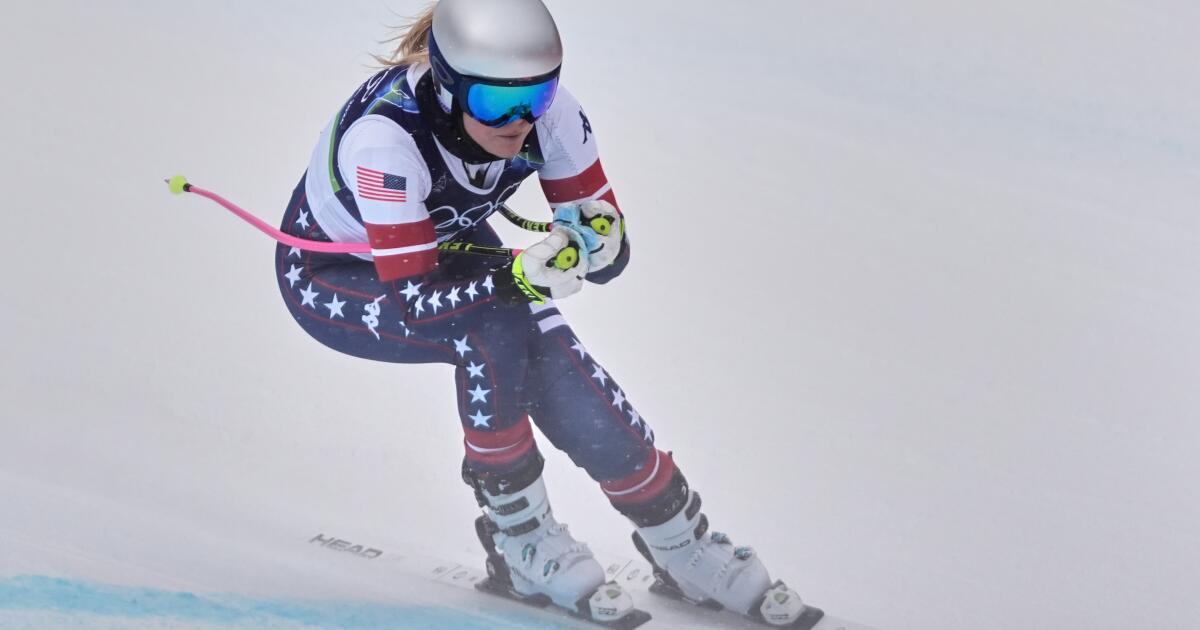
Despite completing multiple test runs, Vonn’s Feb. 8 downhill race lasted 13 seconds before she crashed. She was airlifted from the Olimpia delle Tofane course in Cortina d’Ampezzo, Italy.
In addition to the previously reported complex tibia fracture, Vonn said Monday that she also fractured her fibular head and tibia plateau on her left leg during the crash.
“Just kind of everything was in pieces,” said Vonn, who added that she also broke her right ankle during the accident.
Vonn said that all the trauma in her left leg caused a condition called compartment syndrome, which involves excessive pressure building up inside a muscle, either from bleeding or swelling, and can restrict blood flow and possibly lead to permanent injury.
“When you have so much trauma to one area of your body that there’s too much blood and it gets stuck, and it basically crushes everything in the compartment so all the muscle and nerves and tendons, it all kind of dies,” Vonn said.
“And Dr. Tom Hackett saved my leg. He saved my leg from being amputated. He did what’s called a fasciotomy, where he cut open, like both sides of my leg, and kind of filleted open, so to speak, let it breathe. And he saved me.”
At one point since the crash, Vonn said, she received a blood transfusion to raise her hemoglobin levels.
“I can’t tell you how painful it’s been,” she said.
Vonn still has a long road to recovery. She said she’s “very much immobile,” confined to a wheelchair for the time being and then on crutches for at least two months.
“It will take around a year for all of the bones to heal and then I will decide if I want to take out all the metal or not,” Vonn wrote in the Instagram post, “and then go back into surgery and finally fix my ACL.”
She added in the video: “We have to take the punches as they come, so I’ll do the best I can with this one. It really knocked me down, but I’m like Rocky. I’ll just keep getting back up.”
What was going on in the mind of the legendary 41-year-old ski racer, whose violent crash resulted in her being airlifted off the course and in surgery hours later Sunday with, at minimum, a fractured left leg?
Was it a calculated risk or stubborn foolishness?
“She’s so tough mentally that as long as physically she was OK, she was going to do it,” said Stacey Cook, a retired racer and Vonn’s former teammate on the U.S. Ski Team. “I think the harder part is wrapping your mind around putting yourself at risk again. And that’s never been an issue for her. She’s always been willing to, like, put it on the line… She was always the, like, extra fearless one.”
American Lindsey Vonn completed an alpine ski downhill training session in Cortina d’Ampezzo, Italy, without incident on Friday, two days before she crashed.
(Marco Trovati / Associated Press)
What’s more, Cook said, consider what was at stake.
“It isn’t common in everyday life to go another week with an ACL injury, putting yourself at risk,” Cook said. “It’s always common to take care of it right away. But there’s more on the line for the Olympics than that.”
Dr. Neal ElAttrache, who lives in Los Angeles and is a preeminent sports surgeon, doesn’t count Vonn among his current patients but he has scoped her knee twice to remove scar tissue. He’s also in contact with members of her medical team, as he trained Dr. Tom Hackett, a renowned orthopedic surgeon at the Steadman Clinic in Vail, Colo., who works with Vonn to manage her knee health.
“These aren’t amateur people who were helping her make this decision,” said ElAttrache, who specializes in sports medicine at Kerlan-Jobe Orthopaedic Clinic and is renowned for his treatment and research of knee, shoulder and elbow injuries.
ElAttrache said the typical risk-reward calculation was not in play.
“Everybody knew going into it that there was only one way that this was going to come out good, and that’s if she not only made it through the race, but performed well,” he said. “If she didn’t ski a Lindsey Vonn race and was at least competitive at the top of the leaderboard, it would be considered a failure. There wasn’t a lot of upside, except for Lindsey.”
This combination of images shows American Lindsey Vonn crashing during an alpine ski women’s downhill race at the Winter Olympics in Cortina d’Ampezzo, Italy, on Sunday.
(Jacquelyn Martin / Associated Press)
Vonn’s crash came near the top of the Olimpia delle Tofane course where she had won 12 World Cup races during her storied career, six in downhill and six in super-G. She was on the podium there a total of 20 times before these Olympics.
Cook said the first turn on the course, which Vonn was traversing when she got into trouble, is actually much steeper falling away from the skier than it looks on TV.
“It’s like dipping into a double-black-diamond and trying to come back out of it for a second,” Cook said. “What the racer sees in that section is way different than how it looks on TV. The way it feels is a lot different.”
The racer is traversing the hill perpendicular to the fall line, almost moving in an upward direction.
“It’s a very tough turn,” Cook said. “And the next gate, you can’t see it until you’re pretty much on top of it. You might as well put on a blindfold because you can’t see anything in front of you.”
She said you have to be there to truly understand the difficulty of negotiating the turn.
American Lindsey Vonn crashes during the alpine downhill during the Winter Olympics in Cortina d’Ampezzo, Italy, on Sunday.
(Handout / Getty Images)
“To the average fan, you would stand on top of it and just go, ‘Um, no. Not doing that.’ ”
ElAttrache has studied video of the crash and said there’s no obvious indication the knee in question caused Vonn to fall.
“It’s unclear that her fall was due to an instability event in her knee … and when you look at it, you don’t see that she was weight-bearing on that knee and that she had an instability event that led to the fall,” he said.
An executive from the International Ski and Snowboard Federation told reporters Monday that Vonn was simply “incredibly unlucky” in the crash.
“It was a one in a 1,000,” said Johan Eliasch, FIS president. “She got too close to the gate, and she got stuck when she was in the air in the gate and started rotating. No one can recover from that, unless you do a 360. … This is something which is part of ski racing. It’s a dangerous sport.”
Vonn had a chance to compete on one of her favorite courses and cap her career with a meaningful Olympic moment.
“This was not about proving anything to anyone,” said Dr. Armando Gonzalez, Vonn’s mental coach, in an interview with the Los Angeles Times two days before the fateful race. “It was more about defying the odds that were placed against her and being a competitor that always found a way, no matter what, no matter if it was pain, no matter if it was noise from the outside, she’d always find a way.”
ElAttrache made a comparison between Vonn and star NFL receiver Odell Beckham Jr., who was playing on a compromised ACL when the Rams won the Super Bowl in the 2021 season. Beckham understood the risks, but was somewhat at an advantage as a receiver because he knew the routes he would be running, as opposed to being a defensive back who has to react abruptly to what the player he’s covering is doing.
Often, ElAttrache said, an ultra-elite athlete will apply a different calculus when deciding whether to play with an injury such as a compromised ACL.
He said Vonn, having endured multiple injuries and surgeries to both knees, understood the risks to her own body the way few athletes do. And whereas most skiers would be hamstrung by a fear of injury that could endanger their career, Vonn is an established icon willing to accept risks others might not. In short, it might not make sense to many, but it made sense to the battle-tested Vonn, who has “earned the right” to make those types of decisions.
What’s more, she had performed well on the same course the day before.
“If you have somebody like her, who’s earned the right to try it, if that’s what she really wants to do, she was going into that race as one of the best skiers on the U.S. team,” ElAttrache said. “She was driving that ship.”
MILAN — One short week after Lindsey Vonn crashed in Crans-Montana, Switzerland, and tore her left anterior cruciate ligament, she was tearing down the hill in Cortina d’Ampezzo, Italy, a light knee brace warping the fabric of her racing suit the only obvious sign of anything amiss. When she finished the training run Friday, clocking the third-fastest time for a U.S. woman on the day, she casually fist bumped an American teammate at the finish line.
She made the feat look effortless. Sports medicine experts can say it’s anything but.
“It’s atypical to be able to compete without an ACL, at anything, but especially at a high level like Lindsey Vonn’s going to compete at,” said Clint Soppe, a board certified orthopedic surgeon and sports medicine specialist at Cedars-Sinai. “So this is very surprising news to me as well.”
The ACL, which connects the shin bone to the femur, is a main stabilizing force in the knee and protects the lower leg from sliding forward. Straight-line movement doesn’t stress the major knee ligament and some day-to-day tasks such as walking are easily accomplished without an ACL. But what Vonn is doing is far from normal.
“If you add cutting, pivoting, changing directions, in 95% of humans, you need an ACL to do that,” said Kevin Farmer, an orthopedic surgeon and professor at the University of Florida’s department of orthopedics and sports medicine. “She’s obviously fallen into that 5%.”
Farmer calls the rare group “copers.” They overcome the lack of an ACL by strengthening and engaging other muscles. It’s primarily the hamstrings and quadriceps, but everything, including the glutes, calves, hips and core, counts.
Vonn will have had just nine days between the Olympic downhill race and her injury when she stands at the start gate Sunday. But the 41-year-old has had her whole career to develop the type of strength and control necessary to carry her through the Games without an ACL. She’s already done it before.
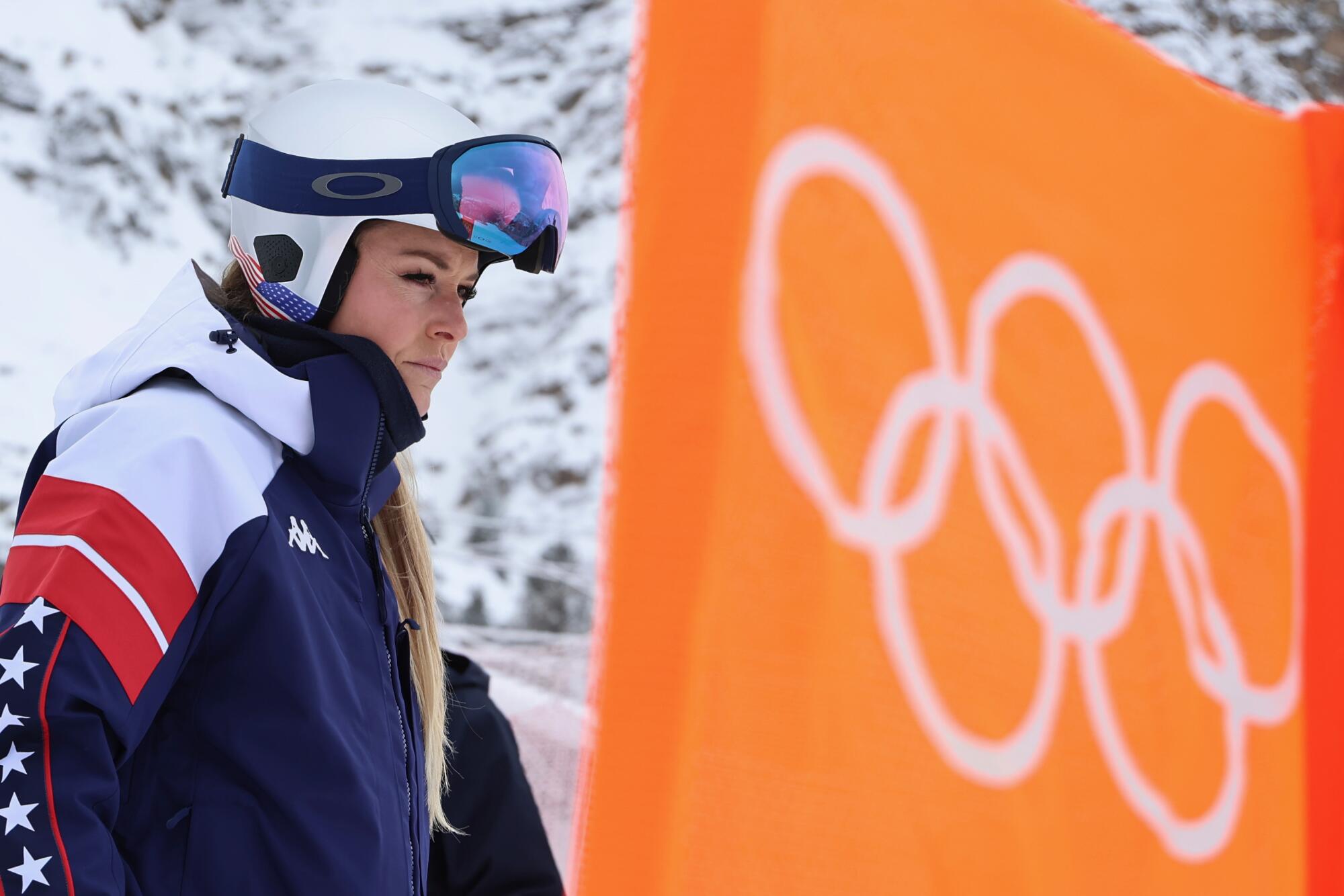
Lindsey Vonn concentrates ahead of a downhill training run in Cortina d’Ampezzo on Friday.
(Marco Trovati / Associated Press)
Vonn skied on a torn right ACL for more than a month until withdrawing just before the 2014 Sochi Olympics. In 2019, she won a bronze medal at world championships without a lateral collateral ligament and three tibial fractures in her left knee. She said this week that the same knee feels better than it did during that bronze medal run.
“She’s dealt with knee injuries in this knee before, so she’s been able to develop mechanisms and strategies,” Farmer said. “She probably doesn’t even realize that, but just from years of practicing with a knee that’s not normal, her body has developed mechanisms of firing patterns that allow her knee to have some inherent stability that most people don’t have.”
For athletes who suffer major injuries for the first time, pain often prevents them from firing their muscles, said Jason Zaremski, a nonoperative musculoskeletal and sports medicine physician and clinical professor at the University of Florida’s department of physical medicine and rehabilitation. But Vonn, whose injury history is almost as long as her resume, looked calm during training, her coach Aksel Lund Svindal told reporters in Cortina on Saturday.
So even if she’s one ACL short, Vonn’s team knows she has more than enough of the intangibles to get her not only down the mountain, but into medal contention.
“Her mental strength,” Svindal told reporters in Cortina on Saturday. “I think that’s why she has won as much as she has.”
Vonn completed her second training run Saturday with the third-fastest time before training was suspended after 21 athletes. She was 0.37 second behind compatriot Breezy Johnson, who is intimately familiar with what Vonn is attempting.
Johnson, a medal contender for the United States who led the second training run at 1 minute and 37.91 seconds, attempted to ski in Cortina without an ACL in 2022. She had one successful training run, but crashed on the second one, sustaining further injuries that forced her to withdraw from the Beijing Olympics.
Johnson, like many, gasped when she saw Vonn’s knee buckle slightly on a jump during training Saturday. She said coming off jumps on this course are especially difficult.
“There are, I think, more athletes that ski without ACLs and with knee damage than maybe talk about it,” Johnson said at a news conference from Cortina. “… I think that people often are unwilling to talk about it because of judgment from the media and the outside.”
Critics say Vonn is taking a spot from a healthy teammate or that she simply refuses to give up the sport for good. But Vonn has already come to terms with the end of her career. She said she came out of retirement with a partially replaced right knee simply wanting an opportunity to put the perfect bow on her ski racing career at a course she especially loves.
The stage is different, but the sentiment is familiar to Zaremski. The doctor has worked with high school athletes who beg for a chance to play a final game after suffering a torn ACL. Through bracing, taping and treatment, sometimes there are temporary fixes for the biggest moments.
“If we’re trying to get a huge event like the Olympics, I would never put anything past [Vonn],” Zaremski said. “She’s an amazing, once-in-a-generation athlete.”
MILAN — A partial knee replacement in her right leg wasn’t enough to stop Lindsey Vonn from pursuing her Olympic comeback. Neither will a recent left torn anterior cruciate ligament.
Vonn revealed Tuesday she suffered a completely ruptured ACL in a crash last week but remains focused on racing in the Milan-Cortina Olympics.
“If my knee is not stable, I can’t compete and at the moment, it is stable and it is strong,” Vonn said during a virtual news conference from Cortina d’Ampezzo. “… So far so good but we have to take it day by day. But if it remains the way it is now, I think I’m pretty solid.”
The 41-year-old Vonn said she skied Tuesday to test her knee. She is not in any pain and the swelling has gone down, but with bone bruising and additional meniscus damage, she still has to tackle full-speed downhill training runs beginning on Thursday before the downhill competition starts Sunday.
Vonn, who also has hopes to race in the super-G and the team event, said her “intention is to race everything.”
“I am not letting this slip through my fingers,” she said. “I’m going to do it, end of story. I’m not letting myself go down that path. I’m not crying. My head is high, I’m standing tall and I’m going to do my best, whatever the result is.”
Vonn is no stranger to knee injuries. She retired from the sport in 2019 and underwent a partial knee replacement in April 2024. Since announcing her comeback in November 2024, Vonn has already defied expectations by becoming the oldest skier to win a World Cup race when she won at St. Moritz, Switzerland, in December and by making the Olympic team seven years after her retirement.
“I think if anyone can do it, it’s Lindsey,” U.S. teammate Bella Wright said of competing with a torn ACL. “I think we all know how strong of a skier she is, but I think that her mental game is what makes Lindsey Lindsey.”
Vonn was racing at a World Cup event Jan. 30 at Crans-Montana, Switzerland, when she lost control while attempting to land a jump. She slid into the safety netting and was later airlifted to a hospital. While a torn ACL typically sends athletes straight to the operating room, Vonn said surgery was not a discussion.
“The Olympics are the only thing that I’m thinking about,” Vonn said.
Despite the crash occurring so close to the Games, Vonn said her knee feels better now than when she has battled other injuries, including in 2019 when she competed at the world championships without a lateral collateral ligament and three tibial plateau fractures. She still won the bronze medal.
“I know what my chances [at the Olympics] were before the crash, and I know my chances aren’t the same as it stands today,” Vonn said, “but I know there’s still a chance and as long as there’s a chance, I will try.”