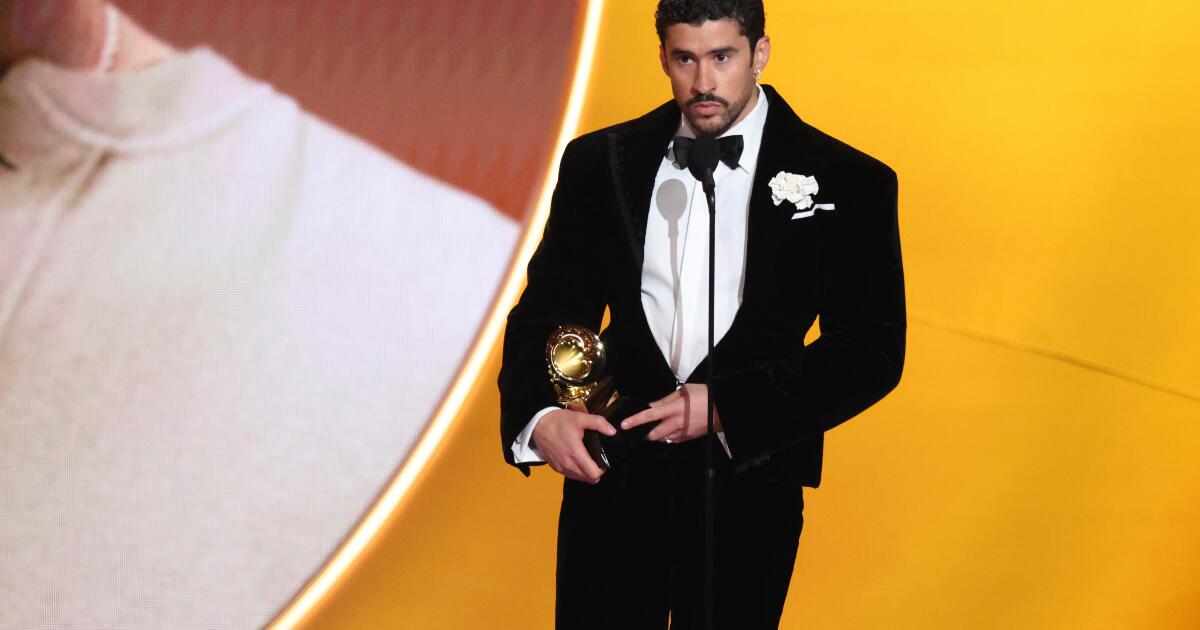
68th grammy awards

Why Bad Bunny’ Super Bowl halftime performance matters to Latinos

A few months back, a discussion broke out in the De Los chat about whether or not Bad Bunny would win album of the year at the 68th Grammy Awards for his LP “Debí Tirar Más Fotos.”

I was firmly in the “yes” camp from the day the nominations were announced and I was right!

But if I’m being honest, I had my doubts that it would happen until the second that presenter Harry Styles called out the Puerto Rican singer’s name Sunday night.

Those in the “no” camp — who were still rooting for him to win — had history in their favor. It’s so rare for any major awards show, but especially the Grammys, to recognize artists at the peak of their powers. It’s almost as if these voting bodies feel that some (usually Black) artists must go through a weird humiliation ritual before being deemed worthy.

You’re reading Latinx Files

Fidel Martinez delves into the latest stories that capture the multitudes within the American Latinx community.

By continuing, you agree to our Terms of Service and our Privacy Policy.

In 2015, Beyoncé’s self-titled LP lost album of the year in favor of Beck’s “Morning Phase.” She was overlooked again when Adele won album of the year for “25” over her seminal album “Lemonade” at the 59th Grammy Awards. Her club classic “Renaissance” also missed out on the top prize in 2023, with Styles’ “Harry’s House” taking home the award.

Rapper Macklemore won the rap album Grammy over Kendrick Lamar’s “good kid, m.A.A.d. City” at the 56th iteration of the award ceremony. At the 2016 Grammys, Lamar’s deeply layered LP “To Pimp a Butterfly” lost album of the year to Taylor Swift’s “1989.” Mumford & Sons’ “Babel” won album of the year in 2013 over Frank Ocean’s “Channel Orange.”

The anti-Blackness in the Recording Academy — the voting body that chooses Grammy winners — cannot be understated.

But in a rare move the voters, which included the Latin Grammy Awards’ voting body for the first time this year, chose the album that actually reflected the cultural zeitgeist.

Really it was less so that I believed Bad Bunny would win as much as I felt that he needed to win.

The past year has been exceedingly trying for the Latinx community as Immigration and Customs Enforcement raids have been conducted throughout the country. It has oftentimes felt as though being Latinx — looking a certain way, speaking Spanish, having certain names — is a crime. I don’t know how many times I’ve seen videos of or heard heartbreaking stories of Latinx people being separated from their families, harassed or even killed due to activities of federal agents.

So even if it was just a moment of recognition for Bad Bunny, I had a lot riding on one win for Latinx people. A win for an album that is unapologetically in Spanish, explored ideas of resistance toward colonization and dared to be joyful, would mean something to me.

When he won, I had the same reaction as him. I couldn’t believe it and I cried — genuine tears in my Latina eyes.

It felt like an acknowledgment that Latinx people exist and matter. I was also moved when he explicitly shouted out immigrant and Latinx communities. There was just something that felt radical, too, in him giving the majority of his acceptance speech in Spanish.

De Los writer Andrea Flores also had faith in Bad Bunny’s Grammys viability from the very beginning.

“I knew Bad Bunny was going to win big at the Grammy Awards the moment he released this album,” she told me. “Bad Bunny made music for Puerto Rico, and the world listened.”

“I cried when I saw that Bad Bunny won album of the year. For me, it felt like sweet vindication for Latinx artists — reggaetoneros, more specifically — who have long been ignored, and at times vilified, by mainstream media for so many years. But what made me even more emotional was seeing posts on X showing Bad Bunny in 2016 as a bag boy at a local Puerto Rican supermarket. He looks familiar in that picture, like a cousin, brother or childhood friend. That was only 10 years ago. It’s proof to me that so much can change if you believe in your art and in yourself.”

It’s weird that a Latinx artist from an American colony is the most powerful cultural figure in the country at the same time that Latinx people face the most tenuous situation in the U.S. that I’ve seen in my life.

When Bad Bunny takes the stage for the Super Bowl halftime show on Sunday, I wish he’d get up there and call out ICE again on an even-bigger stage or do some kind of spectacular act of protest against the vile political class that has always and continues to push through discriminatory policies against non-white communities.

It’d be awesome if that happens, but even if it doesn’t, there will still be something profoundly radical about him simply being there and performing exclusively in Spanish.

Two red roses coming out of a blue manilla folder

(Jackie Rivera / For The Times; Martina Ibáñez-Baldor / Los Angeles Times)

The latest on Trump’s immigration enforcement

People protest against ICE as they march toward South Texas Family Residential Center on January 28, 2026 in Dilley, Texas.

(Joel Angel Juarez / Getty Images)

After killing two U.S. citizens, forcibly extracting immigrants and using force against protestors, some 700 federal agents are being pulled out of Minnesota. About 2,000 officers will remain in the state, White House border czar Tom Homan said early this week.

On Tuesday, immigration officers in Minneapolis pulled their guns on and arrested protestors who were trailing their vehicles, the AP reported.

Meanwhile, my colleague Gavin J. Quinton reported that the Senate isn’t “anywhere close” to reaching an agreement on ICE funding, as Democrats demand “nonnegotiable” ICE reforms.

In some good news, Liam Conejo Ramos — the 5-year-old from Minnesota who was famously photographed wearing a bunny hat and Spider-Man backpack while detained by ICE agents — and his father, Adrian Conejo Arias, were released from a detention facility in Dilley, Texas and are back home in Minnesota.

The duo was released thanks to a ruling from the U.S. District Judge Fred Biery.

“[T]he case has its genesis in the ill-conceived and incompetently-implemented government pursuit of daily deportation quotas, apparently even if it requires traumatizing children,” the judge wrote in his ruling.

Stories we read this week that we think you should read

Unless otherwise noted, stories below were published by the Los Angeles Times.
Politics and Immigration

Arts, culture and entertainment

Latin America

Source link

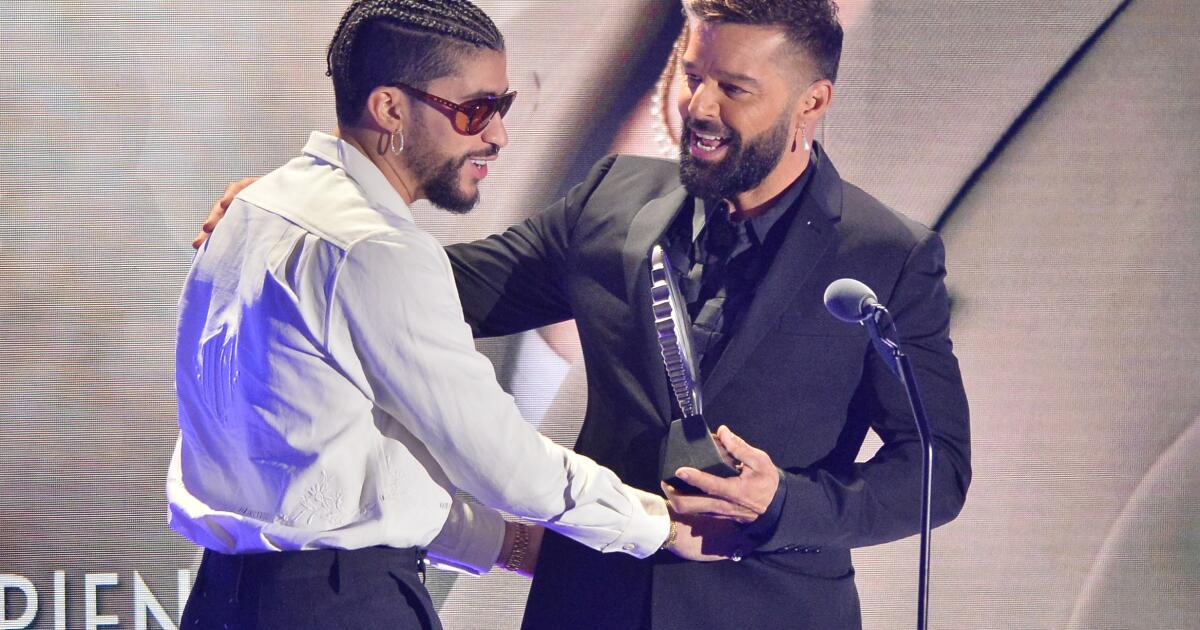
Ricky Martin pens tribute to Bad Bunny after his historic Grammy win

Following Bad Bunny’s landmark album of the year win at the 68th Grammy Awards for “Debí Tirar Más Fotos,” Ricky Martin penned a letter of appreciation to commemorate the moment.

In an opinion piece for the Puerto Rican newspaper El Nuevo Día published Tuesday, the Boricua hitmaker said Bad Bunny’s accomplishment stirred deep feelings within him.

“Benito, brother, seeing you win three Grammy Awards, one of them for album of the year, with a production entirely in Spanish, touched me deeply,” Martin wrote. “Not only as an artist, but as a Puerto Rican who has walked stages around the world carrying his language, his accent and his history.”

In addition to becoming the first all-Spanish album of the year winner, the “Nuevayol” artist took home the Grammy Awards for música urbana album and global music performance for the track “EoO” on Sunday.

Martin further called Bad Bunny’s achievement a “human” and “cultural” win, lauding him for not bending to the will of anyone who tried to change his sound in any way.

“You won without changing the color of your voice. You won without erasing your roots. You won by staying true to Puerto Rico,” Martin wrote. “You stayed true to your language, your rhythms and your authentic narrative.”

Martin, who first broke out as a solo musical act in the mid-’90s, became an international superstar off the back of his Spanish-language hits including 1995’s “María,” 1998’s “Vuelve” and “Perdido Sin Ti.”

He reached a new strata of stardom after his track “La Copa de Vida” was used as the official anthem for the 1998 FIFA World Cup. That song charted in over 60 countries and was translated into English. He landed his biggest hit with “Livin’ La Vida Loca,” which was the lead single from his 1999 self-titled English album.

When accepting his album of the year award Sunday night, Bad Bunny addressed the crowd predominantly in Spanish and spoke of the strugglesof the immigrant experience.

“I want to dedicate this award to all the people who had to leave their homeland, their country, to follow their dreams,” he said in English.

“Puerto Rico, believe me when I say that we are so much bigger than 100 by 35 and there is nothing that exists that we can’t accomplish,” the “Dakiti” artist said in Spanish. “Thank God, thank you to the academy, thank you to all the people who have believed in me throughout my whole career. To all the people who worked on this album. Thank you, Mami, for giving birth to me in Puerto Rico. I love you.”

The 54-year-old singer also showed love to Bad Bunny for using his platform to show solidarity for vulnerable communities.

“What touched me most about seeing you on the Grammys stage was the audience’s silence when you spoke,” Martin wrote. “When you defended the immigrant community, when you called out a system that persecutes and separates, you spoke from a place I know very well where fear and hope coexist, where millions live between languages, borders and deferred dreams.”

Martin concluded his letter by thanking Bad Bunny for reminding him and showing other Puerto Ricans that there is power in being true and authentic to yourself.

“This achievement is for a generation to whom you taught that their identity is non-negotiable and that success is not at odds with authenticity,” Martin wrote.

“This was for Puerto Ricans, for all our Latino brothers and sisters who dream in Spanish, for those crossing seas and borders wearing their cultures like a flag. From the heart, from one Boricua to another, with respect and love, I thank you for reminding us that when one of ours succeeds, we all succeed.”

Source link

Bad Bunny wins Grammy for album of the year

Bad Bunny’s “Débi Tirar Más Fotos” was named album of the year at Sunday night’s 68th Grammy Awards — the first time a Spanish-language LP has won the Recording Academy’s most prestigious prize.

Bunny delivered the speech primarily in Spanish.

“I want to dedicate this award to all the people who had to leave their homeland, their country, to follow their dreams,” he said as the audience rose to its feet.

“Puerto Rico, believe me when I say that we are so much bigger than 100 by 35 and there is nothing that exists that we can’t accomplish,” he said in Spanish. “Thank God, thank you to the academy, thank you to all the people who have believed in me throughout my whole career. To all the people who worked on this album. Thank you, mami, for giving birth to me in Puerto Rico. I love you.”

“For all the people who have lost a loved one and even then have had to continue moving forward and continue with so much strength, this award is for you all.”

Intricately arranged with the sounds of the singer and rapper’s native Puerto Rico, “Débi Tirar Más Fotos” was released to rave reviews in January 2025 and quickly reached No. 1 on the Billboard 200 album chart. Last summer, Bad Bunny supported the project with a 30-date concert residency at San Juan’s José Miguel Agrelot Coliseum; he followed that with the announcement of a world tour that avoided the United States, in part, he told I-D magazine, because of his concern that immigration agents might turn up at shows.

Prior to Sunday’s win, “Débi Tirar Más Fotos” — the title translates in English to “I Should Have Taken More Photos” — was named album of the year at November’s Latin Grammy Awards. Next weekend, Bad Bunny (whose real name is Benito Antonio Martínez Ocasio) will headline the halftime show at Super Bowl LX in Santa Clara.

He won earlier in the night for música urbana album and global music performance.

The other LPs nominated for album of the year were Justin Bieber’s “Swag,” Sabrina Carpenter’s “Man’s Best Friend,” Clipse’s “Let God Sort Em Out,” Lady Gaga’s “Mayhem,” Kendrick Lamar’s “GNX,” Leon Thomas’ “Mutt” and Tyler, the Creator’s “Chromakopia.”

In 2025, Beyoncé took the prize with “Cowboy Carter.”

Source link