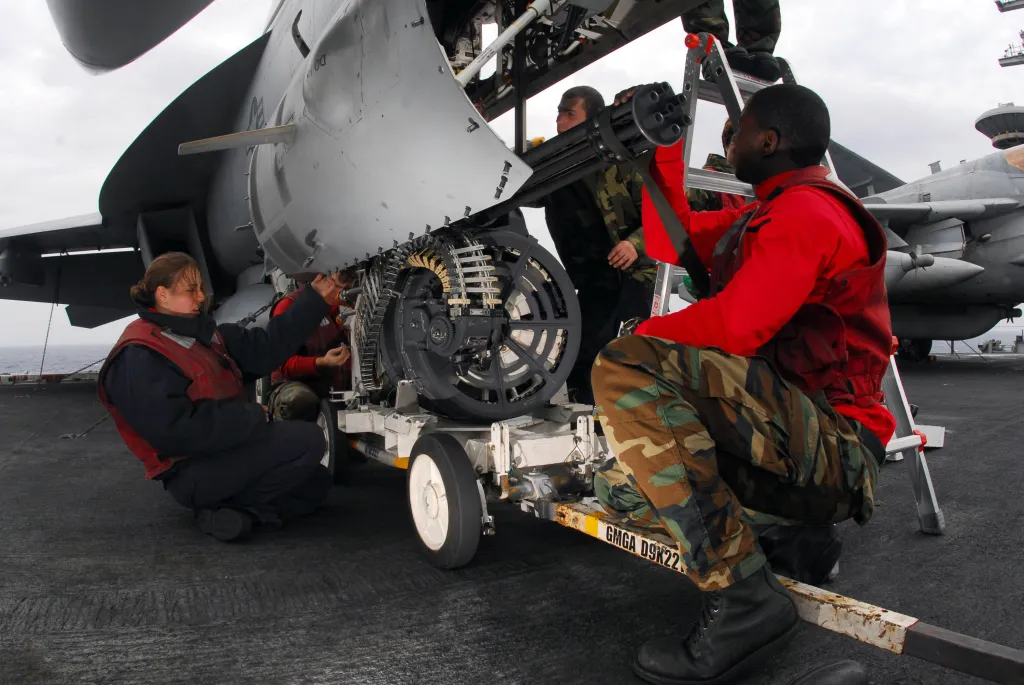
F/A-18 Super Hornet Blasts Blockade-Running Iranian Ship’s Rudder With 20mm Cannon (Updated)
U.S. forces operating in the Gulf of Oman disabled an Iranian-flagged ship trying to run the ongoing blockade of Iranian ports by blasting its rudder with several rounds from the 20mm cannon of an F/A-18 Super Hornet , U.S. Central Command stated on X. The jet was launched from aircraft carrier USS Abraham Lincoln.
The incident occurred at 9 a.m. EDT, according to the command. It came as a new peace initiative between the U.S. and Iran is being floated and a day after President Trump paused the short-lived Project Freedom operation to protect commercial shipping trying to escape the Persian Gulf through the Strait of Hormuz.
CENTCOM forces “observed M/T Hasna as it transited international waters enroute to an Iranian port on the Gulf of Oman,” the command added. “American forces issued multiple warnings and informed the Iranian-flagged vessel it was in violation of the U.S. blockade.”
When it ignored the warnings, the Super Hornet opened fire. After being fired upon, the ship is no longer traveling to Iran, CENTCOM explained.

“The U.S. blockade against ships attempting to enter or depart Iranian ports remains in full effect,” the command continued. “CENTCOM forces continue to act deliberately and professionally to ensure compliance.”

The Hasna incident is the second known time the U.S. has fired on an Iranian-linked large commercial ship running the blockade. The Arleigh Burke class guided missile destroyer USS Spruance struck the Iranian cargo ship Touska on April 19th with its 5-inch MK 45 gun. The destroyer fired nine inert rounds into the cargo ship’s engine room after the vessel failed to comply with warnings while transiting the north Arabian Sea, Joint Chiefs Chairman Gen. Dan Caine said last month. The Super Hornet used its own method to disable but not sink the ship via taking out its rudder control.
You can see him explain the incident in the following video.
Meanwhile, a French-owned ship is “currently drifting without power” after being “struck by an Iranian drone” yesterday, a maritime security official told TWZ.
The container vessel, CMA CGM San Antonio, was damaged and eight people were injured in the attack, the U.N.’s International Maritime Organization (IMO) told us. The attack was reported about two hours before Trump paused Project Freedom, pending further negotiations with Iran.
A U.S. military official told us that it is “aware of the reports” about the attack on the San Antonio, but had no further details about how it happened.
“The transit in question was not coordinated” through Project Freedom, said the official, adding that the crew did not seek U.S. assistance.
Since the war began on Feb. 28, UKMTO “has received 46 reports of incidents affecting vessels operating in and around the Arabian Gulf, Strait of Hormuz (SOH), and Gulf of Oman,” the organization states. There were 26 reported ship attacks, including the San Antonio, 18 suspicious activity reports and two ships hijacked.

Vessel Attacked In Strait Of Hormuz As US Pauses Operation To Guide Ships | US Iran Update
In the wake of Trump’s decision to pause Project Freedom, the IMO and shipping companies say the short-lived effort did not changed the level of danger for ships trapped in the Persian Gulf.
“The situation remains the same,” IMO told us Wednesday morning. “IMO has been consistent in its messaging that the Strait of Hormuz is not safe at present for ships to transit, and ships should exercise maximum caution. Things have not materially changed over the past few weeks.”
“Our risk assessment goes on continuously and it is still valid, that the Strait of Hormuz remains closed for Hapag-Lloyd transits until further notice,” a spokesperson for the German shipping giant told us
“We don’t have a comment specifically addressing the decision to pause,” a spokesperson for Maersk told us. ”We are following the guidance of our security partners in the region, and it is currently recommended to avoid transiting the strait.”
A U.S. official declined comment on how the pause is affecting CENTCOM operations. However, “U.S. forces are currently focused on enforcing the U.S. naval blockade against Iran,” the official told us.
As we reported yesterday, Trump paused Project Freedom after little more than a day, pending negotiations with Iran.
The move came after Iran fired on U.S. warships and commercial vessels being protected under Project Freedom. Trump said he made that decision at the behest of Pakistan, which has been mediating peace talks. The president claimed the goal was to give Iran time to respond to U.S. proposals.
Given the circumstances, it seems probable that tactical considerations also drove this decision.
UPDATE: 6:57 PM EDT –
NBC News is reporting that Trump’s abrupt pause on Project Freedom “came after a key Gulf ally suspended the U.S. military’s ability to use its bases and airspace to carry out the operation. The network cited two U.S. officials.
“Trump surprised Gulf allies by announcing ‘Project Freedom’ on social media Sunday afternoon, the officials said, angering leadership in Saudi Arabia,” NBC added. “In response, the Kingdom informed the U.S. it would not allow the U.S. military to fly aircraft from Prince Sultan Airbase southeast of Riyadh or fly through Saudi airspace to support the effort, the officials said.”
A call between Trump and Saudi Crown Prince Mohammed bin Salman “did not resolve the issue, the two U.S. officials said, forcing the president to pause Project Freedom in order to restore U.S. military access to the critical airspace,” NBC continued.
Other close Gulf allies were also caught off guard, the outlet noted, pointing out that “the president spoke with leaders in Qatar after the effort had already begun.”
UPDATE: 5:56 PM EDT –
Israel carried out its first strike in Beirut since before the ceasefire in Lebanon entered into effect on April 16, the Times of Israel reported. Prime Minister Benjamin Netanyahu and Defense Minister Israel Katz said it targeted the commander of Hezbollah’s elite Radwan Force.
Netanyahu and Katz say Radwan Force operatives “were responsible for firing [rockets] at Israeli communities and harming IDF soldiers.”
UPDATE: 5:41 PM EDT –
As we have previously reported, Trump is mulling over sending a ground force into Iran to capture its highly enriched uranium. Now, Spencer Faragasso, a senior fellow Institute for Science and International Security, says new satellite imagery shows Iran is preparing for such an event.
“We just observed new developments at the Pickaxe Mountain complex, just south of the Natanz Nuclear Complex,” he stated on X. “The two eastern tunnel portals have been partially blocked with dirt/rock material that would prevent ground vehicle access from entering those tunnel portals. This is not the result of a landslide, but a deliberate effort to prevent ground vehicle access into the portals. Dirt could have been easily taken from the nearby large spoil piles. No changes to the western tunnel portals can be seen. The Natanz nuclear complex hasn’t seen any new activity either.”
During an afternoon press conference, Trump was about facing “an opponent in Iran that has refused to submit.
“Why do you say they refuse to submit?” the president responded. “You don’t know that.”
“They fired at U.S. ships a few days ago, the reporter retorted.
“A few days ago is a long time ago,” Trump proffered. “They want to make a deal badly.”
Speaking to reporters in China, Araghchi claimed Iran has “attained an elevated international standing” during the war with the US and Israel.”
UPDATE: 5:27 PM EDT –
ran issued a message to commercial vessels in the Strait of Hormuz saying its ports were fully prepared to provide general maritime services and support to those ships, the official Iranian IRNA news agency reported. Reuters’ Phil Stewart noted that the announcement came just hours after CENTCOM said it disabled the Hansa.
UPDATES
With the U.S. and Iran reportedly moving closer to a peace deal, President Trump on Wednesday repeated his contention that U.S. will resume attacks at a more intense level should no deal be reached.
“Assuming Iran agrees to give what has been agreed to, which is, perhaps, a big assumption, the already legendary Epic Fury will be at an end, and the highly effective Blockade will allow the Hormuz Strait to be OPEN TO ALL, including Iran,” Trump proclaimed on Truth Social. “If they don’t agree, the bombing starts, and it will be, sadly, at a much higher level and intensity than it was before.”
There are swirling claims about the state of peace negotiations with Iran, which have been moving ahead despite recent incidents. As we reported yesterday, officials in the UAE and Oman say Iran has attacked their countries with missiles and drones in addition to the Iranian attacks on shipping we mentioned earlier in this story.
Wednesday morning, Axios claimed that the White House “believes it’s getting close to an agreement with Iran on a one-page memorandum of understanding to end the war and set a framework for more detailed nuclear negotiations.”
The U.S. expects Iranian responses on several key points “in the next 48 hours,” the outlet stated, adding that “[n]othing has been agreed yet, but the sources said this was the closest the parties had been to an agreement since the war began.”
The deal would involve Iran committing to a moratorium on nuclear enrichment, the U.S. agreeing to lift its sanctions and release billions in frozen Iranian funds, and both sides lifting restrictions around transit through the Strait of Hormuz.
“Many of the terms laid out in the memo would be contingent on a final agreement being reached, leaving the possibility of renewed war or an extended limbo in which the hot war has stopped but nothing is truly resolved,” Axios noted.
We reached out to the White House for additional information.
Trump expressed optimism about striking a deal with Iran, which could include Iran exporting its highly enriched uranium to the United States, in a phone call Wednesday morning with PBS News.
Trump told the network he feels the U.S. is closing in on a deal, “but I felt that way before with them, so we’ll see what happens.”
He added that sending special envoys Steve Witkoff and Jared Kushner, his son-in-law, to talks is “unlikely.”
The president suggested it’s possible a deal could be struck to end the war before his trip to China next week.
“I think it’s got a very good chance of ending, and if it doesn’t end, we have to go back to bombing the hell out of them,” Trump told PBS White House correspondent Liz Landers.
In addition to sticking points remaining over Iran’s nuclear program, its closure of the Strait and ballistic missile arsenal, finding officials in Tehran who can respond remains a challenge. As we have noted before, there are fractures in the government between the Islamic Revolutionary Guard Corps (IRGC) and more moderate elements, making it hard for the U.S. to gain a consensus on its offers. Difficulty reaching Ayatollah Mojtaba Khamenei, who is reportedly injured and in hiding, is also slowing down negotiations.
In response to Trump’s latest message, one element of the Iranian government expressed skepticism.
“The concept of ‘negotiations’ requires, at the very least, a genuine attempt to engage in discussions with a view to resolving the dispute,” Iranian Foreign Ministry spokesman Esmaeil Baqaei stated on X. “It needs ‘good faith’, then, meaning that ‘negotiations’ is not ‘disputation’; nor is it ‘dictation’, ‘deception’, ‘extortion’ or ‘coercion.’”
Iran has reportedly not yet responded to the latest U.S. proposal aimed at ending the more than two-month war, Iran’s Tasnim news agency said on Wednesday, citing an unnamed source who added that the draft contained some unacceptable provisions.
Israeli Prime Minister Benjamin Netanyahu said on Wednesday that he was not surprised by the recent developments in the negotiations between the US and Iran and that there is “full coordination” between the US and Israel, according to the Jerusalem Post.
“We are maintaining continuous contact with our friends in the US. I speak with President Trump on an almost daily basis. My people and his people speak daily, including today. And I will speak again with President Trump later tonight,” Netanyahu said.
“We share common goals, and the most important objective is the removal of all enriched material from Iran and the dismantling of Iran’s enrichment capabilities,” he added. “However, we are prepared for any scenario, and this is the directive I have given to the IDF and our security agencies. Israel is stronger than ever; Iran and its proxies are weaker than ever.”
Meanwhile, Iranian Foreign Minister Abbas Araghchi was meeting with his Chinese counterpart in Beijing. As we have previously reported, China relies heavily on Iranian oil and is also suspected of aiding its war efforts.
“I held constructive talks in Beijing with Chinese Foreign Minister Wang Yi,” Araghchi claimed on X. “Both sides reaffirmed Iran’s right to safeguard national sovereignty and national dignity.”
Iran “appreciates the four-point proposal put forward by the Chinese side on upholding and promoting regional peace and stability,” he added. “The Iranian side trusts the Chinese side and expects the Chinese side to continue playing a positive role in promoting peace and stopping war, and supports the establishment of a new post-war regional architecture that can coordinate development and security.”
For its part, the Chinese Foreign Ministry said Beijing “will continue to work for deescalation in the Strait of Hormuz, and keep Chinese vessels and crew members there safe. Hope parties will avoid further escalation, resolve disputes through dialogue and restore peace to the Strait soon.”
Iranian airstrikes “have damaged or destroyed at least 228 structures or pieces of equipment at U.S. military sites across the Middle East since the war began, hitting hangars, barracks,fuel depots, aircraft and key radar, communications and air defense equipment,” according to a Washington Post analysis of satellite imagery. “The amount of destruction is far larger than what has been publicly acknowledged by the U.S. government or previously reported.”
We have previously noted that Iran has destroyed a E-3 Sentry. KC-135 Stratotankers and Black Hawk helicopters on the ground, as well as radar sights across the region, have also been damaged.
A Chinese truck-mounted anti-drone laser system was reportedly spotted at an airport in the UAE, which has been repeatedly attacked by Iran over the course of the war and ensuing ceasefire.
As we have previously reported, a similar system has appeared in Iran.
We cannot independently confirm the location or date of the following video, which appears to have been taken by a passenger on a plane.
The French aircraft carrier Charles de Gaulle entered the Red Sea on Wednesday.
“The reason why we must make a renewed effort today is simply that the blockade of Hormuz continues, the damage to the world’s economy is therefore becoming more and more pronounced, and the risk of a prolongation of hostilities is too serious for us to accept it,” a French presidency official told reporters in a briefing after the army announced the strike group’s deployment.
Meanwhile, the U.S. Navy aircraft carrier USS Gerald R. Ford was spotted transiting west through the Strait of Gibraltar, heading back toward America after taking part in Epic Fury during its record breaking deployment.
The Ford, which set a post-Vietnam-era record for the longest deployment, suffered through a fire and plumbing problems. Its departure leaves two carriers, the USS Abraham Lincoln and USS George H.W. Bush, in the CENTCOM region.
A video emerging online purports to show the remains of a U.S. Air Force MQ-9 Reaper drone reportedly shot down over Iran last night. The video shows what appears to be the fuel tank of the drone peppered with shrapnel.
We cannot independently verify the provenance of the video or when or where it was taken. We have reached out to CENTCOM for more details.
The U.S. has reportedly lost more than two dozen of these drones since the war began.
Contact the author: howard@thewarzone.com