S. Korea targets deployment of nuclear-powered submarines in late 2030s

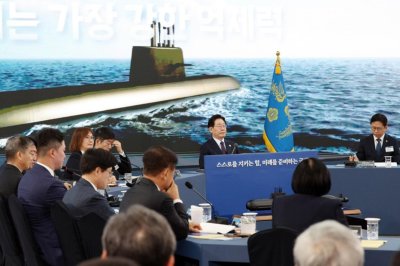
South Korean President Lee Jae Myung (2-R) presides over a defense strategy committee meeting in Changwon, South Gyeongsang Province, South Korea, 26 May 2026. Photo by YONHAP / EPA
May 26 (Asia Today) — The South Korean government said Tuesday it aims to launch its first nuclear-powered submarine by the mid-2030s and deploy the vessel to the Navy in the late 2030s.
The plan was presented during the first meeting of the Future Defense Strategy Committee in Jinhae, South Gyeongsang Province, attended by President Lee Jae-myung.
According to the government, South Korea plans to domestically develop and build the submarines to strengthen the independence and stability of its military procurement, maintenance and operational systems.
The submarines are expected to use low-enriched uranium fuel enriched below 20%, allowing for long operational cycles without frequent refueling.
Defense Minister Ahn Gyu-back briefed Lee on the government’s basic plan for developing nuclear-powered submarines.
The announcement came seven months after Lee said he received support from President Donald Trump during a bilateral summit in October for South Korea’s submarine program.
“Based on the strong South Korea-U.S. alliance, the nuclear-powered submarines we will build symbolize our determination to take responsibility for peace and security on the Korean Peninsula ourselves,” Lee said.
He added that the project would also contribute significantly to strengthening South Korea’s defense industry capabilities.
Lee also emphasized the importance of regaining wartime operational control, known as OPCON, from the United States.
“The recovery of wartime operational control is a core element of self-reliant national defense,” Lee said. “It will serve as an opportunity for South Korea to more clearly establish itself as the main actor in defending the Korean Peninsula.”
He said Seoul and Washington would continue close consultations to finalize a roadmap for the transfer, including the timing of the transition.
Lee also called for integrating advanced science and technology into national defense to build what he described as a “smart military” capable of dominating future warfare.
— Reported by Asia Today; translated by UPI
© Asia Today. Unauthorized reproduction or redistribution prohibited.
Original Korean report: https://www.asiatoday.co.kr/kn/view.php?key=20260527010007660