
A second example of Russia’s Oreshnik intermediate-range ballistic missile (IRBM) has been fired against Ukraine. Moscow claimed the overnight strike was in retaliation for a supposed attempted Ukrainian drone attack on President Vladimir Putin’s residence late last month — an allegation Kyiv and Washington have said is false. Ukrainian authorities described Moscow’s justification for the latest Oreshnik strike, part of a massive overnight missile and drone barrage, as “absurd.”
The Oreshnik (Russian for hazel tree) missile first emerged in public after it was used in what was then an unprecedented attack on Ukraine in November of 2024. The Pentagon states that the Oreshnik is based on the RS-26, a mysterious strategic weapon system, the development of which was supposedly halted in 2018. There was also an unverified report of a failed Oreshnik launch directed at Ukraine in February 2025, but this was subsequently refuted by Ukrainian authorities.
Late last month, the Oreshnik was in the news again, after Belarus announced the deployment of the missile on its territory, which you can read more about here. On this latest occasion, however, it appears that the IRBM was launched from the Kapustin Yar test range in Russia.
Ukraine confirmed the overnight Oreshnik strike, saying it took place in the west of the country, close to the Polish border. Videos posted to social media confirm that the Oreshnik’s target was in the Lviv region; the footage included the telltale signs of glowing reentry vehicles plunging toward the ground.
Unverified social media reports suggested the target may have been a large underground gas storage facility, something that at least one Ukrainian official denied, saying the missile struck a residential area. However, the local governor of the Lviv region confirmed that Russian strikes had damaged a critical infrastructure facility there.
Ukraine’s foreign minister said the use of an Oreshnik missile so close to the EU and NATO border posed a “grave threat” to European security and called on partners to increase pressure on Moscow.
Initial reports suggest that the Oreshnik used in last night’s strike may have carried inert warheads, as was apparently the case with the example fired in November 2024. On that occasion, Ukrainian authorities said that the missile carried six warheads, each containing six more sub-payloads, but that these contained no explosives.

It’s possible the missile was used in an attempt to penetrate the underground storage facility and damage it without the use of a large explosive warhead, instead having the reentry vehicles burrow deep into the ground upon impact at very high-speed.
While the Oreshnik is nuclear-capable, the potential value of a conventionally armed intercontinental ballistic missile (ICBM), which some countries may be looking at fielding if they haven’t already, is something that we discussed in detail in this previous story.
Dmitry Stefanovich, a research fellow at the Russian Center for International Security, IMEMO RAS, noted that the latest Oreshnik strike differed from the first in that it was combined with a large number of other ground- and sea-launched long-range weapons, and said that it was still unclear whether the United States was notified of the attack in advance, via the Nuclear Risk Reduction Center (NRRC), as was the case when it was first employed.
Other nuclear analysts suggest that the United States did receive prior notification. We have approached U.S. authorities for clarification on that point.
As for the claim that the IRBM strike was in retaliation for an attempted drone strike against Putin himself, Stefanovich was less convinced:
“In general, the question remains that if Russia is engaged in the demilitarization of Ukraine and has been conducting a special military operation for many years, why link massive strikes to ‘terrorist attacks’? Of course, it takes time to accumulate weapons and find targets, but such rhetoric does not look very solid.”
Putin has repeatedly invoked the Oreshnik in recent months as a threat against Ukraine and the West, especially since its range — estimated at up to 3,400 miles — is enough to reach every NATO capital city in Europe from within Russian territory.
Putin has made some extravagant claims about the Oreshnik in the past, pointing to its supposed invulnerability to interception.
The Russian leader has described the Oreshnik as “a ballistic missile equipped with non-nuclear hypersonic technology” capable of reaching a peak speed of Mach 10. “The kinetic impact is powerful, like a meteorite falling,” the Russian president has also said.

As we have discussed in the past, Russian claims of hypersonic performance for the Oreshnik are factual, but also a bit misleading in a modern context. There is no evidence of true hypersonic boost-glide vehicles, for example, but larger ballistic missiles, even ones with traditional designs, do reach hypersonic speeds, typically defined as anything above Mach 5, in the terminal stage of their flight.
As for the claimed attempted Ukrainian attack on Putin’s residence, while this is now being used to frame the latest use of the Oreshnik, Ukraine and U.S. national security officials have denied that attempted attack. Furthermore, a CIA assessment also found no evidence of it having happened.
More significant is likely the fact that the latest Oreshnik strike came just days after Ukraine’s European allies agreed on key elements of postwar security guarantees, which would come into play in the event of a ceasefire with Russia. The agreement included a declaration that some of these allies would be ready to deploy troops to Ukraine after a peace deal.
This very significant new commitment regarding troops has been under discussion for months. The Kremlin has repeatedly said it will categorically oppose any NATO soldiers being based on Ukrainian soil.

Overall, the use of a single Oreshnik against Ukraine overnight appears to be more of a symbolic sideshow, engineered to create alarm in the West (as well as in Ukraine), rather than deliver a specific effect on a high-priority target.
After all, the IRBM was just one part of a much larger barrage launched against targets across the country last night. This is said to have involved 242 drones, 13 other ballistic missiles, and 22 cruise missiles, based on Ukrainian Air Force figures.
Russian forces carried out particularly heavy strikes on Kyiv, hitting several districts of the Ukrainian capital.
According to Ukrainian authorities, at least four people were killed in the region, and another 19 were injured. Meanwhile, at least five rescue workers were injured while responding to the attacks, Ukraine’s security service said.
The Kyiv mayor, Vitali Klitschko, said half of the capital’s apartment blocks were left without heating after the Russian strikes.

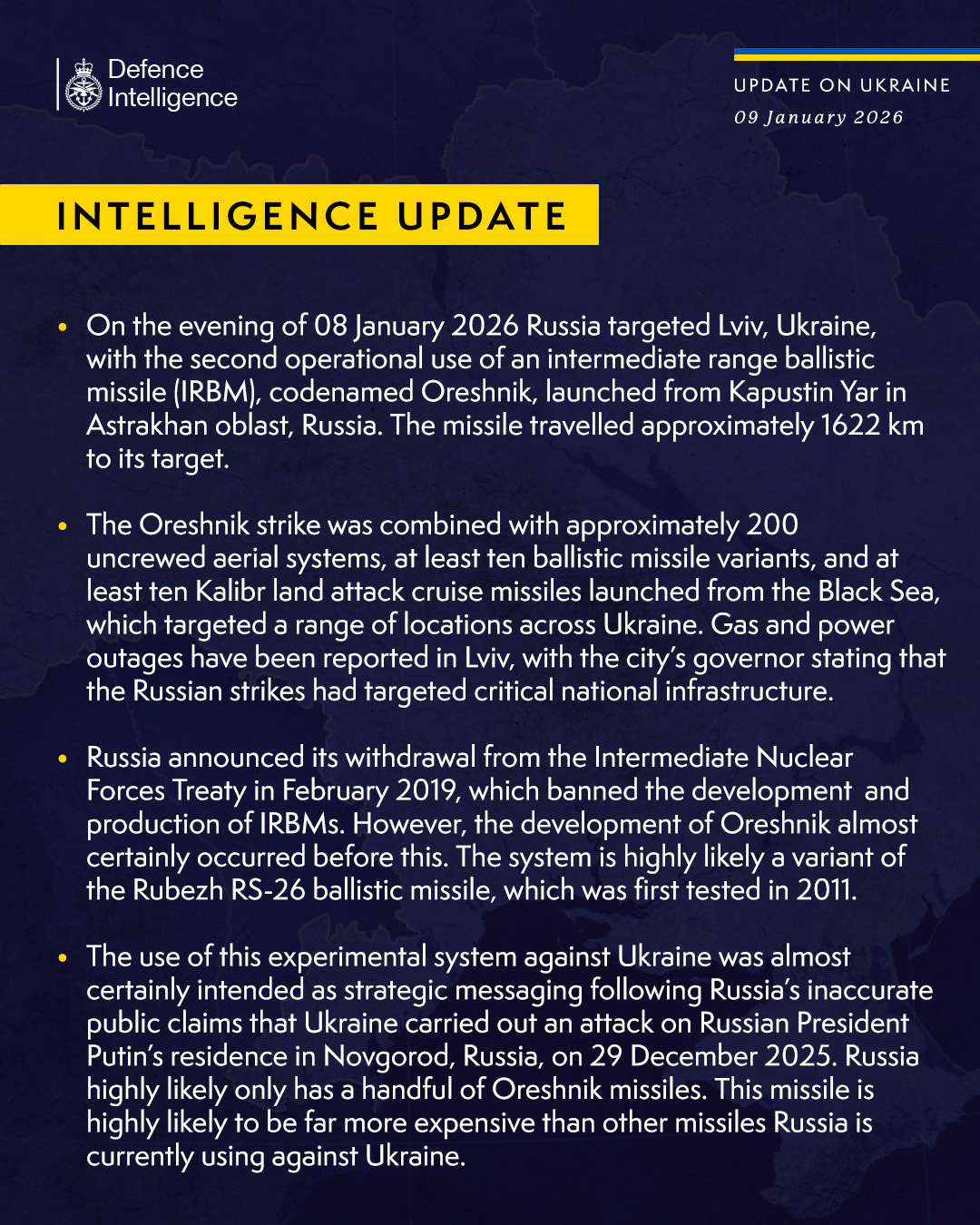
Overall, the use of a single Oreshnik IRBM without warheads and the possibility that nothing of military value was hit, suggests that the missile was primarily used as an instrument of intimidation. It’s also unclear how many of these expensive IRBMs have actually been manufactured at this point, and whether Russia would even be able to fire multiple examples in any kind of sustained campaign. According to an assessment from the U.K. Ministry of Defense, Russia currently has only a handful of Oreshniks.
That said, the Kremlin clearly has reasons enough to lash out at Ukraine and its allies at this point, and has opted for this type of missile-based signaling. At this stage, it remains very much questionable whether it will have the desired coercive effect.
Contact the author: thomas@thewarzone.com