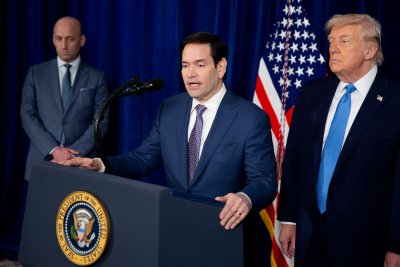
Jan. 4 (UPI) — Secretary of State Marco Rubio said in interviews on Sunday that it is “premature” to discuss elections in Venezuela because higher priorities, including reinvigorating the country’s oil industry, must be addressed first.
In interviews with ABC, CBS and NBC, Rubio said that the United States will continue to strike drug boats and detain oil tankers as the Trump administration moves to stabilize and “run” Venezuela after the apprehension of Venezuelan President Nicolas Maduro on Saturday.
The Trump administration plans to keep its “quarantine” of Venezuelan oil in place as it pressures the remainders of Maduro’s government to end their cooperation with South American drug gangs, as well as stop selling oil to the United States’ adversaries, Rubio said.
“As we move forward here, we’ll set the conditions so that we no longer have in our hemisphere a Venezuela that’s the crossroads for many of our adversaries around the world, including Iran and Hezbollah,” Rubio said on ABC News’ “This Week.”
Rubio added that Venezuela would also no longer be “a narcotrafficking paradise for all those drugs coming out of Colombia … and toward the United States.”
Offshore armada is ‘leverage’
In a press conference on Saturday, Trump told reporters that there was a second strike planned in the case that Venezuelan forces responded to Maduro’s capture or the plan was not successful, but U.S. military commanders decided against launching it.
Trump noted Saturday, and Rubio reiterated on Sunday, that the roughly 15,000 troops offshore of Venezuela spread across more than a dozen warships would remain in the Caribbean.
Their objectives, he told CBS’ “Face The Nation,” are striking drug trafficking boats, apprehending tankers suspected to be carrying sanctioned Venezuelan oil and using the armada, as Trump has referred to it, of U.S. military ships offshore to encourage the remaining members of Maduro’s administration to comply with U.S. demands.
“What’s going to happen here is that we have a quarantine on their oil,” Rubio said. “That the means that their economy will not be able to move forward until the conditions that are in the national interest of the United States and of the Venezuelan people are met.”
“So, that leverage remains,” he added. “That leverage is ongoing. And we expect that it’s going to lead to results here.”
No elections yet
Although the Trump administration “cares about elections, we care about democracy, we care about all of that,” the priority is the U.S.’ goals of stopping the flow of drugs into the United States and U.S. “safety, security, well-being and prosperity,” Rubio told NBC News’ “Meet The Press.”
At this point, he said, considering new elections in Venezuela “is premature at this point” as Trump has tasked Rubio with “running policy” in the South American country.
In the next several months, Rubio said that the main priorities are to end entanglements between the Venezuelan government and drug gangs, as well as to prevent Iran, Russia, China and Cuba, among other nations, from investing in the country and gaining a foothold in the Western Hemisphere.
Maduro and his wife, who are in a jail in New York City awaiting trial, along with four other people in the Venezuelan government who were not arrested in Saturday’s raid, have been indicted for allegedly working with Colombian drug gangs and rebel groups to assist them in trafficking cocaine.
The quarantine on ships transporting Venezuelan oil is linked to Trump’s goal of sending U.S. oil companies to inspect and reinvigorate Venezuela’s ailing oil industry, while keeping the oil in the Americas.
While noting that the United States, which is a net oil exporter, does not need the oil, he questioned why Iran, Russia or China should need Venezuelan oil considering all three are nowhere near South America.
“They’re not even in this continent,” Rubio said. “This is where we live, and we’re not going to allow the Western Hemisphere to be a base of operations for adversaries, competitors and rivals of the United States.”