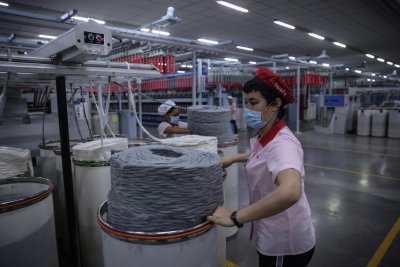

An Ethnic minority worker operates machinery at Aksu Huafu textile limited company in Aksu, western China’s Xinjiang Uyghur Autonomous Region during a government organized trip for foreign journalists, Aksu, China, 20 April 2021 (issued 30 April 2021). File Photo by WU HONG/EPA
Dec. 28 (Asia Today) — Hanyang University business professor Lee Woong-hee said South Korean companies face structural disadvantages versus fast-rising Chinese rivals, citing China’s lack of inheritance and gift taxes and fewer work stoppages tied to strikes.
In a column, Lee said many in South Korea view China as a socialist system with low economic freedom, but argued Beijing has increasingly tolerated business autonomy since its “reform and opening-up” era. He pointed to China’s 2004 constitutional recognition of private property rights as an example of what he described as a bold shift, even though the state retains land ownership.
Lee argued China has absorbed Western institutions such as private property rights and joint-stock companies into its system, rebranding them as “new socialism,” and said Chinese scholars have promoted theoretical justifications for that approach.
Lee said China holds advantages that South Korean firms do not, starting with taxation. He wrote that China does not currently levy inheritance, estate or gift taxes, unlike South Korea, where high inheritance and gift tax burdens can pressure founders to sell companies rather than pass them on to heirs.
He also said China faces fewer production disruptions from strikes. Lee noted China removed the right to strike from its 1982 constitution and allows only the All-China Federation of Trade Unions as a legal union structure, limiting independent organizing.
While acknowledging an increase in labor disputes, Lee cited reports estimating 1,509 labor incidents in 2024 and argued they remained relatively small-scale and dispersed, with authorities preventing wider escalation.
Beyond taxes and labor, Lee said China benefits from deeper pools of engineering talent and stronger industrial support. He also argued South Korea’s industrial electricity rates are significantly higher than China’s, and said Beijing offers broad policy backing for strategic industries.
Lee wrote that China’s startup momentum appears stronger, citing surveys suggesting higher startup rates among Chinese graduates and pointing to global rankings that placed Beijing among leading startup cities. He said China ranks second globally in the number of unicorn companies after the United States.
Lee concluded that China’s older socialist traits appear to be fading and that its entrepreneurial culture is reasserting itself, arguing it may only be a matter of time before China becomes more business-friendly than South Korea.
— Reported by Asia Today; translated by UPI
© Asia Today. Unauthorized reproduction or redistribution prohibited.
Caption:Professor Lee Woong-hee of Hanyang University’s business school. /Asia Today