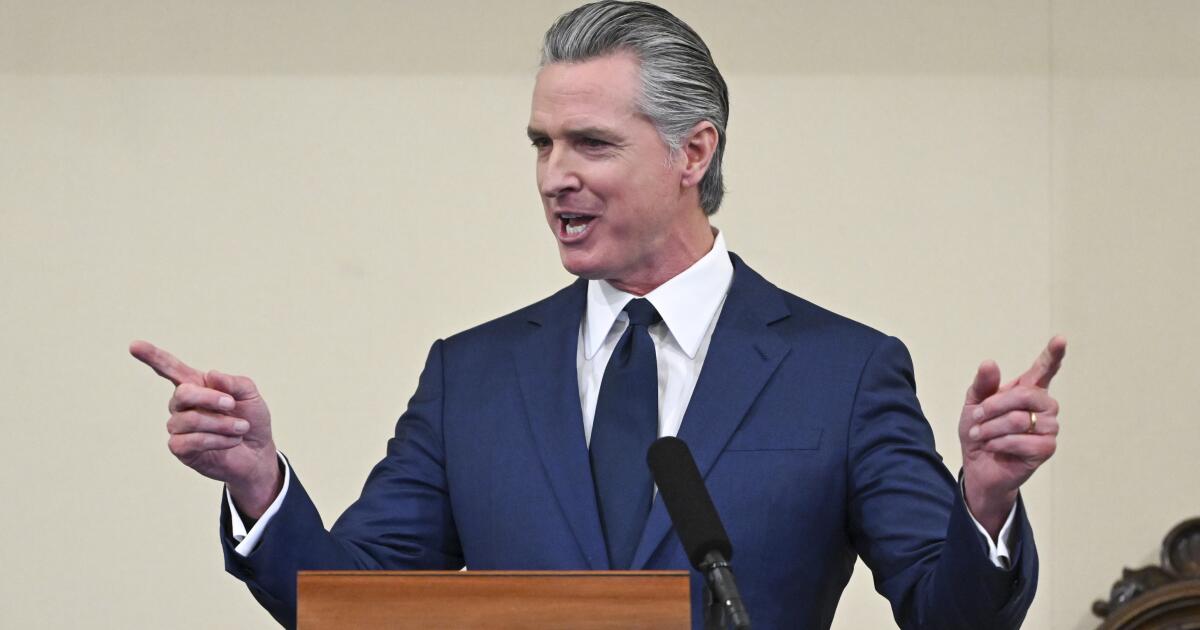
In a State of the State speech that largely ignored any talk of the big, fat budget black hole that threatens to swallow the California dream, Gov. Gavin Newsom instead laid out a vision of the Golden State that centers on inclusivity and kindness to combat Trump’s reign of darkness and expulsion.
In a week dominated by news of immigration authorities killing a Minnesota mother; acknowledgment that “American First” really means running Venezuela for years to come; and the U.S. pulling even further out of global alliances, Newsom offered a soothing and unifying vision of what a Democratic America could look like.
Because, of course, far more than a tally of where we are as a state, the speech served as a likely road map of what a run for president would sound like if (or when) Newsom officially enters the race. In that vein, he drove home a commitment to both continuing to fight against the current administration, but also a promise to go beyond opposition with values and goals for a post-Trump world, if voters choose to manifest such a thing.
It was a clear volley against Republicans’ love of using California as the ultimate example of failed Democratic policies, and instead positioning it as a model.
“This state, this people, this experiment in democracy, belongs not to the past, but to the future,” Newsom told the packed Legislative chamber Thursday. “Expanding civil rights for all, opening doors for more people to pursue their dreams. A dream that’s not exclusive, not to any one race, not to any one religion, or class. Standing up for traditional virtues — compassion, courage, and commitment to something larger than our own self-interest — and asserting that no one, particularly the president of the United States, stands above the law.”
Perhaps the most interesting part of Thursday’s address was the beginning — when Newsom went entirely off script for the first few minutes, ribbing the Republican contingent for being forced to listen to nearly an hourlong speech, then seeming to sincerely thank even his detractors for their part in making California the state it is.
“I just want to express gratitude every single person in this chamber, every single person that shaped who we are today and what the state represents,” Newsom said, even calling out Assemblymember Carl DeMaio, one of his most vociferous foes, who released a questionable AI-generated “parody” video of Newsom in response to the speech.
It was in his off-the-cuff remarks where Newsom gave the clearest glimpse of what he might look like as a candidate — confident, at ease, speaking to both parties in a respectful way that the current president, who has labeled Democrats as enemies, refuses to do. Of course, he’d likely do all that during a campaign while continuing his lowbrow online jabbing, since the online world remains a parallel reality where anything goes.
But in person, at least, he was clearly going for classy over coarse. And gone is the jargon-heavy Newsom of past campaigns, or the guarded Newsom who tried to keep his personal life personal. His years of podcasts seem to have paid off, giving him a warmer, conversational persona that was noticeably absent in earlier years, and which is well-suited to a moment of national turmoil.
Don’t get me wrong — Newsom may or may not be the best pick for Democrats and voters in general. That’s up to you. I just showed up to this dog-and-pony show to get a close-up look at the horse’s teeth before he hits the track. And I’ve got to say, whether Newsom ends up successful or not in an Oval Office run, he’s a ready contender.
Beyond lofty sentiments, there was a sprinkling of actual facts and policies. Around AI, he hinted at greater regulation, especially around protecting children.
“Are we doing enough?” he asked, to a few shouts of “No,” from the crowd. This should be no surprise since his wife, Jennifer Siebel Newsom, has made oversight of artificial intelligence a priority in her own work.
Other concrete policy callouts included California’s commitment to increasing the number of people covered by health insurance, even as the federal government seeks to shove folks off Medicaid. In that same wellness bucket, he touted a commitment to getting processed foods out of school cafeterias and launching more medications under the state’s own generic drug label, including an $11 insulin pen launched last week.
On affordability, he found common ground with a proposal Trump put out this week as well — banning big investors from buying up single family homes. Although in California this is less of a problem than in some major housing markets, every house owned by a big investor is one not owned by a first-time buyer. Newsom called on the Legislature to work on a way to curtail those big buyers.
He also hit on our high minimum wage, especially for certain industries such as fast food ($20 an hour) and healthcare ($25 an hour), compared with states where the federal minimum wage still holds sway at just more than $7 an hour.
And on one of his most vulnerable points, homelessness, where Republicans and Trump in particular have attacked California, he announced that unsheltered homelessness decreased by 9% across the state in 2025 — though the data backing that was not immediately available. He also said that thousands of new mental health beds, through billions in funding from Proposition 1 in 2024, are beginning to come online and have the potential to fundamentally change access to mental health care in the state in coming years. This July, a second phase of Proposition 1 will bring in $1 billion annually to fund county mental health care.
Newsom will release his budget proposal on Friday, with much less fanfare. That’s because the state is facing a huge deficit, which will require tough conversations and likely cuts. Those are conversations about the hard work of governing, ones that Newsom likely doesn’t want to publicize. But Thursday was about positioning, not governing.
“In California, we are not silent,” Newsom said. “We are not hunkering down. We are not retreating. We are a beacon.”
It may not be a groundbreaking stand to have a candidate that understands politics isn’t always a battle of good and evil, but instead a negotiation of viewpoints. It’s surely a message other Democrats will embrace, one as basic as it is inspiring in these days of rage and pain.
But Newsom is staking that territory early, and did it with an assurance that he explained in a recent Atlantic profile.
He’d rather be strong and wrong than weak and right — but strong and righteous is as American as it gets.