In Jafar Panahi’s acclaimed thriller “It Was Just an Accident,” it’s a distinct sound that alerts Vahid (Vahid Mobasseri), a mechanic, that the man who tortured him in prison might be dangerously close.
After hearing it, he embarks on a rage-fueled mission to kidnap and kill the interrogator. But Vahid is not certain he has the right man, so he enlists a group of other victims to help identify him. What ensues is a brilliantly taut ensemble piece.
The latest from the Iranian master earned the Palme d’Or at the Cannes Film Festival and is now a major contender this awards season, representing France at the Oscars in the international feature category. Iran would not submit the politically charged film.
“Because the auditory sense of prisoners is usually strongest above all the other senses, I thought that I would begin the film with a sound,” a stoic Panahi says via an interpreter in a hotel room in Santa Monica. “In prison, you keep trying to guess if this voice that you hear belongs to an older person, a younger person, what he looks like and what he does in life.”

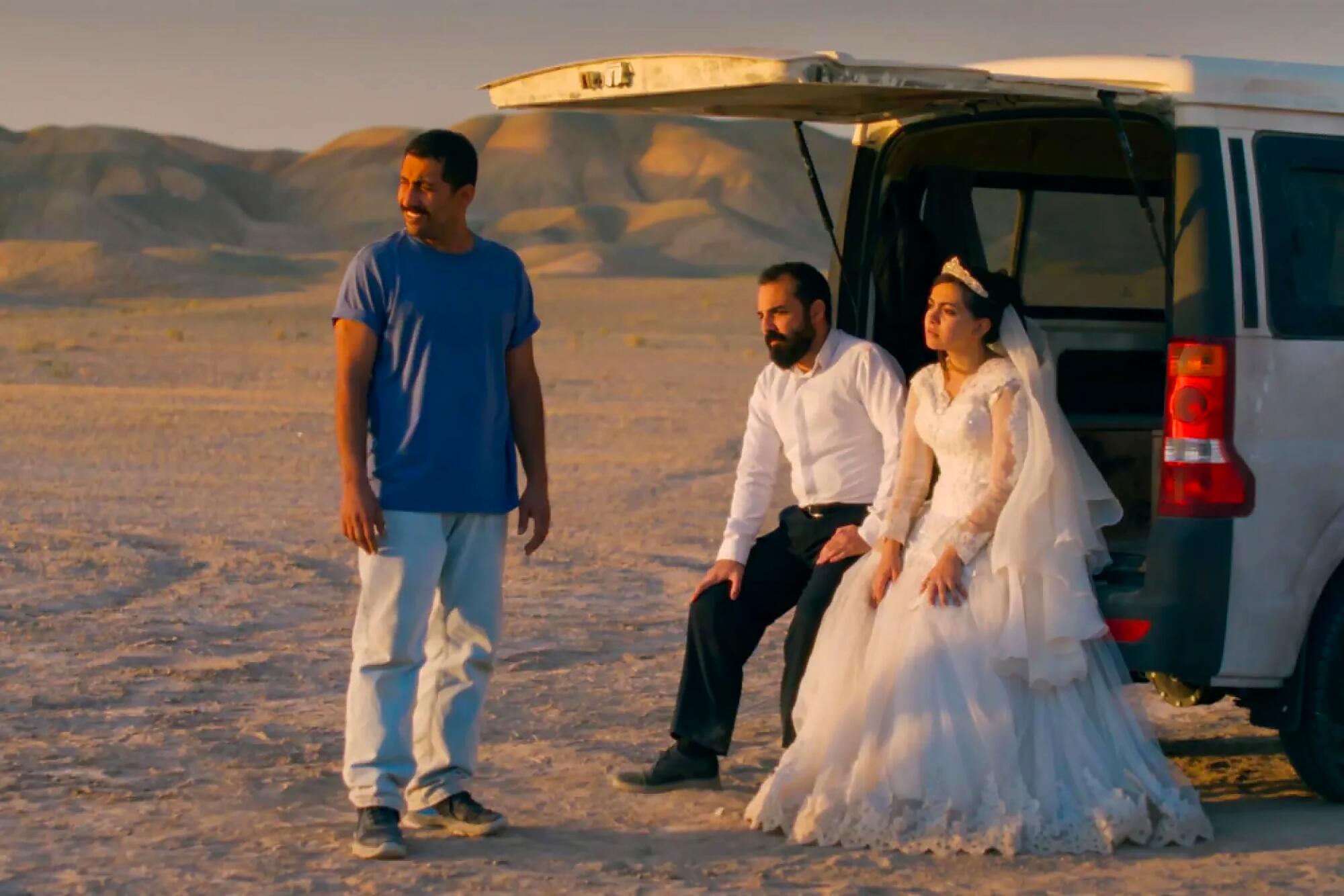
A scene from “It Was Just an Accident.”
(Neon)
Panahi is no stranger to being deprived of his freedom. Arrested in 2022 for his outspokenness against the regime’s practices, he spent seven months in prison. It wasn’t until he went on a hunger strike that his right to legal representation was granted.
Without an attorney present, Panahi explains, interrogators blindfold detainees and stand behind them, either asking questions directly or writing them on a piece of paper and handing it to the detained, who lifts their blindfold just enough to read it. An interrogation nearly identical to that description plays out in last year’s Oscar-nominated film “The Seed of the Sacred Fig” by Mohammad Rasoulof, one of Panahi’s longtime collaborators.
“I had not actually seen Rasoulof’s film because when we make films clandestinely, we don’t talk about them, even with our close friends,” he explains. “I didn’t even know what his film was about. Only when I got to France to mix [‘It Was Just an Accident’], and Rasoulof’s film was out in theaters there, that’s when I saw it.”
Making films on the outskirts of legality under an authoritarian regime entails high-stakes discretion. The script for “It Was Just an Accident” never left Panahi’s sight when casting.
“To all of the actors, I gave the script in my own apartment,” he recalls. “I told them, ‘Read it here, don’t take it with you. Go and think about it for 24 hours, and then tell me whether you want to be a part of it.’” Everyone in the stellar cast, composed of dissident artists with varying degrees of experience in front of the camera, was aware of the risks it entailed.

Jafar Panahi.
(Kate Dockeray / For The Times)
Mobasseri had appeared in Panahi’s previous effort, “No Bears,” while Majid Panahi, who plays a groom swept up in the scheme by his vengeful bride, is the director’s nephew. Mariam Afshari, as a photographer who also joins the plot, had minimal acting experience, but had been involved in other productions in below-the-line roles. Panahi says he casts actors based on how their physical traits resemble the character he has in mind.
That was the case with the tall and lean Ebrahim Azizi, who appears as Eghbal, the man the group believes was their ruthless captor. For a scene near the end where Eghbal breaks down, thinking he’s about to be killed, Panahi placed his trust in Azizi — who only acts in underground films, not state-approved projects — to convey the tempestuous humanity of a presumed villain.
“I felt a huge burden on my shoulders when I left prison that made me feel I owed something to my fellow prisoners who were left behind,” Panahi says. “I said this to Ebrahim Azizi, ‘Now the entire burden of this film is on your shoulders with your acting, and you have to put that burden down with utmost commitment.’”
The first time Panahi shot that searing scene, he sensed it wasn’t coming together. After all, his only experience with real-life interrogators was from the receiving end of their questioning. “I went to one of my friends, Mehdi Mahmoudian, who has spent one-fourth of his life in prison,” he says. “I told him, ‘Because you know these personality types very well, come and tell this actor what to do.’ He guided [Azizi] and we took two or three more takes and it was done.”
Amid the hard-hitting moral drama of “It Was Just an Accident,” moments that warrant a chuckle for their realistic absurdity might surprise some viewers. However, a touch of sardonic levity has always been part of Panahi’s storytelling.
“Humor just flows through life. You cannot stop it,” he says.
To make his point, Panahi recalls a morbid memory from when he was around 10 years old. One of his friends had lost his father. Disturbed, the boy threatened to take his own life. Panahi and his other friends followed him to try to stop him if he did in fact attempt to hurt himself.
Determined, the boy announced he would stand in the middle of the road and throw himself in front of a large vehicle. “We were lucky because we were in a very isolated part of town and there were no real big cars passing by,” he says. “Two hours later we were all sitting in a movie theater. Humor is always there. It’s not really in my hands.”