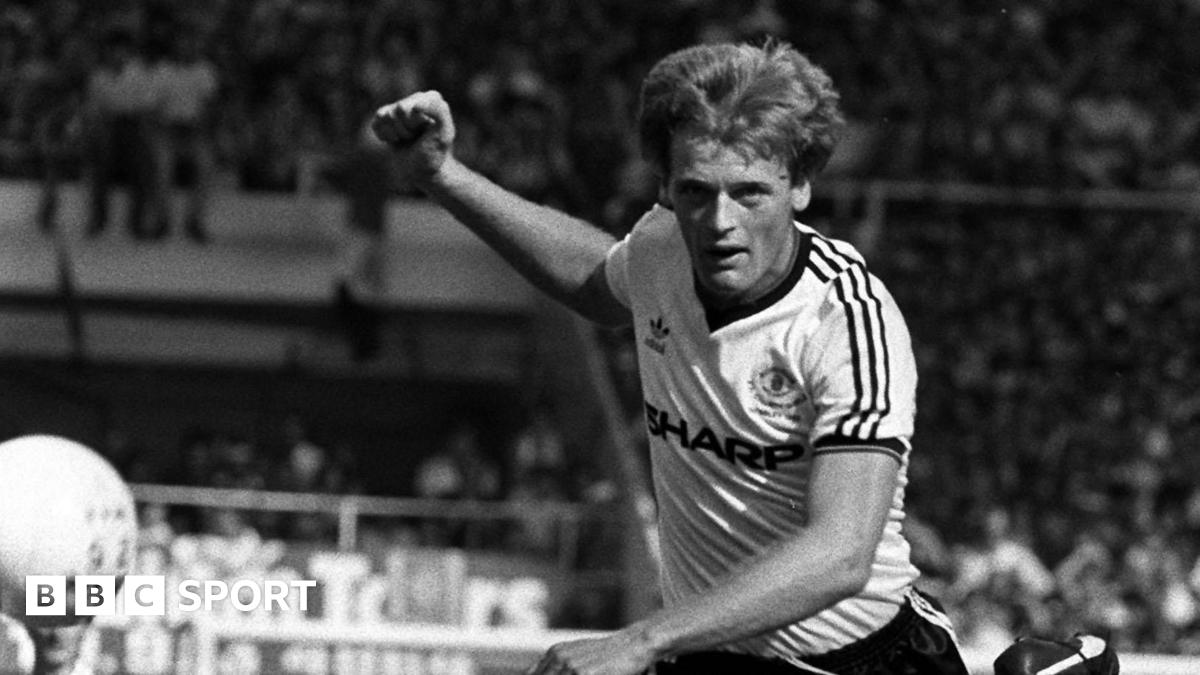
“He just wouldn’t really know what year it was or what day it was,” Hayley said.
“He was very active and trying to do crosswords and watch football. He lost the ability to write.
“He couldn’t make a cup of tea. He got confused about what went where. He kept saying, ‘there’s something not right in my head’.”
“He used to get confused about things. Never people – he had an incredible memory for the past.
“It was more the withdrawn nature of my dad. He would be the centre of attention, but (with dementia) he would have to be asked a question to speak.”
Asked by Michael Rawlinson KC, representing the McQueen family, how her father scored his goals, Hayley said: “Mainly with his head, from a set-piece.”
Professor Willie Stewart, a consultant at Queen Elizabeth University Hospital in Glasgow who examined McQueen’s brain after his death, described how a membrane in the brain appeared torn and that chronic traumatic encephalopathy (CTE) was present in various places.
“Gordon technically fell into the lower stage of the disease, although on the threshold of the higher stage,” he said.
Prof Stewart said symptoms of CTE were cognitive decline and neuro-behaviour change, and that they “can’t be explained by another condition – it must be progressive”.
He said symptoms were “typical in individuals who have long careers – professional footballers and rugby players”.
Asked if there was a causal link between CTE and repetitive head injury, he said: “The answer to that is yes.”
Senior coroner John Heath said the post-mortem found pneumonia in McQueen’s right lung, mixed vascular dementia and CTE.
Prof Stewart, who conducted a 2021 study on whether certain positions on the pitch were more associated with neurodegenerative disease than others, said: “The players, the goalkeepers who don’t head the ball had a risk equivalent to general population, whereas in outfield positions, particularly defenders, the risk was higher.”
The inquest continues.