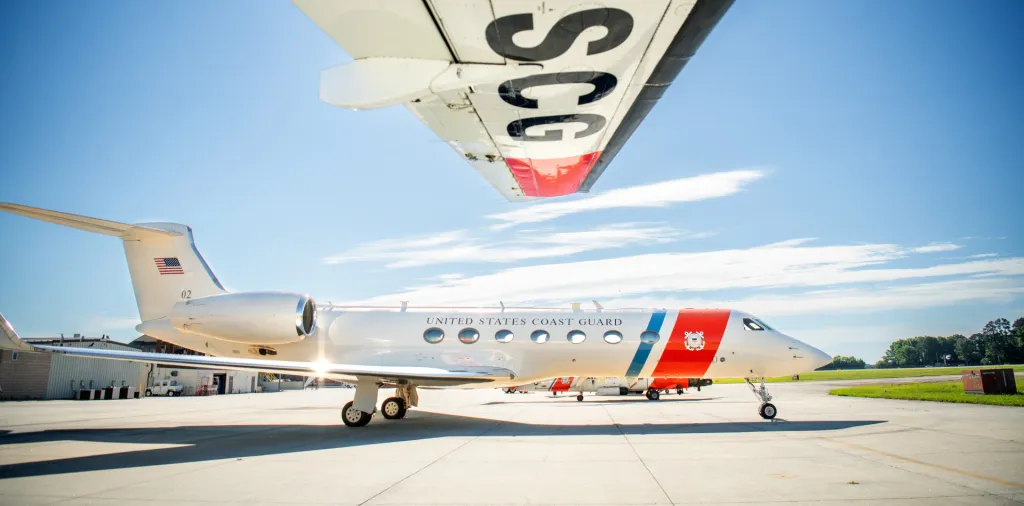
We have what appears to be the first look at one of two new Gulfstream 700 (G700) VIP jets for the U.S. Coast Guard. The jet notably has a livery almost identical to that of a 737 Boeing Business Jet (BBJ) with a luxurious VVIP interior and clear ties to the Department of Homeland Security (DHS) rather than a more typical Coast Guard paint scheme.
Aviation photographer Lennon Popp took a picture of the G700, seen at the top of this story, at Savannah/Hilton Head International Airport in Savannah, Georgia, on Tuesday. This airport is home to Gulfstream’s main headquarters and manufacturing facility. The aircraft was using the callsign Gulf Test 96 (GLF96) at the time. What the timeline might be for formal delivery of the jet, if that has not already occurred, is unclear. The Coast Guard said in the past that it hoped to have the jets in hand no later than December 31, 2025. TWZ has reached out to DHS and the Coast Guard for more information. The Coast Guard currently falls under the purview of DHS.
The G700 acquisition does look to be proceeding on a very fast schedule, but what tradeoffs this may require is unknown. DHS and the Coast Guard only confirmed the order for the jets, referred to as Long Range Command and Control Aircraft (LRCCA), last October. The Coast Guard’s present LRCCA fleet consists of a C-37A and a C-37B, which are based on older and out-of-production Gulfstream V and G550 models, respectively. Various Gulfstream models are also in service across the U.S. military and with other U.S. government agencies, but none of them currently operate 700-series types.

The existing LRCCAs are regularly used as a VIP transport for the Secretary of Homeland Security (currently Kristi Noem) and other senior departmental leaders, as well as top Coast Guard leadership. The jets also have a role in larger continuity of government planning to ensure U.S. authorities can keep functioning in the event of a host of different severe contingency scenarios, including major hostile attacks and devastating natural disasters.
What is immediately eye-catching in Popp’s picture is the G700’s paint scheme, which is white over blue with red and gold cheat lines. The DHS seal is also painted on the side of the fuselage just behind the main cabin door, and the Coast Guard seal is seen on the side of the engine nacelle. “United States of America” is written in large lettering on the side of the fuselage, and there is a large American flag, depicted blowing in the wind, on the side of the tail.

In contrast, the Coast Guard’s two existing LRCCAs have a different livery. They are overall white with orange and blue bands around the forward end of the fuselage, similar to what’s found on all of the other fixed-wing aircraft the service operates.

As noted, the G700’s livery is virtually the same as the one that appeared unexpectedly on the 737 Boeing Business Jet (BBJ) last month. We will come back to that aircraft, which carries the U.S. civil registration number N471US, later on. The paint scheme seen on N471US and now on the G700 is also very similar to what President Donald Trump had picked for the forthcoming pair of Boeing 747-8i-based VC-25B Air Force One aircraft during his first term. President Joe Biden subsequently reversed that decision, going back to the same iconic, Kennedy-era livery worn by the current VC-25A Air Force One jets that the VC-25Bs are set to replace. Last August, the Air Force told Inside Defense it was “implementing a new livery requirement for VC-25B,” but did not offer any further details.


The Coast Guard has shared some details about how the G700 LRCCAs will otherwise be configured.
“Gulfstream (as the OEM [original equipment manufacturer]) is the only vendor capable of acquiring G700s under a secure, strict, and time-sensitive process,” according to a formal justification for the sole-source contract that the Coast Guard posted online last October. “DHS and USCG require exacting follow-on cabin refresh, next generation satellite connectivity, and open the potential for a secure command and control communications suite to replicate capabilities of the C-37B.”
The document specifically mentions “Starshield installation” as part of the communications suite for the G700s. Starshield is a more secure cousin to SpaceX’s commercial Starlink space-based internet service intended for government customers. Starshield and Starlink have become increasingly ubiquitous across the U.S. military, including in support of tactical operations, and other U.S. government agencies, in recent years. This underscores SpaceX’s preeminent position in the satellite internet and communication marketspace, as well as when it comes to other space-related services, as you can read more about here.
“The G700 provides a combination of increased range, speed, seating capacity, and enhanced avionics in comparison to a used G550,” the justification document adds. “While a G550 is capable, it is no longer in production and USCG is at the mercy of the re-sell [sic] market to grow the LRCCA fleet in the required time.”

DHS and Coast Guard officials have stressed these points repeatedly in the past year in arguing for the need to modernize the LRCCA fleet. Members of Congress have previously leveled significant criticism on DHS, and Secretary Noem more specifically, over the plans to buy new jets, the total cost of which has been said be between $170 and $200 million. The price of a base model G700 before any alterations, painting, and other work is done is generally set at around $70 to $80 million.
Disputes over the allocation of funding and the decision to order the jets during a protracted government shutdown have drawn particular ire from some legislators. DHS has seen a huge boost in its total budget in the past year.
A Joint Explanatory Statement report accompanying a draft Homeland Security spending bill making its way through Congress right now includes a new demand for monthly updates detailing the use of the Coast Guard’s LRCCA fleet. Among other things, those status reports must include “for official travel, the nexus to a statutory Department of Homeland Security mission and justification for [the] trip” and “any alcoholic beverages consumed on the flight and the source of such beverages.”
The G700 purchase does reflect a broader trend in expanding U.S. government executive aircraft operations under the Trump administration. When it comes to DHS, specifically, this was already evidenced by the emergence of N471US, the aforementioned 737 BBJ jet. At the time of writing, DHS does not yet appear to have officially commented on that aircraft, but it was tracked flying to various destinations in Europe and the Middle East between December 15 and December 19. Online flight tracking data showed that its routes matched those of the Coast Guard’s C-37B LRCCA. Both aircraft notably visited Jordan’s capital, Amman, during that timeframe. On December 16, Jordanian authorities shared that Secretary Noem had met with King Abdullah II to discuss the U.S. Global Entry program and other matters.
N471US has also been tracked flying between various destinations in the United States, as you can read more about here. Online flight tracking data also shows the jet made trips outside of the United States to Bermuda and the Dominican Republic last week.
The new surge in U.S. executive aircraft developments has also been particularly visible when it comes to the Air Force’s plans surrounding the VC-25B Air Force One jets. In December, the service confirmed that it was buying two Boeing 747-8 airliners from German flag carrier Lufthansa to provide training support and as sources of spare parts for the future VC-25Bs. The VC-25B program has faced repeated delays in recent years, though the Air Force said last month that it had made some progress in mitigating those schedule impacts. The first of the new Air Force Ones is currently set to be delivered in 2028.
The Air Force is also pushing ahead with work to repurpose a highly-modified ex-Qatari VVIP 747-8i aircraft, which it is now referring to as the VC-25 bridge aircraft. The service said this week that it is expecting to take delivery of that jet this summer. TWZ has questioned the feasibility of this plan in detail in the past. The current timeline only raises more questions about the risks being taken when considering the strenuous operational and other requirements the ‘interim’ Air Force One jet will have to meet if it is ever to truly serve in that role.
President Donald Trump’s frustration with the VC-25B delays is said to have been a major factor in the decision to acquire the additional jet from Qatar, ostensibly as a gift from that country. Regardless, the expected future Air Force One fleet has now ballooned to five 747-based aircraft from two, though only four will be flyable.
The Coast Guard also now looks to be getting closer to recieving the first of its G700-based LRCCA jets, if it has not officially taken delivery of it already.
Special thanks again to Lennon Popp for sharing the picture of the G700 Savannah/Hilton Head International Airport with us.
Contact the author: joe@twz.com