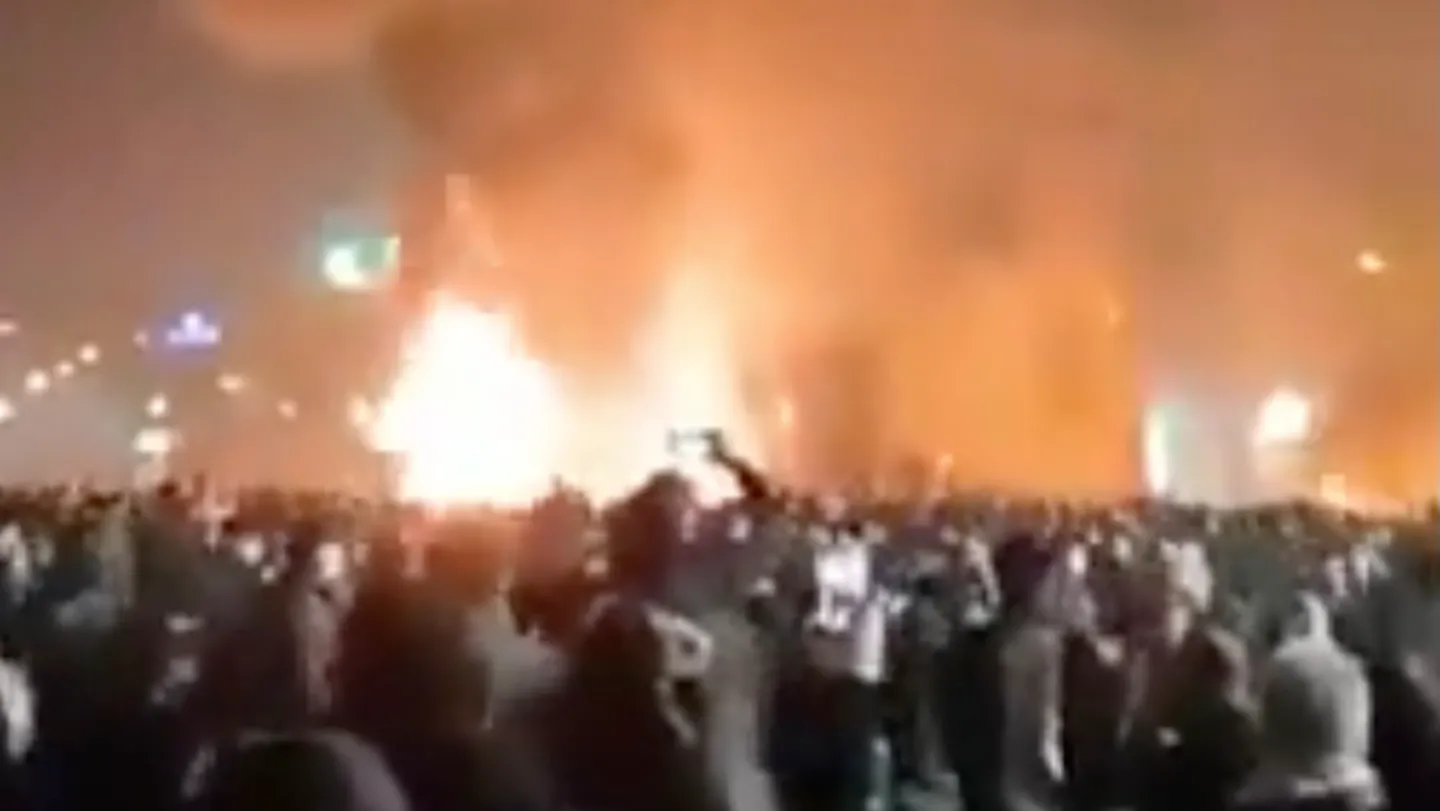

Sparked by anger over rising prices, devalued currency, a devastating drought, and brutal government crackdowns, protestors have taken to the streets in cities across Iran. These demonstrations, further fueled by the son of the former Shah, represent perhaps the biggest internal threat to the regime since it took control 47 years ago.
This comes at the same time as Israeli Prime Minister Benjamin Netanyahu ordered new plans to attack Iran over concerns about its nuclear weapons ambitions and the rebuilding of the country’s military capabilities. Meanwhile, U.S. President Donald Trump is threatening to “hit [Iran] very hard” should the government of Ayatollah Ali Khamenei carry out a large, deadly response against the protestors in Iran. Still, there have been no observable movements of U.S. forces to the region as of yet due to either of those contingencies.
Videos emerging on social media show fires raging in several cities, huge jeering crowds clogging streets, and people chanting anti-government slogans.
Many people waved the Lion and Sun flag, the official emblem of Iran prior to the 1979 Islamic revolution.
There were also scenes of reported attacks by government security forces.
However, getting an up-to-date picture of what is taking place right now is greatly complicated by the loss of internet services across Iran, which has even blacked out official media outlets like Tasnim and Irna.
“At least 45 protesters, including eight children under the age of 18, have been killed and hundreds more injured in the first 12 days of the new round of nationwide protests in Iran,” according to the Norway-based Iran Human Rights organization. “State forces have used live ammunition to suppress the protests and have carried out widespread, mass arrests in some cities. The number of people detained in relation to the protests has now exceeded 2,000. “
Meanwhile, Iranian state-affiliated Fars News Agency said 950 police officers and 60 personnel from the paramilitary Basij force have been injured in the protests, mostly in confrontations in western provinces with “rioters” who were “equipped with firearms, grenades and weapons.”
The War Zone cannot independently verify these claims.
Protests in Iran are not new. The country has faced several rounds of nationwide demonstrations in recent years. However, a combination of increased sanctions and economic losses after the 12-day war with Israel saw the rial currency collapse in December, reaching 1.4 million to $1. Adding to the discontentment, a drought gripping Iran “has seen its president warn the country it may need to move its government out of Tehran by the end of December if there’s not significant rainfall to recharge dams around the capital,” according to The Associated Press.
Soon after the currency cratered, organized protests broke out in Tehran’s bazaars and universities and gradually spread to cities nationwide, involving thousands of people.
“Experts said the leaderless and uncoordinated movement turned violent as economic protests intertwined with political ones,” CNN noted.
As the civil unrest grew with each passing day, Crown Prince Reza Pahlavi, whose fatally ill father fled Iran ahead of the 1979 Islamic revolution, is stirring the pot.
On Tuesday, he penned an oped in The Washington Post calling for support for the protestors and a new government, though not necessarily one led by him.
On Wednesday, Pahlavi issued his first direct call for protests, urging Iranians to take to the streets at 8 p.m. local time on Thursday and Friday.
“Great nation of Iran, the eyes of the world are fixed upon you,” he stated on X. “Take to the streets and, in united ranks, shout out your demands. I warn the Islamic Republic, its leader, and the Revolutionary Guards that the world and the President of the United States are closely watching you. The suppression of the people will not go unanswered.”
At the hour suggested by Pahlavi, “neighborhoods across Tehran erupted in chanting,” witnesses told AP. “The chants included ‘Death to the dictator!’ and ‘Death to the Islamic Republic!’ Others praised the shah, shouting: ‘This is the last battle! Pahlavi will return!’”
The ferocity of the protests has led to Khamenei considering “a back-up plan to flee the country should his security forces fail to suppress protests or desert,” The Times reported earlier this week, citing an intelligence report shared with the publication.
“Khamenei, 86, plans to escape Tehran with a close circle of up to 20 aides and family, should he see that the army and security called on to quell the unrest are deserting, defecting or failing to follow orders,” the newspaper posited. “The ‘plan B’ is for Khamenei and his very close circle of associates and family, including his son and nominated heir apparent, Mojtaba.”
We cannot independently verify this claim.
Amid the turmoil, Trump repeated a suggestion that he is considering attacking Iran should its crackdowns get out of hand. However, he added that he has yet to make that determination.
“Well, some have been killed by, you know, problems of crowd control and other things,” he told Hugh Hewitt. “We’re watching it very closely. The crowds are so large it’s been a stampede. There’s been three stampedes, and people have been killed and I’m not sure I can necessarily hold somebody responsible for that, but they know, and they’ve been told very strongly, even more strongly than I’m speaking to you right now, that if they do that, they’re going to have to pay hell.”
Despite Trump’s rhetoric, Fox is reporting that there is no change to the current U.S. military force posture in the region.
While it is unknown what Trump’s current plans are, Iran’s leadership well remembers Operation Midnight Hammer, the attack that saw U.S. Air Force B-2 Spirit stealth bombers drop 14 30,000-pound GBU-57/B Massive Ordnance Penetrator (MOP) bunker buster bombs on Iran’s Fordow and Natanz nuclear facilities.
Nothing, however, seems imminent. Tracking data is not showing any huge surge of U.S. military aircraft or ships toward the Middle East. Several people who closely follow military movements tell us they have not seen signs of major deployments either.
Meanwhile, in Jerusalem, Netanyahu approved a new military plan, dubbed “Operation Iron Strike,” and expressed solidarity “with the aspirations of the Iranian people for freedom.”
According to the Israeli channel i24news, Netanyahu chaired a security meeting on Sunday that lasted about five hours, during which he outlined priorities for potential action against Iran. This could involve strikes against Iran, though its full scope and specific targets have not been publicly confirmed.
A high-ranking Israeli Defense Forces (IDF) official told The War Zone that there are no clear signals either way about what either Jerusalem or Washington might do in the wake of the growing Iranian protests.
“The general sense here is that tensions are clearly elevated, but there’s still no strong indication that a strike is imminent,” said the official, speaking on condition of anonymity to discuss operational details. “That said, the main uncertainty is political rather than military. Trump is widely viewed as unpredictable, and there’s a growing assessment that he could seek to build on recent perceived successes elsewhere.”
The recent U.S. capture of Venezuelan dictator Nicolas Maduro, dubbed Operation Absolute Resolve, “is a prominent example and [Trump could] translate that momentum into other arenas, Iran included,” the official suggested. “A limited but high-impact action could be framed as backing Iranian protesters against the regime and as proof that the U.S. stands behind its threats, reinforcing an image of decisive global leadership.”
In Israel, “many believe such a scenario would also serve Netanyahu politically,” the official added. “Historically, any military confrontation shifts the public discourse away from the corruption trial, the constitutional overhaul, the ultra-Orthodox draft issue, and the ongoing erosion of Israel’s liberal democratic norms. A security crisis tends to consolidate power and dampen internal criticism.”
“So in short: higher readiness and signaling are evident, but the real risk lies in political incentives and miscalculation rather than in a clearly defined operational timetable,” the official posited.
At the same time, the U.S. and/or Israel getting involved kinetically could give the regime a very opportunistic gift, allowing them to once again claim and show proof of a common enemy its involvement in the uprisings, true or not, as well as distract from the ongoing unrest.
As day breaks across Iran, we could learn more about the extent of the protests roiling the country. Meanwhile, the world is watching warily for how this situation develops.
Contact the author: howard@thewarzone.com