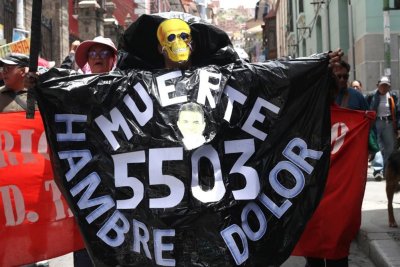

Members of the Bolivian Workers’ Union, or COB), participate in a march in La Paz on Thursday. Centrist Rodrigo Paz marks two months in office in Bolivia amid a simmering conflict over the decree that withdrew fuel subsidies in the country, which is opposed mainly by labor unions and peasant groups that were allies of the Movement Toward Socialism governments. Photo by Luis Gandarillas/EPA
Jan. 13 (UPI) — Bolivia’s government and major labor and farm groups reached an agreement to end weeks of protests and road blockades that paralyzed the country, easing a standoff triggered by a disputed economic decree.
The administration of President Rodrigo Paz signed the accord with the Central Obrera Boliviana, known as the COB, the country’s largest labor federation, along with peasant unions and other social groups.
The agreement calls for repealing the decree and creating a commission to draft a new measure that would keep fuel subsidies and review other provisions challenged by protesters.
Six cabinet ministers signed the document alongside representatives of the social organizations. Talks took place over the weekend in El Alto, a city neighboring La Paz that was among the areas hardest hit by road closures, according to Bolivian news outlet Erbol.
Protests began in early January after the government issued a decree declaring an economic emergency and moving to eliminate state fuel subsidies. The measure led to gasoline and diesel price hikes of up to 160%, driving up transportation costs and the price of basic goods.
The core of the agreement is the full repeal of Supreme Decree 5503, which sparked public anger for its economic changes, including the end of fuel subsidies.
The draft framework for a new decree also includes plans to reschedule bank loans, improve social benefit payments and reorganize wage policy, according to the signed text.
In the days before the deal, Bolivia experienced one of its most severe traffic disruptions in years.
The Bolivian Road Administration reported at least 52 blockade points on key highways, especially in the La Paz region. Thousands of passengers and truck drivers were stranded and supplies of food and fuel began to tighten.
The protests, led by the COB and peasant federations, intensified after the government insisted on keeping the decree despite widespread opposition. Union leaders called on “all Bolivian people” to mobilize for its repeal, warning the measure would bring “hunger” to future generations.
While the agreement reopened most roads, some isolated protests continued, particularly in parts of Cochabamba, where groups maintained blockades, arguing their demands have not been fully addressed. Unions said they will remain on alert until the new decree is formally issued, according to Visión 360.
Paz initially defended ending the subsidy in a post on X, saying, “For each day without the subsidy, we saved $10 million, which means public works and jobs. For each day of blockades, we lost $20 million in public works, jobs and production.”
Analysts said the government now faces the challenge of balancing economic goals with social demands.
Claudia Edith Serrano. a specialist in Latin American studies at the National Autonomous University of Mexico and a professor at the Faculty of Higher Studies Aragon, told Reporte Indigo that any renewed attempt to fully remove subsidies could reignite protests, urging the administration to proceed cautiously and prioritize dialogue with grassroots groups.