It’s nothing new or extraordinary to remake a foreign TV show for a different country.
“All in the Family” was modeled on the British series “Till Death Us Do Part,” as “Steptoe and Son” became “Sanford and Son.” The popular CBS sitcom “Ghosts” comes from the show you can find retitled as “U.K. Ghosts” on American Netflix. The British mysteries “Professor T” and “Patience” (from Belgian and Franco-Belgian productions, respectively), have been successful on PBS. And there is, of course, “The Office,” which outlasted its original by many, many seasons and nearly 200 episodes. It doesn’t always work out (“Life on Mars”; “Viva Laughlin,” from “Blackpool,” which lasted a single episode despite starring Hugh Jackman; “Payne” and “Amanda’s,” two failed stabs at adapting “Fawlty Towers”), but there’s nothing inherently wrong with the practice.
The new Fox series “Best Medicine,” arriving Sunday as an advance premiere before its time slot premiere on Tuesdays, remakes the U.K. “Doc Martin,” previously adapted in France, Germany, Spain, Greece, the Netherlands and the Czech Republic. For better or worse, I have a long, admiring relationship with the original, having signed on early and attended every season in turn — and interviewed star Martin Clunes three times across the run of the series (10 seasons from 2004 to 2022). And I am surely not alone. Unlike with most such remakes, whose models may be relatively obscure to the local audience, “Doc Martin” has long been widely available here; you can find it currently on PBS, Acorn TV and Prime Video, among other platforms — and I recommend that you do.
In “Doc Martin,” Clunes played a brilliant London surgeon who develops a blood phobia and becomes a general practitioner in the Cornwall fishing village where he spent summers as a child. He’s a terse, stiff, antisocial — or, more precisely, nonsocial — person who doesn’t stand on ceremony or suffer fools gladly, but who time and again saves the people of Portwenn from life-threatening conditions and accidents or, often, their own foolishness. A slow-developing, on-again, off-again love-and-marriage arc with schoolteacher Louisa Glasson, played by the divine Caroline Catz, made every season finale a cliffhanger.
Obviously, the fair thing would be to take “Best Medicine” as completely new. But assuming that some reading this will want to know how it follows, differs from or compares to the original — which was certainly the first thing on my mind — let us count the ways.

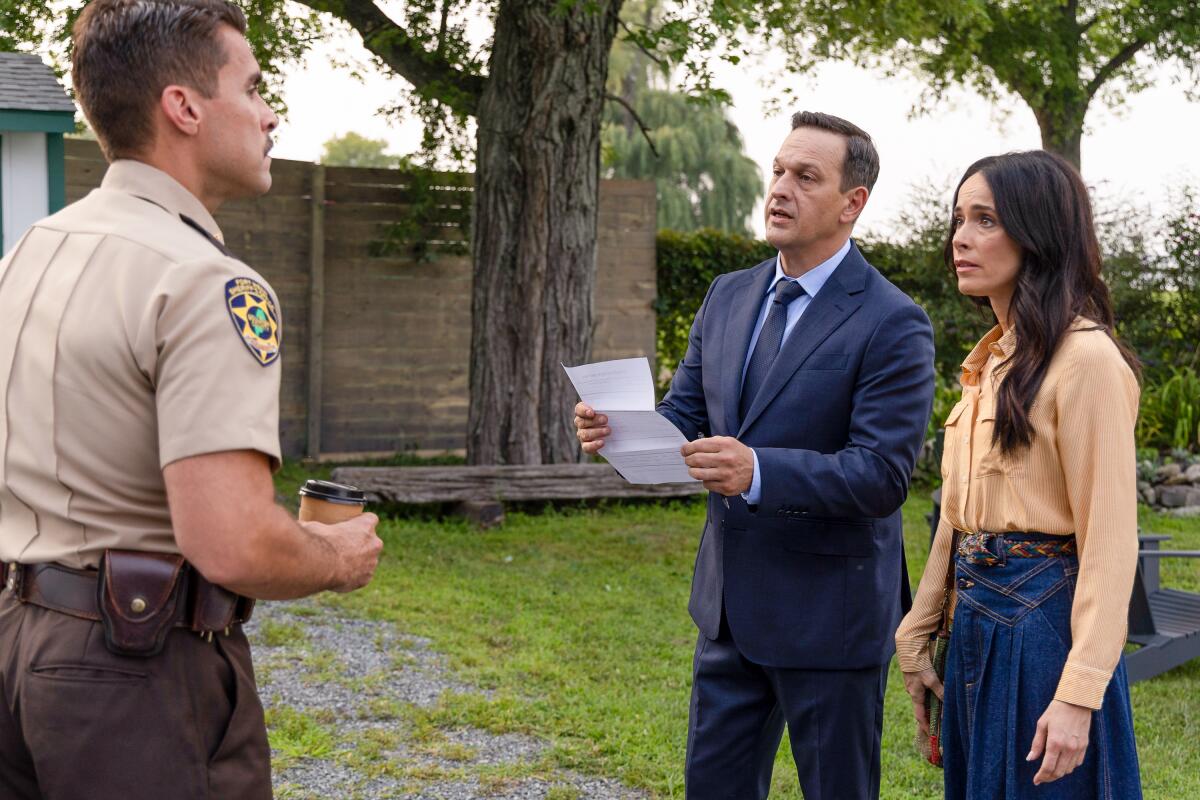
Josh Segarra, Josh Charles and Abigail Spencer in “Best Medicine.”
(Francisco Roman / Fox)
The names have mostly not been changed. For no clear reason — numerology, maybe? — Martin Ellingham is now Martin Best (Josh Charles); Aunt Joan is Aunt Sarah (Annie Potts), a fisherwoman instead of a farmer. Sally Tishell, the pharmacist in a neck brace, has become Sally Mylow (Clea Lewis); and distracted receptionist Elaine Denham has been rechristened Elaine Denton (Cree). Keeping their full names are Louisa Gavin (Abigail Spencer), father and son handymen Bert (John DiMaggio) and Al Large (Carter Shimp), and peace officer Mark Mylow (Josh Segarra). Portwenn has become Port Wenn, Maine. (Lobsters are once again on the menu.)
As in the original, Martin is hounded by dogs (no pun intended, seriously), to his displeasure; teenagers are rude to him, because they are rude teenagers. Mark Mylow is now Louisa’s recently jilted ex-fiance. Liz Tuccillo, who developed the adaptation, has added a gay couple, George (Jason Veasey) and Greg (Stephen Spinella), who run the local eatery and inn and have a pet pig named Brisket (sensitive of them not to name it Back Ribs); and Glendon Ross (Patch Darragh), a well-to-do blowhard who bullied Martin in his youth. Apart from the leads Charles and Spencer, few have much to do other than strike a quirky pose, though Segarra, recently familiar as school district representative Manny Rivera on “Abbott Elementary,” makes a meal of Mark’s every line, and Cree, who gets a lot of scenes and a personal plotline, makes a charming impression. Spencer is good company; Potts, whom I am always happy to see, is more an instrument of exposition than a full-blown character, and it feels a little unfair.
The first episode is modeled closely on the “Doc Martin” pilot, from Martin and Louisa’s antagonistic meet cute — in which he offends her, leaning in unannounced to examine her eye — to the episode’s main medical mystery (gynecomastia), a punch in the nose for our hero. Other details and plotlines will arrive, but there has been an attempt to give “Best Medicine” its own identity and original stories.
On the whole, it’s cuter, milder, more cuddly (multiple vomit jokes notwithstanding), more obvious and more whimsical, but less real, less intense and less sharply written than “Doc Martin.” The edges and angles have been sanded down and polished; tonally, it resembles “Northern Exposure” more than the show it’s adapting. Port Wenn (represented by the coincidentally named Cornwall, N.Y., with a wide part of the Hudson River subbing for the Atlantic Ocean) itself comes across as comparatively upscale; the doctor’s office and quarters are here plushly appointed, rather than spare, functional and a little shopworn.
As Martin, Charles stiffens himself and keeps his facial expressions generally between neutral and annoyed, though he’s softer than Clunes, less a prisoner of his own body, less abrasive, less otherworldly. Where Dr. Ellingham remained to a large degree inexplicable — the series expressly refused to diagnose him — Tuccillo has given Dr. Best a quickly revealed childhood trauma to account for his blood phobia and make him more conventionally sympathetic.
I freely admit that in judging “Best Medicine,” my familiarity with “Doc Martin” puts me at a disadvantage — or an advantage, I suppose, depending on how you look at it. But taken on its own merits it strikes me as a rather obvious, perfectly ordinary example of a sort of show we’ve often seen before, a feel-good celebration of small-town values and traditions and togetherness that will presumably improve the personality of its oddball new resident, as the townspeople come to accept or tolerate him anyway in turn. In the first four episodes, we get a celebration of baked beans, a town-consuming baseball championship and a once-a-year day when the women of Port Wenn doll themselves up and go out into the woods to meet a jacked, shirtless, off-the-grid he-man, right off the cover of a romance novel, who steps out of the forest, ostensibly to provide wilderness training. It’s like that.
All in all, “Best Medicine” lives very much in a television reality, rather than creating a reality that just happens to be on television. To be sure, some will prefer the former to the latter.