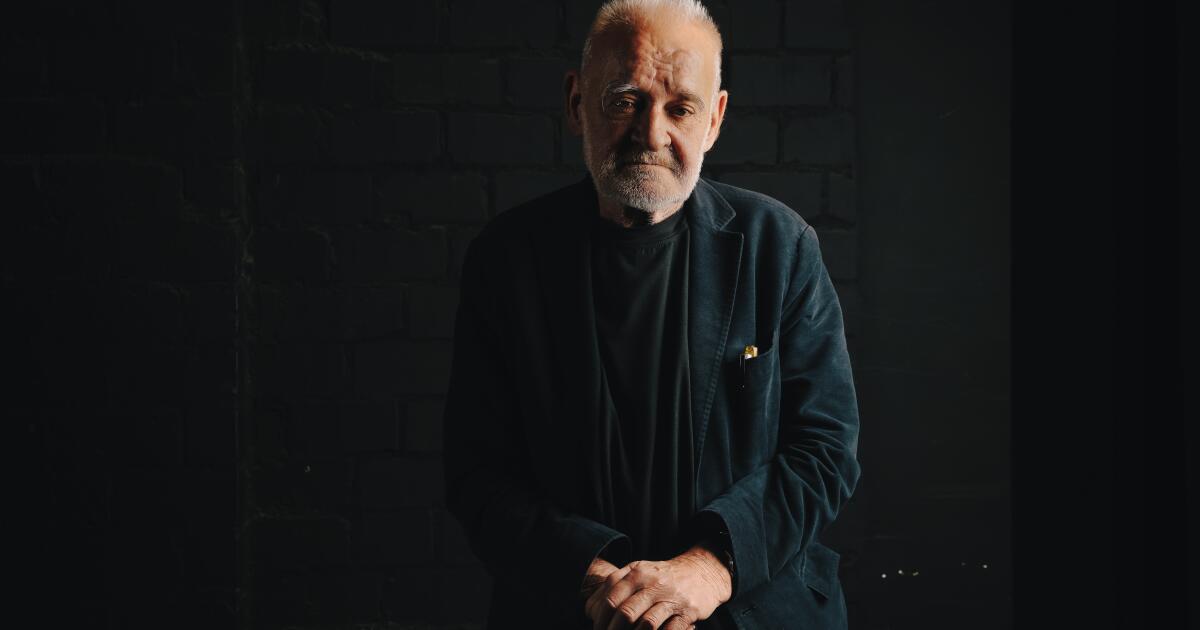
The contemplative cinema of Béla Tarr was as excruciatingly beautiful as it was brazenly original, often conjuring comparison to the work of a master painter.
His stark black-and-white imagery in assiduously long takes with creeping camera movements — hallmarks of his filmmaking — demanded that the viewer pause to look, to see, as one might in regarding a Picasso or a Bruegel.
Tarr’s revolution in form, however, cannot be separated from the radical humanity of his filmmaking. In a concentrated collection of 10 features over less than four decades, his gaze was fixed on the resolute dignity of his marginalized and downtrodden characters, which elevated his work beyond the realm of cinephile contemplation.
With the death of the Hungarian master on Tuesday at age 70, that enduring humanity makes his work as essential as ever.
“I despise stories,” Tarr once explained to an interviewer, “as they mislead people into believing that something has happened. In fact, nothing really happens as we flee from one condition to another. … There are only states of being — all stories have become obsolete and cliched, and have resolved themselves. All that remains is time.”
His films typically did not concern themselves with the plot of individual lives, which in reality are revealed in retrospect, if at all. They focused instead on human experience as it unfolds, moment by uncertain moment, capturing everyday foibles, errors and foolishness in the face of quotidian ruthlessness. As in Samuel Beckett’s tragicomic theater and novels, Tarr’s movies, by turns funny and heartbreaking, dignify human struggle with an uncommon tenacity of vision and empathy.
Some of Tarr’s most memorable scenes feature landscapes, often bleak and despairing settings of decaying Hungarian towns, punctuated with close-ups of characters’ faces. Asked by film historian David Bordwell about this juxtaposition, Tarr replied: “But the face is the landscape.”
Tarr arrived in the late 1970s declaring his intention to “kick in the door” of contemporary cinema. He did so, more than once.
He announced himself with a trilogy of domestic dramas. “Family Nest,” “The Outsider” and “The Prefab People” focused on couples and individuals trapped by commonplace struggles and social constraints, a thematic affront to late-communist Hungary. Featuring handheld camerawork and frequent close-ups, these early works evoke the quasi-improvisational style of John Cassavetes smothered in claustrophobia.
Tarr followed with a TV adaptation of “Macbeth” (1982), filmed in two shots, the second lasting more than an hour. After a brief experimentation two years later with a wild palette of color in “Almanac of Fall,” he returned to his discoveries in “Macbeth,” a stylistic transformation that would define the rest of his career.
“Damnation” (1988) opens with an extended shot of a system of towers and cables transporting vast buckets of mining materials across a desolate plain. A harsh grinding of the elevated cable system is the only sound. (In Tarr films, sound features as evocatively as image.) Slowly the camera pulls back to reveal an interior window, and then the back of a man’s head in silhouette, as our protagonist watches the monotonous procession.
The audience experiences the scene of agonizing beauty as the man does. We remain with him throughout the movie, as we follow his futile pursuit of a married cabaret singer with whom he is irrevocably in love. The story does not unfold as a typical narrative, but in a series of scenes that feel distinct yet unified, like a collection of short stories.
Tarr worked with a common team of filmmakers in nearly all his films, including his longtime partner and editor, Ágnes Hranitzky, cinematographer Fred Kelemen, composer Mihály Víg and a core group of actors.
“Damnation” marked Tarr’s first collaboration with his friend László Krasznahorkai, the Hungarian novelist and 2025 Nobel Prize in Literature winner. The pairing of literary and filmmaking masters, which spanned five features over a quarter of a century, recalled that of Graham Greene and Carol Reed, but nothing in movie history quite compares.
Tarr’s two greatest works, “Sátántangó” (1994) and “Werckmeister Harmonies” (2000), were based on Krasznahorkai‘s novels (the latter derived from his “The Melancholy of Resistance”). The books are cornerstones of Krasznahorkai’s Nobel-winning oeuvre, and the films are two of the defining movies of their era and established Tarr as a giant of cinema.
“Sátántangó” is an epic equivalent in running time to some four feature films, which Susan Sontag called “devastating, enthralling for every minute of its [more than] seven hours.” It often appears on critics’ lists among the greatest films ever made.
The movie follows a group of petty cheats, liars and drunks who are duped by nefarious opportunists who visit their crumbling town. Tarr employs the extended take to even greater lengths, creating an exquisite manipulation of our sense of time, and some of the most memorable scenes in modern filmmaking.
In “Werckmeister Harmonies,” another opportunist visits another desperate town, this time accompanying a traveling exhibit of a preserved whale. The depictions of mob violence are chilling evocations of the darkest moments of the 20th century. The culminating episode, as the mob smashes and ransacks a hospital and terrorizes its patients, ultimately reveals a frail elderly man, standing naked and alone in an empty bathtub as the club-wielding assailants approach. His appearance, stopping them in their tracks, is one of the most heartrending moments of any movie.
Tarr followed with “The Man From London,” which he and Krasznahorkai adapted from a novel by Georges Simenon, about a seaside railway signalman who confronts a moral quandary involving a murder mystery.
In 2012 came “The Turin Horse,” in which director and novelist reimagined the story of the whipping of a horse in the Italian city that was said to have triggered philosopher Friedrich Nietzsche’s mental breakdown. The movie follows the unfortunate horse as it is led away by its owner to his rural home he shares with his daughter. Their repetitive routines and the young woman’s daily burdens are reminiscent of Chantal Akerman’s classic “Jeanne Dielman.”
After the release of the film, among his most acclaimed, Tarr stunned the film world by announcing it would be his last feature. He was just 56 at the time.
He went on to open an international film school in Sarajevo, Bosnia-Herzegovina, known as film.factory, which continued until 2017, and he produced a number of movies.
Tarr was long outspoken in denouncing authoritarian governments, whether Hungary’s old communist model or the current populist nationalism of Hungarian Prime Minister Viktor Orbán, France’s Marine Le Pen and President Trump. He supported students at the University of Theatre and Film Arts in Budapest — his former school — who had occupied their campus in 2020 in protest of Orbán’s policies.
In 2019, Tarr embarked on one more film-related project, “Missing People,” an exhibition at the annual Vienna Festival. The film portion of the program, according to reports about the event, featured the faces of some 270 homeless people living in the Austrian capital.
The project appeared a few months after Orbán’s adoption of a Hungarian law that essentially criminalized homelessness. A final act in the radical humanity that was the art of Béla Tarr.