Whether you’re Irish by blood or Irish just for the day — you want to head to the best spots in the UK to ring in the festivities — and that’s where we come in.
Let the Guinness and the good times roll.(Image: AFP via Getty Images)
St Patrick’s Day is just around the corner and it’s the one day of the year people really like to let loose and celebrate.
Every year on March 17, people all over the world outside of Ireland — but especially the UK — come out in hordes to celebrate St Paddy’s Day. We’re talking lively parades, a sea of endless green, and booze. Lots and lots of booze.
Whether you’re Irish by blood or Irish just for the day — you want to head to the best spots in the UK to ring in the festivities. And that’s where we come in.
It goes without saying that the capital cities of Belfast in Northern Ireland and Dublin in the Republic of Ireland are must-visits if you’re looking for the ultimate St Paddy’s celebrations, but for those of you who can’t make it all the way to Ireland — don’t worry, we got you.
We’ve compiled a list of the best cities in Britain where you can celebrate St Patrick’s Day this year, so whether you’re planning to head out with a group of mates or go on a solo adventure, make sure to give these spots a whirl.
Let the Guinness and the good times roll.
London
It’s no surprise London is on this list. The UK’s capital city hosts a massive St Paddy’s Parade every year, and this year it’s going to be bigger and better than ever.
March 15 will see the official parade weave its way from Hyde Park to Trafalgar Square, with Irish music, pageantry, dance troupes, floats, and marching bands on display, along with a free-for-all party in Trafalgar Square for the public to enjoy featuring live music, comedy, food and drink.
It’s not just the parade that’s a draw — the weekend closest to March 17 always sees a flurry of activity as London’s thriving Irish community comes out in full force — along with just about every other person looking for a fun time. The Guinness Open Gate Brewery has also recently arrived in the city, hosting a line-up of craic, comedy, and electric music.
Look no further than London for a truly epic time.
Birmingham
The UK’s second largest city is undoubtedly one of the best to celebrate St Patrick’s Day in. In fact, it was one of the first cities in the country to begin hosting St Patrick’s Day celebrations, with a dedicated parade for the day since 1952.
With endless welcoming pubs, restaurants and clubs, there’s no dearth of exciting ways to celebrate the Irish holiday in Birmingham.
While the city’s annual St Patrick’s Day Parade has unfortunately been cancelled once again this year, there’s still more than enough to do in Brummy to get the celebrations going.
Revellers can instead head to St Patrick’s Family Fun Day at the Irish Centre on March 15 which will see a host of activities and entertainment including live bands, music and plenty of food and drink.
Or you can just head down to one of the local pubs — because parade or no parade, St Paddy’s Day is always a rip-roaringly fun time in Birmingham.
Manchester
There’s no way Manchester wasn’t going to be on this list. The city is all set to host its Irish parade for Paddy’s Day on March 15 and revellers can enjoy foot-tapping live Irish music, mouthwatering food, drinks and much more.
Expect to see “plenty of bright costumes, lively parades, and fun events happening across the city”.
In fact, the 10-day Manchester Irish Festival has been running since March 7 and will go on till March 17, with the parade on Sunday being the event’s highlight.
Liverpool
Liverpool is another UK city that’s always a good time on St Patrick’s Day. Irish pubs, karaoke bars and top-class entertainment means if you’re in Liverpool, it’s going to be a hell of a time.
Those hoping for a more peaceful and religious St Paddy’s Day can make their way to Liverpool Cathedral which is Britain’s biggest.
The 10th Annual Liverpool St Patrick’s Day Parade will take place at the Old Irish Centre on March 17, Tuesday. The anniversary parade promises to be “the biggest and best yet — with music, dance, colour, and Irish pride filling the streets. Bands, floats, and community groups are all welcome, and the whole city is invited to join in the festivities”, as per the official website.
The UK’s most beautiful places have been ranked and one English spot has particularly impressed thanks to its enchanting scenery and quaint villages
16:30, 13 Mar 2026Updated 16:30, 13 Mar 2026
This article contains affiliate links, we will receive a commission on any sales we generate from it. Learn more
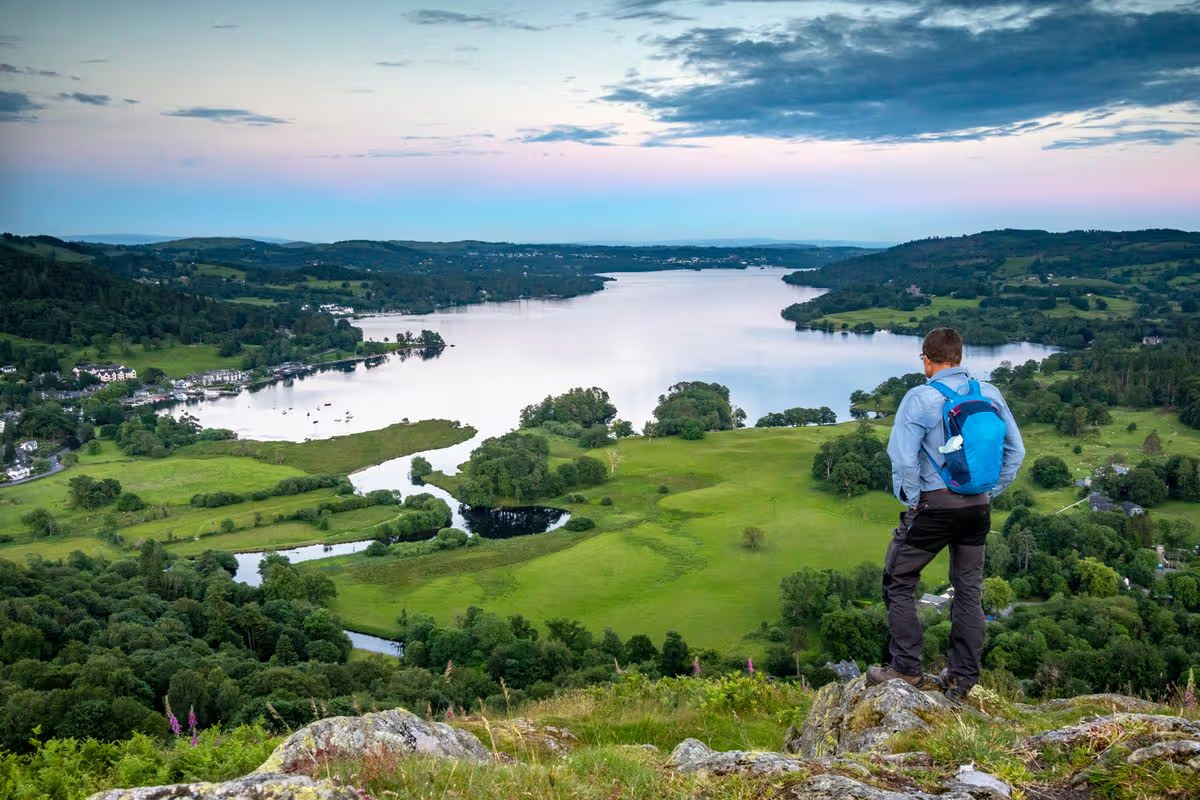
The Lake District is one of the destinations in the top 10 rankings(Image: Getty Images)
A beautiful region full of rolling green hills, lakes with azure waters and charming villages that are the stuff of fairytales has been named England’s most beautiful place for 2026.
The Lake District has long been attracting visitors from around the world, often featuring on rankings of the more scenic spots and picturesque landmarks across Britain. Now, it’s been named one of the UK’s most beautiful places, taking the silver medal in new rankings from Big 7 Travel.
“England’s largest national park, the Lake District, is surely one of the UK’s most beautiful areas,” the team behind the research explained. “Whether it’s grass-covered fells, England’s highest mountain (Scafell Pike), beautiful lakes such as Ullswater and Windermere or quaint towns like Grasmere and Keswick, the Lake District has it all. Perfect for everyone from hikers to swimmers, photographers to artists and more, the Lake District is easily one of the most beautiful places in the UK.”
While it’s hardly a hidden gem, it’s not difficult to see why the Lake District is so popular with tourists. There are plenty of breathtaking lakes to explore in the region – 16 in fact – with popular highlights including the likes of Lake Windemere, Derwentwater and Ullswater which boast a host of water sports facilities and attractions. (Families may particularly want to bookmark the World of Beatrix Potter which brings the stories of Peter Rabbit and his friends to life).
Then of course that lush green landscape is packed with everything from scenic strolls to epic hiking trails, depending on how far you want to cover in your hiking boots. Oh, and the region is renowned for the many, many brilliant pubs where you can warm up by a fire, tuck into a hearty roast and enjoy a well-deserved drink after a busy day of exploring.
As for where to stay, there’s a plethora of accommodation to choose from, with the likes of Sykes Holiday Cottages and Holidaycottages.co.uk both offering up some brilliant options that look like the stuff of storybooks, or if you fancy treating yourself to a hotel stay, TripAdvisor has a handy guide to some of the best cheap Lake District hotels you’ll want on your radar.
Meanwhile, if you’re after more staycation inspiration then you could of course head to the UK’s most beautiful destination in the rankings. That accolade went to the Queen’s View in the Scottish Highlands, a picturesque viewing point that overlooks Loch Tummel. One of its most famous visitors, Queen Victoria, arrived at the site in 1866 and reportedly assumed that the location was named after her. (In reality, It is thought that it was named after Isabella, Robert the Bruce’s first wife, who lived more than 500 years before Victoria’s visit).
British tourists who’ve jetted off to Tenerife to make the most of the island’s reputation as the “island of eternal spring” have been experiencing a “disappointing” holiday because of one issue
Jess Flaherty Senior News Reporter
15:58, 13 Mar 2026Updated 15:58, 13 Mar 2026
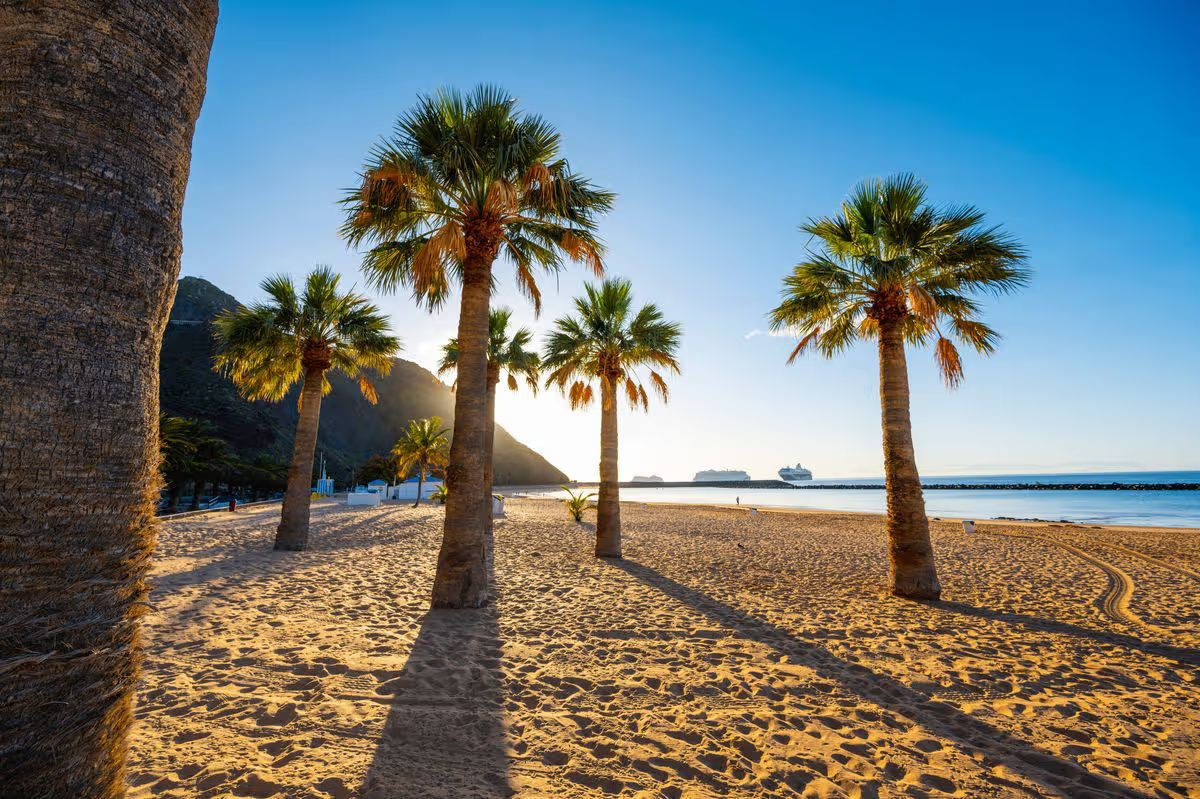
Brits holidaying in Tenerife have been left disappointed by one unexpected issue (stock image)(Image: Marco Bottigelli via Getty Images)
For those looking to escape the drizzle and freezing conditions of dreary Britain weather in favour of sand, sun, and some well-deserved rest, Tenerife is usually a safe bet. However, many visitors heading to the Spanish island – the largest of the popular Canary Islands and a firm favourite among Brits – this month have been left “disappointed”.
Tenerife is famed for its many beaches, holiday resorts, bars, restaurants, and stunning landscapes made up of volcanic mountains, vast national parks, and much more. It’s a perfect location for hiking, relaxing and observing the stars.
It’s appealing thanks to its reputation as the “island of eternal spring“, which comes from its temperate and stable climate all year round, where temperatures typically hover between 20 and 28 degrees.
Yet many Brits who’d been anticipating some sunshine and warmth are instead dealing with an unexpected chill. On the popular TikTok account Tenerife First Excursions, one man shared a first-hand account.
Speaking directly to the camera, he said: “If you’re wanting to know what the weather is like at the moment in Tenerife then I’m gonna disappoint you.”
Content cannot be displayed without consent
He turned the camera to reveal thick grey clouds above, although there were patches of blue sky and bright sunshine breaking through in certain areas. He went on: “It has been like this for the last four or five days now, with a little bit of sunshine for an hour or so in between.”
He continued: “It’s been a disappointing week but then again, a lot of people are here for Cheltenham [Festival] so everyone’s in the bars, day drinking, having a good time. The sunshine is back on the weekend, though. I said to someone the other day, they absolutely love it. I said, ‘I absolutely love it when the sun’s back and I’d leave it with that.'”
In the comments section, fellow social media users were keen to share their views. One said: “Can’t believe how lucky I was. I was there for two weeks in Feb and it was scorching every day. Brilliant sunshine every day.”
Another wrote: “We come Sunday praying it gets warmer.” A third said: “I’m here on Tuesday! Hoping it improves!”
A fourth posted: “Here now and I did not bring enough warm clothes.” Someone else said: “It was c*** when I was there a couple of weeks ago. Roll on June.”
Another commented: “Dontttt I was there in Jan and it was perfect so I booked to come back again next week. I hope it gets better.”
One TikTok user revealed: “Mum and dad arrived yesterday and they are cold!! Been sat in hoodies in [the] apartment.”
Another said: “Been like that for 10 days now.” Someone else shared: “We left on Tuesday been there a week was absolutely gutted, no hot days till we were leaving, just my luck.”
However, one person added: “Absolutely love [Tenerife] whatever the weather.”
AS SPRING emerges, your Instagram feed will soon look like a sea of pink as people head off to find cherry trees blossoming – and the UK has some great free spots to see them.
Known as ‘hanami’, the tradition of seeing cherry blossoms is a centuries-old Japanese custom.
Sign up for the Travel newsletter
Thank you!
There are a number of places you can see blossom trees for free across the UKCredit: AFP
Taking place in the spring, the tradition celebrates the blossoms which symbolise new beginnings, mortality and the beauty of life.
While the UK doesn’t have anywhere near as many blossom trees as Japan does, there are several locations across the UK where you can catch them blooming for free – here’s some of the best.
Battersea Park, London
In South West London, head to Battersea Park and you will find a long run of cherry blossom trees on Cherry Tree Avenue.
If heading to the park, make sure to enjoy a wander next to the River Thames whilst seeing the 40 blossom trees.
The Meadows is a large public park south of Edinburgh‘s UNESCO World Heritage Old Town.
The park is even protected by an Act of Parliament, that was created in 1827.
During the spring, there are avenues of cherry trees.
They are known to bloom a little later than other places, usually starting to bloom in April.
In Edinburgh, The Meadows has an avenue of cherry treesCredit: Getty
Pittencrieff Park, Dunfermline
Up in Dunfermline, Scotland, head to Pittencrieff Park and walk along the path near the main entrance to enjoy a row of cherry trees that line the path.
The cherry trees usually blossom here in late April and whilst you are exploring the park, make sure to look out for its resident peacocks and the Andrew Carnegie statue.
Nearby, you can also visit Dunfermline Abbey and Palace.
Castle Park, Bristol
Castle Park in Bristol is an open space between the city’s Shopping Quarter and the Floating Harbour.
In addition to ruins in the park, visitors will be able to find different cherry trees.
One spot is the cherry avenue, with 21 trees.
And the other spot is a singular, white Japanese Cherry Tree that was planted in 2014 to mark the 70th anniversary of Hiroshima.
This type of cherry tree had actually died out completely in Japan, but was saved when a single specimen of the tree was found in England in 1923.
Paid-for spots to see cherry blossom in the UK
Kew Gardens, London – has a dedicated cherry walk and Sounds of Blossom festival
Alnwick Garden, Northumberland – home to the world’s largest orchard of Taihaku (Great White) cherry trees
Batsford Arboretum, Cotswolds – over 120 Japanese flowering cherry trees
RHS Wisley Garden, Surrey – an avenue of 140 Yoshino cherry trees
A group of 24 passengers watched in disbelief as their plane took off after spending over an hour navigating airport security delays at Tours Airport in France
14:44, 13 Mar 2026Updated 14:44, 13 Mar 2026
Ryanair passengers were stunned when their plane left without them (stock)(Image: turbo83 via Getty Images)
The service, departing from Tours Airport in France, was scheduled to fly to Marrakech in Morocco at 12.15pm on Wednesday, 11 March. With just 15 minutes remaining before departure, the pilot took the decision to shut the doors and proceed as planned, leaving a quarter of his passengers behind.
The 37-yea-old maintains he turned up at the airport nearly two hours ahead of his scheduled take-off time. He said: “It’s a completely crazy situation.
“Going through customs and security took ages. We spent over an hour and a half there. At one point, we realised the pilot had decided to take off without us, knowing that our suitcases were already on the Ryanair plane.”
Maxime claims his baggage stayed on the tarmac as the aircraft departed at 12.57pm, 42 minutes beyond its scheduled take-off. He branded it a “completely absurd situation”.
Louis Chaumont, director of Tours Airport, described the circumstances as “regrettable”. He clarified that pilots are permitted to depart during their allocated take-off slot to prevent having to wait for another to become available.
He indicated this was one of three key factors that resulted in the passengers missing their flight. He stated: “The first was an unannounced inspection by the gendarmerie brigade across the entire airport. The second is the introduction of a new measure, the ESS (Entry/Exit System).
“This is a measure introduced by the EU which requires customs checks on all passengers entering and leaving the Schengen area, so passengers travelling to Marrakech are affected.
“Previously, the screening rate was 10%, and it takes time to implement this measure, which takes three to four minutes per passenger. Added to this is the third factor: the pilot of this flight had a designated take-off slot. If he doesn’t comply, he has no idea when he’ll be able to get another one to fly. So he’s perfectly within his rights to close the doors of his plane and take his slot.”
Whilst the director stopped short of promising full refunds for passengers, he confirmed compensation claims will be evaluated individually. He indicated the airport “will investigate what happened and determine who is responsible.”
In a statement to French media outlets, Ryanair maintained its policy is to guarantee a “punctual departure”. The airline asserted the delays within the airport were “entirely beyond our control”.
A spokesman informed ICI: “Had these passengers arrived on time, they would have boarded this Tours–Marrakech flight alongside the 155 other passengers who arrived at the gate on time. We regret that these delays, caused by security checks at Tours Val de Loire Airport-which are entirely beyond our control-resulted in some passengers missing this flight.”
IN CORNWALL is a pretty fishing village that made an appearance on television across 18 years in the hit ITV series Doc Martin.
Now, a pub that starred in the show and overlooks the seafront will reopen after it announced its sudden closure last month.
Sign up for the Travel newsletter
Thank you!
Port Isaac was used as the filming location for Doc Martin 18 yearsCredit: AlamyThe Golden Lion that featured as the Crab and Lobster will reopen on Friday 13 MarchCredit: Refer to Source
The postcard-worthy village of Port Isaac sits on the North coast of Cornwall.
It’s full of white-washed cottages and pubs including The Golden Lion which closed in February when the ‘local company running them ran out of money‘, according to Cornwall Live.
Just a few weeks later, the pub announced it was under new ownership of St Austell Brewery and would reopen on Friday 13 March with the same team.
When the news was revealed on Facebook, one local said: “So pleased to hear it will be reopening. It is the hub of the village. Will be in next week for a meal.”
In fact, lots of Port Isaac was used in the TV show as it doubled as the fictional village of Portwenn.
Fans of the series will recognise the pretty harbour, beaches and the Grade-II Listed Fern Cottage which is perched high above the harbour.
The stone cottage once stood in as the doctor’s surgery and now fans of the show can rent it out as a two-bedroom self-catering holiday cottage.
The cosy cottage sleeps four, it also has a sun terrace, garden and a hot tub.
It’s not cheap though as the booking website estimates the cottage at £443 per night.
The village was used as a filming location for Doc Martin for yearsCredit: Neil GenowerStone Fern Cottage sits high above Port Isaac’s harbourCredit: Alamy
Fans of the show can take guided walking tours exploring locations like the cottage as well as Mrs. Tishell’s pharmacy, and the harbour.
One of the spots where Harry Potter has been filming is in Cadgwith Cove, a small fishing village and Kynance Cove, a tidal beach with white sand, turquoise sea and rock stacks.
THE world’s greatest places of 2026 have been named and there are two on the list from the UK.
TIME’s annual World’s Greatest Places list looks at everything from hotels and cruises to attractions and experiences.
Sign up for the Travel newsletter
Thank you!
TIME’s World’s Greatest Places has included everything from hotels to attractionsCredit: APThe ew V&A East Storehouse in London was includedCredit: AlamyAn afternoon tea experience in Somerset was also namedCredit: Instagram/thenewtinsomerset
This year, this included Disney cruises, new museums and beautiful coastal regions, mainly looking at anything “new, exciting, and relevant”.
The museum’s collection is broken down into three ‘themes’ – items that have a story, items inspired by the V&A and items that show a working museum.
Having opened last years, TIME explained: “At a time when many museums’ permanent collections have so far outgrown their galleries that only a fraction of their holdings can ever be exhibited at once, the new V&A East Storehouse is taking a radically different approach.
“The real game-changer is theOrder an Object system, which lets guests search a digital catalog of more than half a million items and select up to five pieces to be pulled from the shelves and presented one-on-one by a museum staffer for up-close inspection during a future visit.
She said: “An element I loved was the lack of walls where you can see everything while standing in one spot.
“It almost reminded me of an IKEA warehouse with the simple plywood and metal structures and open concept.
“But the variation of items (of which there are 250,000) means there is something for everyone.”
It’s free to visit, with free lockers and an on-site cafe.
Also making the TIME top 100 list is The Maid of Somerset, a very fancy afternoon tea experience.
Guests enter the Creamery at Castle Cary Station, with the afternoon tea taking place in a “British Pullman style” saloon car.
TIME said: “Unlike the stereotypical snooty high tea, the Maid’s service is steeped in the good humor – and obsession with quality – that typifies Roos’ and Bekker’s projects.
“The friendly attendants prepare 11 loose-leaf teas – a mix of house blends and Prince & Sons selections – and serve finger sandwiches like cucumber and Waterlip, a tangy feta-style cheese made on site at the Creamery.
“A three-tiered sweets tower follows, featuring cardamom-scented orange cakes and scones paired with the Newt’s strawberry-rose preserves.”
The experience costs £35, or £45 with alcohol.
The experience takes place on a luxury trainCredit: Instagram/thenewtinsomersetThe Grand Egyptian Museum in Giza was also mentionedCredit: Alamy
A FUTURISTIC theme park has just been named one of the best in Europe and you can fly there for just £13.
Futuroscope in France is a theme park dedicated to “multimedia, cinematography and emerging technologies”.
Sign up for the Travel newsletter
Thank you!
Futuroscope is a futuristic theme park in FranceCredit: AlamyAt the theme park, there are over 40 rides and attractionsIt has even been dubbed as the “equivalent to Universal Studios in Europe”
Named 15th on Blooloop’s best theme parks in Europe list, the theme park appeals to both adults and children.
The attraction originally opened back in 1987 and can be found just outside the city of Poitiers.
Speaking to Blooloop in 2024, Rodolphe Bouin, Futuroscope’s CEO, said: “Futuroscope is unique because it aims to develop visitors’ curiosity, not just entertain them.”
The park has even been dubbed as the “equivalent to Universal Studios in Europe”, by theme park content creator That’s So Mid on TikTok.
The park features several attractions including an astronaut training programme-themed rollercoaster and the Mission Bermudes boat ride.
For adrenaline junkies, there’s Tornado Chasers, where you get to ride into a tornado on a rotating platform, with the world’s largest indoor LED screen.
Toddlers haven’t been forgotten either, with little electric cars, a small floating log ride and Waterworks play area.
There’s also a number of playgrounds including an airport theme one with a plane climbing frame.
In fact there are over 40 attractions at the park and three shows.
New for this year is the Greenhouse of Worlds, which is an immersive greenhouse that comes to life as you walk through it.
Another new attraction for this year is T.Rex – a 6K laser projection show that follows the true story of three children who discover a Tyrannosaurus fossil with a team of palaeontologists.
Opening on April 4, there will be Pulse! The Electric Odyssey as well.
The new attraction explores all the forces of nature, with interactive activities for children of all ages.
Parents can enjoy the experience too by heading to Bar Lab to try futuristic cocktails.
There are a couple new attractions this year, including and immersive greenhouse
And more recently, in 2024, the theme park opened its second park called Aquascope – an immersive indoor waterpark.
Inside visitors can expect eight “XXL size” slides and four themed universes.
The indoor water park is also home to Les Abysses de lumière, which is Europe’s first aquatic cinema.
One interactive part of the aquatic cinema is The Eauculus, where visitors can dive under the water and discover a seabed of strange creatures.
There’s a lazy river as well that takes you on a journey through Aquascope.
Smaller children can make a splash in the Aquatic Maze or head to the Musical Cave to come up with a melody.
One visitor said: “Aquascope is a kind of aquatic nightclub crossed with a James Cameronfilm.
There’s then also Aquascope, which is an immersive indoor waterparkSome visitors have even compared it to like being in Avatar
“Between the digital projections on the walls and the 29°C water, you no longer know if you’re there to swim or to attend a contemporary art performance.
“The ‘Luminous Abyss’ zone is the highlight of the show – swimming amidst interactive projections that react to your movements is the ultimate experience for anyone who has ever wanted to live in Avatar.”
Another person said: “The scenery is magnificent; it’s like being in Avatar!”
On sunny days, there is an outdoor pool and terrace too, with The Aquadynamic – a river course with effects throughout.
When it comes to having a bite to eat, head to the Space Loop restaurant – the only rollercoaster restaurant in France.
Inside, guests will be served their food via a small rollercoaster where dishes spiral down to where you are sat.
As this is an experience as well as a restaurant you do have to book and it does cost an extra €27.50 (£23.76) for adults and €16 (£13.82) for children.
Food then includes burgers, risotto and pork tenderloin costing around €16 (£13.82) each.
Even the hotels onsite are themed too
If you want to extend your stay, you can do at the Hotel Station Cosmos which is themed to be a space station, with themed rooms.
The hotel costs from €196 (£169.35) per night and includes a show, breakfast and access to Futuroscope park.
Other hotel options at the theme park include Hôtel Ecolodgee Futuroscope which features nature-themed lodges from €166.50 (£143.86) per night or the Hôtel du Futuroscope, with basic family rooms from €126 (£108.89) per night.
A day ticket to Futuroscope and Aquascope costs from €68.80 (£59.49) per adult or child aged over 13-years-old and from €56.80 (£49.11) per child between five and 12-years-old.
Children between zero and four-years-old go free.
The closest airport to the park is Poitiers Airport, which is about 17 minutes away by driving or just under an hour on public transport.
Flights from London Stansted cost as little as £13 one-way in April and the flight only takes an hour and a half.
Travel expert Mark Wolters warns holidaymakers against saying certain phrases at passport control that could land them in hot water with immigration officers
Travellers are being urged not to say one ‘fun’ phrase at passport control(Image: Getty)
Mark Wolters, from Wolter’s World, has visited more than 80 countries throughout his travels. He now shares his expert advice for people who find themselves venturing across the globe.
He explained: “‘I’m going to stay here forever, I love your country’. That sounds like a fun thing to say to the passport control officer when you come into a country, but I want to tell you, that is something you don’t ever want to say when you come across a border.”
He emphasised that you shouldn’t “joke around” when at passport control. He encourages travellers to respond to them “politely”, reports the Express. He continued: “Don’t add in the dad jokes.
“I know for me, my go-to when they’re like, ‘What are you going to do here?’ I’m like, I’m going to help the British economy by spending lots of money.
“Yes, it’s a good dad joke but it’s best to be like, ‘I’m here for tourism with my family’. That’s one of those things, you have to realise those passport and those border officers aren’t allowed to have humour, they’re there doing their job.”
Mark explains that border force officers are stationed there to ensure the “wrong people aren’t coming in”, which means it’s unwise to mess about. He suggests you can make your “life easier” by staying composed and courteous.
Mark cautions there are certain phrases you should “never” utter at security. He continued: “You don’t ever say the word bomb, you don’t say human trafficking, you do not joke about drugs, you do not joke about overstaying, like, ‘I want to stay here forever’.
“You do not say any of those things because those are the trigger words where they go, ‘Oh wait, we need to do something’. Even if they know you’re joking, they don’t have a choice.”
The specialist also recommends people keep their passport out until they’ve cleared security. He mentions he’s frequently witnessed travellers packing away their documents and wandering off, only to be summoned back by passport control.
He stated: “If you’re putting your documents away before they feel it’s right, they could think, ‘Oh this person’s nervous, they’re trying to get away quicker’. That can lead to other questions, so just wait until they dismiss you.”
Holidaymakers are also advised to ensure they’ve got their accommodation sorted. He notes that arriving without lodgings arranged can frequently trigger “more questions” and raise concerns about trafficking.
“I sent my itinerary to myself, so we can say, ‘Oh we’re staying at the Marriott Amsterdam on this street here’,” Mark elaborates. “That makes it a lot easier because that’s one of those typical questions they might ask, so it’s good not to be vague.”
This digital news source highlights the cultural significance and history of the Chapchar Kutfestival in Mizoram, India. Originating in the 15th century, the event serves as a period of rest and celebration for farmers following the completion of grueling jungle clearing for the new planting season. Although the festival experienced a decline during the region’s transition to Christianity, it was successfully reinvigorated in the mid-20th century as a major community event. Currently recognized as the largest Mizo festival, it features thousands of participants engaging in traditional music and dancing. The article emphasizes that while modern iterations have adapted to l …
A POPULAR ride at Thorpe Park has closed after nearly 40 years.
The Chertsey-based theme park’s Rumba Rapids was a river rapids ride where passengers would board a boat able to carry up to eight people at a time.
Sign up for the Travel newsletter
Thank you!
The Rumba Rapids ride is closing permanently at Thorpe Park theme parkCredit: Alamy
The ride originally opened back in 1987 as ‘Thunder River’ and was Thorpe Park’s first thrill ride, but has not been running since the end of the 2025 season.
Jack Silkstone, a theme park vlogger, posted a reel on Instagram announcing the news.
The post states: “After 39 years of soaking thrill seekers, Rumba Rapids at @thorpeparkofficial has now permanently closed.
“Join me as I take a trip down memory lane to look back at the history, rethemes and memories of one of Thorpe Park’s longest-running attractions.”
Thorpe Park has shared the video to its Instagram story, as well as commenting on the video: “Thank you for helping us pay tribute to such an iconic ride!”
In an official statement, a Thorpe Park spokesperson told Sun Travel: “After nearly four decades of making a splash, Rumba Rapids at Thorpe Park has permanently closed.
“First opening as Thunder River in 1987, the iconic water raft ride has been soaking generations of thrillseekers ever since.
“While we don’t have plans to share just yet on what’s next, we’re always reviewing our line-up of world-class rides and attractions to make sure Thorpe Park remains the UK’s most thrilling theme park.”
Riders would begin at the highest point of the ride on a turntable belt before turning sharply and heading down a curve to make the boat spin.
The boat would then head into a tunnel with a waterfall effect, before exiting the tunnel and entering the wave section of the ride.
The riders would then pass under a bridge and pass a photo opportunity.
The Rumba Rapids was the park’s second-oldest ride at the time of its closure.
Taking to social media, several fans have expressed their sadness at the news.
One person commented: “Sad times. I always enjoyed going on this to have a break and a chill from all the coasters.”
Another person said: “End of an era, the soundtrack alone was ICONIC.”
Over the years the park has been rebranded a few times, including in 2002 becoming Ribena Rumba Rapids with the colour theming changing from yellow to purple and the ride got its own soundtrack.
The ride was Thorpe Park’s first thrill rideCredit: AlamyThe ride originally opened in 1987 at ‘Thunder River’ with yellow boatsCredit: Alamy
In 2007, the partnership with Ribena ended and the ride became Rumba Rapids.
A decade later the ride was re-themed to fit in with the design of the Jungle area of Thorpe Park.
Thorpe Park also recently announced that they would be closing the waterpark after more than 35 years.
Instead, Amity Beach pool will be replaced with a new attraction called The Launchpad, which will be a recharge zone.
WORK is set to restart on a disused lido in Cumbria – two years after it was originally set to reopen.
The Grade-II listed lido in Grange-over-Sands has been closed since 1993, but could welcome back locals as soon as this summer.
Sign up for the Travel newsletter
Thank you!
The lido sits on the promenade Grange-over-Sands in CumbriaCredit: The TimesThe pool closed in 1993 and work to reopen it started back in 2023Credit: Alamy
The pool on the promenade in Grange-over-Sands first opened in 1932 and is the only surviving seaside lido in the north of England.
In 1993 the lido closed because of low usage and rising repair costs.
Work then began in 2023 with £6.8million worth of funding to restore the site with an initial opening timeframe of just 14 months.
The opening date was delayed but work continued – during this time there was an upgrade to the pavilion building and an accessible entrance from the promenade was created.
The changing rooms have been upgraded, and work to the roof and terraces has been completed, so have security upgrades, cleaning, and decoration.
A new play area on-site has already been built and work to the diving board has been completed.
However, work was paused in May 2025 after problems with concrete at the site were discovered.
Now, it’s set to restart in April 2026, with Westmorland and Furness Council saying it hopes the site will be open at the end of this summer.
In its initial opening, it won’t be used as a lido.
There is a temporary infill of the pool and the site will be used as a public space before phase two of the restoration begins.
Plans include a new pavilion and an accessible entrance from the promenadeCredit: West Morland and Furness Council
On the Save Grange Lido website, it explains: “There’s to be a 25m 6 lane pool with a depth of 1.35m which can be used for County Level competition and training, a smaller, shallower 13m pool (0.9m deep) and a paddling pool or splash pad.”
Locals have been vocal in wanting the outdoor lido to reopen for swimming.
In 2011, the lido was granted Grade-II listed status and in the same year, the Save Grange Lido group was formed.
18,000 people signed a petition calling on the council to include the reopening of the pool in any plans to restore the lido site.
One upon a time blokes couldn’t wait to cut the apron strings and jet off with their mates, but now mums are right up there as favourites among holiday companions
Mum’s the word when it comes to holiday’s nowadays(Image: Getty Images)
But Brits are increasingly swapping group getaways for time away with the person who took them on their first ever holiday: their mum. New research from Heathrow Express reveals that 30% of adults have been away with their mum, parent or carer in the last three years.
Meanwhile 16% are planning a holiday with their mum in the next year, fuelling the rise of bonding trips based on connection. The research shows a growing desire for spending quality time with the people you love – nearly 60% worry they’re not making enough time for their mum, parent or carer as they get older.
Those who do travel with parents believe there are real benefits, with 38% saying it’s a more relaxing experience than going away with friends. There are also long term advantages including creating lasting memories (37%) strengthening relationships (29%) and helping with reconnection (28%).
Aoife Considine, business lead at Heathrow Express, said: “Travel has a wonderful way of pressing pause on everyday life. When you’re away together, there’s space for conversations you don’t normally have and moments you don’t always make time for at home.
“For many adults, a trip with their mum or parent figure isn’t just another holiday – it’s a chance to reconnect, laugh about old stories and create new ones. Those are the kinds of memories people carry with them long after they’ve returned home.”
As families celebrate Mother’s Day, Heathrow Express is giving travellers 20% off from March 14 to 21 by using the discount code HEXMARCH.
Those jetting off over the Mother’s Day weekend itself can also get a complimentary dessert with any main course bought at Gordon Ramsay’s Plane Food Market at Heathrow Terminal 5.
GREECE is the latest holiday destination seeing a drop in holiday bookings amid the Iran crisis.
In a statement released this week, On The Beach confirmed a number of popular holiday destinations including Greece had seen a drop in demand as a result of growing tensions in the Middle East.
Sign up for the Travel newsletter
Thank you!
On The Beach has reported that travellers are not booking holidays to GreeceCredit: Alamy
The announcement came as the online package holiday provider made a statement that it was suspending its profit forecast.
The group said: “Whilst the group has limited exposure to destinations in the Middle East, it has experienced a significant slowdown in demand following the onset of conflict in the region, particularly to destinations such as Turkey, Greece, Cyprus and Egypt.
“The timing of when the conflict will end and the shape of recovery in demand to these destinations are unknown.”
Despite this, the Government currently has no warning against travel to Greece.
And there are other companies, such as TUI, that have seen increased interest in Greece (along with Portugal and Spain)as “customers opt for familiar destinations”, reports The Times.
Taking to Reddit, travellers currently in Greece have shared what it is like.
One person commented: “I’m in Athens currently and it’s very crowded, also it feels perfectly safe.”
Another person said: “I live in Peloponnese, southern tip on the coast of Greece.
“We’ve been hearing a ton of military planes flying around us the last few days.
“They are definitely preparing for the worst but we are not scared at all.”
Earlier this month, the RAF Akrotiri base on Cyprus was hit by an Iranian drone.
As a result, there was a temporary closure of Paphos Airport, with flights being cancelled.
Despite this, Cyprus remains on the safe to travel list with the Foreign Office warning: “Regional escalation poses significant security risks and has led to travel disruption.”
Current guidance includes monitoring local and international media and signing up for local information alerts and resources.
Current Government advice lists Greece as safe to travel toCredit: Alamy
However, similar to Greece, Cyprus has also seen a drop in tourism.
Local businesses have expressed how people are “thinking twice” about visiting, with a number of hoteliers saying that bookings are down across March and April.
Cyprus’ foreign minister Constantinos Kombos told the BBC: “I don’t think that anyone should be in two minds, given the fact that the situation, as I have been describing right now as we speak, has been perfectly normal.
“All activity is normal. Air traffic is going back to 100 per cent what it was before the incident.
“So I don’t think this is something that should be affecting people’s decisions.
“And the security factor in terms of people feeling that everything is being done that is humanly possible to protect both citizens, residents, and visitors to Cyprus.”
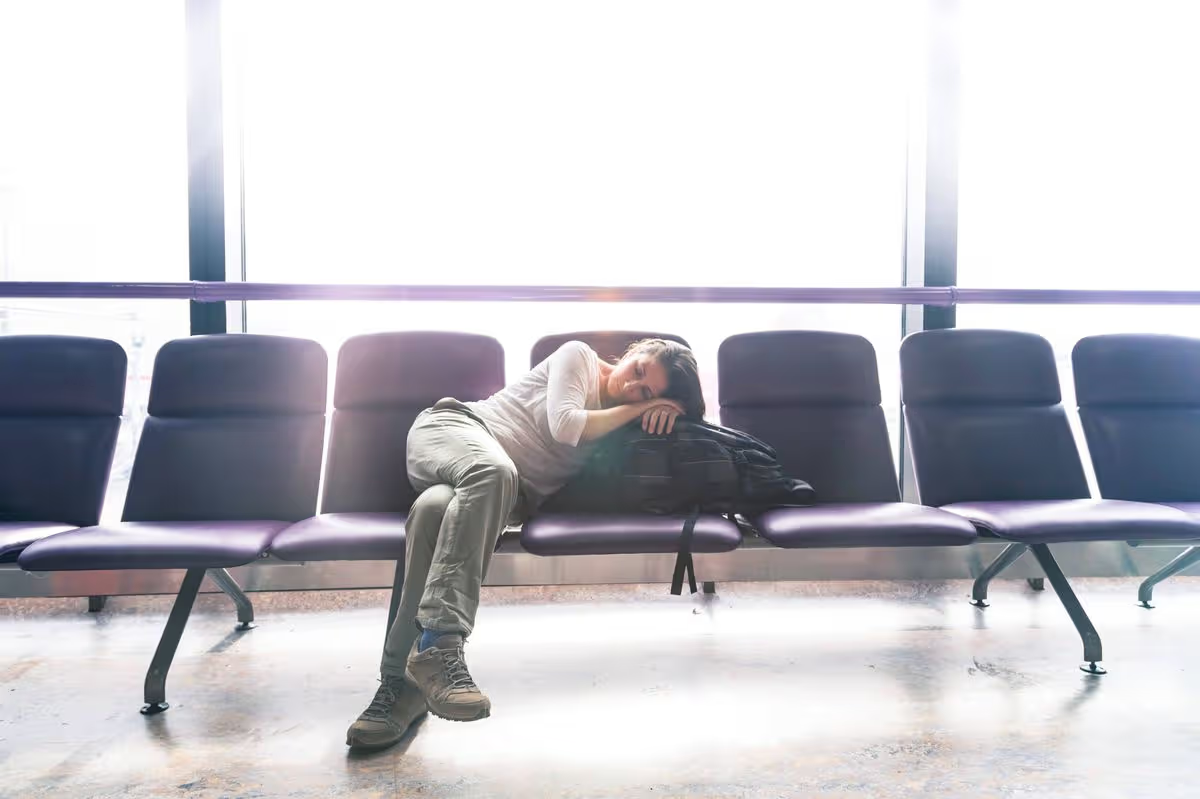
An airline captain with 35 years of experience shares his strategy for managing jet lag on long-haul flights cutting recovery time from days to just hours
Regular travellers will know the misery of jet lag(Image: TommasoT via Getty Images)
During the late 1970s, a new range of travel options opened for holidaymakers as transatlantic journeys became much more affordable. Yet whilst the monetary cost of long-haul travel has steadily declined, the toll it takes on the body has remained unchanged.
Jet lag stems from several contributing elements, including the oxygen-poor cabin environment on aeroplanes, but the primary culprit is an abrupt shift between time zones. The body’s internal clock cannot adapt swiftly enough, and it’s typical for long-distance passengers to experience sleep disturbances alongside digestive problems.
Flying eastwards can trigger particularly brutal jet lag, with over-60s generally suffering more severely than their younger counterparts. Veteran travellers often swear by solutions like melatonin or strong coffee, but naturally the best source of wisdom on combating jet lag comes from airline personnel themselves.
Alfonso de Bertodano, an airline captain with 35 years of experience, has a straightforward and proven strategy: “To avoid jet lag, if I’m going to be in a place for two or three days, I try to meet up with people who are eating lunch or dinner at their usual time. Otherwise, it will take you six days to get over it”.
Speaking to Mundo Deportivo, Alfonso continued: “The reality is that I try to change my schedule as little as possible. I arrive at my destination at 8pm, which is 2am in Spain, and I go straight to bed. I don’t go out for dinner, I don’t go out for a drink.”
Alfonso, an airline pilot who needs to be alert and refreshed for his job, shared: “I set myself a countdown of seven or eight hours and get up at whatever time it is, regardless of what time it is in that country.
“That way, I maintain my Spanish schedule. Because jet lag isn’t just about sleep. It’s about muscle tone, it’s about the digestive tract… It’s not the same to feed your body at 3 in the morning as it is to feed it at 10 or 11 at night.”
He emphasised that mingling with locals and adapting to their routine as swiftly as possible is the secret to overcoming jet lag. “The ideal thing is to be with people who are having breakfast, lunch or dinner at their usual time, and you’re with them maintaining neural activity, brain activity and muscle tone activity,” advised the pilot.
Alfonso further added: “You’ll adjust much more quickly than if you do it on your own. And when you return, it’s exactly the same. That’s why when you arrive, you might sleep for a little whilst, but I immediately set my alarm clock to wake myself up and get on with my daily life,” explained the aircraft commander.
“It’s tiring, but you get your body used to performing like that. In the end, you have to control your body because if you let your body control you, you’ll end up curing your jet lag, or getting over your jet lag, in six days instead of 24 or 48 hours.”
A SURGE in fuel prices due to the Middle East conflict has resulted in a major airline axing five per cent of its flights.
Air New Zealand announced that it will be cutting back on flights over the next two months.
Sign up for the Travel newsletter
Thank you!
Air New Zealand will be cutting back on its number of flights until MayCredit: AlamyThe crisis in the Middle East has resulted in the rising price of fuelCredit: Alamy
Chief Executive of Air New ZealandNikhil Ravishankar said the airline would see roughlya five per cent reduction in its services.
And that this would continue until the beginning of May 2026.
This reduction equates to around 1,100 flights which in turn will affect 44,000 passengers out of its 1.9million.
Talking to 1News Nikhil Ravishankar explained: “We’re focused on consolidating flights that are off-peak flying hours, for example, or where there is an alternative that we can re-accommodate customers.”
He later added that the, “interventions we’re putting in place are not only reasonable, but are what all airlines around the world are doing”.
Air New Zealand said that most of the passengers affected would be moved onto other flights.
The airline has not provided a list of affected flights, but some officials in New Zealand have revealed domestic routes have been altered.
Mayor Nadine Taylor said that Air New Zealand intends to reduce its routes from Marlborough to Wellington, with Auckland and Christchurch flights also affected
The airline detailed that fewer long-haul flights would be cut.
MR Ravishankar said: “People want to get to Europe still, and over the US airspace we can get them into Europe, and that’s what we’re focused on doing.”
The announcement comes shortly after Air New Zealand increased its prices in response to the rising cost of fuel.
Domestic flights were going up by $10 (£4.37) one way, short haul by $20 (£8.74), and long haul $90 (£39.35).
As a result, it’s not just Air New Zealand that has increased its ticket prices – other airlines like Qantas and Scandinavia’s SAS have done the same.
However, some airlines like Ryanair, easyJet, British Airways and Virgin Atlantic, are less affected because they have secured some of their fuel at fixed prices for a set amount of time.
Ryanair boss Michael O’Leary said the rise in jet fuel “won’t affect our costs and it won’t affect our low fares”.
“I sometimes feel like the mayor of Larchmont,” Rosenthal says over the phone as he greets diners who notice him at the counter. “When people come in and realize I’m involved, they’re always surprised to see me. It’s a bit like being at Disneyland and running into Goofy.”
In Sunday Funday, L.A. people give us a play-by-play of their ideal Sunday around town. Find ideas and inspiration on where to go, what to eat and how to enjoy life on the weekends.
Rosenthal is probably best known for creating the popular TV show “Everybody Loves Raymond” and hosting Netflix’s “Somebody Feed Phil,” which is moving to YouTube in 2027, but he is more than just a famous foodie. He’s now touring the country for his live show, “An Evening With Phil Rosenthal,” and he recently published his second children’s book, “Just Try It! Someplace New!,” which he wrote with his daughter Lily. (They’ll sign books at Barnes & Noble at the Grove on March 14.)
“The book series started when my daughter called and said, ‘Kids love your show. Why don’t you do a kids’ book?’ “ he says, before adding with a laugh: “I told her, ‘Yes, if you’ll do it with me.’ That’s a dad trick to get more time with your daughter.”
Rosenthal believes stories about kids feeling nervous or afraid to try new things connect with both children and adults. “When you write a kids’ book, you realize that it is not just a kids’ book,” he says. “It’s really a book for everyone.”
Although he travels a lot, Rosenthal likes to spend Sundays close to home. He enjoys walking his dog Murray to Larchmont Village and hosting movie night with friends at his place in Hancock Park.
Here’s what his perfect Sunday in L.A. looks like, with lots of good food along the way, of course.
This interview has been lightly edited for length and clarity.
7:45 a.m.: Coffee with Murray and neighborhood friends
Every Sunday morning, I walk my dog Murray to Larchmont Village and stop at Go Get Em Tiger. It’s our daily ritual. Over time, we’ve built a great community there, and I always invite others to join us. We sit outside, talk and have become close friends. I usually post a photo of Murray on Instagram each day. He’s a rescue mutt, and I like to joke he’s part Pyrenees, part psychopath.
9 a.m.: Shop for produce at the Larchmont Village Farmers’ Market
After about an hour, I head across the street to the Larchmont Village Farmers’ Market, which is held on Wednesdays and Sundays. I usually pick up some fruit for the house. It’s a great community spot.
9:30 a.m.: Breakfast at Max and Helen’s
Next I walk down the street to Max and Helen’s, the diner my family opened. I’m about to order the L.E.O., which is Gingrass Smoked salmon lox, three eggs and onions. So if I sound like my mouth is full, you’ll know why.
One of my favorite things on the menu is the sourdough waffle Nancy [Silverton] created, topped with butter mixed with maple syrup. I also love the hot chocolate, and the tuna melt is a special, more romanticized version of the classic. If you eat there every day, it’s smart to pick something healthy, like I’m having today — high protein and no carbs.
11 am: Browse titles at a neighborhood bookstore
I love visiting Chevalier’s Books, the oldest independent bookstore in Los Angeles. I’ve been going there since I moved to Los Angeles from New York in 1989. It’s just two doors down from the diner and feels like our community bookstore.
Noon: Hit the gym
Afterwards, I walk home and fit in a workout. I have to exercise every day because I eat a lot. If I didn’t walk everywhere, I’d probably weigh 300 pounds. My gym is simple — just some weights and a bench — but it works for me. Since I travel often, I stick to a routine I can do anywhere.
1 p.m.: Enjoy a surprising meal at a Michelin-noted restaurant
If I weren’t hosting movie night, I’d love to stop by République. It’s an amazing place, maybe the best restaurant in L.A. Every menu is great. I usually eat just about anything there, and sometimes I ask them to surprise me. It’s an all-day restaurant and I’ve gone for breakfast, lunch and dinner. Their egg dishes are excellent, the burger is top-notch and the roasted chicken, which is cooked over an open fire in the kitchen, is superb. I often let the chef decide what to bring me, especially when I’m with a group. It’s fun to be surprised and try shareable dishes.
I also really enjoy Connie and Ted’s in West Hollywood, Michael Cimarusti’s casual spot. The seafood is just as good as it is at Providence, his fine dining place. Their fresh Maine lobster roll is excellent, and they have the best oysters in L.A. It’s pretty awesome. Check before you head over there, though, as I’ve heard it’s for lease.
3 p.m.: Go for a hike
I used to hike more before I started traveling so much, but I still enjoy it. After all, this is L.A. While other places deal with bad weather, we get to be outside. I love hiking in Runyon Canyon and Griffith Park. It’s great to make the most of the outdoors here.
6 p.m.: Movie night and Pizzeria Mozza at home
On Sundays, we host movie nights at home. We have a dedicated screening room, a wood-burning pizza oven in the kitchen and a chef from Pizzeria Mozza, who comes over to make pizza. The best part is that someone connected to the film often joins us. Sometimes we watch new movies, other times old favorites. Aaron Sorkin came for “The Social Network,” and when we screened “Tootsie,” Elaine May, Dustin Hoffman and Bill Murray joined us. We usually have about 25 to 30 people.
I really love my neighborhood and the people in it. One of the best things about traveling so much is that it makes you appreciate home even more.
I’ve had my fair share of bad neighbors over the years. Ones who’d stomp their feet above my bedroom at odd hours of the night or who’d block my parking garage without warning every time they had guests over. Talking to friends in L.A., such experiences seem to be the norm rather than the exception — people either have gripes about their neighbors or no feelings at all. A Stanford study showed that the percentage of Americans who frequently interact with their neighbors declined among all age groups from 2017 to 2023.
As someone who doesn’t live near any family, I know that good neighbors can be a godsend. And though I’ve had some questionable ones, I’m lucky to have also had some of the best. Like Joseph, who let me borrow his portable air conditioner — and even installed it — when a heat wave hit Los Angeles. Or Mr. Art, who’d close my garage whenever I was in a hurry and forgot to do it. And my current neighbor, Ms. Cassandra, who always makes sure to save me a plate when she grills her mouthwatering barbecue ribs.
Neighbors can become your friends — or even your family. That’s why we’re looking for Los Angeles’ most neighborly neighbors. And we want you tell us about yours. What’s the most remarkable thing they’ve done for you, big or small? Did they lend you a cup of sugar when you were baking a five-layer cake? Did they offer you a ride to work? Did they babysit for you last minute? Or invite you over for a holiday dinner so you wouldn’t have to spend it alone?
Nominate your favorite neighbor below. We may feature them in a future story.
Visiting this Spanish archipelago is like winning the lottery
A short ferry ride from Vigo (daily and overnight visitor numbers are capped) took us to the tiny archipelago of the Cíes Islands, a protected cluster of islands where seabirds rule and tiny beaches remain unspoilt. There are no cars on the island and only a few small restaurants dotted about. There is one campsite, with little else but the waves of the Atlantic to lull you to sleep. I felt as if I had won the lottery when we visited and knew this would be an experience not easily matched. Helen E
Ischia in Italy is best by bus
Ischia, in the Bay of Naples. Photograph: Alxpin/Getty Images
Italy has brilliant public transport. We found it so easy to use the ferries and buses during our visit to Ischia in the Bay of Naples. The simple circular routes on the island mean there is almost zero chance of getting lost. You can buy a day ticket for a few euros, hopping on and off at your leisure until quite late in the evening. Much more fun to experience the lovely island like the locals and cheaper than a taxi. Jane
Profile
Readers’ tips: send a tip for a chance to win a £200 voucher for a Coolstays break
Show
Guardian Travel readers’ tips
Every week we ask our readers for recommendations from their travels. A selection of tips will be featured online and may appear in print. To enter the latest competition visit the readers’ tips homepage
–
A serene corner of Elba
‘Heaven’ … Cavo on Elba, in Italy. Photograph: Image Professionals/Alamy
Tiny Cavo on the island of Elba is my idea of heaven. Some of the hydrofoils from Piombino on the mainland stop there; some continue round to the busier Portoferraio with its mega yachts and bustle. Cavo is much quieter, more serene, and the iron-rich landscape means that the sea glitters with tiny flecks of iron as you swim underwater. A few hotels, a beach, prawns the size of your head, a jazz festival in the summer: what’s not to like? Porto Azzurro is more glamorous, but the quiet of Cavo is what I want. Angharad
An overlooked Greek island
The Temple of Aphaea at Aegina, in Greece. Photograph: Panagiotis Karapanagiotis/Alamy
I recently revisited Aegina, off Athens, which was my childhood holiday spot for many years. It’s more than just “a small island near Piraeus”; it was once, very briefly, the capital of Greece and still has impressive ancient temples from a time when it stood strong among larger Greek city states. The town has changed, but it was great to see once again the port with its colourful mansions, market, and the mix of boats bobbing in the water. Returning felt like a trip down memory lane, and I’m grateful that Aegina remains charming and slightly off the usual tourist path. Michael Castelli-Coats
For a nostalgic escape, head to Rügen, Germany’s Baltic jewel and largest island. Famed for its white chalk cliffs, the island’s soul lies in its fine sands and unspoilt towns. In Binz and Sellin, ornate belle époque villas line the promenade, feeling wonderfully frozen in time. We took the Rasender Roland steam train from Putbus to Göhren, stopping at charming seaside resorts along the way. Whether soaking up the architecture or lounging in a wicker strandkorb (beach basket), Rügen is a masterclass in coastal serenity. We stayed at Hotel Am Meer & Spa (€165 B&B) and enjoyed its panoramic views. Daniela
The UK’s ultimate north
A puffin in Hermaness national nature reserve, on Unst, in the Shetland Islands. Photograph: FLPA/Alamy
Unst, the UK’s most northerly inhabited island, is reached via two small ferries through Shetland. The journey is part of the pleasure. Rolling, heather-covered hills greet you. Hermaness national nature reserve is a highlight, with boardwalks to dramatic cliffs and the UK’s northernmost point. May to August offers the best chance of good weather and puffins, though neither is guaranteed. Nor were the otters that we glimpsed. Richard Waters
Kayaking around Vis, Croatia
‘You can kayak round the island in a week’ … Stiniva Beach on Vis. Photograph: Mauritius Images/Alamy
The cliffs on the north side of the Croatian island of Vis rise straight up from the sea, a crumpled mass of limestone. You can kayak round the island in a week – if the weather gods are kind – but it’s the desolate north coast that makes the greatest impression. Eleonora’s falcons nest there and screech as you paddle past. At one point along the shore, a blowhole erupts in a burst of spray with each wave. Small bays with sandy beaches let you take a break from kayaking, but you won’t see another person until you reach Vis port, tired but deeply satisfied. Andrew Cassely
A timeless slice of village life in Sicily
‘Sicily slowed to a human pace’ … The hilltop Novara di Sicilia. Photograph: Danita Delimont/Alamy
Perched high in the Nebrodi mountains, Old Noar Villa in Novara di Sicilia offers a rare kind of island escape: Sicily slowed to a human pace. Fruit trees, grapevines and walnut trees surround the house, scented by mountain air and deep quiet. Ancient churches and a beautifully preserved 200-year-old theatre anchor village life, alongside the butcher, baker and biscotti maker, cafes and softly buzzing bars. The sea is never far – the almost Grecian Aeolian Islands are just a hop away. Neil Masey
Cycle to huge beaches off the Netherlands
‘One of the largest beaches in Europe’ … at Schiermonnikoog. Photograph: Westend61/Alamy
Schiermonnikoog is well off the beaten track in the north of the Netherlands. Only permanent residents are allowed to drive; everyone else cycles or walks. It has one of the largest beaches in Europe, where you can go seal spotting or birding. It’s brilliant for kids because there’s hardly any traffic – they can safely roam around by themselves. Sabine
Winning tip: We glimpsed our future on a Scottish island
Stags at Lochranza, on Arran. Photograph: John Rae/Alamy
Arran is stunning and diverse. We went just after finding out my partner was pregnant, so it holds a special place in our hearts. In Lochranza, we stepped off the bus and immediately saw a herd of deer and seals on the beach. We walked the rugged coast to Hutton’s Unconformity, where it was realised the Earth is millions not thousands of years old, and imagined our future. In the cosy community pub, a friendly barman shared his whisky knowledge. We returned for our first family holiday. We took a slower pace, pottering along the seafront and castle gardens in Brodick. Auchrannie spa pool was perfect for our baby’s first swim. We’ll go back again when he’s old enough to enjoy more of an adventure on Arran. Nic
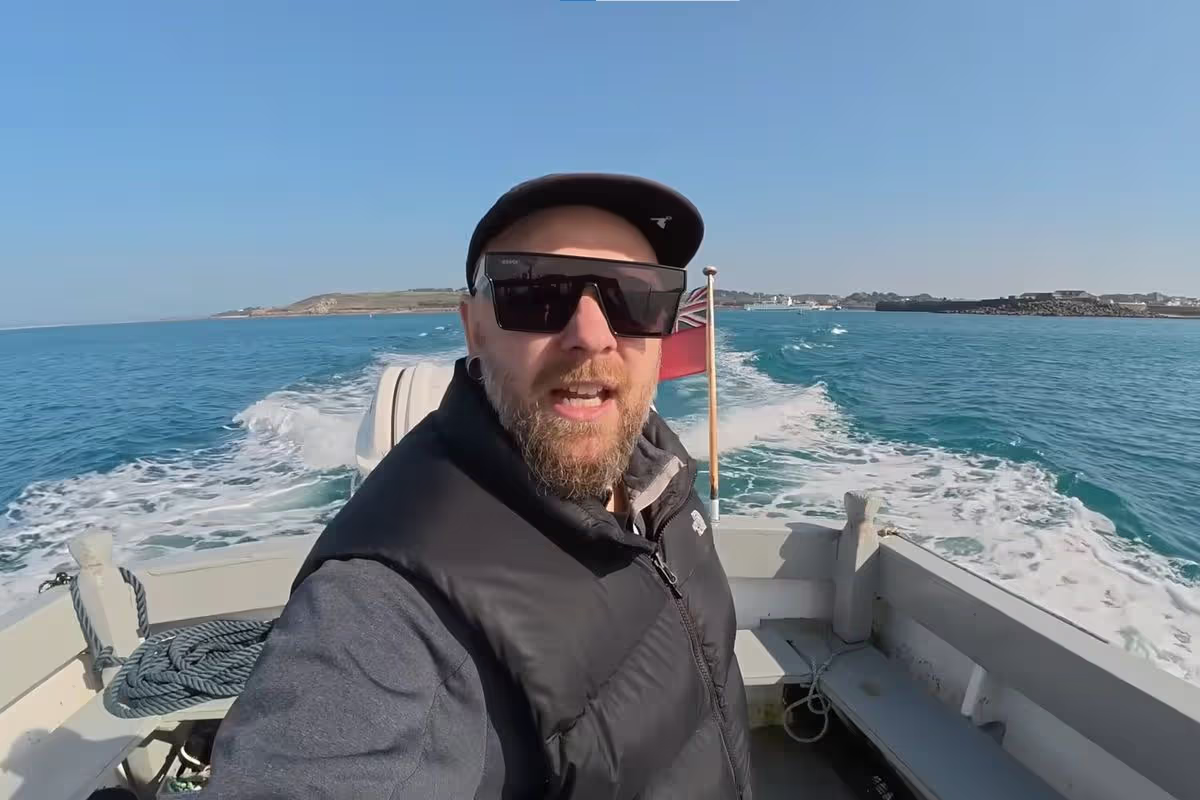
YouTuber Wendall flew to the Isles of Scilly off Cornwall and found stunning golden sandy beaches that he compared to the Caribbean, with experts also praising the remote islands as a UK paradise
YouTuber Wendall went to the Isles of Scilly(Image: YouTube/@WendallExplores)
A traveller who journeyed to some of England’s most isolated islands has insisted certain beaches rival those found in the Caribbean.
YouTuber Wendall, who shares content on the video platform through his eponymous channel, travelled to the Isles of Scilly. The Isles of Scilly comprise five inhabited islands including St Mary’s, Tresco, St Martin’s, Bryher, and St Agnes.
The Isles of Scilly are a compact archipelago situated just off the Cornish coast and have been recognised for generations as a location of significant interest and cultural value to the United Kingdom, reports the Express.
Whilst touring the region by boat, Wendall questioned the vessel’s operator about the standard of the beaches. He observed: “I’ve heard St Martin’s has got the nicest beaches.”
The boat operator responded: “It does have nice, golden, sandy beaches, yes. Nice golden sandy beaches.”
Wendall then remarked: “Caribbean-esque.”
Wendall isn’t alone in highlighting the Isles of Scilly’s beaches, with those at Tresco’s Pentle Bay also garnering considerable acclaim.
Specialists from GO Outdoors recently named Pentle Bay among the finest beaches to explore this spring, thanks to temperatures hovering around 10C and approximately 7.2 hours of daily sunshine.
This reputation is echoed in numerous Google Reviews. One visitor described it as “one of the most beautiful beaches I’ve ever seen,” while another called it a “mini paradise” and a “private gem.”
Discussing the subject, Calum Jones, author at GO Outdoors, commented: “As the days get longer and the weather warms up, spring is the perfect time to explore the stunning coastlines across the UK. From Druridge Bay Beach in the North East to Immeridge Bay in the South West, there are breathtaking beaches to discover all around the country.”
Beaches in this region are not the only ones to attract attention; Cornwall’s shores have also earned widespread acclaim, including Kynance Cove.
Located just a short drive from Falmouth, Kynance Cove has drawn comparisons to beaches on the opposite side of the globe in New South Wales, Australia.
Research conducted by Parkdean Resorts found that Kynance Cove boasts the whitest sand in the UK.
They stated: “Topping the list as the UK’s whitest beach is Kynance Cove in Cornwall. This Cornish cove boasts powder-soft sands made primarily of quartz, giving the beach its bright, white appearance. This breathtaking spot gives even Australia’s iconic coastline a run for its money.”
This article contains affiliate links, we will receive a commission on any sales we generate from it. Learn more
This is the best beach for spring(Image: Patricia Hamilton via Getty Images)
As temperatures begin to climb, thoughts naturally turn towards seaside escapes. There’s nothing quite like the sound of crashing waves and the sensation of sand between your toes – but with countless stunning locations dotted around the UK, how do you decide where to visit?
For an ideal spring beach getaway, you’ll want maximum sunshine, pleasant temperatures and minimal rainfall – and that’s precisely where the specialists at Go Outdoors come in. They’ve put together a ranking of Britain’s finest beaches based on average spring temperatures, precipitation levels, hours of sunshine and Googlereviews to identify the absolute cream of the crop.
Every beach featured received a rating out of 10 according to its weather conditions, rainfall and visitor feedback.
Taking the top spot is Cuckmere Haven with an impressive score of 9.60. This breathtaking beach sits in East Sussex and boasts a remarkable 7.8 hours of daily spring sunshine alongside just 52mm of monthly rainfall.
Those visiting the beach can first take in spectacular views of the Seven Sisters — England’s famous white cliffs overlooking the channel — before embarking on a picturesque stroll along the Cuckmere River as it winds its way towards the coast. Hear the cries of seagulls circling above, and feel the fresh sea breeze against your skin, reports the Express.
Claiming second position is Southwold Beach with a rating of 8.68 out of 10. This expanse of sand extends from the River Blyth’s mouth, passing Southwold Pier which offers plenty to discover.
There are arcade games and numerous cafés and restaurants where you can pop in for refreshments or a bite to eat. Securing the third spot, and boasting the highest Google review rating amongst all the beaches, is Druridge Bay Beach.
Google reviews rate this beach at a stellar 4.9 out of five, and the Go Outdoors research awarded it an impressive overall score of 8.53 out of 10.
The beach itself extends for seven miles, and the adjacent woodlands are teeming with wildlife such as roe deer and red squirrels.
I couldn’t stop looking at the thick bunches of California brittlebush, their bright yellow daisy-like flowers bursting alongside the sandy trail at Eaton Canyon.
I’d last walked the path a week after the Eaton fire, when I observed that “charred limbs of manzanita and other small trees and shrubs jerked out of the earth like seared skeletal remains. Heaps of leathery brown prickly pear pads sagged into the dirt and ash. Even the rocks were burned.”
Last Saturday, almost 14 months later, I marveled at how healthy Eaton Canyon looked as I attended L.A. County Department of Parks and Recreation’s launch of its Landscape Recovery Center. This is in large part thanks to volunteers who’ve dedicated hundreds of hours to restoring the canyon. I’m excited to tell you how you can be a part of those efforts.
You are reading The Wild newsletter
Sign up to get expert tips on the best of Southern California’s beaches, trails, parks, deserts, forests and mountains in your inbox every Thursday
The Department of Parks and Rec’s effort is a major step in repairing the damage wreaked by the Eaton fire that started Jan. 7 of last year.
The center includes a nursery full of native plants that will be used not only in Eaton Canyon but also in six other parks damaged by fire, including five in Altadena, and Castaic Lake State Recreation Area. Workers will also reestablish vital tree canopy lost in the fire, planting coast live oak, Engelmann oak and Western sycamores.
Native plants at the nursery at the Landscape Recovery Center at Eaton Canyon.
(Jaclyn Cosgrove / Los Angeles Times)
L.A. County is partnering with the Theodore Payne Foundation and the Altadena Seed Library to achieve two key goals: 1) Grow the plants in the recovery center’s nursery from locally sourced seeds. 2) Build decentralized seed banks by procuring seeds from L.A. County nature centers.
The latter involves the “process of conserving plant genetics by dehydrating and securely storing seeds for future potential restoration or research projects,” said ecologist Nina Raj, founder of Altadena Seed Library, who is working with the county to develop the seed bank project.
“By carving out space at existing nature centers for a bit of tabletop equipment and storage space, the seeds from their adjacent natural areas [will] be conserved alongside backup populations from partnering nature centers — like an insurance policy in case of, or rather, in preparation for the next natural disaster,” Raj said.
A path near the parking lot of Eaton Canyon Natural Area, as seen on Jan. 14, 2025, and on Saturday.
(Jaclyn Cosgrove / Los Angeles Times)
In the coming months, officials estimate that more than 100,000 seeds sourced from Eaton Canyon will be propagated to aid recovery efforts. The county has also purchased more than 1,000 native shrubs and understory plants, chosen not only for their ecological value but also their cultural significance to the San Gabriel Band of Mission Indians Gabrieleno/Tongva, whose leaders have been advising the county on its canyon restoration efforts.
The county also bought 200 native trees whose seeds came from “mother” trees grown in soil “extremely compatible with the organic matter here at Eaton Canyon,” said Norma Edith García-González, director of L.A. County Parks and Recreation.
All of this intentional sowing and planting is a 180-degree turn from previous recovery efforts. After the Kinneloa fire burned through Eaton Canyon in 1993, officials rushed to stabilize the hillsides. An expert team recommended grass seed be dropped from helicopters all over the hillsides, which present-day experts say may have introduced nonnative grasses to the region.
The nursery at L.A. County’s Landscape Recovery Center at Eaton Canyon.
(Jaclyn Cosgrove / Los Angeles Times)
“The Landscape Recovery Center represents a best-practice model for restoring nature, rebuilding habitat diversity and supporting disaster recovery,” García-González said. “[We are] rebuilding with intention, using climate-resilient native species informed by both ecological science and cultural knowledge.”
Most of Eaton Canyon, including its beloved nature center, burned in the 2025 fire. The recovery center’s modular building and the land around it are among the first built improvements, and the area now has electricity, water access, irrigation systems and restrooms. (The recovery center’s footprint is south of the burned nature center, and no announcement was made Saturday regarding when it might be rebuilt.)
These improvements will allow the Landscape Recovery Center, which will have five full-time and four part-time staff members, to host volunteers interested in caring for habitat, supporting the plant nursery or working in local outreach or on community science.
Volunteer events, including hands-on nursery work, will be scheduled Tuesday through Saturday, with times varying depending on the program. Those age 14 and older can sign up by calling or texting (626) 662-5091. (A quick note: Eaton Canyon remains closed to the public, outside of volunteer opportunities.)
A cultural sign welcomes visitors to Eaton Canyon.
(Jaclyn Cosgrove / Los Angeles Times)
Many volunteers have already been hard at work. Organized by the Eaton Canyon Nature Center Associates, volunteers have donated hundreds of hours to clear out short-pod mustard, castor bean, tree tobacco and fountain grass, which choke out native plants and serve as flashy fuel for wildfires.
All of this work must be done before hikers and other outdoors lovers can return to Eaton Canyon.
Jeremy Munns, a trails planner for L.A. County Parks and Recreation, said rebuilding the Eaton Canyon Trail and other county trails in the Eaton Canyon Natural Area will be part of a future phase.
The fire and subsequent flooding washed out the trail and caused hillsides to collapse into and around the canyon. Contractors, county staff and conservation corps crews will need to install retaining walls, repair drainages and add rock walls (called rock armoring) to stabilize the canyon and protect it from further erosion, Munns said.
A path near the Landscape Recovery Center.
(Jaclyn Cosgrove / Los Angeles Times)
Munns said there isn’t currently a plan to include volunteers in that work because of safety concerns.
“In the future, there will be opportunities for volunteers to help with the maintenance of these trails, but the timing of that has not yet been determined,” he said.
As I walked through the nursery during Saturday’s event, I found myself feeling hopeful. Several rows of California sagebrush, California buckwheat, chaparral beard tongue, sticky monkey flower and more sat in their pots, awaiting their new homes in the nearby ground.
It’s easy to imagine a future in which the entire canyon is healthy once again.
3 things to do
Workers tend to plants growing at the Santa Monica Mountains Fund seed farm.
(Jacsen Donohue / Santa Monica Mountains Fund)
1. Nurture yourself and nature in Newbury Park The Santa Monica Mountains Fund and Second Nature Collective will host a yoga and volunteer day from 8 a.m. to noon Saturday in Newbury Park. Participants will first be led through a 45-minute mindful and meditative yoga session before placing hundreds of native plants in the ground. Register at eventbrite.com.
2. Nosh on nonnative plants in Studio City Urban forager Nick Mann will lead a 3-mile foraging walk from 9:30 a.m. to noon Saturday through Fryman Canyon. He will teach participants how to identify edible nonnative plants commonly found along local trails. Donations requested but not required. Register at eventbrite.com.
3. Ride the river near Azusa Active SGV will host a 12.4-mile bike ride from 9 a.m. to noon Saturday along the West Fork National Scenic Bikeway north of Azusa. Carpooling is encouraged, as the parking lot at the trailhead fills up. Register at eventbrite.com.
The must-read
Condor A1 (a.k.a. Hlow Hoo-let) soars across the sky in far Northern California.
(Matt Mais / Yurok Tribe)
In a potentially historic win for condor conservation, Yurok wildlife officials say there might be a condor pair tending to an egg in the tribe’s Northern California homeland — where condors haven’t nested for more than a century. Times staff writer Lila Seidman wrote that condors vanished from the state’s North Coast because of violence carried out by European settlers. “The pair believed to be nesting in Yurok country were captive born and released in 2022, as part of the first group reintroduced in that region,” Seidman wrote. “The pair, formally known as A1 and A0, are the oldest birds from their release cohort at nearly 7 years old — and the only ones old enough to reproduce.”
Happy adventuring,
P.S.
It’s officially baby season at the San Dimas Raptor Rescue. The L.A. County facility, which rehabilitates birds of prey, took in its first great horned owlet in early February. The center anticipates taking in dozens of great horned owlets who are found starving and need to be nursed back to health before being released. Generally, the center tries to release a bird back to the area where it was found. In this little baby’s case, that would be Venice Beach. The center is run, in part, by volunteers who are trained by the county before working with the birds. If you ever find a raptor that you perceive is in need, you can call the center at (626) 559-5732 before interacting with the animal. A great service to our local wildlife!
For more insider tips on Southern California’s beaches, trails and parks, check out past editions of The Wild. And to view this newsletter in your browser, click here.