Police in the Australian city of Sydney have used pepper spray against pro-Palestine protesters who have rallied against a visit by Israeli President Isaac Herzog.
A journalist with the AFP news agency witnessed police arresting at least 15 demonstrators during the confrontation on Monday. Media members covering the event were also affected by pepper spray.
Thousands of demonstrators gathered in Sydney’s business district with more protests planned across the country on Monday night.
In Melbourne’s city centre, simultaneous protests took place with participants demanding an end to Israel’s occupation of Palestinian territory. About 5,000 protesters gathered outside downtown Flinders Street Railway Station before marching several blocks to the State Library, blocking evening peak-hour traffic, according to police.
The protests continued despite Palestine Action Group organisers losing a court challenge of a police order barring them from marching from the Town Hall in Sydney to the New South Wales Parliament.
A 20-year-old woman was arrested after allegedly burning two flags and causing fire damage to a tram stop. Police released her but said she was expected to face wilful damage charges.
Activists said Herzog, whom a United Nations commission of inquiry has found to be responsible for inciting genocide against Palestinians, should not be immune to protests.
“President Herzog has unleashed immense suffering on Palestinians in Gaza for over two years – brazenly and with total impunity,” Amnesty International’s Australia chapter said. “Welcoming President Herzog as an official guest undermines Australia’s commitment to accountability and justice. We cannot remain silent.”
Herzog characterised the protests as mostly attempts to “undermine and delegitimise” Israel’s right to exist.
Earlier, Prime Minister Anthony Albanese had called for respectful behaviour during Herzog’s visit, noting he would join the president to meet families of the victims of the December Bondi Beach mass shooting.
New South Wales authorities implemented recently expanded police powers under new protest management legislation. Protesters’ legal challenge to these measures was rejected by the state’s Supreme Court shortly before the demonstrations began.
Herzog had earlier laid a wreath in the rain at Bondi Pavilion to honour victims of the attack that killed 15 people during a Hanukkah celebration.
The Israeli president began his four-day Australian visit there. He also met with survivors and victims’ families.
“This was also an attack on all Australians,” Herzog said at the site. “They attacked the values that our democracies treasure, the sanctity of human life, the freedom of religion, tolerance, dignity and respect.”
“I’m here to express solidarity, friendship and love,” he added.
SHAKIRA suffered a nasty fall during a live stage performance over the weekend, with the singer twisting her ankle in the middle of her concert.
The Columbian star, 49, was performing in San Salvador on Saturday when she left fans worried during a mid-song tumble.
Sign up for the Showbiz newsletter
Thank you!
Shakira suffered a nasty fall during her live tour show on Saturday night in San SalvadorCredit: Jam PressThe star twisted her ankle and tumbled over while walking across the stageA loud gasp could be heard throughout the crowd as she fell to the floorCredit: Jam Press
Singing her hit song Si Te Vas during the night, Shakira was walking across the stage when her right ankle suddenly twisted.
She then completely toppled to her side, falling onto her elbow as she brought her microphone stand down with her.
During the moment, Shakira stopped singing as gasps could be heard amongst the audience.
But ever the professional, she quickly got herself back up and managed to continue the song – with the star’s band continuing as her guitarist cheered her on.
Seeing the funny side of the accident, Shakira later took to her Instagram Stories to share the clip as she wrote in Spanish: “Don’t worry, I’m made of rubber hahah”.
She said on The Tonight Show with Jimmy Fallon in 2024: “I’ve been putting out music here and there but it was really hard for me to put together a body of work.
“I didn’t have time because of the husband factor.
“Now I’m husbandless. Yeah, the husband was dragging me down. Now I’m free. Now I can actually work.”
Referencing the name of her album, she giggled: “It’s men’s turn now.
“For too long we have been sent to cry with a script in our hands and without an end just because we are women.
Handling it like a champ, Shakira quickly got back up on her feetThe performance was part of her Las Mujeres Ya No Lloran World Tour, which wraps up in AprilCredit: AFP
Russian authorities on Sunday announced the arrest of a suspect in Friday’s failed assassination attempt of Lt. Gen. Vladimir Alexeyev. File Photo by Russian Defense Ministry/EPA
Feb. 9 (UPI) — Two detained Russian nationals have confessed to their roles in the failed assassination attempt of a senior military general, Russia’s Federal Security Service said Monday, as Moscow sought to bolster its claim that Ukraine was behind the attack.
Lt. Gen. Vladimir Alekseyev was seriously wounded Friday when he was shot by an assailant in Moscow. Authorities said Alekseyev was inside a residential building on Moscow’s Volokolamskoye Highway when the attack occurred.
Lyubomyr Korba, born in 1960 in what was then the Ukrainian Soviet Socialist Republic, was arrested over the weekend in Dubai and extradited to Russia. Viktor Vasin, born in 1959, was arrested by Russian authorities in Moscow.
Russia’s intelligence agency FSB said in a statement Monday that both men “confessed their guilt” and described the attempt on Alekseyev’s life.
According to the intelligence agents, Korba was the alleged shooter and Vasin an alleged accomplice.
The FSB accused Korba of entering Alekseyev’s apartment building and waiting for the general to appear in the lobby. Four shots were fired. The pistol, previously identified as a Makarov-type firearm fitted with a suppressor, was discarded at the scene, after which the suspect fled.
Within hours of the shooting, Korba had allegedly boarded a plane for the UAE and was detained in Dubai by local authorities at the request of Russia.
The Investigative Committee of the Russian Federation on Sunday said in a statement that Korba arrived in Moscow late last year “on assignment from the Ukrainian special services to carry out a terrorist attack.”
On Monday, the FSB accused Korba of being recruited by the Security Service of Ukraine in August. He is alleged to have conducted surveillance on senior Russian military officials in Moscow at Kyiv’s instruction.
Russian intelligence said Korba allegedly retrieved the gun and an electronic key for the apartment building from a drop location in Moscow.
Vasin is alleged by Russian agents to be a supporter of the Anti-Corruption Foundation, an organization designated by the Kremlin as a terrorist organization and founded by the late opposition leader Alexei Navalny who died in a Russian penal colony on Feb. 16, 2024.
The FSB accuses Vasin of having rented a “covert residence” for the operation as well as having provided Korba with public transportation tickets.
A third suspect, Zinaida Serebritskaya, born in 1971, is alleged to have lived in the same apartment building as Alekseyev and to have supplied the electronic key used for the alleged shooter to gain access to the target.
The three were identified as suspects in the attempted assassination on Sunday, when the FSB said in a statement that Korba had been handed over to Russia by the UAE.
Neither UAE nor Dubai authorities have confirmed the arrest nor offered details on the operation.
State-run Russian news has published FSB-released video showing the suspect Korba handcuffed and blindfolded being escorted off a plane by masked men and seemingly onto the tarmac of a Russian airport.
Korba has been charged with attempted murder of a service member and illegal possession of firearms, according to the investigative committee.
Russian authorities said Vasin was detained in the Moscow region and is facing the same charges as Korba.
Russia’s Investigative committee said Serebritskaya has left Russia for Ukraine.
Alekseyev, 64, is a senior official in the General Staff and is accused of leading intelligence supporting Russia’s February 2022 invasion of Ukraine.
Tim Allan steps down a day after Starmer’s chief of staff, Morgan McSweeney, quits, adding pressure on the PM.
Published On 9 Feb 20269 Feb 2026
Share
United Kingdom Prime Minister Keir Starmer’s communications chief, Tim Allan, has stepped down as the leader of the governing Labour Party faces fallout from the Jeffrey Epstein scandal.
The move on Monday came a day after Starmer’s chief of staff, Morgan McSweeney, also quit.
Recommended Stories
list of 4 itemsend of list
“I have decided to stand down to allow a new No. 10 team to be built,” Tim Allan said in a short statement.
Starmer has come under criticism for appointing Peter Mandelson as ambassador to the United States despite his known links to Epstein, a convicted late US sex offender.
The prime minister said on Monday politics should be a force for good and emphasised the importance of moving forward after the resignations.
“We must prove that politics can be a force for good. I believe it can. I believe it is. We go forward from here. We go with confidence as we continue changing the country,” Starmer told his Downing Street staff.
Mandelson has been under investigation since his name appeared in files on the Epstein investigations released by the US Department of Justice.
He was sacked by Starmer in September over his friendship with Epstein and last week also quit the Labour Party and House of Lords, the upper chamber of the UK Parliament. The Foreign and Commonwealth Office said it is reviewing an exit payment made to him after he was fired.
The photograph is so intimate, so vulnerable, it’s painful to look at.
It depicts a woman in her early 20s lying on a hospital bed twisted to the side, her wrists and ankles restrained. The black-and-white image — nearly five feet wide — is so crisp that bits of the woman’s toenail polish glimmer and the hair on her thigh appears to spark. Most pronounced: the loneliness and resignation on her face.
“I was 20 or 21 then. I’d had a psychotic episode and was taken to a public hospital in Massachusetts,” says Palm Springs-based artist Lisa McCord of the self-portrait she later staged. “I’m very transparent and I wanted to share my experience afterward. It was the ‘70s. I’d tell people, in school, I’d been in a psychiatric hospital and no one wanted to hang out with me — it was a very lonely time.”
McCord’s work is part of an exhibition at the Los Angeles Center of Photography addressing the idea of loneliness, now considered an epidemic in America. The exhibition, “Reservoir: Photography, Loneliness and Well Being,” was curated by LACP‘s executive director, Rotem Rozental, and includes participation from more than 40 artists representing “a wide array of geographies, approaches, ages, nationalities and lived experiences,” she says.
Rozental had been thinking about loneliness in our society — how increasingly pervasive it is — since the start of the pandemic. In late 2024 she began having conversations about it with LACP board chair and artist Jennifer Pritchard. Art reflects the world that we live in and Rozental felt that, as a photography center, LACP had an obligation to amplify “some of the larger issues” our society is grappling with.
“There’s something about photography that really brings people together around their vulnerabilities,” Rozental says. “Even if it just means you’re seeing, through an image, that someone else is experiencing what you’re experiencing.”
In this case: loneliness — “something that is looming heavy on everybody,” Rozental adds.
Asiya Al. Sharabi’s “Inward” (2025) addresses the uncertainty, and sometimes loneliness, of being a woman and an immigrant.
“Most recent studies indicate that 50% of Americans are often lonely,” Nobel says, adding that a December 2025 study found that “loneliness is increasing, even after the pandemic. And it’s driving a change in behavior, the big one being that people are disengaging from each other and community activities, so that also isolates them.”
What’s more, chronic loneliness has tangible, dangerous effects on our health, he says.
“Loneliness increases the risk of heart attack and stroke and general early mortality by up to 30%. Dementia risk goes up by 40%, diabetes risk goes up 35% from being chronically lonely. That’s increased the urgency to address it as a public health crisis.”
It’s important to note, Nobel says, that there’s a difference between being alone and being lonely, with the former potentially good for your health.
“Being alone means you don’t have social connection. Loneliness is the subjective feeling that you don’t have the social connections you want,” Nobel says. “You can be lonely in a crowd, you can be lonely in a racist workplace, you can be lonely in a failed relationship or marriage. But being alone can actually be quite positive — solitude. You can be in touch with thoughts and feelings and can have emotional growth.”
Nobel consulted with many of the artists during the development of “Reservoir.” It was a natural pairing as his more than 20-year-old nonprofit, the Foundation for Art & Healing, explores how creative expression helps individuals and communities heal. The experience “definitely validated ‘how do creative people use their creative orientation to further explore and reveal what’s going on with loneliness,’” he says. “That’s the power of this exhibit.”
A detail shot from Diane Meyer’s “The Empty Space of Nothing #43” (2025)
(Diane Meyer)
To create the exhibition, Rozental selected six photographic mentors, all established artists, each of whom chose a theme around loneliness — “aging,” “immigration,” “technology and hyper-consumerism” or “the solo creative process,” for example. The mentors then invited artists to create new work responding to their themes. Over nine months last year, the groups of artists met monthly on Zoom — “six countries and seven time zones,” says Rozental — along with therapists, scholars and others to plumb the topic.
The resulting exhibition features mostly two-dimensional photography but also includes multimedia works and 3D installations.
L.A.-based artist Diane Meyer sourced about 100 old black-and-white photographs from private collections. Then she hand-painted each of them, blocking out most everything in the image except select figures with white paint. The individuals in the photos appear to float in a sea of clouds or snow, disconnected.
In one image, two young boys teeter on a seesaw, as if suspended in midair; in another, a middle-aged man lies on a blanket in the fetal position, white paint spilling over onto his blanket and body, as if he is sinking into a void. The creative process — which the work speaks to — is evident here, the artist’s hand noticeable. The paint is splotchy in places and the photographs are pinned delicately to a dark surface, their edges curling, giving the overall installation a textured materiality.
Meyer’s work is in stark contrast to Jacque Rupp’s installation on the opposite wall. Rupp’s slick multimedia work speaks to both technology and societal perceptions of aging women. After recently becoming a grandmother, the Bay Area-based artist asked AI to “imagine a grandmother in 2025.” The result is a black-and-white photo grid of several hundred female faces staring blankly into the camera, mouths closed and eyes vacant. Beside it is a TV monitor on which their faces morph into one another, without audio. The overall effect is polished and high-tech, touching on the perceived invisibility of women as they age.
“I felt that these two works needed to be in conversation,” Rozental says.
Julia Buteux’s “Have We Said Hello” (2025)
(Rotem Rozental)
Nearby, Julia Buteux’s three-dimensional installation of transparent fabric panels hang from the ceiling, shimmying in the air and inviting guests to walk around it. The Rhode Island-based artist downloaded images from social media and deleted the people from them. The backgrounds are colorful but all that’s left of the subject is a transparent imprint of their face and upper body. “So you’re getting the absence of the user,” Rozental says. It speaks to how isolating online social milieus can be.
Asiya Al. Sharabi — who is Yemeni American and lives between Egypt and Virginia — created large-scale, conceptual self-portraits that she manipulated in the printing process. One is a double exposure depicting the front and side of her face. It addresses issues of duality and the uncertainty of her standing in society as both a woman and an immigrant. In another, the artist sits in a rocking chair in a home beside a vase of dead flowers — but her body is transparent. “She almost disappears within the domestic space,” Rozental says.
McCord’s photograph is part of a larger interactive installation that includes a “visual diary” guests can flip through featuring photographs of her life over the decades paired with handwritten diary entries from 1977 to 2021. McCord narrates snippets from the diary, which visitors may listen to on headphones.
“Reservoir” aims, of course, to shine a light on the condition of loneliness. But it also hopes to serve as a public health intervention by hosting creative workshops — incorporating the photography in the exhibition — to address loneliness and spark connection.
“Creative expression changes our brains,” Nobel says. “It reduces levels of the stress hormone cortisol, it increases the levels of the feel-good hormones, so you’re less anxious about the world and in a better mood. It’s then easier to engage with others. It invites us to be less lonely and more connected, not just to other people, but ourselves.”
The exhibition, which closes March 14, is planned to travel internationally, including to the Museo Arte Al Límite in Chile, the Inside Out Centre for the Arts in South Africa and to the Karuizawa Foto Fest in Japan. The goal is to use the workshop element as a model that can be replicated in community arts organizations around the world.
Rozental says photography is the perfect conduit for that, calling the medium “a language, a space for connection and communication.”
“We hope that people will walk into this space and see themselves on the walls,” she says. “Maybe their burden will ease a little bit by knowing that they might feel lonely, but they’re not alone.”
The advertisement featuring multiple survivors urges US Attorney General Pam Bondi to disclose all remaining files related to the late sex offender.
Published On 9 Feb 20269 Feb 2026
Share
Survivors of the convicted late sex offender Jeffrey Epstein’s abuse have renewed calls for the full release of government records tied to the disgraced financier’s sex-trafficking network, putting up an advertisement during the Super Bowl.
The advertisement, released by multiple survivors working with the group World Without Exploitationduring the National Football League’s (NFL) Super Bowl on Sunday, demanded that US authorities disclose all remaining files related to Epstein and his associates.
Recommended Stories
list of 3 itemsend of list
“After years of being kept apart, we’re standing together,” one female survivor said in the advertisement. “Because she deserves the truth,” says another, holding a photograph from her childhood.
The scene cut to a graphic reading “three million files still have not been released”, shown with black redactions. “Tell Attorney [General] Pam Bondi it’s time to tell the truth,” it added.
The advertisement was reshared by a number of US politicians and public figures, including Senate Democratic Leader Chuck Schumer.
The appeal from survivors comes after the US Department of Justice released three million pages last month related to Epstein, casting a spotlight on some of the world’s most prominent people and their relations with him.
The largest tranche yet of legal documents relating to the prosecution of Epstein for sex offences includes documents, as well as 2,000 videos and 180,000 photographs, and was released a week ago.
They have implicated many famous people, from princes to industry leaders, believed to have been part of Epstein’s vast network, including Andrew Mountbatten-Windsor, formerly Prince Andrew, billionaire Elon Musk, Microsoft founder Bill Gates and British politician Peter Mandelson.
Despite this latest disclosure, a group of survivors said some of their alleged abusers “remain hidden and protected”.
The documents were published under the Epstein Files Transparency Act, which President Donald Trump signed into law in November following pressure to make the files public.
Epstein died from apparent suicide in a New York jail cell in August 2019, a month after he was indicted on federal sex-trafficking charges.
The entrance of the Armenian Church in the Old City of occupied Jerusalem witnessed a new assault on Sunday, carried out by Israeli settlers. Surveillance camera footage and eyewitness testimonies showed several of them deliberately spitting in front of the church entrance, in a provocative attack that violates freedom of worship and targets Christian holy sites.
Local sources said Israeli occupation forces also raided the town of al-Issawiya, northeast of occupied Jerusalem, and the al-Bustan neighbourhood in Silwan, south of Al-Aqsa Mosque. The occupation forces were deployed in streets and residential areas, causing tension among residents.
The sources added that the occupation municipality in Jerusalem imposed a fine of 5,000 shekels on the manager of the post office in Silwan, claiming that a “no smoking” sign was not displayed, despite the sign being inside the office. The move was seen as part of ongoing administrative pressure targeting Palestinian institutions.
In the same context, Israeli forces raided shops in the Ain al-Lawza neighbourhood in Silwan and checked the identities of workers. This disrupted commercial activity and caused losses to local businesses.
These incidents come amid a series of continued violations targeting the holy city and its residents, as part of an ongoing escalation by Israeli forces and settlers against Palestinian neighbourhoods and holy sites.
This season’s Oscar nominees for film editing have one thing in common: coping with trauma. The Envelope invited editors from each film to break down a pivotal scene that showcased their craft.
‘F1’
“F1” builds momentum for its underdog tale with an intricately constructed racing montage.
(Warner Bros. Pictures)
Editor: Stephen Mirrione Scene: The montage in which Brad Pitt’s washed-up racer Sonny Hayes begins his winning streak through a momentum-building Grand Prix swing.
“There were more than a dozen structural versions of how we were getting through this story,” said Oscar winner Mirrione (“Traffic”). The three-minute, high-octane montage benefited from 5,000 hours of footage, captured with 20 cameras around the tracks. It was treated like a massive puzzle, with the racing order moved around for maximum impact. The key was seamlessly integrating in-camera footage with broadcast footage from actual races that offered happy accidents such as rain and a crash. “At one point, it was more focused on rookie driver Joshua [Damson Idris],” added Mirrione. “But then we realized that Sonny was more interesting, visually, in terms of his arc about dealing with the trauma of his near-fatal crash. And then once we saw it in context, it was not just about the two of them and their rivalry but also the team coalescing around Sonny.”
‘Marty Supreme’
A dinner in “Marty Supreme,” starring Timothée Chalamet as Marty Mauser, leads to a startling flashback.
(A24)
Editors: Ronald Bronstein, Josh Safdie Scene: The jarring dinner scene/Holocaust flashback introducing nasty businessman Milton Rockwell (Kevin O’Leary)
In this scene from the 1950s-set psychological drama, we get a glimpse of Marty’s (Timothée Chalamet) motivation for his obsessive pursuit of table tennis: Jewish pride and survival instinct. “The adversarial impulse of the Rockwell dinner scene involves several characters, each with a distinct subjective agenda,” said Bronstein. “The act of cutting the scene [with close-ups and extreme close-ups] became inseparable from its sensations and emotions.” Yet Bronstein pushed it to extremes with the bizarre Auschwitz flashback involving Marty’s dinner guest, Béla (Géza Röhrig). Thanks to his table tennis prowess, Béla disarms bombs for the Nazis in the woods. But when he discovers a beehive, he shares the honey with his fellow prisoners by smearing it over his body. “That’s like a carrot on a rope that’s hanging in front of me at all times, and when I get to the end of that exchange, I’m allowed to break free and go into an entirely new set of tools, which are much more expressive,” added Bronstein.
‘One Battle After Another’
Leonardo DiCaprio as Bob Ferguson, nearing the conclusion of “One Battle After Another’s” climactic car chase.
(Warner Bros. Pictures)
Editor: Andy Jurgensen Scene: The climactic roller-coaster car chase
Jurgensen assembled the best VistaVision car chase in history for Paul Thomas Anderson‘s turbulent father-daughter actioner. That’s where teenage Willa (Chase Infiniti) becomes the hero by outsmarting and killing the hired muscle (John Hoogenakker), who chases her up and down the rolling hills followed closely by Willa’s flummoxed ex-revolutionary dad, Bob (Leonardo DiCaprio). Shot at shaky high speeds, the scene actually took shape as a result of the unique San Diego location called the Texas Dip, which looks epic in the 8 perf/35mm horizontal format. The Hitchcockian cross-cutting among the three cars, favoring Willa’s POV, was achieved with close-ups from rearview and side mirrors. The layering of the propulsive soundscape and Jonny Greenwood’s percussive score completed the adrenaline rush. But the tender father-daughter reunion at the end required reshooting. “The moment Bob pulled up to the crash site, when we first did the scene, he ran over to her right away, and they embraced,” Jurgensen recalled. “When we watched the dailies, it just didn’t feel authentic. So we reshot it with more meat: Willa second-guessing everybody and Bob having to earn her trust by proving his identity with the secret code.”
‘Sentimental Value’
Renate Reinsve’s Nora plays a part in her father’s new film in “Sentimental Value.”
(Kaspar Tuxen Andersen)
Editor: Olivier Bugge Coutté Scene: Actor Nora Borg’s (Renate Reinsve) early stage fright breakdown
Joachim Trier’s family drama finds Nora confronting the Borgs’ generational trauma when she reunites with her estranged director father, Gustav (Stellan Skarsgård). After an opening montage on the layered history of their Oslo home, which Nora once wrote about in a school essay, our introduction to the adult Nora is conveyed by the chaos and humor of her panic attack before a performance. But finding this arresting sequence first required trimming a very long setup of patrons entering the theater and sitting down, and the camera discovering Nora, frozen in fear, in the back of the dark stage. “It was so boring,” Coutté insisted. “But here we’re starting right on Nora’s face. Where are we? Has she become an actress? And then you slowly understand. There are no rules; just rhythm.”
‘Sinners’
Jayme Lawson performs “Pale, Pale Moon” in a pivotal scene from “Sinners.”
(Warner Bros. Pictures)
Editor: Michael P. Shawver Scene: Pearline’s (Jayme Lawson) violence-inducing “Pale, Pale Moon” performance
In Ryan Coogler’s Imax spectacle, where the blues collides with vampires, the monstrous transformation commences with Pearline’s siren call: “Pale, Pale Moon.” This was Shawver’s boldest sequence, cross-cutting her mesmerizing performance with the rhythmic crowd stomping, the brutal beating of a card cheater and newbie vampire Mary (Hailee Steinfeld) seducing and murdering Stack (Michael B. Jordan). “When this was first cut together, it was about three or four times as long as the actual song that had been recorded and performed,” explained Shawver. “And so Ryan watched it and he liked what he saw, but he wanted to cut it to the length of the song. That first moment I wondered if I was the right editor, but that fear and anxiety gives you a bit of freedom to find those spiritual connections that built to this climax at the end. It was really just about Ryan’s ability to engage audiences on a personal level and unlock those things and find the ways that they can go together.”
Visits by Canadians to Florida dropped by 15% in the third quarter of 2025 as political tensions triggered by U.S. President Donald Trump’s imposition of tariffs and other economic factors extended a chill for “snowbird” travelers. File Photo by Graham Hughes/EPA
Feb. 9 (UPI) — As strained relations between Canada and the Trump administration enter a second year, the latest statistics and anecdotal evidence indicate the flight of Canadian “snowbirds” from Florida is still negatively affecting its vital tourism economy.
Angry Canadians have been engaged in an unofficial boycott of U.S. travel since early early last year, when a newly re-elected President Donald Trump began to repeatedly voice his desire to annex Canada as the “51st state” and slapped tariffs on broad sectors of the Canadian economy.
And rather than losing steam, the slowdown of Canadian visitors to Florida and elsewhere in United States appears to be holding steady if not picking up speed as the 2025-26 winter tourism season progresses.
Travel statistics recently released by Canadian and Florida officials are continuing to show the effects of the slowdown, which has been blamed not only on political tensions, but also on a weak Canadian dollar and other economic factors.
In November, the number of Canadian-resident return trips from the United States was down 23.6% year-over-year, Statistics Canada reported Jan. 23.
Meanwhile, Visit Florida reported that while overall tourism was up 3.2% year-over-year during the third quarter of 2025, visits by Canadians were down 15% and have plunged 28% when compared to 2019’s pre-pandemic levels.
The third-quarter total of 507,000 Canadian visitors was the lowest for any single quarter since the COVID-19-affected fourth quarter of 2021, when the state logged just 275,000 Canadians visitors.
After Florida Gov. Ron DeSantis initially dismissed reports of the sharp dropoff in Canadian visitors, state tourism officials now say they are planning to reach out to their North American neighbors in hopes of attracting more visitors.
Visit Florida President and CEO Bryan Griffin told members of the agency’s executive committee Jan. 26 he is setting up a meeting with Canadian officials to “see what we can do” to boost the flow of tourists, the News Service of Florida reported last week.
His task may be a big one, however, as the numbers continue their negative trends and seem likely to stay depressed, or perhaps even worsen, as the year progresses, according to a noted Canadian travel expert.
Frédéric Dimanche, a professor and former director of the Ted Rogers School of Hospitality and Tourism Management at Toronto Metropolitan University, said he’s not seeing any signs of the situation improving.
“I don’t think things have changed, and if you look at the recent Statistics Canada data for car returns and employment and this type of thing, it’s down,” he told UPI. “We’re still down, and what must be kept in mind is that last year was just the beginning of a trend that has since deepened or expanded.”
Dimanche predicted that as more tourism figures are released in the coming months, they will continue to show huge declines in Canadian tourist visits across the United States when compared to 2024.
“You really see how much of a gap there still is when you look back to two years ago,” he said, dubbing the phenomenon a “Trump slump” in which international tourism fell by 5.4% in the United States last year even while jumping by 4% around the rest of the world.
While cautioning that he “has no crystal ball,” Dimanche predicted last year’s trend, with its month-after-month declines, will continue into this year.
“It’s not going to stop because it’s 2026,” he said, noting that it’s not only Trump’s threats to Canadian sovereignty and his tariff policies, but also the strong U.S. dollar, aggressive immigration enforcement activities, perceived safety issues and the potential for social media screening at the border that are combining to “make people are feel very uncomfortable about going to the U.S.”
Gulf Coast tourism hard-hit
The effects of the Canadian tourism slowdown appear to be hitting Florida’s Gulf Coast the hardest, especially in the southwestern part of state in and around Lee and Collier counties, where snowbirds from north of the border have long-established ties with vacation rentals and homes and condos they own.
The issue remains a sensitive and politically fraught one in the region, and questions posed by UPI to local tourism officials and real estate agents who have Canadian customers, as well as to Canadian snowbird organizations, were met with “no comment” or were not responded to.
However, there is statistical and anecdotal evidence to suggest that southwestern Florida is feeling a keen economic impact during this winter tourism season.
Media interviews and online comments by Canadian travelers indicate the backlash to Trump’s policies is continuing unabated, with traffic at tourism-dependent Gulf Coast businesses down and Canadian homeowners rushing to sell their vacation properties.
Among the firsthand evidence of the plight faced by Gulf Coast businesses comes from Collier County, which includes such favorite Canadian tourism destinations as Naples and Marco Island. Tourism is the county’s largest industry, supporting nearly 30,000 jobs and generating more than $2.8 billion in direct economic impact annually.
County officials reported last month that November’s overall international tourism traffic fell by 10.8% compared with the year-earlier figure, including a 14.8% decline in Canadian visitors, who numbered just 12,000. Their share of the county’s overall tourism pie dropped from 5.9% from 6.7%.
Those numbers come on top of a “choppy” and “soft” local tourism economy since 2024, due not only to the decline in visits from Canada, but also broader economic trends such as stubborn inflation and lack of consumer confidence.
Sharon Lockwood, area general manager of the JW Marriott Marco Island Beach Resort, told the Collier County Board of Commissioners in September the slowdown is making a dent in the industry.
“I can tell you firsthand, I have lost some significant group business from Canada over the last two years, year and a-half, but most importantly in 2025 for future business,” she said. “So I’m going to be out looking for new business.”
The hotelier said she couldn’t justify hiring new workers.
“I don’t have enough hours for the individuals that I’m currently employing,” Lockwood said, adding, “Restaurants [on Marco Island] are closing down one or two days a week because they cannot afford the payroll to stay open full-time. It has not been that way since I’ve been down here.”
Meanwhile, there is unmistakable evidence that significant numbers of Canadian homeowners in Florida and elsewhere in the United States are seeking to put their homes on the market as they look to exit what they feel has become politically hostile territory.
More than half (54%) of Canadians who currently own residential property in the United States said last summer they were planning to sell within the next year, with most of them (62%) citing the actions of the Trump administration as the main reason, according to a survey conducted by real estate firm Royal LePage.
“Places like Florida, Arizona and California stand to lose millions in economic activity each year — and thousands of neighbors — if Canadian owners pull their capital from U.S. housing markets,” Royal LePage president and CEO Phil Soper said in a release.
Along the Gulf Coast, those Canadians are selling into a oversaturated market that is expected to take hard price hits during 2026, with likely declines of 10.2% in Cape Coral, 8.9% in North Port and 3.6% in Tampa, according to projections from Realtor.com.
In April, Budge Huskey, CEO of Premier Sotheby’s International Realty in Naples, Fla., called Canadians “integral to our housing market, especially along the Gulf Coast, contributing to community vibrancy, tourism, and property tax revenue,” noting in an opinion piece published in the Sarasota Herald-Tribune that they account for 11% of all foreign homebuyers in the United States, with Florida consistently ranked as their top destination.
“Yet, recent trade tensions have chipped away at that relationship,” he wrote. “Beyond the economic impact, rhetoric and policy decisions perceived as antagonistic have left many Canadians feeling unwelcome.
“In neighborhoods across our markets, including likely your own, it’s not uncommon to see ‘for sale’ signs on properties owned by Canadians who have decided they’ve had enough.”
Huskey implored all Floridians “to remind our northern neighbors just how much they are respected and appreciated.”
Dimanche said the trend toward Canadians selling their Florida homes is not only related to Trump, but also to economic concerns.
“One of the factors is that the Canadian dollar is still weak compared to the U.S. dollar, even though the U.S. dollar has gone down slightly the past couple of weeks,” he said.
“The Canadian dollar is very low, so that makes things a lot more expensive for the Canadians.
“The second thing is the price of home insurance has gone up and keeps going up in Florida,” he added. “This is related to global warming, which triggers hurricanes and rising sea levels. A lot of people may not be concerned about climate change in the U.S., but the insurers are paying attention to this and they make you pay for it.”
Politics, hostility determining factors
Some Canadian snowbirds are telling reporters and posting online that they are looking to move on from Florida due to politics and being made to feel unwelcome.
The Canadian Snowbird Association, a nonprofit group advocating for the interests of Canadians who live part of the year in the United States, declined to comment to UPI on how their members are viewing the political and economic tensions as the winter season continues.
But one member who posted about it in the organization’s “Bird Talk” forum in December summed up the feelings of many others who have made comments on social media.
“We believe in democracy and are leery of the current situation as snowbirds to Florida,” they wrote. “We are seriously considering not going south this winter. As we own a home there, we have also thought of selling. We are very sad as in the past 12 years, we have loved our winters south.
“Almost all our neighbors, family and friends have mentioned to us that we should not go; they won’t be going or visiting us. If we didn’t own, we absolutely would not go. And are close to being positive in not going even though we own a home there. We feel we must take a stand for democracy!”
The forum moderator responded that “hundreds of thousands of Canadians are going south for the winter. We suspect that many of them are doing it quietly,” while blaming the media “for negative stories and gets lots of attention when they amplify the rhetoric.
“Do what is right for you, your family and your conscience. Enjoy your winter and travel well!”
One Canadian couple, Gwen and Paul Edmond of Dartmouth, Nova Scotia, told CTV News last month they are selling their home at a seniors’ complex in Largo, Fla., after spending five months a year in Florida since 2011.
“We are not happy with the change in government, as many aren’t. We will just leave it at that, I guess. It feels very unsettled there,” Gwen Edmond said.
The Nordic noir thriller has been praised for its ‘excellent’ action and gorgeous visuals
Megan Nisbet Content Editor
10:45, 09 Feb 2026
The fourth series of a very popular thriller has just dropped on Channel 4(Image: Channel 4)
The fourth series of a very popular thriller has just dropped on Channel 4.
Arctic Circle is the latest box set to dop on the broadcaster’s streaming platform and has been described as a “gripping Finnish crime drama” that follows detective Nina Kautsalo as she investigates a string of dangerous cases that straddle the border between Russia and Finland.
The series first aired back in Finland in 2018 for four seasons, and now all of them are available to binge on Channel 4. Arctic Circle stars Iina Kuustonen in the lead role, alongside fellow cast members Pihla Viitala, Mikko Leppilampi, Venla Ronkainen, and Taneli Mäkelä.
The fourth season sees Nina, now chief of police in Ivalo, investigate a possible threat to an astrophysicists’ conference occurring during the rare Eiscat comet.
As her former boss Jaakko Stenius joins the inquiry, a carbon‑monoxide incident killing 24 care‑home residents, initially ruled accidental, reveals evidence of mass murder.
The synopsis reads: “When the rare Eiscat comet blazes across the endless night sky in its first appearance in two thousand years, it draws scientists from around the world to Ivalo for an international conference.
“After the FBI warns of a potential threat, Nina’s former boss, Jaakko Stenius (Kari Ketonen), arrives to lead a covert investigation with her. As they dig deeper, chilling links emerge between the comet and a fanatical sect determined to fulfill an ancient prophecy before the comet disappears again.”
Set in Lapland, the show has been praised by viewers for its “sublime” casting and gorgeous visuals.
One viewer wrote: “This series has it all: interesting story with multiple plot lines, nice balance between drama and thriller, good acting by everyone involved (Finnish actress Iina Kuustonen is a marvel to watch), and beautiful shots of vast snowy landscapes in Lapland.”
While another said: “Outstanding. This is a top quality show with fine performances and a terrific plot. Good production values with characters that are fully explored.”
Adding: “All good shows there must be an array of engaging characters. Artic Circle has that in spades. The countryside is both haunting beautiful and bleak. It’s an unforgiving environment and has been captured to perfection.”
And a third commented: “The show itself has a brilliant storyline and the location for filming sets the scene nicely. The acting is superb, especially the young girl who plays Venla.”
It come after Channel 4 announced its “most watched show” of 2026, Patience, would be returning to screens for a third season. You can read more on this here.
Series 1 to 4 of Arctic Circle are available to stream on Channel 4 now.
Milan, Italy – The world’s largest shipping line has been enabling the transport of goods to and from illegal Israeli settlements in the occupied West Bank, as the United States and Europe continue to promote trade despite clear responsibilities under international law, a joint investigation by Al Jazeera and the Palestinian Youth Movement (PYM) reveals.
The Switzerland-based Mediterranean Shipping Company (MSC) has regularly shipped cargo from companies based in Israeli settlements in the occupied Palestinian territory, according to commercial documents obtained through US import databases.
Recommended Stories
list of 3 itemsend of list
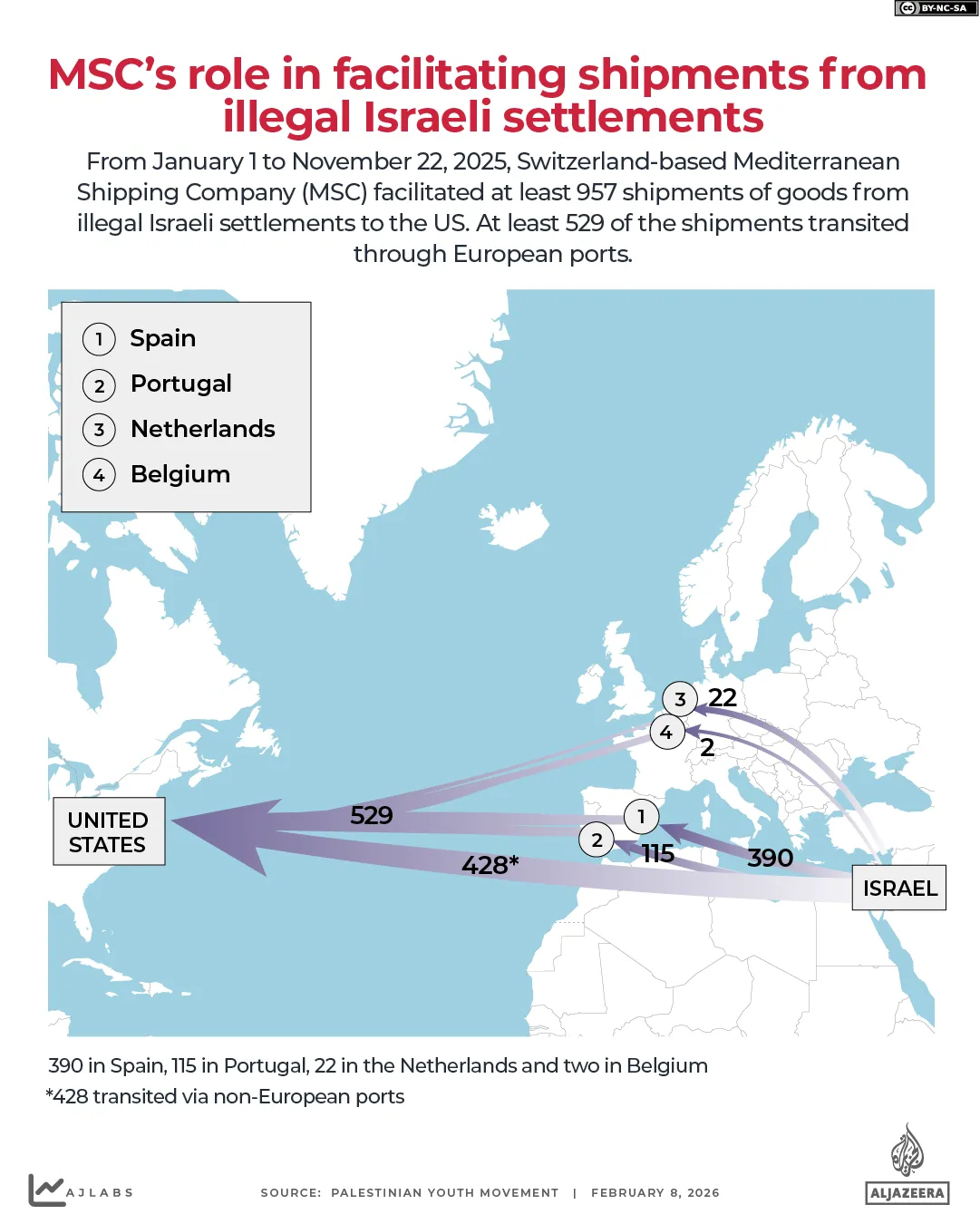
Between January 1 and November 22, 2025, lading bills show that MSC facilitated at least 957 shipments of goods from Israeli outposts to the US. Of these shipments, 529 transited through European ports, including 390 in Spain, 115 in Portugal, 22 in the Netherlands, and two in Belgium.
MSC is privately owned by Italian billionaire Gianluigi Aponte and his wife, Rafaela Aponte-Diamant, who was born in the Israeli city of Haifa in 1945, then under British rule as Mandatory Palestine.
“Israeli settlements are widely considered illegal under international law, because they are built on occupied territory, in violation of the Fourth Geneva Convention,” Nicola Perugini, senior lecturer in international relations at the University of Edinburgh, told Al Jazeera. “Commercialising products from these settlements effectively supports the illegal settlements.”
The findings capture a limited portion of the settlement trade, since import and export data from Israel and most European countries is not publicly available. They reveal a reliance on cargo shipping companies and European maritime ports for the transport of a vast range of settlement products, from food items and textiles to skin care and natural stones.
Perugini said states should ban trade with illegal settlements entirely, as it contributes to ongoing violations of international law.
“You cannot normalise the profits of an illegal occupation,” he said.
(Al Jazeera)
US, EU positions on illegal settlements
Under President Donald Trump, the US adopted a permissive stance towards Israeli settlements, reversing decades of policy in 2019. Washington declared them as not inherently illegal under international law and continued this approach upon Trump’s re-election in 2025.
While the EU does not recognise Israel’s sovereignty over West Bank settlements and regards them as an “obstacle to peace”, the findings show that goods were delivered directly from European ports to illegal settlements.
In 2025, MSC facilitated at least 14 shipments from Italy, according to Italian export data. In each case, the cargo originated from the port of Ravenna, which stretches along the Adriatic Sea in central Italy, and openly listed the names and zip codes of Israeli settlements as recipients.
The trade stands in contrast with a landmark 2024 opinion by the International Court of Justice (ICJ) advising that third states are obliged to “prevent trade or investment relations that assist in the maintenance of the illegal situation created by Israel in the Occupied Palestinian Territory”.
The ICJ opinion does not directly address the responsibility of private corporations like MSC.
In April, the UN Human Rights Council urged individual corporate actors to “cease contributing to the establishment, maintenance, development or consolidation of Israeli settlements or the exploitation of the natural resources of the Occupied Palestinian Territory”.
Additionally, a 2024 EU directive on corporate sustainability mandates that large companies working in the bloc identify and address adverse human rights and environmental impacts in their operations.
Israeli Finance Minister Bezalel Smotrich and a woman hold up a map that shows the long-frozen E1 settlement scheme, which would split Israeli-occupied East Jerusalem from the occupied West Bank, on the day of a news conference, near the illegal Israeli settlement of Maale Adumim, in the Israeli-occupied West Bank, on August 14, 2025 [Ronen Zvulun/Reuters]
PYM, a grassroots, international pro-Palestinian movement, last year found that Maersk, Denmark’s publicly owned shipping company, facilitated trade from Israeli settlements.
The world’s biggest container group before being overtaken by MSC in 2022, Maersk is now reviewing its screening process to align with the UN Global Compact, which urges companies to adopt sustainable, socially responsible policies, and guidelines from the Organization for Economic Co-operation and Development (OECD) to the same effect.
MSC told Al Jazeera in a statement that it “respects global legal frameworks and regulations wherever it operates” and applies this “to all shipments to and from Israel”.
Despite insurance companies raising premiums due to security risk as Israel launched its genocidal war on Gaza in October 2023, MSC announced that it would absorb the extra costs rather than impose war surcharges.
It also holds cooperation and vessel-sharing agreements with Israel’s publicly held cargo shipping company, ZIM.
The Spanish and Italian interior ministries were also contacted by Al Jazeera, but did not respond to requests for comment on the shipments.
The Israeli ministry did not respond to requests for comment.
Sustaining settlement economy
According to UN estimates, settlements in Area C – comprising more than 60 percent of the occupied West Bank that Israel controls – and occupied East Jerusalem contribute about $30bn to the Israeli economy each year.
As Israel enforces administrative and physical barriers that severely limit Palestinian businesses, the West Bank’s economy is understood to have suffered a cumulative loss of $170bn between 2000 and 2024.
Israel has recently accelerated efforts to build illegal settlements in the heart of the occupied West Bank, pressing a controversial project known as E1 that could effectively sever Palestinian land and further cut off East Jerusalem.
The plan includes about 3,500 apartments that would be situated next to the existing settlement of Maale Adumim.
Israel’s far-right finance minister, Bezalel Smotrich, said the project would effectively “bury” the idea of a sovereign Palestinian state.
In August, 21 countries, including Italy and Spain, condemned the plan as a “violation of international law” that risked “undermining security”.
Bills of lading obtained by Al Jazeera and PYM show that MSC delivered shipments on behalf of at least two companies, listing their address in Maale Adumim and the nearby Mishor Adumim industrial zone.
Maya, a wholesale supplier for supplement and candy companies, lists Mishor Adumim in the shipper address in 13 out of 14 shipments. Extal, a private company that develops aluminium solutions and holds partnerships with Israeli weapons manufacturers – including Israel Aerospace Industries (IAI) and Rafael Advanced Defense Systems – listed the Mishor Adumim industrial zone in all 38 bills of lading.
Extal is among 158 companies listed by the UN Human Rights Office (OHCHR) in its database of entities officially known to be operating from illegal Israeli settlements.
In at least three other cases, MSC delivered shipments on behalf of settlement-based companies listed in the OHCHR database.
This includes 17 shipments from Ahava Dead Sea Laboratories, an Israeli world-renowned cosmetic brand that has come under intense scrutiny for reportedly pillaging Palestinian natural resources.
A substantial portion of the settlement-based companies listed in the bills of lading were based in the Barkan Industrial Zone, one of the largest in the occupied West Bank. The area was established on confiscated private Palestinian agricultural land and, over the past 20 years, its expansion has led to the fragmentation and isolation of nearby Palestinian villages.
Obligation to uphold human rights
European member states are aware of a gap between the business-as-usual reality on the ground and the mandates of international law.
In June, nine EU countries called on the European Commission to come up with proposals on how to discontinue EU trade with Israeli settlements.
“This is about ensuring that EU policies do not contribute, directly or indirectly, to the perpetuation of an illegal situation,” the letter addressed to EU foreign policy chief Kaja Kallas said. It was signed by foreign ministers from Belgium, Finland, Ireland, Luxembourg, Poland, Portugal, Slovenia, Spain and Sweden.
The European Commission has not fulfilled the request. Currently, products originating from the settlements can be imported into Europe, but do not benefit from the preferential tariffs of the EU-Israel Association Agreement. Since an EU court ruling in 2019, they must be labelled as originating from Israeli settlements.
Hugh Lovatt, senior policy fellow with the Middle East and North Africa programme at the European Council on Foreign Relations (ECFR), said the EU theoretically has an obligation to align its policies with international law.
Whether that happens “comes down to a political decision”.
“Human rights abuses should be a core criterion for deciding what to buy and what to invest in,” he said. “But in the current global attitude, that approach has been increasingly undermined.”
In 2022, restrictions on trade and investment were imposed on Russian-controlled areas of Ukraine following Moscow’s full-scale invasion, but no similar measures were taken towards illegal Israeli settlements.
A few member states have opted to take independent action. Spain and Slovenia last year banned the imports of goods produced in Israeli settlements, while Ireland, Belgium and the Netherlands are working on legislation.
As of January 2026, Spain banned importing goods produced in Israeli settlements, but its measures do not make explicit mention of transshipments through its ports.
Bills of lading obtained as part of this investigation show that the port of Valencia plays a key role, receiving 358 out of a total of 390 shipments transiting through Spain.
Several bills of lading directly reference illegal settlements in the Syrian Golan Heights.
Aquestia Ltd, a company that specialises in hydraulic systems, list Kfar Haruv and Ramat HaGolan in the shipper address. Miriam Shoham, which exports fresh fruit, also lists Ramot HaGolan, while polypropylene manufacturer Mapal Cooperative Society lists Mevo Hama.
PYM said, “MSC’s transfers to and from Israeli settlements are systemic and in violation of both international and domestic Spanish laws.
“MSC provides the infrastructure connecting illegal settlements to global markets, thus encouraging further occupation of Palestinian and Syrian land.”
Jeffrey Epstein pressured a media tycoon he did business with to quash coverage of allegations of his sexual abuse of girls, according to documents released by the United States Department of Justice.
Epstein leveraged close personal and professional ties with the Canadian-American billionaire Mortimer Zuckerman to try to influence the New York Daily News’s coverage of allegations against him after his 2008 conviction for soliciting a minor for prostitution, the documents show.
Recommended Stories
list of 4 itemsend of list
After Epstein reached out to Zuckerman, the then-owner of the Daily News, the tabloid first delayed its coverage of the allegations and then omitted details that the late financier had specifically requested be left out, according to the documents.
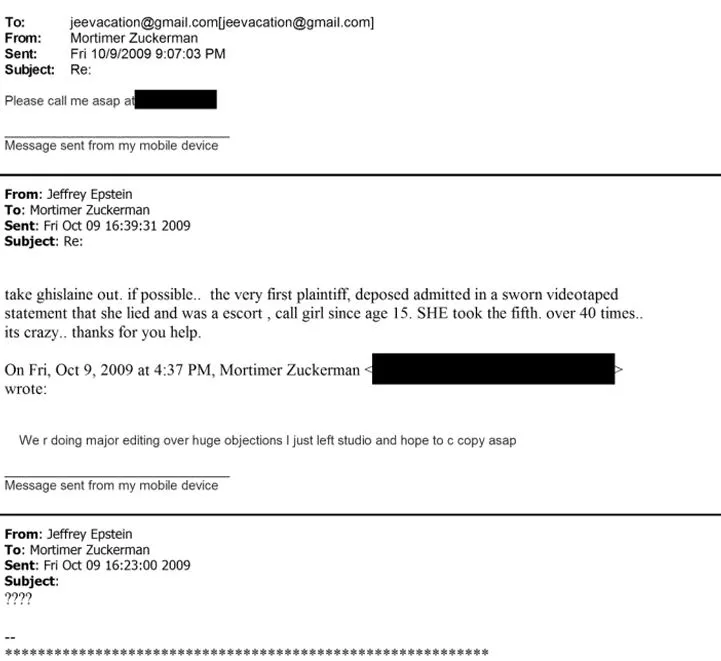
In an email dated October 9, 2009, Epstein shared a “proposed answer” to questions from the newspaper with Zuckerman that disputed allegations made against him and his girlfriend Ghislaine Maxwell, who is currently serving a 20-year sentence for child sex trafficking.
The allegations, which had been put to Epstein and Maxwell by then-Daily News journalist George Rush, included accusations that the pair had subjected a minor known as “Jane Doe No 102” to routine sexual abuse and had engaged in threesomes with “various underage girls”.
The allegations also included claims that Maxwell kept a computer database of “hundreds of girls and oversaw the schedule of girls who came to Epstein’s homes”.
In the proposed response that he shared with Zuckerman, Epstein said “no sex occurred” with Jane Doe No 102 and she had admitted in a deposition to being an “escort, call girl, and a massage parlor worker since the age of 15”.
“All of the adult establishments in which she admitted working require proof of age. Rc the rest of the questions,” Epstein’s email to Zuckerman said.
“These are all malicious fabrications designed to get Mr Edwards clients more money than they normally receive though she did testify under oath that she made as much as 2000 per day,” the email said, referring to Bradley J Edwards, a Florida-based lawyer who has represented many of Epstein’s accusers.
Later that day, Zuckerman told Epstein in an email that the Daily News was “doing major editing over huge objections” and he would “c copy asap”.
“take ghislaine out. if possible,” Epstein responded in an email a few minutes later.
“the very first plaintiff, deposed admitted in a sworn videotaped statement that she lied and was an escort , call girl since age 15. SHE took the fifth. over 40 times.. its crazy.. thanks for you help.”
“Please call me asap,” Zuckerman wrote to Epstein several hours later, before asking Epstein to call him again later that night.
The Daily News ultimately published an article on December 19, 2009, that described Epstein reaching a settlement with his accuser for an undisclosed amount of money.
The article noted that Epstein was facing “more than a dozen” lawsuits from women who accused him of sexually abusing them but made no mention of Maxwell or the allegations against her.
Zuckerman, a staunch supporter of Israel who served as head of the America-Israel Friendship League and the Conference of Presidents of Major American Jewish Organizations, has never been accused of any involvement in Epstein’s crimes.
The front page of the New York Daily News on August 12, 2020 [Bebeto Matthews/AP]
Rush, who left the Daily News in 2010, confirmed that Epstein had tried to “cajole” Zuckerman, the current owner of US News & World Report, into burying or shaping the story to Epstein’s liking.
Rush said the Daily News decided to delay publication after Epstein offered the newspaper an interview.
“Unfortunately, Epstein immediately insisted that the interview be off the record. He also used the conversation to make remorseless claims that he was a victim of overzealous prosecutors and shyster lawyers,” Rush told Al Jazeera.
Rush said Zuckerman, who sold the Daily News in 2017, never suggested that the newspaper cancel the story altogether or publish coverage that was favourable to Epstein.
“I do recall being advised to leave Ghislaine Maxwell out of the story,” Rush said.
“At the time, the paper’s lawyers had libel concerns, and I saw it as a necessary compromise.”
Rush said he had objected to the efforts to interfere in his story but the episode did not cause a “newsroom furore”.
“Most people hadn’t heard of Epstein at that point. I didn’t like Epstein and Maxwell trying to appeal to the owner,” he said.
“But I was relieved that the story wasn’t killed, just delayed, and hopeful that Epstein might say something quotable in the interview. It speaks to Epstein’s arrogance that he thought he had the power to get Mort to do his bidding.”
Zuckerman’s personal assistant and the Zuckerman STEM Leadership Program, an initiative founded by the billionaire to fund scientific collaboration between the US and Israel, did not reply to requests for comment from Al Jazeera.
Ties for two decades
Zuckerman’s ties to Epstein stretch back more than 20 years.
In 2005, Zuckerman, who also owned The Atlantic magazine from 1984 to 1999, worked with Epstein on the short-lived relaunch of the gossip-and-entertainment magazine Radar.
After a US congressional panel in September released a scrapbook prepared for Epstein’s 50th birthday in 2003, Zuckerman was among a slew of high-profile names revealed to have sent the financier their well-wishes.
But the latest tranche of files from the 2019 prosecution of Epstein, released last week by US authorities, show that Zuckerman’s relationship with the sex offender was much closer than previously believed.
In 2008, Zuckerman sought Epstein’s advice on his plans for passing on his estate, sharing sensitive details about his financial affairs in the process, including a copy of his will and an evaluation of his assets that put his net worth at $1.9bn.
In 2013, Epstein drafted several agreements to provide Zuckerman with “analysing, evaluating, planning and other services” related to the billionaire’s plans for passing on his wealth.
Epstein proposed a fee of $30m in a proposal drafted in June 2013 before offering his services for $21m in a revised proposal that December, according to the documents.
In correspondence around this period, Zuckerman appeared to hold Epstein’s claimed expertise in high regard.
“Your questions have been critical to my growing understanding of how much lies ahead before my finances are properly organized,” Zuckerman wrote to Epstein in an email dated October 12, 2013, after the financier had earlier claimed to have identified “wild errors” in Zuckerman’s accounting of his finances.
“You have been an invaluable friend and In the most constructive way a provocateur I am completely grateful and am now beginning to focus, in on the issues you have raised. With appreciation from a hesitant amateur Mort.”
Documents that were included in the release by the US Department of Justice of its Jeffrey Epstein investigative files [File: Jon Elswick/AP]
It is not clear whether Zuckerman ultimately signed the agreement proposed by Epstein.
Zuckerman and Epstein communicated regularly, and the two men arranged numerous dinners and other meetings over the years, according to the documents, including at the financier’s Manhattan home.
“Mort is now booked for tonight at 8:30…i am being asked if you could see him this weekend…please advise,” Lesley Groff, Epstein’s personal assistant, wrote on May 5, 2015, in one of many emails detailing appointments.
While Zuckerman turned to Epstein for financial advice, he also appeared to regard him as a friend.
“Hi there. You are very special. And a great friend. Mort,” Zuckerman wrote to Epstein in an email dated August 24, 2014.
Katie Price has reunited with her husband Lee Andrews in Dubai for their honeymoonCredit: wesleeandrews/InstagramLee has shared numerous snaps of the couple since Katie arrived in Dubai on SundayCredit: wesleeandrews/InstagramKatie’s return to Lee shows she is defying the wishes of her family, who we revealed are ‘extremely worried’ for the star amid her whirlwind new romanceCredit: Youtube/Katie Price
Alarm bells rang for Katie’s family when Lee got down on one knee after just weeks of knowing Katie, and married her a day later.
And since then, a wave of facts about who self-proclaimed millionaire Lee really is have come to light.
He was found to have faked photos of himself with celebs like Kim Kardashian and Elon Musk as well as lying about being on the Labour Party’s Board of Advisors and the Director of Philanthropy at The King’s Trust.
But seemingly ignoring any red flags, Katie appeared loved-up with Lee as she finally arrived to the middle east this weekend.
The couple, who got engaged and married in the UAE, have spent the last two weeks apart as Katie returned home to the UK and Lee stayed in Dubai.
But reunited, they enjoyed a day of sunshine by the beach, with Lee sharing a selfie with his bikini-clad wife.
In another snap, where they wrapped up warmer in jumpers, Lee wrote to his Instagram Stories: “Hubby and wife date”.
This morning, they enjoyed an al fresco breakfast date as Lee snapped a picture of their spread, which included a fruit bowl for him, chia pudding for Katie and a basket of bread and pastries.
While Lee has already shared numerous pictures from their one day together so far, Katie is yet to post anything to her social media.
Posting a new vlog of herself packing for the trip to Dubai, Katie said: “I bet everyone’s thinking what’s going on in the Katie Price world. Well you guys tell me because I’m reading it as it unfolds, just like you guys.
“I’m fully aware like everyone else, I see stuff, I get sent stuff. What I want everyone to know is, I’m a grown a**e woman.
“I’m 48 this year, I’m not a young kid. I’ve learned a lot in the past few years, through therapy and learning to love myself. So I’m not stupid, I know what I’m doing and if I’m happy that’s all that matters.”
Defending the marriage, she added: “I’m not worried, so you don’t need to worry about anything. Like I say, I will do what I want to do.”
However, The Sun reported earlier this month that her family, on the other hand, are extremely worried over the union.
A source exclusively told us: “Katie’s family and friends are so concerned about her relationship with Lee but she isn’t listening.
Adding that they didn’t want her to return to Dubai, the source also said: “Her family have read reports about Lee and are so concerned about Katie’s welfare.
“She has insisted he is a good man though and is sticking by him.”
Since arriving to Dubai, Katie has enjoyed a beach day and date night with her husbandCredit: wesleeandrews/InstagramThe couple enjoyed an al fresco breakfast together this morningMany have been concerned for Katie after a number of Lee’s claims about his job and lifestyle have been disproved, with the ‘businessman’ also having numerous AI-generated pictures with celebrities on his social mediaCredit: Instagram
The Epstein files dump has led to days of intense media coverage, revealing how powerful elites around the world engaged in either illegal or morally reprehensible behaviour. But even as journalists sift through millions of documents, one of the most significant stories remains largely missing from the mainstream narrative.
Contributor: Murtaza Hussain – National security and foreign affairs reporter, Drop Site News
The farce of the ‘ceasefire’ coverage in Gaza
More than 500 Palestinians have been killed since a US-brokered “ceasefire” was signed, which begs the question: Should journalists, in contextualising the story, really be calling this a “ceasefire”? As Israel signals it’s preparing to resume full-scale war, we examine how media silence, selective framing and restricted access help keep Gaza off the world’s screens.
Featuring:
Shaiel Ben-Ephraim – Senior analyst, Atlas Global Strategies Diana Buttu – Palestinian lawyer Muhammad Shehada – Visiting fellow, European Council on Foreign Relations Daniel Levy – President, U.S./Middle East Project
Dhaka, Bangladesh – On Wednesday evening in Dhaka, Shafiqur Rahman, the emir (chief) of the Bangladesh Jamaat-e-Islami, unveiled an ambitious election manifesto. A key promise: If his party wins the country’s February 12 election, it would lay the ground for Bangladesh to quadruple its gross domestic product (GDP) to $2 trillion by 2040.
Addressing politicians and diplomats, the 67-year-old Rahman pledged investment in technology-driven agriculture, manufacturing, information technology, education and healthcare, alongside higher foreign investment and increased public spending.
Recommended Stories
list of 4 itemsend of list
Economists in Dhaka have cast doubt on whether sweeping promises can be financed, describing the manifesto as heavy on slogans but short on detail. But for Jamaat’s leadership, the manifesto is less about fiscal arithmetic than signalling intent, say analysts.
For years, critics have tried to portray Jamaat, Bangladesh’s largest Islamist party, as driven too much by religious doctrine to be able to govern a young, diverse, forward-looking population. The manifesto, by contrast, presents a party long excluded from power as a credible alternative – and as a force that sees no contradiction between its religious foundations and the modern future that Bangladeshis aspire to.
His audience was telling too.
Until recently, Bangladesh’s business elites and foreign diplomats either kept their distance from Jamaat or engaged with it discreetly. Now, they are doing so openly.
Over the past few months, European, Western, and even Indian diplomats have sought meetings with Rahman, a figure who, until not long ago, was seen by many internationally as almost politically untouchable.
For a leader whose party has been banned twice, including by ousted Prime Minister Sheikh Hasina’s administration, the coming election is raising a question few would have dared to ask even a year ago: Could Shafiqur Rahman become Bangladesh’s next prime minister?
Rahman poses for a photograph after an interview with Reuters news agency in Dhaka, on December 31, 2025 [Kazi Salahuddin/Reuters]
‘I will fight for the people’
The shift in how Jamaat and its leader are being viewed is at least partly to do with a political vacuum that has opened up in Bangladesh.
The July 2024 uprising that ousted Sheikh Hasina did more than end her long rule. It upended the country’s political order, hollowing out the familiar duopoly that for decades defined Bangladeshi politics – the rivalry between Hasina’s Awami League and the Bangladesh Nationalist Party (BNP).
With the Awami League effectively barred from the political field and the BNP the only big party left standing, a vacuum emerged. Many initially assumed it would be filled by the student-led National Citizen Party (NCP). Instead, Jamaat – long pushed to the margins – moved to occupy the space.
As Bangladesh heads towards a high-stakes election in less than two weeks, Jamaat has now emerged as one of the country’s two most prominent political forces. Some pre-election polls now place it in direct competition with the BNP.
At the centre of that transformation is Rahman, according to Ahsanul Mahboob Zubair, Jamaat’s assistant secretary-general and a longtime associate of the party chief.
Zubair, who worked closely with Rahman when he led Jamaat in the country’s Sylhet region, said the resurgence is the result of years of grassroots social work and political survival under repression.
Rahman, a soft-spoken former government doctor, took over as Jamaat’s chief in 2019, at a time when the party was banned under Hasina. In December 2022, he was arrested in the middle of the night on charges of supporting militancy and was released only after 15 months when he secured bail.
In March 2025, months after the student-led protest had overthrown Hasina and an interim government under Nobel laureate Muhammad Yunus had taken office, Rahman’s name was dropped from the list of accused in the case.
Since then, his carefully calibrated, emotional public appearances have drawn wide attention.
At a massive rally in Dhaka last July, Rahman collapsed twice on stage due to heat-related illness but returned to finish his speech, defying doctors’ advice.
“As long as Allah grants me life, I will fight for the people,” he told the crowd, barely sitting on the stage, supported by the doctors. “If Jamaat is elected, we will be servants, not owners. No minister will take plots or tax-free cars. There will be no extortion, no corruption. I want to tell the youth clearly – we are with you.”
Rahman waves his party flag during an election campaign in Dhaka, January 22, 2026 [Mahmud Hossain Opu/AP Photo]
Reinventing Jamaat’s image
Supporters describe Shafiqur Rahman as approachable and morally grounded – a leader who prefers disaster zones to drawing rooms, and projects calm in a country exhausted by confrontation.
Now in his third term as chief, Rahman commands firm authority inside the party.
“He is a good and pious man. Everyone in the party trusts him,” said Lokman Hossain, a Jamaat supporter in Dhaka. He said that over the past year and a half, the party has reached far more people than before, with Rahman’s appeal beyond Jamaat’s traditional base playing a central role.
Rahman’s challenge, however, is no longer purely electoral – it is reputational.
As new supporters drift towards Jamaat, he is attempting to reframe how the party is seen: less as an Islamic force defined by doctrine and history, and more as a vehicle for clean governance, discipline and change.
Whether this reinvention is substantive or merely cosmetic will define both Rahman’s leadership and Jamaat’s future, say analysts.
Any attempt to recast Jamaat’s public image, however, runs up against the unresolved legacy of 1971. For decades, the party’s role during Bangladesh’s war of independence – when it sided with Pakistan – and the subsequent trials and executions of several senior leaders have shaped perceptions of Jamaat at home and abroad.
Rahman has approached that history with caution. He has avoided detailed admissions but has recently acknowledged what he calls Jamaat’s “past mistakes”, asking forgiveness if the party caused harm.
The language marks a subtle shift from outright denial, while stopping short of naming specific actions or responsibilities. Supporters say this reflects political realism rather than evasion – an attempt to move the party beyond its dark chapter. Critics, by contrast, see the ambiguity as deliberate, arguing it softens Jamaat’s image without confronting the substance of its past.
“He knows what those mistakes were,” said Saleh Uddin Ahmed, a United States-based Bangladeshi academic and political analyst. “But stating them explicitly would destabilise his leadership inside the party.”
Ahmed nonetheless considers Rahman more moderate than Jamaat’s previous leaders, noting his relative willingness to discuss unresolved historical questions and address issues such as women’s rights – topics the party long avoided. “This opening up is also happening because of increased public and media scrutiny,” Ahmed said. “People are asking questions now, and Jamaat has to respond.”
Jamaat’s effort to reach voters beyond its traditional base and reassure foreign audiences, while retaining the loyalty of its conservative supporters, has created a persistent tension – one that has often resulted in dual messaging.
That balancing act has been evident in public statements by senior leaders. Abdullah Md Taher, one of Rahman’s closest aides, in an interview with Al Jazeera, said Jamaat is a moderate party, adding that it would not impose or strictly adhere to Islamic law.
Yet when addressing conservative supporters, the party continues to emphasise its Islamic identity, with some backers encouraging votes for Jamaat as an act of religious merit – a practice the rival BNP has criticised as the misuse of religious sentiment.
The strategy appears to have helped Jamaat re-enter political conversations that were once closed to it. At the same time, it has sharpened doubts about how far Rahman is willing – or able – to go in reinterpreting the party’s past and ideology as he courts a broader electorate.
Those limits are most visible in Jamaat’s stance on women and leadership. They came into sharp focus during his Al Jazeera interview in which Shafiqur Rahman said it was not possible for a woman to hold the party’s top position – a remark that reignited longstanding criticism of Jamaat’s gender politics, despite its attempts to project a more inclusive image.
“Allah has made everyone with a distinct nature. A man cannot bear a child or breastfeed,” Rahman said. “There are physical limitations that cannot be denied. When a mother gives birth, how will she carry out these responsibilities? It is not possible.”
Critics argue that the stance exposes the limits of Jamaat’s claims of moderation.
Mubashar Hasan, an adjunct researcher at the Humanitarian and Development Research Initiative at Western Sydney University in Australia and author of Narratives of Bangladesh, also questioned Jamaat’s internal culture, noting that even female leaders who publicly endorse such views operate within a male-dominated hierarchy. He was referring to the party’s large number of female supporters and members, including women within its Majlis-e-Shura, the highest decision-making body. “It reflects a structure where women follow what men say in that party,” he said.
The criticism carries particular weight given the movement that helped reopen political space for Jamaat itself. The July 2024 uprising against Hasina, analysts note, saw extensive participation by women, often at the front lines of protest. “Women were part of that movement as much as men, if not more,” Hasan said. “Undermining them now gives Jamaat a deeply problematic outlook.”
Political historians argue this is not a new contradiction but a longstanding one. Since contesting elections under its own symbol in 1986, Jamaat has never fielded a woman candidate for a general parliamentary seat, relying instead on reserved quotas.
“This isn’t a temporary position or a tactical lapse,” said political historian and author Mohiuddin Ahmad.“It reflects the party’s ideological structure, and that structure has not fundamentally changed.”
Rahman (left) with the head of Bangladesh’s interim government, Muhammad Yunus, at the inauguration of a museum to commemorate the student uprising that overthrew Hasina, on January 20, 2026 [Mahmud Hossain Opu/AP Photo]
The ‘grandfather’ expanding Jamaat’s reach
Yet among Jamaat supporters – particularly younger ones – the issue is often filtered through loyalty to Rahman himself rather than doctrine.
During his recent nationwide campaign, young supporters can frequently be heard calling Shafiqur Rahman “dadu” – grandfather. White-bearded, soft-spoken and visibly attentive to supporters, Rahman fits the image.
“He connects with young people through his words,” said Abdullah Al Maruf, a Gen Z law student from Chattogram and a Jamaat supporter. “There is something about his recent work that feels like the relationship between a grandfather and his grandchildren. Where BNP leaders often belittle young people, Shafiqur speaks to them with respect.”
Maruf added that Rahman’s appeal extends beyond Jamaat’s traditional base. “Outside the usual Jamaat circle, he is more popular than previous Jamaat leaders,” he said.
Zubair, Jamaat’s assistant secretary-general, described the party’s outreach beyond traditional voters – such as the decision to nominate a Hindu candidate – not as a tactical move but one rooted in Jamaat’s constitutional framework rather than political expediency.
“Our constitution allows any Bangladeshi, regardless of religion, to be part of the party if they support our political, economic and social policies,” he said. “Supporting our religious doctrine is not a requirement for political participation.”
Jamaat leaders argue the move reflects a broader effort to shift the party’s public image – from one defined primarily by theology to one centred on governance and accountability. “We are emphasising corruption-free politics, discipline and public service,” Zubair said. “People have seen our leaders stand with them during floods, during COVID, and during the July uprising. That is why support is growing.”
Krishna Nandi, the party’s Hindu candidate from the city of Khulna, agrees. “When families fall into poverty, Jamaat-linked welfare networks step in without asking about religion or political loyalty. This culture of service explains why many citizens see Jamaat not as a party of slogans but as a party of discipline, structure and responsibility,” Nandi wrote for Al Jazeera.
The Jamaat’s outreach has also extended well beyond domestic audiences. Zubair said the party’s leadership has held meetings with Indian diplomats in Dhaka who paid a courtesy visit to Shafiqur when he was ill. Jamaat figures were invited to India’s 77th Republic Day reception at the Indian High Commission last month – an unprecedented step.
European and Western diplomats, he added, have also sought engagements with Rahman in recent months. That shift has been mirrored in Washington. In a leaked audio recording reported by The Washington Post, a US diplomat was quoted as saying American officials wanted to “be friends” with the Jamaat, asking journalists whether members of the party’s influential student wing might be willing to appear in their programmes.
As Jamaat’s international engagement expands – and as it emerges as a serious electoral force alongside frontrunner BNP – many general supporters express confidence in Rahman’s leadership.
“He is a patriot,” said Abul Kalam, a voter in Rahman’s Dhaka constituency. “Whether as prime minister or opposition leader, he will lead us well.”
What lies next for the party is unclear. But analysts say that irrespective of the outcome of the elections, Rahman’s stature within Jamaat – and beyond, in Bangladesh – appears resolute.
“Shafiqur Rahman is an experienced politician and is frequently in the headlines,” Ahmad, the political historian, said. “His political thinking is not yet fully clear, but his grip over the party is evident.”
The rules will make it easier for Israeli settlers to buy land in the occupied West Bank and give Israeli officials more powers to enforce its laws on Palestinians in the area.
A real couple said “I do” at the Super Bowl halftime show — and Bad Bunny and Lady Gaga were there to bless the union.
For those analyzing the details in Bad Bunny’s 15-minute halftime performance, there was a real wedding that took place at Levi’s Stadium in Santa Clara in front of 75,000 fans.
The couple signed their nuptials as Lady Gaga performed a salsa rendition of her ballad “Die With a Smile” — notably without collaborator Bruno Mars.
According to a statement released by Bad Bunny’s publicist, the couple had first invited Bad Bunny to attend their wedding but were instead invited to be part of the Apple Music halftime show performance.
Amid his busy performance — which included dancing on utility poles, a bodega, a field filled with laborers and the pink casita stage created during his 2025 residency in San Juan, Puerto Rico — the Puerto Rican star still made time to sign off on their marriage certificate before the newlyweds relished their first slice of cake.
1 of 2 | Seo In-taek, co-standing chair, delivers a vision at the launch ceremony of the Citizens’ Solidarity for One Korea on Feb. 4. Photo by the Citizens’ Solidarity for One Korea
Feb. 8 (Asia Today) — Leaders of a newly launched civic group advocating Korean unification said they plan to support private broadcasts to North Korea that emphasize what they call a “unification vision,” arguing that entertainment alone will not change attitudes in the North.
The Citizens’ Solidarity for One Korea, inaugurated Feb. 4, is promoting “Korea Link,” a global fundraising campaign to support broadcasting and related content distribution. Organizers said participants pledged about 80 million won (about $60,000) at the launch ceremony.
Co-representatives Seo In-taek and Kenneth Bae spoke with Asia Today about why they are pushing the initiative and how they plan to deliver content to North Korean residents.
Q: Why launch a private broadcasting push now?
Seo In-taek: “The government has halted broadcasts to North Korea, and the United States has also stopped funding Voice of America and Radio Free Asia. With balloon launches and maritime information activities also suspended, private broadcasts are effectively the only remaining way to deliver information to North Koreans.”
Kenneth Bae: “The immediate priority is to revitalize existing private broadcasts to North Korea. We need to strengthen what is already operating and broaden its reach.”
Q: What is ‘Korea Link’ and what is the core goal?
Seo: “‘Korea Link’ is not about simply sending outside information or South Korean dramas. The goal is to deliver a ‘unification vision’ – to present alternatives so North Korean residents can have choices.”
Bae: “The fund should first be used to support existing broadcasts, then to develop better content and expand the base so broadcasting becomes sustainable.”
Q: What format will the broadcasts take?
Bae: “I plan to appear on Far East Broadcasting to take part in broadcasts aimed at the North. We will start with shortwave radio, but we want to expand to medium-wave and internet-based broadcasting over time.”
Seo: “Shortwave is a start, but we should also look at practical ways to deliver content more widely, including digital storage methods.”
Q: How would you deliver content if internet access is restricted?
Seo: “There are several ways. Digital storage devices can be effective for information inflow, and we want to use such tools not only to deliver information but also to convey a unification vision. To do this consistently, we need a nationwide fundraising campaign.”
Q: How will raised funds be managed?
Seo: “If funds are secured, we plan to establish an operating committee to ensure the money is used transparently and effectively.”
Bae: “Funding should be tied to measurable improvements – stronger broadcasts, better content and broader distribution.”
Q: What kind of content do you want to send?
Seo: “Simply providing outside information is not enough. A unification vision is needed. South Korean dramas are mostly ‘chaebol stories.’ That kind of content alone will not change North Korea.”
Bae: “We need content that can stimulate interest in unification and keep that message consistent. If we keep producing and sending it, it can help widen support for unification.”
Q: Beyond broadcasting, what else do you plan to do?
Bae: “We will also advocate internationally for North Koreans’ right to know and right to access information.”
LDP looks set to secure 316 seats in Japan’s 500-member house, marking its best result since its founding in 1955.
Japan’s Prime Minister Sanae Takaichi has promised to cut taxes and keep her cabinet intact as she celebrated her Liberal Democratic Party’s (LDP) landslide victory in Sunday’s general election.
Takaichi’s pledge on Monday came as projections by the NHK broadcaster showed the conservative LDP securing 316 seats in the 500-member National Assembly and winning a “historic” two-thirds majority in the lower house.
Recommended Stories
list of 3 itemsend of list
The results marked the best result for the LDP since its founding in 1955, surpassing the previous record of 300 seats won in 1986 under then-Prime Minister Yasuhiro Nakasone.
LDP’s junior partner Japan Innovation Party won 36 seats, while the main opposition Centrist Reform Alliance managed to keep only 49 of the 172 seats it previously held.
Analysts credited the LDP’s triumph to the extraordinary popularity of Takaichi, who is Japan’s first female leader, and say it will allow her to pursue significant changes in Japan’s security, immigration and economic policies.
In a televised interview with NHK on Monday, Takaichi said she will emphasise policies meant to make Japan strong and prosperous.
She told NHK that she will push for the reduction of consumption taxes as promised by the LDP. During the campaign, the governing party had said it would ease household living costs by suspending the 8 percent food sales tax for two years.
“Most parties are in favour of reducing the consumption tax, such as reducing the tax on food items to zero, or to 5 percent, or reducing the tax on all items to 5 percent,” Takaichi said.
“The LDP has also campaigned for a consumption tax cut. I strongly want to call for the establishment of a supra-party forum to speed up discussion on this, as it is a big issue.”
Takaichi also indicated that she will not make any changes in her cabinet, calling it a “good team”.
The head of Japan’s top business lobby, Keidanren, also welcomed the result, saying it will help in restoring political stability.
“Japan’s economy is now at a critical juncture for achieving sustainable and strong growth,” Yoshinobu Tsutsui said.
United States President Donald Trump, who endorsed Takaichi ahead of the election, congratulated Takaichi in a post on social media and wished her “Great Success”.
South Korea’s President Lee Jae Myung also offered his congratulations and said he hoped to see her soon in Seoul.
The leaders of India, Italy and Taiwan also welcomed Takaichi’s win.
Al Jazeera’s Patrick Fok, reporting from Tokyo, said the message from Taiwan’s President William Lai Ching-te to Takaichi could upset China.
“Remember that Takaichi triggered Chinese anger after suggesting that Japan might intervene in the event of a Chinese attack on Taiwan,” he said, referring to the diplomatic storm the Japanese leader set off last year shortly after taking office.
“How she handles that relationship between Tokyo and Beijing is likely to define Japan’s foreign policy,” Fok added.
China regards Taiwan as part of its territory and has been keeping a close eye on Takaichi and the results of the polls.
The strong mandate for Takaichi could also accelerate her plans to bolster military defence, which Beijing has cast as an attempt to revive Japan’s militaristic past.
“Beijing will not welcome Takaichi’s victory,” said David Boling, principal at the Asia Group, a firm that advises companies on geopolitical risk.
“China now faces the reality that she is firmly in place – and that its efforts to isolate her completely failed,” Boling told the Reuters news agency.